Battalion Oil: Shareholders' Equity Swung $190 Million Into the Black — and Not a Cent of It Was Earned
For a long time Battalion Oil looked like a workout case: negative equity, a deadline from the NYSE American, no borrowing capacity left. The quarterly report as of March 31, 2026 flips that picture — $157.1 million of shareholders' equity instead of minus $32.8 million. The reason sits in the fine print: on March 25, 2026 the preferred holders lost control of the board, so $234.6 million of preferred capital moved into equity as an accounting matter. None of it was earned — in the first quarter of 2026 the common shareholders lost $64.8 million. Add a successful refinancing ($162.5 million at SOFR plus 6.50 percent through the end of 2029) and a new auditor. What remains is the old question: who is standing in line ahead of you?
 Thomas Mücke
Founder & Publisher
Thomas Mücke
Founder & Publisher
Chart
Interactive price chart (TradingView).
Note: pure fact-based analysis, not investment advice and not a solicitation to buy or sell. All figures without guarantee.
There is an investor weakness as old as the stock market that still finds new victims every year: the appeal of the small number. A stock costs only a few dollars, and something clicks in your head: “It can hardly fall much further — there is more room above than below.” Behind that sits perhaps the most expensive confusion in investing, the one between price and value. At Battalion Oil Corporation (NYSE American: BATL) of Houston, a second confusion has been added since the spring of 2026, and it is even trickier: the one between booking and earning. Because this company had shareholders’ equity of minus $32.8 million at the end of 2025 — and three months later, as of March 31, 2026, plus $157.1 million. Roughly $190 million of difference. Not a single cent of it was earned; in the same quarter the books show a net loss of $56.5 million. So let us make a deal: before you decide whether this is cheap, we read together what the company itself reported to the U.S. securities regulator, the SEC — the quarterly report (10-Q) as of March 31, 2026, filed on May 13, 2026, the annual report (10-K) for 2025, and every single filing after that through July 1, 2026. An SEC filing is honest under penalty of law. And this one tells of a business that works, of a refinancing that succeeded — and of roughly $384 million of claims that get paid before you do. In the end you decide for yourself.
What Battalion Oil actually does — 82 wells in West Texas
Battalion Oil is a pure onshore producer: the company drills for oil and gas on land, produces it and sells it. No trading, no refinery, no filling stations — put in everyday terms: a farmer who grows a single crop and sells it at the gate. The acreage lies in the Delaware Basin, the western part of the famous Permian Basin, spread across Pecos, Reeves, Ward and Winkler counties in West Texas. As of December 31, 2025 it was 39,968 net acres (40,476 a year earlier), targeting the Wolfcamp and Bone Spring formations. Battalion operates 82 of its own producing wells and holds minority interests in 22 operated by others. Remarkable for a company this small: 99.8 percent of proved reserves are under its own operational control — the company decides itself when to drill and when to slow down. The footprint shifted twice in 2026: on February 24 roughly 6,100 net acres in Ward County left with the sale of the West Quito area, and on March 19 7,090 net acres directly adjacent to its own Monument Draw position came in — paid for with 485,000 of its own shares.
The operation is small: 40 full-time employees as of December 31, 2025 (38 a year earlier). Production averaged 12,096 barrels of oil equivalent per day in 2025 and even 12,578 in the first quarter of 2026 (11,900 in the prior-year quarter). “Barrel of oil equivalent” (Boe) is the unit producers use to put oil, natural gas and natural gas liquids on a common denominator — like converting apples, pears and cherries into kilos. That matters, so the number does not sound bigger than it is: actual crude oil came to only 2,251 thousand barrels for the year 2025, or roughly 6,167 barrels a day — about half the total. The 2025 mix: 51.0 percent oil, 20.9 percent natural gas liquids, 28.1 percent natural gas. Economically the company is nevertheless almost a pure oil producer: 86.7 percent of oil, gas and NGL revenues came from oil in 2025 ($142.951 million of $164.962 million); measured against total revenues of $166.043 million it is 86.1 percent. The gas brings in almost nothing — more on that later, it is one of the most uncomfortable numbers in this analysis.
The back story includes an old name: Battalion is the successor to Halcón Resources and has carried its present name only since January 27, 2020; the stock has traded on the NYSE American since February 20, 2020. The charter still contains a clause from a Chapter 11 bankruptcy proceeding — the company may not issue non-voting equity securities. A second disappointment came in 2024: the planned takeover by Fury Resources, agreed on December 14, 2023, was terminated on December 20, 2024 because the buyer failed to meet the financing conditions. Battalion collected $10.0 million from the escrow account and carried roughly $5.5 million of transaction costs.
That names the central tension of this analysis, and it runs through every chapter: the business works, the balance sheet suddenly looks healthy — but ahead of the common shareholders stands a capital structure that grows faster than the business. This is not a company that is dying. It is a company in which the common shareholder has almost no economic stake as long as nothing extraordinary happens.
How the stock reached our desk — via Reddit, not the scanner
Battalion Oil is not a hit from our metrics filters. It reached the research list through the Reddit hype scanner, which counts mentions in the big stock forums (data source ApeWisdom). The reading as of July 25, 2026: rank 62, 8 mentions in 24 hours, 32 upvotes. More interesting than the number is its direction: 24 hours earlier BATL was at rank 42 with 15 mentions. The attention is already cooling while the company is simultaneously feeding fresh shares into the market through a sales program. Anyone who mistakes attention for substance is buying the downslope of a wave here. If you want to see which filters we run: they are all in the in-house stock scanner.
And the classic metrics? At Battalion they mislead, in more than one way. There is no price-to-earnings ratio, because a loss is left for the common shareholders. A price-to-book ratio has been mathematically defined again since March 31, 2026 — but it is practically worthless, because that book value contains $221.2 million of preferred capital that does not belong to the common shareholders. And the price-to-sales ratio of about 0.49 (documented market value against 2025 revenue) looks cheap, but it measures only revenue — not the queue of claimants behind it. Note the finding right at the start: at Battalion Oil you are not measuring the price of the company, you are measuring the order of claims. How quickly such an order hollows out an optically cheap price is something we also wrote up at NGL Energy Partners — the same mechanism in a different business.
The numbers over the years — given their due
First what genuinely speaks for Battalion, and it is more than the reputation of a micro cap would suggest. Operating cash flow — the money the business actually brings in before capital spending — has risen two years in a row: from $17.6 million (2023) to $35.4 million (2024) to $39.1 million (2025). And that in a year with markedly weaker oil prices: the realized oil price fell from $73.89 to $63.51 per barrel.
That worked because costs came down. Per barrel of oil equivalent produced, operations cost a combined $27.05 in 2025 (lease operating $10.15 + workover $1.46 + production taxes $2.23 + gathering and transport $9.91 + administration $3.30). Against that stood revenue of $37.36 per barrel — an operating margin of $10.31. Gathering and transport costs alone fell from $12.64 to $9.91 per barrel since 2023, administrative expenses from $19.0 million to $14.6 million a year. That is solid craftsmanship, not luck.
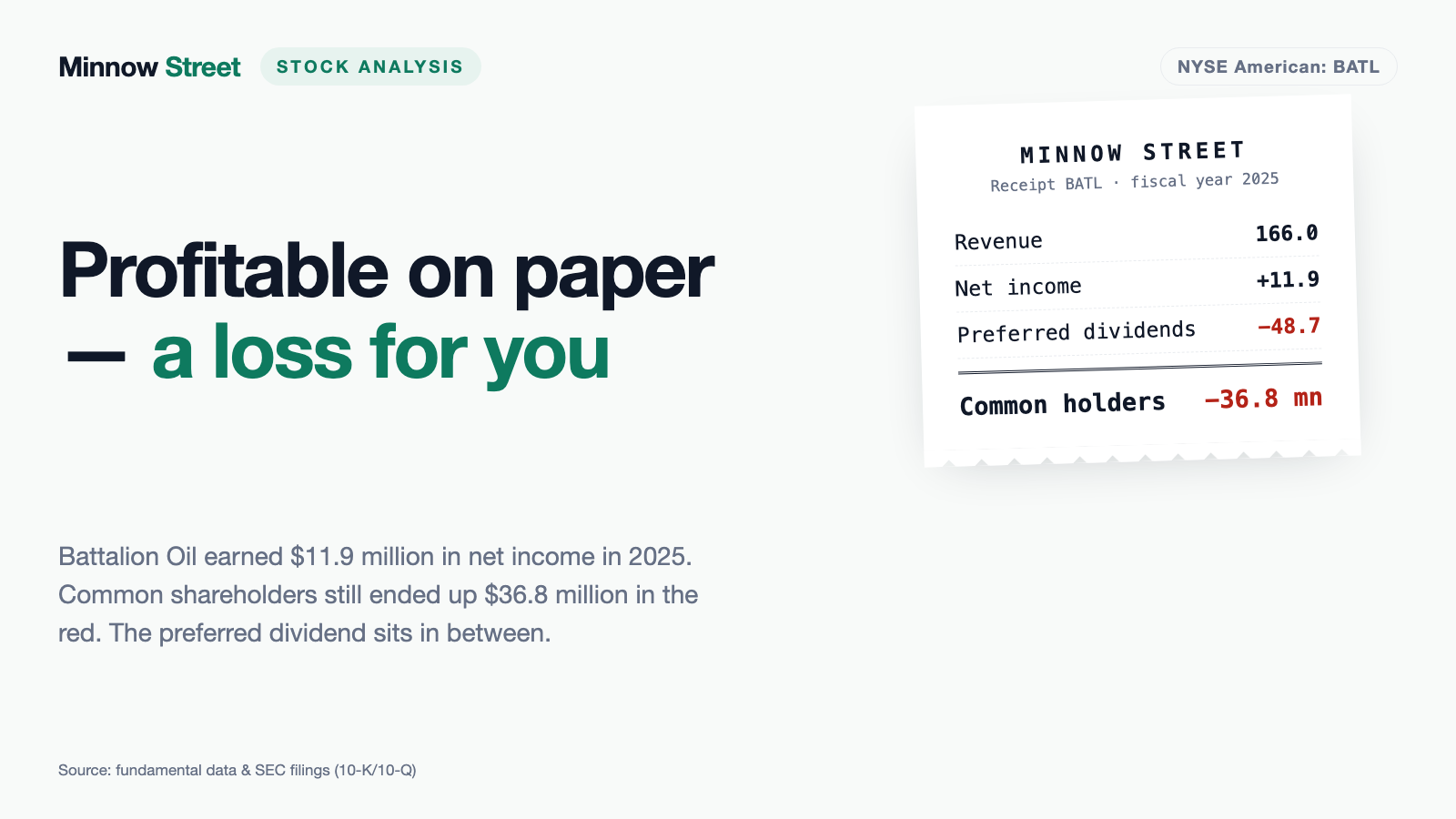
And then comes the line that tips everything over. For 2025 the company reports net income of $11.9 million — after −$31.9 million the year before. Two lines further down, in the same income statement, sits the result that concerns the common shareholder:
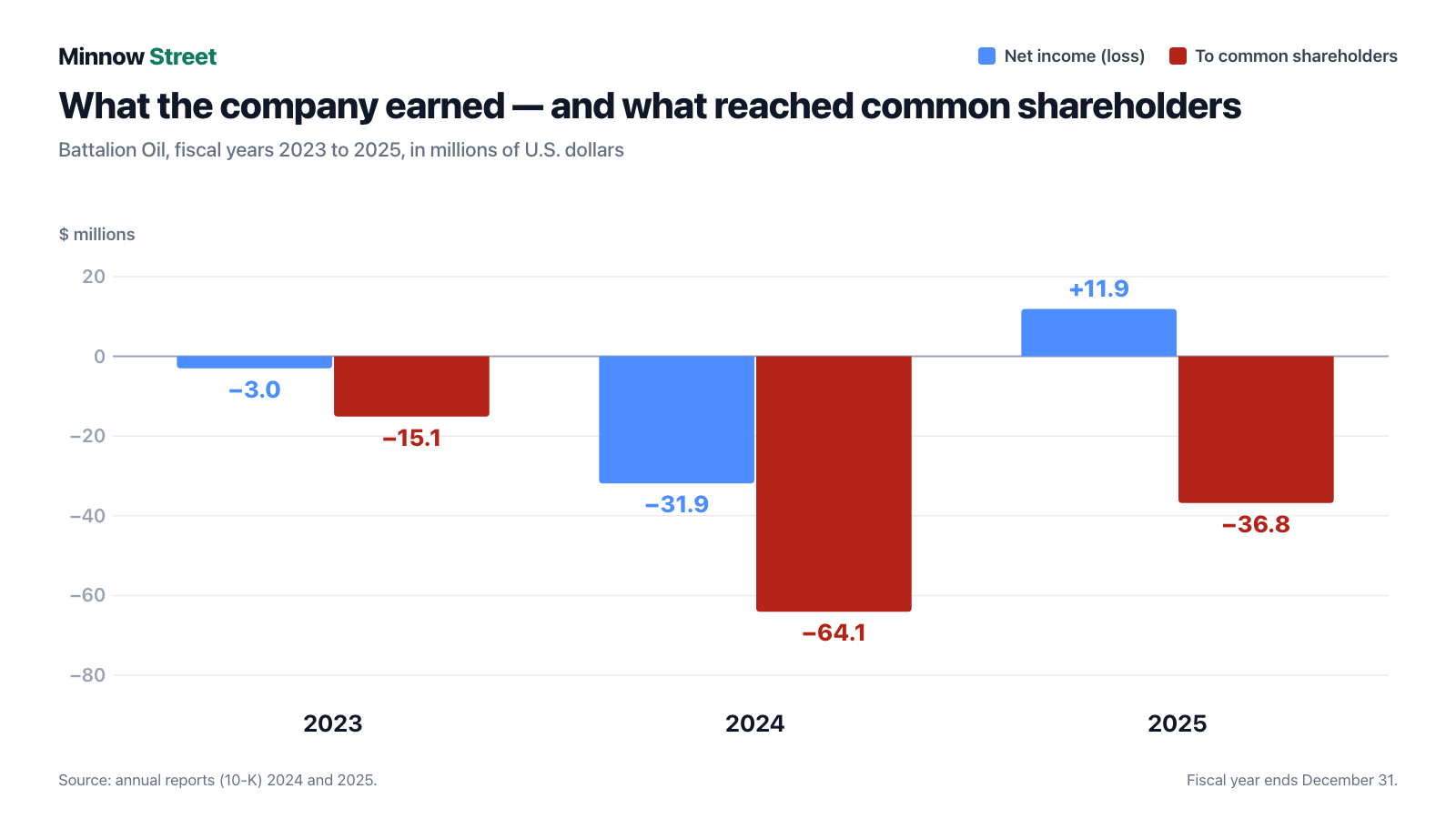
Honesty requires a second caveat, and it matters: even the $11.9 million of net income was not an operating profit. Operating income was negative at −$6.6 million in 2025 (2024: −$11.7 million; 2023: +$17.6 million). What pushed it into the black was the line below: $45.3 million of gains on hedging contracts, of which $29.4 million were pure mark-to-market gains on contracts still open — book values, no money in the bank. Remember: the 2025 profit came from the hedge book, not from the wellbore.
How little that line can be relied on was shown by the very next quarter. In the first quarter of 2026 it turned the other way: a $48.0 million loss on hedging contracts (of which $47.0 million unrealized). Revenue of $39.2 million and an operating loss of $2.1 million thus became a net loss of $56.5 million; after $8.3 million of preferred dividends, the common shareholders were left with a shortfall of $64.8 million, or $3.72 per share. A single quarter therefore produced more loss for the common shareholders than all of 2025.
What is genuinely shrinking is the substance in the ground. Proved reserves fell two years in a row: 68.1 (2023) → 64.9 (2024) → 59.7 million barrels of oil equivalent (2025). The official present value of those reserves, known as PV-10, dropped within a year from $458.5 million to $351.7 million — down 23 percent. PV-10 is the SEC’s calculation rule: what are the future revenues from the reserves less production costs worth if you discount them at 10 percent using fixed average prices (for 2025: $66.01 per barrel of oil, $3.39 per million British thermal units of gas)? The West Quito sale took $36.2 million of that away; roughly $315.5 million remains. At the current production rate the reserves last about 13.5 more years.
And then there is the gap that explains everything. Count along: of the $37.36 of revenue per barrel, $10.31 remains after $27.05 of operating costs. Of that, $6.53 goes to interest alone — leaving $3.78. But capital spending in 2025 was $16.89 per barrel. So a good $13 per barrel produced is missing, and that gap is closed with credit, shares and asset sales. In total: $39.1 million of operating cash flow against $74.6 million of capital spending — free cash flow has been negative for three years running (−$28.9 / −$29.3 / −$35.5 million).
What the filings say — the uncomfortable truths
Uncomfortable truth no. 1: the profit was never meant for the common shareholders
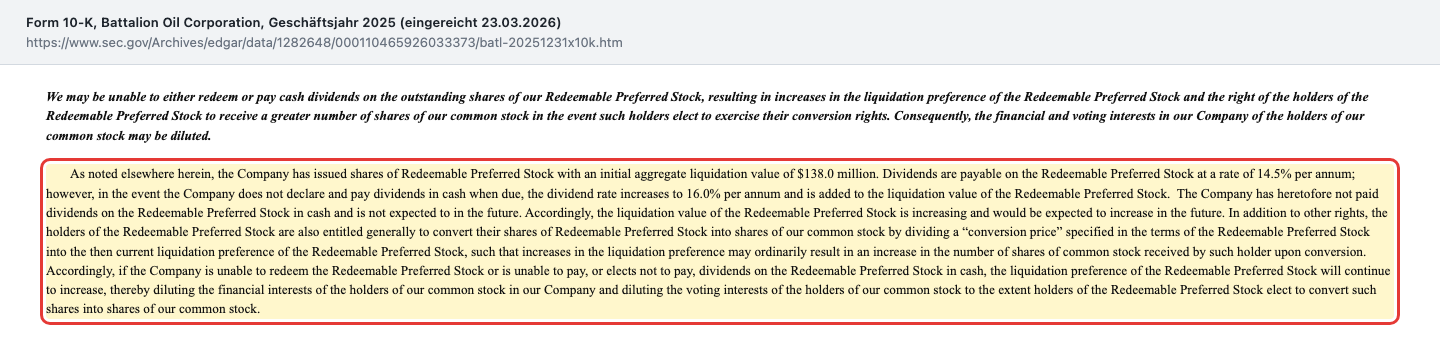
Between net income and the shareholder sits a line that never shows up in a screener: $48.7 million of preferred dividends in 2025, plus another $8.3 million in the first quarter of 2026. Preferred shares are not ordinary shares but a mix of loan and equity: they get their money before the common shareholders — in ongoing distributions as well as in a liquidation. At Battalion the rate is 14.5 percent if paid in cash. If it is not paid in cash, it rises to 16.0 percent and the dividend is settled in new preferred shares — “paid in kind”, or PIK. Put in everyday terms: a loan on which the interest is not paid but added to the principal every year. The pile grows by itself.
And that is exactly what happens. The carrying value of the preferred rose from $106.5 million (2023) to $177.5 million (2024) to $226.2 million as of December 31, 2025 — from an initial liquidation value of $138.0 million. As of March 31, 2026 it is $221.2 million, and the decline is no relief but a conversion: 7,803 shares were exchanged into common stock on March 30, 2026. The company itself says the principle will not change:
„The Company has heretofore not paid dividends on the Redeemable Preferred Stock in cash and is not expected to in the future. Accordingly, the liquidation value of the Redeemable Preferred Stock is increasing and would be expected to increase in the future.“
— Battalion Oil Corporation, SEC annual report 10-K for 2025, Item 1A Risk Factors
What that means for your slice of the pie is one simple division: $221.2 million of preferred capital, spread across the 20,541,563 common shares outstanding as of March 31, 2026, is $10.77 per share — senior claims that get served before the first cent reaches you. For comparison: the documented market value of all common shares is roughly $80.7 million. A single year of preferred dividends therefore equals about 60 percent of the entire market value and 29 percent of 2025 revenue. And because the preferred shares are convertible (conversion prices of $6.21 to $9.03), both threats arrive together in the end: seniority and dilution. How large the second half is stands in the proxy statement of April 30, 2026: conversion could create 26,437,848 new common shares — against 21,468,836 shares outstanding as of April 14, 2026. Your slice can therefore more than halve while the other guy eats first.
The second chart shows why this development does not run out on its own: revenue is falling, the preferred dividend is growing — they have been moving against each other for three years.
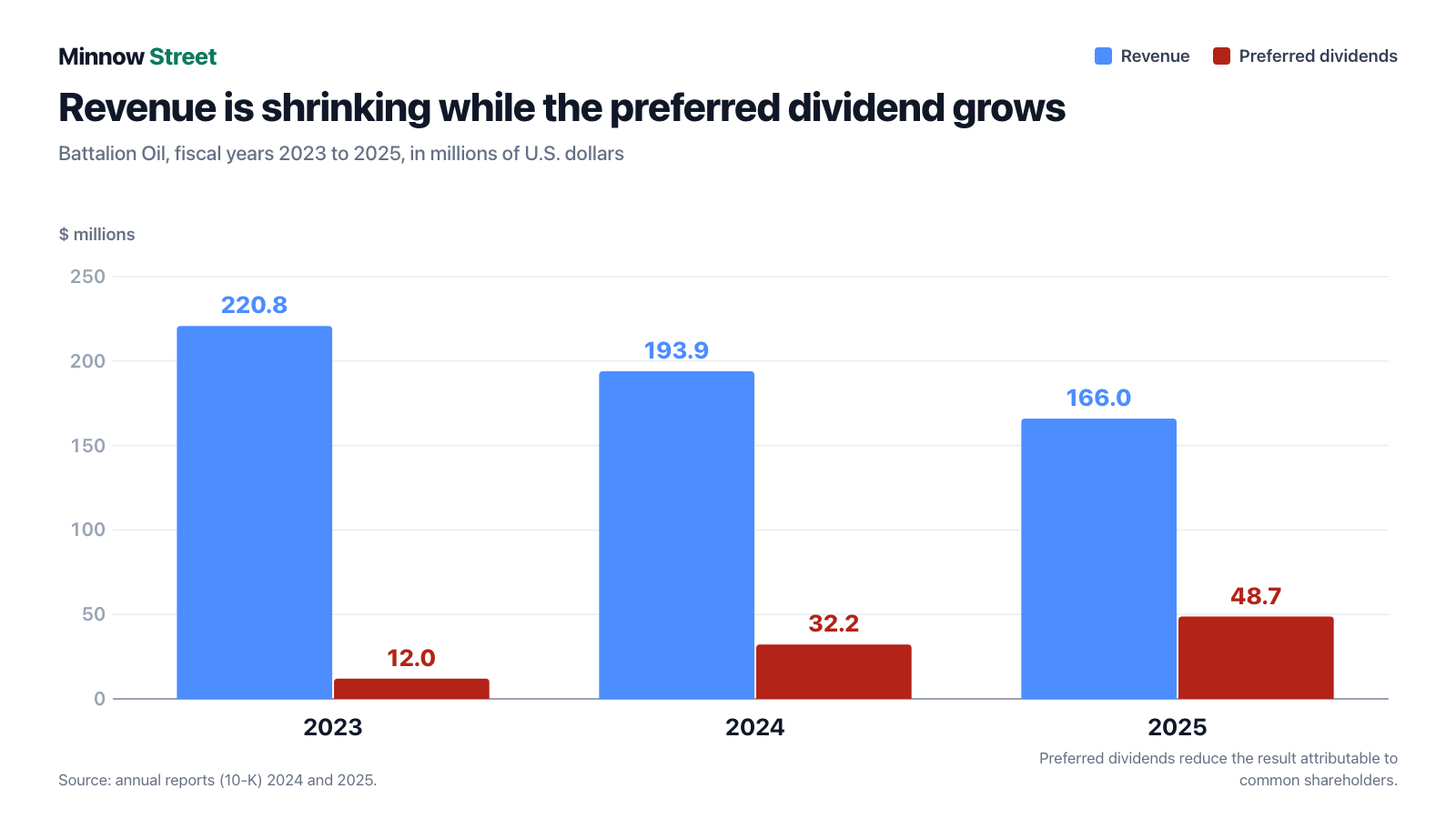
Uncomfortable truth no. 2: the balance sheet was healed — by a booking, not by profit
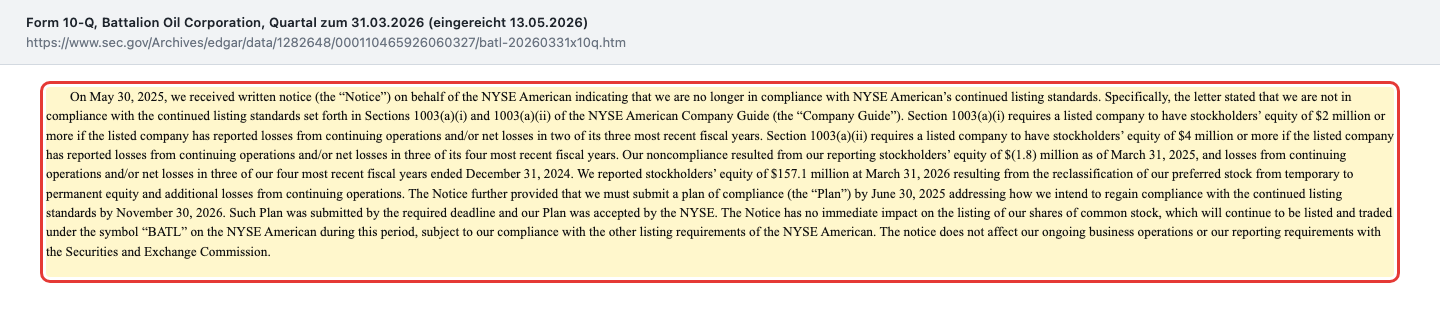
This is the point where you really have to read the filing. As of December 31, 2025 Battalion reported shareholders’ equity of −$32.8 million, after +$4.1 million at the end of 2024 and +$68.0 million at the end of 2023. That is precisely why the NYSE American had written on May 30, 2025 that the continued listing standards were no longer met: section 1003(a)(i) requires at least $2.0 million of shareholders’ equity after losses in two of the last three years, section 1003(a)(ii) at least $4.0 million after losses in three of the last four years. A compliance plan was submitted and accepted, with a deadline of November 30, 2026 to regain compliance.
In the quarterly report as of March 31, 2026 that whole back story is still there — and in the middle of it, one sentence that settles it:
„We reported stockholders’ equity of $157.1 million at March 31, 2026 resulting from the reclassification of our preferred stock from temporary to permanent equity and additional losses from continuing operations.“
— Battalion Oil Corporation, SEC quarterly report 10-Q as of March 31, 2026, Item 2 MD&A
What happened? The 138,000 preferred shares had until then been sitting in mezzanine — a zone of the balance sheet that is neither debt nor equity. Instruments land there when the holder can demand redemption and the company cannot prevent it. That very condition fell away: on March 25, 2026 the preferred holders no longer controlled the board of directors, neither individually nor collectively. Battalion then booked $8.3 million as a deemed dividend to lift the position to its redemption amount and reclassified it into permanent equity at $234.6 million. A shortfall of $32.8 million thus became equity of $157.1 million — without a single dollar being earned. On the contrary: in the same quarter the accumulated deficit grew from $273.0 million to $329.5 million.
Two things need to be said about that, and both belong to honesty. First: nothing about the claim itself has changed. The preferred still ranks ahead of the common stock, still compounds at 16.0 percent, is still convertible. A balance-sheet line changed places, not a creditor. Second: the exchange’s threshold is now vastly exceeded on paper — at most $4.0 million is required, $157.1 million is reported. A formal determination by the NYSE American that the deficiency has been cured, however, was not published by Battalion in any filing (8-K) through July 1, 2026; the quarterly report repeats the November 30, 2026 deadline unchanged and states that the listing suffers “no immediate impact”. Translated: the numbers problem is solved, the paperwork formally is not.
Uncomfortable truth no. 3: the refinancing worked — it is being paid for with new shares
On the credit side stands a year of hard balance-sheet work, and it deserves recognition. The sale of West Quito on February 24, 2026 brought $60.1 million, of which $45.6 million went straight into repayment. The private placement on March 4, 2026 brought $15.0 million gross — for which Battalion issued 1,800,000 shares and 927,273 pre-funded warrants at $5.50 each; the warrants were exercised on April 7, 2026. Debt therefore fell from $208.1 million as of December 31, 2025 to $162.5 million as of March 31, 2026.
And then came the real breakthrough. On June 30, 2026 the subsidiary Halcón Holdings signed a fully restated credit agreement with Fortress Credit Corp.:
„The maturity date of the Third Amended and Restated Credit Agreement is December 31, 2029. […] plus an applicable margin of 6.50% (or, for ABR Loans, a base rate plus an applicable margin of 5.50%). The applicable margin is fixed at 6.50% and replaces the leverage-based pricing grid contained in the Existing Credit Agreement, under which the applicable SOFR margin ranged from 7.75% to 8.50% depending on the Total Net Leverage Ratio“
— Battalion Oil Corporation, SEC filing 8-K of July 1, 2026, Item 1.01
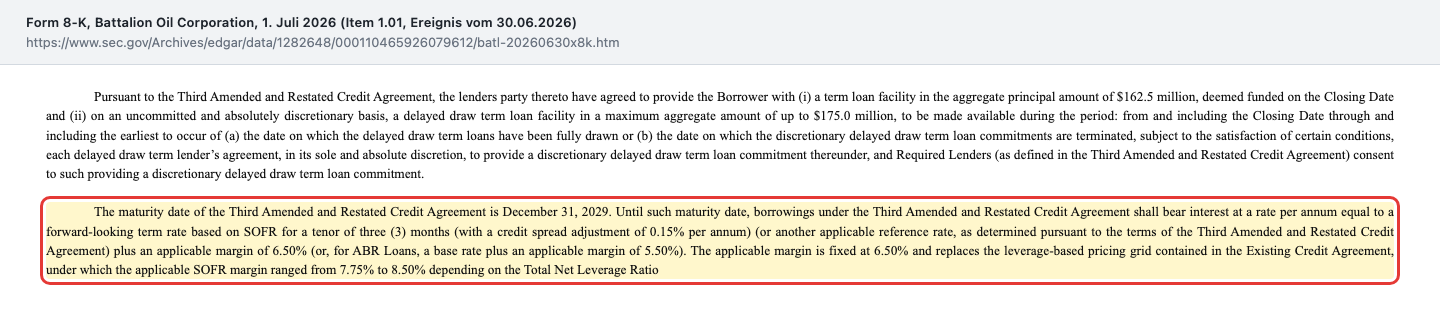
That is better in every respect: 1.25 percentage points less margin (in the first quarter of 2026 the weighted average interest rate was still 11.57 percent, for full-year 2025 it was 12.05 percent), a year more maturity instead of a December 2028 wall, amortization starting only in the second quarter of 2027 instead of a rolling $22.5 million a year — and on top of that a delayed-draw facility of up to $175.0 million for acquisitions and drilling. The claim that Battalion has no borrowing capacity left is therefore obsolete. Two footnotes remain: the facility is expressly “uncommitted and absolutely discretionary” on the lenders’ side, and anyone repaying within the first twelve months owes a full year of interest as a make-whole premium.
The financial covenants were re-sorted as well — metrics the agreement prescribes and whose breach entitles the lender to accelerate the loan. Four apply: a total net leverage ratio of no more than 2.75 times earnings (2.50 from 2027), a current ratio of at least 1.00 — that is, at least as much current assets as current liabilities — an asset coverage ratio of at least 1.75 for the second half of 2026, 2.00 for 2027 and 2.50 thereafter, plus minimum liquidity of $10 million or the next three months of debt service, whichever is greater. All four apply for the first time as of September 30, 2026. And here the last reported figure is worth a look: as of March 31, 2026, current assets of $82.1 million stood against current liabilities of $91.2 million — a current ratio of 0.90, below the future threshold. That is not a breach, because the covenant did not yet apply. It is very much a number to look for in the next report.
All of this is also being paid for with new shares, continuously. On May 5, 2026 Battalion signed an agreement with Roth Capital Partners allowing it to sell common stock worth up to $150.0 million gradually and directly into the market (“at the market”), for a commission of up to 3.00 percent. Between May 6 and May 8, 2026 it already placed 550,013 shares for net proceeds of $1.6 million — arithmetically just under $3 apiece. The share count can be reconciled step by step: 20,541,563 as of March 31, 2026, plus 927,273 from the warrants exercised on April 7, plus 550,013 from the sales program — 22,018,849 shares as of May 8, 2026, exactly the figure on the cover page of the quarterly report. Put differently: the company has bought itself room and is handing over ownership for it. The program is still almost untouched.
One last building block of this chapter is easy to overlook and remarkable nonetheless: Battalion changed its auditor. Following a competitive selection process run by the audit committee, Deloitte & Touche LLP was dismissed on June 24, 2026; on June 30, 2026 the committee engaged BDO USA, P.C. for fiscal year 2026.
„On June 30, 2026, the Audit Committee approved the engagement of BDO USA, P.C. („BDO“) as the Company’s independent registered public accounting firm for the fiscal year ended December 31, 2026, which appointment BDO has accepted.“
— Battalion Oil Corporation, SEC filing 8-K of June 30, 2026, Item 4.01
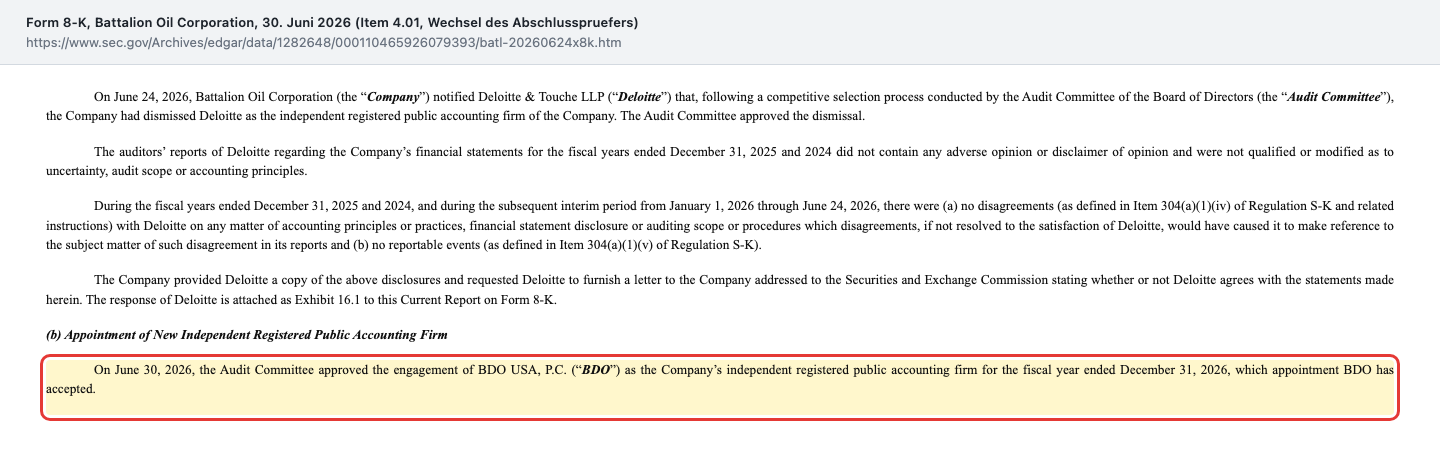
The filing states expressly: in 2025 and 2024 and through June 24, 2026 there were no disagreements with Deloitte and no reportable events; the audit reports for 2025 and 2024 contained no qualification. An auditor change after a competitive process is therefore not an alarm signal — but it does mean that the 2026 accounts will be audited by a firm seeing the company for the first time.
Uncomfortable truth no. 4: one basin, two buyers, and gas that costs money
Battalion produces in one place. That saves cost and travel — and bundles every risk in the same spot. The filing says so itself: because of this geographic concentration the company is more exposed to regional supply and demand effects, regulatory interruptions, processing and transport bottlenecks and water scarcity. If a pipeline fails in West Texas, Battalion’s revenue fails. How strongly the entire Permian Basin depends on a handful of service providers is something we described using ProPetro — the other side of the same dependency.
On the sales side the concentration is even tighter:
„In 2025 and 2024, two individual purchasers of our production, Western Refining Company L.P. and Sunoco Inc., each accounted for more than 10% of total sales, collectively representing 86% and 79%, respectively, of our total sales for the year.“
— Battalion Oil Corporation, SEC annual report 10-K for 2025, Item 1 “Marketing and Customers”
A detail for the precise: the filing contradicts itself on exactly these numbers. The business section says 86 percent (2025) and 79 percent (2024) — the notes to the same report, Note 1, say 83 percent (2025) and 86 percent (2024). Both sentences appear verbatim in the same document. We write this not to be pedantic but because it belongs to diligence: where two places in one report do not match, you had better not rely on the decimal. Only the order of magnitude is certain — four out of five barrels sold go to two customers.
And then there is the gas. Battalion held 5 percent of a joint facility that treats the hydrogen-sulfide-bearing gas from the Monument Draw area — the precondition for anyone taking it at all. The plant ran from March 9, 2024, processed 9.3 billion cubic feet and then shut down from one day to the next:
„On August 11, 2025, we received notice from WAT that it was ceasing taking deliveries of natural gas and was ceasing operations effective immediately. […] During the fourth quarter of 2025, we concluded that the fair value of our equity method investment in WAT was less than the carrying value […] and recorded an impairment of $1.1 million to reduce the carrying value of the investment in unconsolidated affiliate asset to zero as of December 31, 2025.“
— Battalion Oil Corporation, SEC annual report 10-K for 2025, Item 7 “Recent Developments” / Note 15
Battalion had to shut in part of its production as a result; the contract was terminated on January 19, 2026, and a large listed pipeline and processing company has done the work since. The year before, the same stake had already cost $18.5 million in write-downs. And the gas itself? The realized gas price was −$0.28 per thousand cubic feet in 2024 — Battalion was paying so that someone would take the gas at all. In 2025 it was +$0.49, and in the first quarter of 2026 it was −$0.73: gas revenue for the quarter was negative at −$1.5 million. For comparison: oil brought $68.85 per barrel in the same quarter. Remember: a quarter of the production volume is not merely worthless economically, it costs money.
One small thing with a large effect to close this chapter: Battalion does not hedge its prices voluntarily. The credit agreement requires that between 85 and 50 percent of expected production be hedged on a rolling four-year basis. The filing itself warns that such contracts could “limit our potential gains and increase our potential losses” if prices rise substantially above the fixed level. So anyone betting on Battalion to profit from an oil price rally should know: a large part of that rally has already been sold under contract. The net loss of the first quarter of 2026 shows the flip side in its purest form.
Valuation: what is left for the common shareholders?
First the price, and here care is needed. We do not use a daily quote but the last price the company itself recorded in a document: $3.93 on April 29, 2026, cited in the prospectus supplement of May 5, 2026. Multiplied by the 20,541,563 shares outstanding as of March 31, 2026 from the same document, that gives a market value of roughly $80.7 million; on the basis of the 22,018,849 shares as of May 8, 2026 it would be about $86.5 million. Every ratio that follows stands on the $80.7 million — and on the balance sheet as of March 31, 2026.
Add the $162.5 million of debt and the $221.2 million of preferred capital and subtract the $46.4 million of cash, and you arrive at an enterprise value of roughly $418.0 million. Measured against that, Battalion is not cheap: that is 2.5 times 2025 revenue and roughly 9.0 times operating income before depreciation ($46.6 million, deliberately excluding hedging gains). The optically attractive figure — the price-to-sales ratio of 0.49 — arises only because it simply ignores the $383.7 million of senior claims.
The harshest test comes from the reserve report. Remaining PV-10 of roughly $315.5 million minus $162.5 million of debt minus $221.2 million of preferred capital equals −$68.2 million; even with the cash, −$21.8 million remains. On the SEC’s official present-value calculation, in other words, mathematically nothing is left for the common shareholders. Still: before the refinancing and the sale it was −$82.6 million. The gap is shrinking — it is just not closed. That is the core of the whole story.
There is a counter-test, and it is the only real market information in the period: in the West Quito sale the buyer paid $60.1 million for reserves carrying $36.2 million of PV-10 — 1.66 times. Extrapolating that multiple across the remaining base ($315.5 million × 1.66 = $523.7 million) would leave roughly $140.0 million after debt and preferred capital, or about $6.82 per share across the 20,541,563 shares outstanding as of March 31, 2026. This is expressly a scenario, not a forecast: it rests on a single reference sale, undeveloped reserves typically fetch lower prices, the preferred capital keeps compounding at 16 percent a year — and every share issued through the sales program pushes the per-share amount down. The calculation only shows what an investment case at Battalion can plausibly come down to.
Two dated anchors from the filings round out the picture. The first: in early March 2026 institutional buyers paid $5.50 per share in the private placement, while in May the sales program netted just under $3 — the market paid markedly less within two months. The second is the most unusual find of this research: on June 18, 2026 the board approved a bonus pool of $5.0 million payable solely upon a change of control, plus a program granting executives 10 to 20 percent of the increase in value above a base amount measured from May 1, 2026 — and confirmed that 35,419 restricted stock units from 2020 have vested because a change-of-control event has occurred. The quarterly report lists “the sale of the Company” expressly among its liquidity alternatives. Anyone betting on Battalion is therefore, with high probability, betting on a sale — and on there being something left for the common stock in that purchase price after debt, preferred capital and bonus pools.
The ownership structure fits. On the basis of the proxy statement (as of April 14, 2026, each holder assuming conversion of its own preferred), Luminus Management holds 41.2 percent, Brookfield Oaktree 41.3 percent, Gen IV Investment Opportunities 20.5 percent and Alyeska Master Fund 7.7 percent; all directors and executive officers together 41.3 percent. In total there were only about 50 registered holders of record as of March 18, 2026, and the market value of the freely tradable shares was just about $5.0 million as of June 30, 2025 according to the cover page of the annual report ($13.0 million a year earlier). A great deal here is moving on very thin ice.
Diligence finally requires saying what we do not use. A market value of roughly $38 million shown by data services cannot be reconciled with the filing price of $3.93 and 20,541,563 shares — it is therefore not used, and neither is any metric derived from it. Equally unreliable are a reported 52-week high of $29.70 and a “price target” of $18.60 without a single underlying analyst estimate. What cannot be checked against an original document gets named — not used.
Opportunities and risks at a glance
What speaks for Battalion Oil:
- The balance sheet is formally healthy: shareholders’ equity of +$157.1 million as of March 31, 2026, far above the NYSE American threshold of at most $4.0 million.
- The refinancing worked: a new credit agreement of June 30, 2026 for $162.5 million maturing December 31, 2029, a fixed margin of 6.50 percent instead of 7.75 to 8.50, amortization starting only in the second quarter of 2027, plus a delayed-draw facility of up to $175.0 million.
- Debt fell within a single quarter from $208.1 million to $162.5 million, cash rose from $28.0 million to $46.4 million (plus $7.9 million restricted).
- The business earns money: operating cash flow up two years running ($17.6 → $35.4 → $39.1 million), an operating margin of $10.31 per barrel of oil equivalent on $27.05 of unit costs and $37.36 of revenue (2025); production rose to 12,578 barrels of oil equivalent per day in the first quarter of 2026.
- There is substance: roughly $315.5 million of remaining PV-10, 99.8 percent of reserves self-operated, long-term gas processing with a large listed provider since January 2026 instead of a 5 percent stake; the West Quito sale fetched 1.66 times the official present value.
- The company is visibly preparing a sale: a $5.0 million bonus pool on a change of control, a value-increase program from May 1, 2026, and “the sale of the Company” named expressly as an option in the quarterly report.
What speaks against it:
- The equity was reclassified, not earned: $234.6 million moved from mezzanine into equity because the preferred holders lost control of the board on March 25, 2026. Nothing changed about the seniority of the $221.2 million.
- Senior capital eats the result: $221.2 million of preferred shares compound at 16.0 percent a year; $10.77 per common share of seniority against a documented market value of roughly $80.7 million. Conversion could create 26,437,848 new shares — more than exist today.
- The first quarter of 2026 was the worst of the period: an operating loss of $2.1 million, a net loss of $56.5 million, −$64.8 million or −$3.72 per share for the common shareholders, working capital of −$9.1 million.
- Dilution is under way: a sales program of up to $150.0 million, with the first 550,013 shares placed for net proceeds of $1.6 million — after $5.50 per share in the March private placement.
- The new covenants apply from September 30, 2026, and the last reported current ratio was 0.90, below the required 1.00.
- The business is shrinking long term: revenue $220.8 → $193.9 → $166.0 million, reserves 68.1 → 64.9 → 59.7 million barrels, PV-10 down 23 percent within a year; free cash flow negative for three years running.
- Concentration risk at every level: one basin, two buyers taking four of five barrels (the annual report contradicts itself on the percentages), gas with negative revenue (first quarter of 2026: −$1.5 million), a processor that shut down overnight; plus a CEO who is also the principal financial officer and an auditor seeing the company for the first time.
A human conclusion
Back to the appeal of the small number — and to the second confusion, the one between booking and earning. What is startling about Battalion Oil is that within a few months the company has fixed almost everything you could have held against it in early 2026: equity is positive, the loan runs to the end of 2029 and costs 1.25 percentage points less, amortization does not start until 2027, there is a drawing facility again. Only none of these successes is an earned profit. The equity came from a reclassification, the deleveraging from a sale and from new shares, the interest relief from a new lender agreement. Anyone buying here is not buying a stake in 59.7 million barrels of oil in the ground. They are buying the bet that someone will pay more for those barrels than the SEC’s calculation rule allows — and that this happens before $162 million of debt and a preferred pile compounding at 16 percent have eaten the rest. That is not an absurd calculation: the West Quito sale showed that real buyers pay more than the model, and the change-of-control bonus pools show what management itself is working towards.
Battalion is not a fraud and not a zombie. It is a cleanly run small oil producer with 40 people, decent unit costs and a balance sheet that is formally back in order — in which the capital structure has nevertheless outgrown the company. And the Reddit numbers tell the side story too: even the attention that carries such prices is already cooling (rank 62 instead of 42, 8 instead of 15 mentions within a day), while the company keeps handing out shares through the sales program. So the honest question for you is not “is the balance sheet healthy now?” but: do you want to be last in a queue with $384 million standing ahead of you — and the person in front of you getting 16 percent bigger every year? If you take that bet knowingly, it is a thesis. If you take it because there is suddenly a plus sign on the balance sheet, it is a misunderstanding. What you make of it is your decision. And that is exactly as it should be.
Sources
All original documents used in this analysis — to read for yourself:
- Battalion Oil Corporation — SEC quarterly report 10-Q as of March 31, 2026 (filed May 13, 2026)
- Battalion Oil Corporation — SEC annual report 10-K for 2025 (filed March 23, 2026)
- Battalion Oil Corporation — SEC annual report 10-K for 2024 (filed March 31, 2025)
- Battalion Oil Corporation — SEC filing 8-K of July 1, 2026 (Item 1.01, new credit agreement of June 30, 2026)
- Battalion Oil Corporation — SEC filing 8-K of June 30, 2026 (Item 4.01, change of auditor)
- Battalion Oil Corporation — SEC filing 8-K of June 18, 2026 (Item 5.02, change-of-control compensation)
- Battalion Oil Corporation — SEC prospectus supplement 424B5 of May 5, 2026 (at-the-market program, price as of April 29, 2026)
- Battalion Oil Corporation — SEC proxy statement DEF 14A of April 30, 2026 (ownership, as of April 14, 2026)
- Battalion Oil Corporation — SEC filing 8-K of March 31, 2026 (Item 3.02, conversion of preferred stock)
- Complete SEC filing history of Battalion Oil Corporation: EDGAR overview (sec.gov)
- Reddit mentions: ApeWisdom (as of July 25, 2026); accessed through the in-house Reddit hype scanner.
Note on the data basis: this analysis rests on the quarterly report (10-Q) as of March 31, 2026, the annual reports (10-K) for 2024 and 2025, and on every SEC filing through July 1, 2026. Every present-tense statement has been checked against the most recent document that names the state in question. The market value comes from the last price documented in a filing ($3.93 on April 29, 2026), not from a market-data pull. The company does not quantify the actual levels of its financial covenants; no statement about compliance can be derived from the documents.
Transparency & disclaimer: this analysis is a journalistic assessment of publicly available information. It is not investment advice, not a financial analysis in the regulatory sense, and not an invitation to buy or sell securities. Equity investments carry substantial risks up to and including total loss. All information without warranty; the data cut-off is noted in the text in each case. The author holds no position in Battalion Oil shares at the time of publication.
Our Bottom Line at a Glance
- Balance sheet & listing neutral
- Shareholders' equity stood at +$157.1 million as of March 31, 2026, after −$32.8 million as of December 31, 2025 — far above the NYSE American threshold of at most $4.0 million. None of it was earned: $234.6 million moved out of mezzanine and into equity because the preferred holders lost control of the board on March 25, 2026. A formal determination by the exchange that the deficiency has been cured had not been filed through July 1, 2026.
- Financing positive
- The refinancing worked: a new credit agreement of June 30, 2026 for $162.5 million (previously $208.1 million) maturing December 31, 2029, with a fixed margin of 6.50 percent over the reference rate SOFR instead of 7.75 to 8.50 percent, amortization starting only in the second quarter of 2027, and an additional — though uncommitted — delayed-draw facility of up to $175.0 million. Cash rose from $28.0 million to $46.4 million.
- Capital structure negative
- Ahead of the common shareholders as of March 31, 2026 stand roughly $384 million: $162.5 million of debt and $221.2 million of preferred capital that keeps compounding at 16.0 percent a year absent cash payment. That is $10.77 of seniority per common share — against a documented market value of roughly $80.7 million for the entire company. Conversion of the preferred could create 26,437,848 new common shares, more than exist today.
- Earnings quality negative
- The $11.9 million of 2025 net income was not an operating profit: operating income was −$6.6 million, and what turned it was the single line of $45.3 million of hedging gains, of which $29.4 million were pure mark-to-market. How little that can be relied on was shown by the first quarter of 2026: a $48.0 million loss on the same contracts, a net loss of $56.5 million, and −$64.8 million or −$3.72 per share for the common shareholders.
- Dilution negative
- The share count rose from 16,456,563 (December 31, 2025) to 22,018,849 (May 8, 2026) — through a private placement, pre-funded warrants, an acreage purchase paid in stock and a preferred conversion. Since May 5, 2026 an at-the-market program of up to $150.0 million has been running on top; the first 550,013 shares netted $1.6 million, arithmetically just under $3 apiece after $5.50 in March.
- Substance & reserves neutral
- Reserves of 59.7 million barrels of oil equivalent last about 13.5 years but have fallen for a second year; the official PV-10 present value dropped 23 percent within a year to $351.7 million, leaving roughly $315.5 million after West Quito. Net of debt and preferred capital that is −$68.2 million; before the refinancing it was −$82.6 million. The West Quito sale, by contrast, fetched 1.66 times the official present value.
- Concentration & governance negative
- A single operating area, two buyers taking roughly four of five barrels sold (the annual report contradicts itself on these percentages: 86/79 in the business section, 83/86 in the notes), gas with negative revenue (first quarter of 2026: −$1.5 million) and a processor that shut down overnight on August 11, 2025. On top of that, the CEO is also the principal financial officer, and the 2026 accounts will be audited by BDO USA for the first time.
Battalion Oil is the textbook case for two confusions: price versus value — and booking versus earning. Shareholders' equity jumped from −$32.8 million (December 31, 2025) to +$157.1 million (March 31, 2026), but not through profit: $234.6 million of preferred capital moved out of mezzanine and into equity as an accounting matter because the preferred holders lost control of the board on March 25, 2026. What genuinely worked was the deleveraging from $208.1 million to $162.5 million and a refinancing through the end of 2029 at SOFR plus 6.50 percent. What genuinely remains is the preferred load: $221.2 million, 16 percent a year, $10.77 of seniority per share and up to 26,437,848 shares from a conversion. In the first quarter of 2026 the common shareholders lost $64.8 million. Not investment advice.
What Our Rating Means
Substance risk
We found at least one documented issue that threatens the company itself — regardless of how the stock is currently valued.
The order of claims remains the dominant risk, even though the balance sheet now looks different: roughly $384 million of debt and preferred capital stand ahead of the common stock, and the preferred portion keeps compounding at 16 percent a year absent cash payment. On the SEC's official present-value calculation nothing is left for the common shareholders ($315.5 million minus $162.5 million minus $221.2 million = −$68.2 million), and the company keeps issuing new shares through its sales program. Anyone still looking should check four things in every report: does the reclassified equity of $157.1 million hold up against the ongoing loss? Does the NYSE American formally confirm the cure before November 30, 2026? Does the current ratio reach the newly required 1.00 as of September 30, 2026 (last reported: 0.90)? And how many more shares arrive through the $150 million program? The decision is yours.
A journalistic assessment by our editorial team at the time of the deep dive, based on public sources — not investment advice and not a solicitation to buy or sell. Your personal circumstances (investment goals, risk capacity, taxes) cannot be taken into account. What our levels mean, how verdicts are formed, and what conflicts of interest exist →
Worth Noting
- Battalion Oil reached the research list not through a metrics scanner but through the Reddit hype scanner: rank 62, 8 mentions in 24 hours and 32 upvotes (ApeWisdom, as of July 25, 2026) — 24 hours earlier rank 42 with 15 mentions. The attention is cooling while the company keeps handing out shares through the at-the-market program.
- The data basis is the quarterly report (10-Q) as of March 31, 2026, the annual reports (10-K) for 2024 and 2025, and every SEC filing through July 1, 2026. Every present-tense statement has been checked against the most recent document that names the state in question. The company does not quantify the actual levels of its financial covenants — no statement about compliance can be derived from that.
- Deliberately not used: a market value of roughly $38 million shown by data services, which cannot be reconciled with the filing price of $3.93 (April 29, 2026) and 20,541,563 shares; likewise a reported 52-week high of $29.70 and a "price target" of $18.60 without any underlying analyst estimate. Analyses are evergreen — daily prices are not a reason to buy.
- A remarkable side find: on June 18, 2026 the board approved a bonus pool of $5.0 million payable solely upon a change of control, plus a program granting 10 to 20 percent of the increase in value from May 1, 2026 — and confirmed the vesting of 35,419 restricted stock units from 2020 because a change-of-control event has occurred. The quarterly report names "the sale of the Company" expressly as a liquidity alternative.
Frequently Asked Questions
Battalion Oil Corporation (NYSE American: BATL) of Houston, Texas, is a pure onshore oil and gas producer. The entire business sits in a single operating area: the Delaware Basin of West Texas, in Pecos, Reeves, Ward and Winkler counties; as of December 31, 2025 that was 39,968 net acres. The company operated 82 of its own wells with 40 full-time employees and produced 12,096 barrels of oil equivalent per day, of which roughly 6,167 barrels of actual crude. Oil accounted for 86.7 percent of oil, gas and NGL revenues in 2025.
Because of a reclassification, not a profit. The 138,000 preferred shares sat in mezzanine because their holders had a redemption right that was not solely within the company's control. On March 25, 2026 those holders no longer controlled the board, neither individually nor collectively, and the condition fell away. Battalion booked $8.3 million as a deemed dividend and reclassified $234.6 million into equity. The result: +$157.1 million as of March 31, 2026, after −$32.8 million as of December 31, 2025.
On the numbers, no longer. The NYSE American requires $2.0 million or $4.0 million of shareholders' equity depending on the loss history; Battalion reported $157.1 million as of March 31, 2026 and cites that figure expressly in the paragraph dealing with the letter of May 30, 2025. A formal determination by the exchange that the deficiency has been cured was not published in any filing (8-K) through July 1, 2026; the November 30, 2026 deadline still appears unchanged in the quarterly report.
As of March 31, 2026 it was $162.5 million of face value, down from $208.1 million as of December 31, 2025. On June 30, 2026 the loan was fully restated: $162.5 million maturing December 31, 2029, interest at the reference rate SOFR plus a fixed 6.50 percent (previously 7.75 to 8.50 percent depending on leverage), with amortization starting only in the second quarter of 2027. The weighted average interest rate was 11.57 percent in the first quarter of 2026 and 12.05 percent in 2025.
Yes, since June 30, 2026. Alongside the $162.5 million term loan, the new credit agreement contains a delayed-draw facility of up to $175.0 million for acquisitions and drilling. The fine print matters: that facility is expressly uncommitted and sits in the absolute discretion of the lenders. As of March 31, 2026 — under the old agreement — there was no capacity left; in addition, $30.0 million remained available under a support letter from the major investors through August 31, 2026.
Preferred shares get paid before the common shareholders. At Battalion the rate is 14.5 percent when paid in cash — and 16.0 percent when new preferred shares are issued instead. That is exactly what has been happening for years. The carrying value stood at $221.2 million for 130,197 shares as of March 31, 2026, which is $10.77 of seniority per common share. According to the proxy statement, conversion could create 26,437,848 new common shares — against 21,468,836 shares outstanding as of April 14, 2026.
That depends on what you count. The last price documented in a filing was $3.93 (April 29, 2026); with 20,541,563 shares that gives roughly $80.7 million of market value and a price-to-sales ratio of about 0.49. Add debt and preferred capital and subtract cash, and enterprise value is roughly $418.0 million — 2.5 times 2025 revenue. There is no price-to-earnings ratio, because a loss is left for the common shareholders.
The auditor changed in 2026: Deloitte & Touche LLP was dismissed on June 24, 2026 after a competitive selection process, and BDO USA, P.C. was engaged on June 30, 2026 for fiscal year 2026 — with no disagreements and no reportable events. Ownership rests mainly with three fund managers: Luminus Management at roughly 41.2 percent, Brookfield Oaktree at roughly 41.3 percent and Gen IV Investment Opportunities at roughly 20.5 percent, each assuming conversion of its own preferred stock (as of April 14, 2026).
Found an error?
Did you spot a factual error, an outdated number, or a typo in this deep dive? Let us know briefly — your report goes straight to the editorial team.