AZZ Stock: An All-Time High at 15 Times Earnings — but Two-Thirds of the Record Profit Was a One-Off
AZZ galvanizes America's steel and coats its coil — and lights up 12 filters in our in-house stock scanner, almost all of them trend and momentum (scanner run of July 17, 2026). We read the annual reports (10-K) for fiscal years 2025 and 2026 and the fresh quarterly report (10-Q) as of May 31, 2026: a record profit of $317.3 million of which $204.5 million came from the partial sales of a joint venture, earnings per share that fell 69.6 percent in the latest quarter, a balance sheet healthier than it has been in years — and a screener P/E around 15 that knows none of this story. Not investment advice — just the arithmetic of what remains of a record profit once you subtract the sale.
 Thomas Mücke
Founder & Publisher
Thomas Mücke
Founder & Publisher
Chart
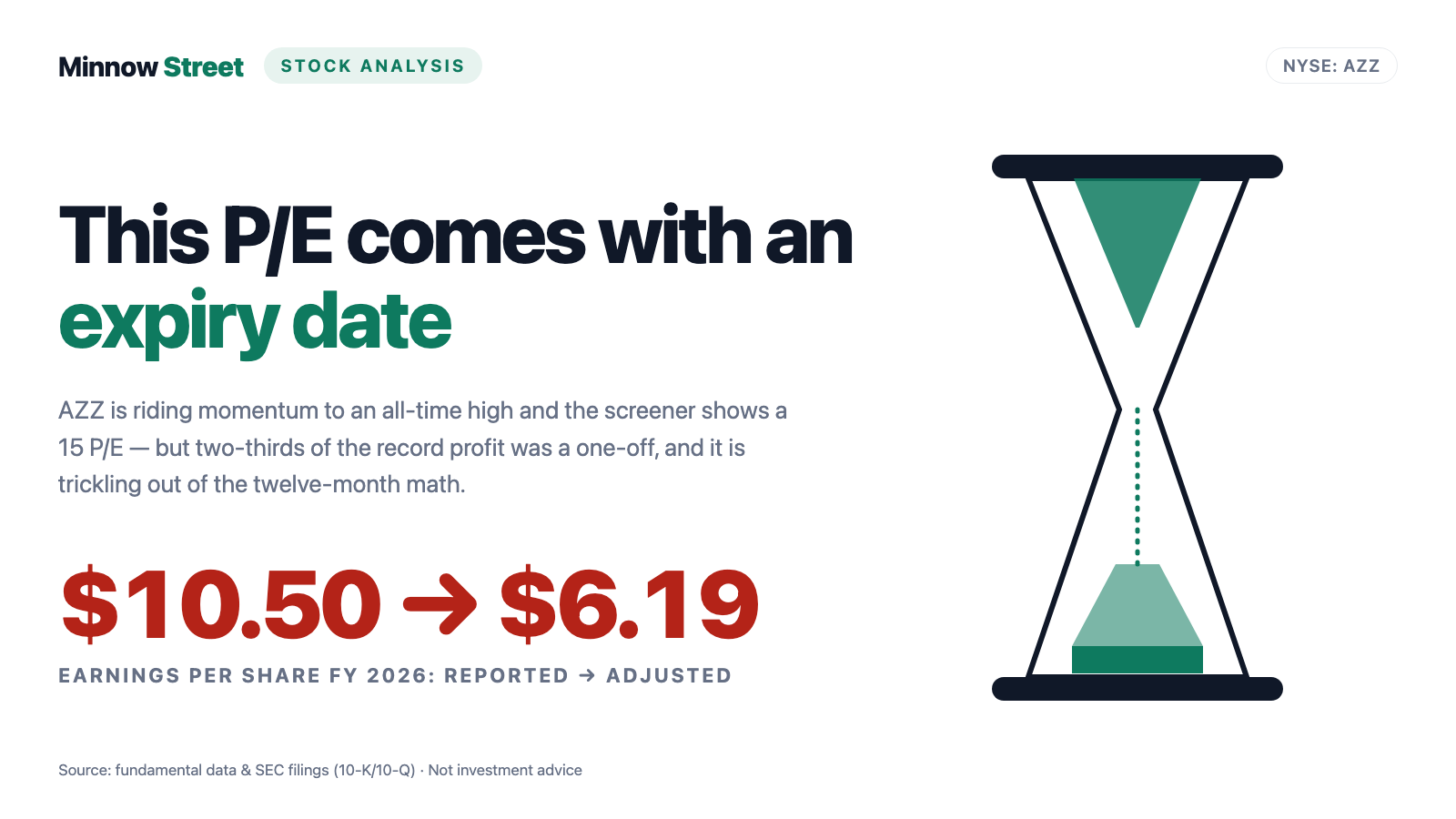
Interactive price chart (TradingView).
Note: pure fact-based analysis, not investment advice and not a solicitation to buy or sell. All figures without guarantee.
There is an investor trap that catches the cautious ones in particular: the anchor trap. It works like this: you see a stock near its all-time high and you actually want to be skeptical — up 73 percent in twelve months, your conscience clears its throat. Then your eye lands on a single number: a price-to-earnings ratio around 15. And your brain exhales. A 15 P/E sounds like solid industry, not hype; the anchor sets, the skepticism goes home. Hardly any mid cap feeds that trap in the summer of 2026 as cleanly as AZZ Inc. (NYSE: AZZ) of Fort Worth, Texas: America\'s largest independent hot-dip galvanizer, showing up in our in-house stock scanner with 12 hits — almost all of them trend and momentum filters (scanner run of July 17, 2026). So let\'s make a deal: before you trust the anchor, we read together what the company itself reported, under penalty of law, to the U.S. securities regulator, the SEC — the annual reports (10-K) for fiscal years 2025 and 2026 and the fresh quarterly report (10-Q) as of May 31, 2026. And this one explains, in a single sentence, why the comforting P/E comes with an expiry date. In the end, you decide for yourself.
What AZZ actually does — and for whom
AZZ runs what may be the least glamorous business on the U.S. stock market — and one of the most useful: hot-dip galvanizing. Steel beams, gratings, poles and guardrails are dipped into kettles of molten zinc; the zinc layer protects the steel from rust for decades. Translated, AZZ is something like the corrosion insurance policy for America\'s infrastructure — paid per dip. The AZZ Metal Coatings segment runs 42 galvanizing plants and four surface technologies sites across the United States and Canada and generated $758.7 million in fiscal 2026, about 46 percent of revenue — at an adjusted operating margin (EBITDA margin) recently above 30 percent. The second leg is AZZ Precoat Metals: 14 plants that coat and paint steel and aluminum coil before it becomes roofs, appliances, HVAC units, cans or garage doors — $891.4 million of revenue in fiscal 2026, about 54 percent of the company, at a margin above 21 percent. This segment only arrived in May 2022, for $1.28 billion — mostly on credit, more on that below. Customers are steel fabricators and manufacturers across construction, electrical infrastructure, industry and transportation; how choppy that water can get is something we dissected at the steel processor Friedman Industries. And then there is a third, invisible part: a 40 percent stake in the AVAIL joint venture — the remainder of the former infrastructure segment that AZZ handed over to the investment firm Fernweh in 2022, keeping a minority. Remember that stake; it is the main character of this analysis. Two calendar footnotes so the numbers don\'t trip you up: per the SEC registers, AZZ was called Aztec Manufacturing until June 2000, and the fiscal year ends at the end of February — "fiscal year 2026" means March 2025 through February 2026, and the "first quarter of fiscal year 2027" covers March through May 2026. Which brings us to the central tension of this analysis, and it runs through every chapter: a rock-solid, deleveraged industrial business is riding genuine momentum to an all-time high — but the valuation anchor accompanying the rally consists, to the tune of two-thirds, of a profit that will not repeat.
Where the stock shows up in our scanner
Every day we run about 3,500 stocks through our scanners. AZZ reached the research list through a broad momentum confluence: 12 hits in the scanner run of July 17, 2026 — among them the Stan Weinstein stage-2 uptrend (price above a rising 200-day average), near 52-week high, above the 50- and 200-day lines, the 21-EMA trend, a Pradeep Bonde breakout signal, the Mark Minervini trend criteria and the Gary Antonacci dual-momentum selection. To replicate it yourself: open the AZZ stock page or browse the stage-2 scanner. Behind it stand plus 24 percent in three months, plus 37 percent in six and roughly plus 73 percent over twelve months — the stock trades just over 3 percent below its all-time high (price and metrics data as of July 10, 2026). Notably, and unlike many momentum candidates, the quality lens nods along too — AZZ additionally makes the KCF ranking, the QARP filter ("quality at a reasonable price") and the Pros 80% list (more than 96 percent of the shares sit with institutional investors). The Piotroski F-score, a nine-point test of the direction of the books, stands at a healthy 7 of 9; the Altman Z-score (an early-warning gauge of insolvency risk built from several balance-sheet ratios) sits around 8, far outside any danger zone; the fundamental grade is a B. And right in the middle, the anchor: a trailing price-to-earnings ratio around 15. Only two numbers refuse to join the choir: the earnings rating stands at a meager 22 of 99, and the latest reported quarter shows earnings down about 21 percent. Remember this dissonance: when trend filters and quality filters cheer but the earnings metrics cough, there is almost always a story in the filings — and you want to know it before you drop the anchor.
The numbers over the years — honestly appraised
First, what genuinely impresses. AZZ has digested its big 2022 acquisition — Precoat Metals for $1.28 billion — at a remarkable pace: revenue climbed from $1.32 billion in fiscal 2023 to $1.65 billion in fiscal 2026, net interest expense was nearly halved from $107.1 million (fiscal 2024) to $55.7 million in fiscal 2026, and net leverage is down to 1.4 times adjusted EBITDA (May 31, 2026). Of the original $1.3 billion acquisition loan (the "Term Loan B"), $335 million remained outstanding as of February 28, 2026; the total debt of $515 million comes due only from fiscal 2028 onward. Operating cash flow reached $525.4 million in fiscal 2026 — though that includes a $273 million special distribution from the AVAIL joint venture, without which it would still have been a respectable quarter-billion or so. The galvanizing business grew a hefty 14.1 percent to $758.7 million in fiscal 2026, carried by more steel processed for construction, electrical and industrial projects, and the new aluminum coil coating plant in Washington, Missouri — operational since the first quarter of fiscal 2026 — is expected to be accretive to earnings in fiscal 2027. On July 8, 2026, management raised its guidance: $1.80 to $1.85 billion in sales and adjusted EPS of $6.75 to $7.15 for fiscal 2027. That is the kind of balance-sheet housekeeping the market rightly likes. Now look at the growth curve underneath:
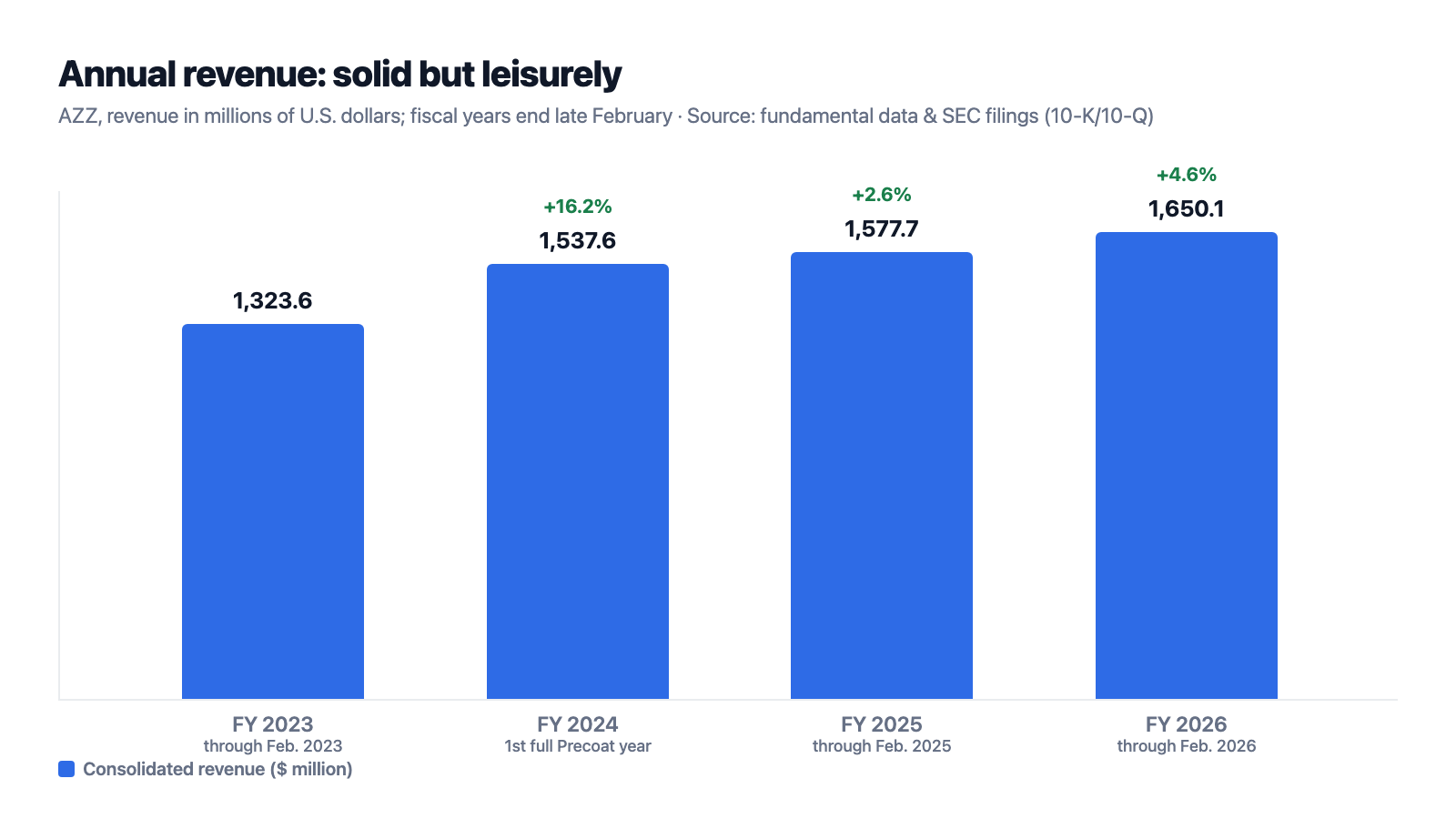
Strip out the acquisition jump of fiscal 2024 and AZZ grows organically in the low-to-mid single digits: plus 2.6 percent in fiscal 2025, plus 4.6 percent in fiscal 2026, plus 6.3 percent in the latest quarter. The coil coating business Precoat Metals actually shrank slightly in fiscal 2026 (from $912.6 million to $891.4 million) and grew just 1.5 percent most recently. A rust-protection company is not a software rocket — perfectly fine. Except: net income jumped from $128.8 million to $317.3 million in fiscal 2026, a gain of 146 percent. How does a 146 percent profit jump fit a 4.6 percent revenue increase? It doesn\'t. Which brings us to the uncomfortable truths.
What the filings say — the uncomfortable truths
Uncomfortable truth no. 1: Two-thirds of the record profit came from a sale, not from galvanizing
The resolution sits in the annual report, in the chapter on the AVAIL stake — that 40 percent residual interest in the infrastructure business spun off in 2022. The joint venture sold two of its businesses in fiscal 2026: the Electrical Products Group to nVent and the majority of the welding services provider WSI to Pelican Energy Partners. AZZ\'s share of those gains flowed through its own income statement via the "equity in earnings" line:
"As of February 28, 2026, our investment in the AVAIL JV was $20.0 million. For the year ended February 28, 2026, we recorded $209.7 million of equity in earnings, which consists of 1) a net gain of $261.8 million from the sale of the EPG and WSI, 2) $3.4 million of equity in earnings from the AVAIL JV's operations for the year ended February 28, 2026, offset by 3) an impairment loss of $45.9 million on the AVAIL JV recognized during the second quarter of fiscal 2026, and 4) an adjustment of $9.6 million related to accounting errors identified within the Brazil operations of the AVAIL JV."
— AZZ Inc., SEC annual report 10-K for fiscal year 2026, Item 7 "Liquidity and Capital Resources — AVAIL JV"

The company itself does the math on what that means: in its reconciliation to adjusted earnings, AZZ strips out exactly $204.5 million — $6.77 per share — as the "AVAIL JV equity in earnings adjustment." What remains is adjusted EPS of $6.19 instead of the reported $10.50. This is no accounting trick by AZZ — quite the opposite: the company discloses the effect with exemplary transparency, and real money did arrive — in the first quarter of fiscal 2026 alone, the joint venture wired a $273 million distribution that went straight into debt repayment. But a gain on sale is like the proceeds from selling your second car: lovely money, you just don\'t earn it twice. Screeners compute with the reported $10.50 — and that is exactly where the comforting P/E around 15 comes from.
Uncomfortable truth no. 2: Minus 69.6 percent — the latest quarter shows the anchor dissolving
What happens when the one-off rolls out of the comparison window went on public display on July 8, 2026, in the fresh quarterly report. Revenue grew nicely — plus 6.3 percent to $448.5 million, the galvanizing business even plus 12.3 percent. And yet:
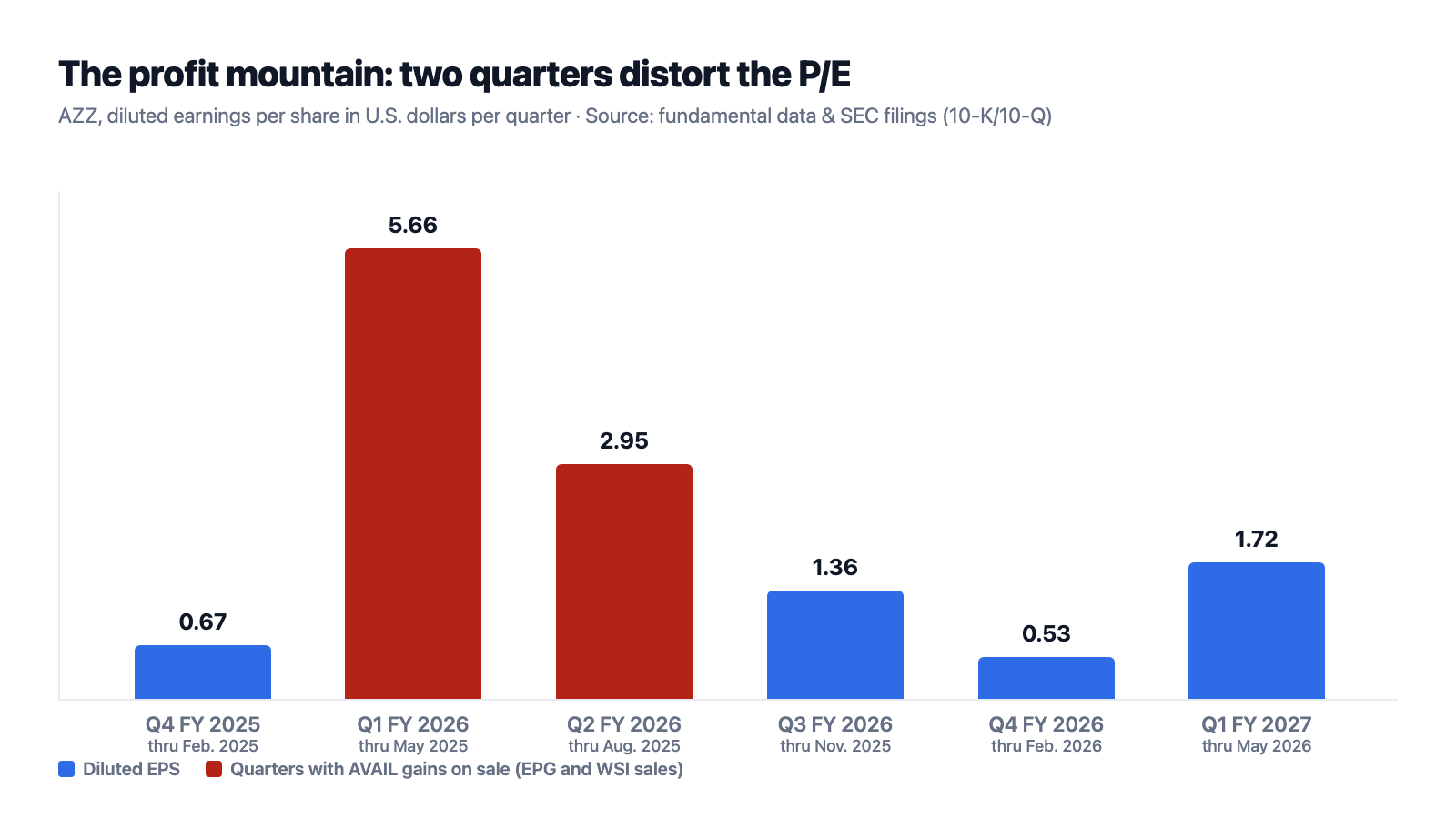
"Diluted earnings per common share decreased by 69.6%, to $1.72 per share for the current quarter, compared to $5.66 per share for the prior year quarter. The decrease was primarily due to the recognition of equity in earnings for the excess distribution from the AVAIL JV in the prior year quarter."
— AZZ Inc., SEC quarterly report 10-Q as of May 31, 2026, Item 2 "Results of Operations"

Let\'s do the anchor math honestly. With the quarterly report of July 8, 2026, the last four reported quarters read: $2.95, $1.36, $0.53 and $1.72 — together $6.56 of earnings per share in twelve months. At the price level of July 10, 2026 (about $160), that is a price-to-earnings ratio of roughly 24 — not 15. On the trailing adjusted earnings (about $6.26) it is roughly 26; on the midpoint of the raised guidance ($6.95) roughly 23. Fairness requires saying: operationally the quarter was fine — adjusted EPS rose 3.9 percent to $1.85, and guidance was raised. But adjusted EBITDA actually slipped ($99.5 million after $106.4 million; the margin from 25.2 to 22.2 percent, partly because the prior year still contained $7.7 million of ongoing JV earnings). A 15 P/E and a 24 P/E describe the same share price — the only difference is whether you turn the page by one quarter. That is precisely what makes the anchor trap so treacherous: the anchor was real, it has merely expired.
Uncomfortable truth no. 3: The residual stake is a black box — with an impairment and accounting errors in Brazil
Which leaves the question of what the record year\'s profit engine is still worth. The annual report\'s answer: $20.0 million — that is the carrying value of the 40 percent stake in the shrunken AVAIL joint venture after the sales, the distributions and a $45.9 million impairment. And the same footnote that explains the gains contains a paragraph hardly any investor has on the radar:
"During the year ended February 28, 2026, AVAIL recorded a prior period adjustment for accounting errors within the Brazil operations of the AVAIL JV. We recorded our proportionate share of the adjustment during the fourth quarter of fiscal year 2026. Our share of the adjustment was approximately $9.6 million [...]. The adjustment is comprised of $1.2 million related to the full year ended February 28, 2026 and $8.4 million related to prior periods."
— AZZ Inc., SEC annual report 10-K for fiscal year 2026, Note 18 "Equity Method Investment"

AZZ concluded, after its own analysis, that the adjustment was not material to previously issued financial statements, and the amount is digestible for a company this size. The point is a different one: the annual report\'s risk section names it itself — the investment could suffer from the "lack of sole decision-making authority over the majority of the strategic and operational decisions of the business" (10-K for fiscal year 2026, Item 1A "Risk Factors"). AZZ is a minority holder in AVAIL: the record year\'s profits came out of a vehicle AZZ neither steers nor consolidates — including an impairment, a Brazil correction and a change in transfer pricing policy, all in the same year. And as a future profit source, the residual stake has little left to give: it sits on the books at $20 million and at its core now consists of an industrial lighting business. The engine of the record year is not just a one-off — it is also running close to empty.
Uncomfortable truth no. 4: Margins hang on zinc, natural gas and paint — and half the company barely grows
And the core business itself? It is robust, but it carries two structural dependencies the annual report names openly. The first: commodities.
"Within our AZZ Metal Coatings segment, zinc and natural gas costs represent a large portion of our cost of sales. In our AZZ Precoat Metals segment, paint and natural gas costs represent a large portion of our cost of sales. [...] Unanticipated commodity price increases could significantly increase our operating costs if we cannot pass the costs to our customers, and could potentially adversely affect profitability."
— AZZ Inc., SEC annual report 10-K for fiscal year 2026, Item 1A "Risk Factors"

AZZ manages this professionally — zinc is bought under supply agreements with fixed premiums, and passing on prices has worked in the past. But it remains a business whose margin is squeezed between metal price, gas bill and customer terms — much like the commodity processors we described at Friedman Industries. The second dependency is the cycle of the end markets: what gets galvanized and coated is what gets built — bridges, power lines, warehouses, appliances. The galvanizing business is currently drawing real strength from infrastructure and grid investment (plus 12.3 percent in the latest quarter). The larger Precoat Metals segment, however, shrank 2.3 percent in fiscal 2026 and grew a meager 1.5 percent most recently — construction and consumer end markets being what they are. In sum, this is a good, weatherproof industrial business. It is just not a business that grows, on its own power, into the price-to-earnings ratio that appears on the ticket once the one-off disappears.
Valuation: $4.8 billion of market value — and the question of which P/E you believe
In early July 2026, the AZZ share cost about $160, making for roughly $4.8 billion in market value (data as of July 10, 2026). Depending on which earnings you use, that is cheap or sporty: P/E around 15 on the reported twelve months through February 2026 (one-off included), around 24 on the twelve months through May 2026 (one-off half rolled out), around 26 on adjusted earnings, around 23 on the midpoint of the raised fiscal 2027 guidance. The price-to-sales ratio sits around 2.9, price-to-book around 3.6. For context: for an industrial with single-digit organic growth, 23 to 26 times earnings is no longer a bargain but a quality premium — the market is paying for the market leadership, the deleveraging and the infrastructure narrative. Capital returns are solid but no turbocharger: the quarterly dividend was raised to $0.20 (a yield of roughly 0.5 percent), and in January 2026 the board authorized a new $100 million buyback program — a good 2 percent of the market value. A piquant detail on the side: the only buyback of note in fiscal 2026 happened in October 2025 — 201,416 shares at an average of $99.28. Management bought a good 60 percent below today\'s price, and has not bought since. The insiders\' mandatory filings show nine sales and not a single purchase over the trailing months, the CEO among them (data as of July 10, 2026). Insider sales near an all-time high prove nothing — but nobody bought here either. The ten analysts covering the stock average a "buy" (consensus 1.3) and expect about $7.63 of EPS for fiscal 2028 — that would be roughly 21 times the earnings of the year after next. Growth, in other words, is priced in; disappointment is not. How quickly the market reprices an industrial quality story — in both directions — is something we just watched at Garrett Motion.
Opportunities and risks at a glance
What speaks for AZZ:
- Market leadership in an unglamorous niche: North America\'s largest independent hot-dip galvanizer (42 plants) plus a leading coil coating network (14 plants) — local economies of scale, recurring corrosion-protection demand, adjusted EBITDA margin above 30 percent in the galvanizing segment (Q1 fiscal 2027).
- The deleveraging is delivered: net interest expense nearly halved from $107.1 million to $55.7 million since fiscal 2024, net leverage at 1.4 times EBITDA (May 31, 2026), fiscal 2027 interest expense guided at just $35 to $45 million.
- Structural tailwind: grid, infrastructure and reshoring investment drives the galvanizing business (+14.1 percent in fiscal 2026, +12.3 percent in the latest quarter); the new aluminum plant in Washington, Missouri is expected to be accretive from fiscal 2027; guidance raised on July 8, 2026.
- Quality the scanner confirms: Piotroski F-score 7 of 9, Altman Z around 8, fundamental grade B, 96 percent institutional ownership, 12 scanner hits including quality filters (KCF, QARP; scanner run of July 17, 2026).
- A disciplined bolt-on program instead of adventures: small acquisitions such as Canton Galvanizing (July 2025, roughly $30 million) — paid out of cash flow.
What speaks against it:
- The valuation anchor is an illusion: the screener P/E around 15 counts $204.5 million of one-off gains; honestly computed, the stock costs 23 to 26 times earnings — for a business with single-digit organic growth (data as of July 10, 2026).
- Three more quarters of ugly comparisons: after minus 69.6 percent in the quarter through May 2026, the base effects of the quarters through August 2025 ($5.66 and $2.95 of prior-year EPS) are still ahead — momentum strategies that screen on reported earnings face headwinds.
- The record year\'s profit source is exhausted: the residual AVAIL stake sits on the books at $20.0 million, was impaired by $45.9 million and delivered a $9.6 million adjustment for accounting errors in Brazil — in a venture where AZZ does not call the shots.
- The commodity-and-cycle squeeze: zinc, natural gas and paint dominate cost of sales, the end markets (construction, appliances, transportation) are cyclical, and the larger Precoat Metals segment shrank 2.3 percent in fiscal 2026.
- Insiders sold nine times and bought zero times recently (CEO included); the scanner\'s earnings rating stands at 22 of 99, because reported earnings must now compete against the one-off quarters (data as of July 10, 2026).
A human conclusion
Back to the anchor trap from the opening. Its trick is not that it shows you false numbers — the P/E around 15 really does appear in the screener, honestly computed from reported earnings. Its trick is that it lets you mistake a single number for the whole story. The whole story of AZZ goes like this: a very good, very boring business — America\'s rust-protection tollbooth — used the proceeds of an old corporate side-wing to pay down its debt in record time, grows organically in the single digits, and is now priced at a quality premium that only becomes visible once you subtract the sale proceeds from the profit. None of this is a scandal, anywhere. It is simply a different investment from the one the anchor promises: whoever buys today is not buying a 15-P/E bargain but a solid industrial compounder at 23 to 26 times earnings — with infrastructure tailwinds on one side, and three quarters of ugly comparisons, zinc bills and cyclical end markets on the other. The hourglass on the title image is running for real, by the way: with every quarterly report, another piece of the one-off trickles out of the twelve-month math, and the shop-window P/E converges toward the honest one. Whether the company is worth that price to you is something you can now decide with the very documents we used for the math. What you make of it is your decision. And that is exactly as it should be.
Sources
All original documents used in this analysis — for your own reading:
- AZZ Inc. — SEC annual report 10-K for fiscal year 2026 (ended February 28, 2026; filed April 22, 2026)
- AZZ Inc. — SEC annual report 10-K for fiscal year 2025 (ended February 28, 2025; filed April 21, 2025)
- AZZ Inc. — SEC quarterly report 10-Q as of 05/31/2026 (filed July 8, 2026)
- AZZ Inc. — SEC quarterly report 10-Q as of 11/30/2025 (filed January 7, 2026)
- AZZ Inc. — SEC quarterly report 10-Q as of 08/31/2025 (filed October 8, 2025)
- AZZ Inc. — SEC quarterly report 10-Q as of 05/31/2025 (filed July 9, 2025)
- AZZ Inc. — First-quarter fiscal 2027 earnings press release with raised guidance (8-K of July 8, 2026)
- Complete SEC filing history of AZZ Inc.: EDGAR overview (sec.gov)
- Fundamental data (metrics, quarterly series, valuation; data as of July 10, 2026), reconciled with the SEC filings.
- Screener and rating data: in-house stock scanner (scanner run of July 17, 2026; price and metrics data as of July 10, 2026).
Transparency & disclaimer: This analysis is a journalistic contextualization of publicly available information and is not investment advice, not a financial analysis in the regulatory sense and not a solicitation to buy or sell securities. Stock investments carry substantial risks up to and including total loss. All information without guarantee; the data cut-off is noted in the text. The author holds no position in AZZ shares at the time of publication.
Our Bottom Line at a Glance
- Business model & market position positive
- North America's largest independent hot-dip galvanizer (42 plants) plus a leading coil coating network (14 plants); recurring corrosion-protection demand, an adjusted EBITDA margin above 30 percent in the galvanizing segment and infrastructure tailwind (+12.3 percent segment growth in the quarter through May 31, 2026; 10-Q).
- Balance sheet & deleveraging positive
- Of the $1.3 billion acquisition loan, $335 million remains; net interest expense nearly halved since fiscal 2024 ($107.1 million to $55.7 million), net leverage 1.4 times EBITDA (May 31, 2026), Piotroski 7 of 9, Altman Z around 8 — the AVAIL distributions went into debt repayment with discipline.
- Earnings quality FY 2026 negative
- $204.5 million of the $317.3 million net income is a one-off from the AVAIL partial sales (adjusted $6.19 versus reported $10.50 per share); in the quarter through May 31, 2026, reported EPS fell 69.6 percent, and two more quarters of distorted comparison bases are still ahead (10-K FY 2026, 10-Q).
- Residual AVAIL stake negative
- The record year's profit source is largely exhausted: carrying value down to $20.0 million, a $45.9 million impairment in the second quarter of fiscal 2026, plus a $9.6 million adjustment for accounting errors in Brazil — in a minority stake without decision-making authority (10-K FY 2026, Note 18 and Item 1A).
- Valuation & technicals neutral
- A stage-2 trend, 12 scanner hits and just over 3 percent distance to the all-time high meet a screener P/E around 15 that honestly computed sits at 23 to 26 (TTM through May 2026, adjusted and guidance-midpoint bases); insiders sold nine times recently and bought zero times (data as of July 10, 2026; scanner run July 17, 2026).
AZZ is the rare combination of momentum stock and boredom business: America's rust-protection market leader used the AVAIL proceeds to deleverage in record time, grows organically in the single digits and is riding twelve scanner hits toward its all-time high. But the rally's valuation anchor — the trailing P/E around 15 — consists to two-thirds of a gain on sale that will not repeat: honestly computed, the stock costs 23 to 26 times earnings, and three quarters of ugly comparisons are still ahead. Solid company, sporty price, misleading anchor. Not investment advice.
What Our Rating Means
- If you don't own the stock
- As long as the question raised in the bottom line stays open, we see no basis for an entry.
- If you hold it in your portfolio
- Our findings offer no acute reason to sell — the checkpoints named remain decisive.
A journalistic assessment by our editorial team at the time of the deep dive, based on public sources — not investment advice and not a solicitation to buy or sell. Your personal circumstances (investment goals, risk capacity, taxes) cannot be taken into account. What our categories mean, how verdicts are formed, and what conflicts of interest exist →
Worth Noting
- AZZ reached the research list through the momentum confluence of 12 hits in our in-house stock scanner (scanner run of July 17, 2026), including Stan Weinstein stage 2, near 52-week high and the Pradeep Bonde breakout — no Reddit hype, pure technicals.
- Scanner metrics (P/E, P/S, Piotroski, Altman Z, fundamental grade, earnings rating) are computed from trailing twelve-month figures through the quarter ended February 28, 2026; the one-off from the AVAIL sales is included, the quarterly report of July 8, 2026 naturally is not yet.
- Price and valuation figures dated July 10, 2026 (about $160, about $4.8 billion market value); analyses are evergreen, daily prices are not a buy argument. AZZ's fiscal year ends at the end of February — every quarterly figure carries the fiscal-year offset.
Frequently Asked Questions
AZZ Inc. (NYSE: AZZ) of Fort Worth, Texas, is North America's largest independent provider of hot-dip galvanizing — steel parts are dipped into molten zinc and protected from rust for decades — with 42 galvanizing plants plus four surface technologies sites. On top comes the Precoat Metals segment: 14 plants that coat steel and aluminum coil for construction, appliances and packaging. Revenue in fiscal year 2026 (ended February 28, 2026): $1.65 billion.
AZZ's fiscal year ends at the end of February. "Fiscal year 2026" therefore covers March 2025 through February 2026, and the "first quarter of fiscal year 2027" means March through May 2026. Anyone comparing AZZ figures with calendar-year figures of other companies should keep that two-month offset in mind.
Net income jumped from $128.8 million to $317.3 million — but $204.5 million of that was a one-off: AZZ's 40 percent stake in the AVAIL joint venture recorded a $261.8 million gain from the sale of the Electrical Products Group to nVent and of the welding services provider WSI, offset by a $45.9 million impairment and a $9.6 million adjustment. On an adjusted basis, AZZ earned $6.19 per share instead of the reported $10.50 (10-K for fiscal year 2026).
In the first quarter of fiscal year 2027 (March through May 2026), diluted EPS fell from $5.66 to $1.72 — per the quarterly report (10-Q), primarily because the prior-year quarter contained the equity in earnings from the AVAIL special distribution. Operationally, revenue grew 6.3 percent to $448.5 million, and adjusted EPS rose 3.9 percent to $1.85.
Only on paper: the trailing price-to-earnings ratio around 15 (data as of July 10, 2026) still counts the $204.5 million one-off from the AVAIL sales. On the twelve months through May 2026 the P/E works out around 24, on adjusted earnings around 26, and on the midpoint of fiscal 2027 guidance ($6.75 to $7.15 per share) around 23 — a quality premium for a business with single-digit organic growth.
Considerably more solid than two years ago: net interest expense was nearly halved from $107.1 million in fiscal 2024 to $55.7 million in fiscal 2026, only $335 million of the $1.3 billion acquisition loan remained outstanding as of February 28, 2026, and net leverage stands at 1.4 times adjusted EBITDA (May 31, 2026). A Piotroski F-score of 7 of 9 and an Altman Z-score around 8 confirm the picture (data as of July 10, 2026).
AVAIL is the remainder of AZZ's former infrastructure segment, majority-sold to the investment firm Fernweh in 2022; AZZ keeps 40 percent without running the business. In fiscal 2026, AVAIL sold its Electrical Products Group to nVent and the majority of the welding services provider WSI — the source of AZZ's one-off gains. After distributions (including $273 million), a $45.9 million impairment and a Brazil-related adjustment, the stake sits on the books at $20.0 million (February 28, 2026).
Found an error?
Did you spot a factual error, an outdated number, or a typo in this deep dive? Let us know briefly — your report goes straight to the editorial team.