AvePoint: The First Profit Ever — and the 27.6 Million Shares Still Allowed to Show Up
AvePoint made money for the first time in 2025: $35.1 million after two years of losses. That is why our in-house stock scanner lists the stock on its fundamental-rank screen — a Piotroski score of 8 out of 9, $444.1 million in cash, no debt. But the annual report filed February 26, 2026, also shows where more than half of that swing came from: a mark-to-market item left over from the blank-check days had cost $35.8 million in 2024. And the quarterly report filed May 7, 2026, lists 18.4 million options at a weighted-average $4.95 plus 9.2 million employee share awards still waiting for their cut. A look at how much of a first profit actually reaches the shareholder.
 Thomas Mücke
Founder & Publisher
Thomas Mücke
Founder & Publisher
Chart
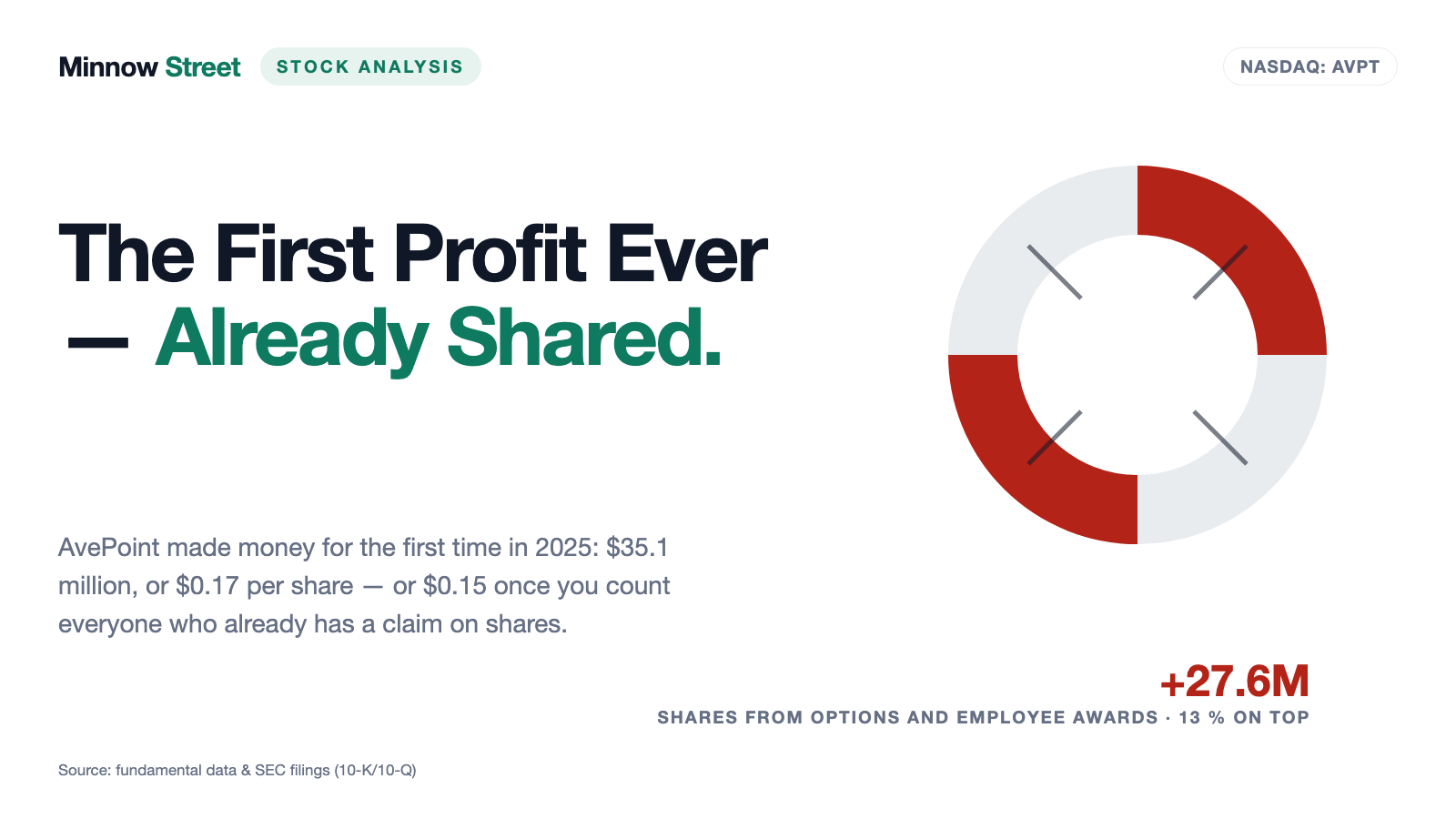
Interactive price chart (TradingView).
Note: pure fact-based analysis, not investment advice and not a solicitation to buy or sell. All figures without guarantee.
There is a moment when a switch flips in your head. Call it the threshold illusion. A company posts losses for years, and then one day the bottom line is black. Red turns to black — and it feels as if a state has changed, as if somebody finally found the lever and pulled it. That is exactly what happened at AvePoint, Inc. (Nasdaq: AVPT) in 2025: $35.1 million of net income, after a $29.1 million loss in 2024 and a $21.5 million loss in 2023. Our in-house stock scanner picked the stock up on its fundamental-rank screen on July 26, 2026. So let us make a deal: before you believe the black number, we read together what the company itself reported, under penalty of law, to the U.S. securities regulator, the SEC — the annual report (10-K) for 2025 filed February 26, 2026, and the quarterly report (10-Q) as of March 31, 2026, filed May 7, 2026. And what they describe is a fast-growing subscription business, a genuinely strong balance sheet, an accounting item from the past that makes the swing look bigger than it is — and 27.6 million shares that do not exist yet.
What AvePoint actually does — the janitor for corporate data in the cloud
Picture a company that dumped its paper archive into an open-plan office overnight. Everything is there, nothing is labeled, every door stands open, and nobody knows anymore which binder holds payroll and which holds the cafeteria menu. That is the state of many companies now that their documents, chats, recordings and spreadsheets live in cloud services. AvePoint sells the janitor for that: software that inventories the data, classifies it, controls access rights, keeps backups and restores everything when something goes wrong.
The products run under the name AvePoint Confidence Platform and reach into the large cloud ecosystems — Microsoft, Google, Salesforce, Amazon Web Services, Box and Dropbox, plus services such as Docusign, GitHub, Jira and Okta. Most of it is sold indirectly, through a two-tier channel model and through the marketplaces of the cloud providers themselves. As of December 31, 2025, AvePoint counted more than 28,000 end customers in over 100 countries, and the annual report states explicitly that no single customer represented more than 10 percent of billings or accounts receivable. Anyone who has ever looked at a software company leaning on three big accounts knows how valuable that sentence is.
The market story on top of it has been artificial intelligence for two years now — and for once it is not bolted on. The logic: turn an AI loose on your corporate data and you also multiply the damage that badly sorted or wrongly shared data can do. The annual report puts it plainly:
"In an era where trusted data is a prerequisite for AI adoption, data protection is no longer a back-office IT function, it is a strategic business imperative."
— AvePoint, Inc., SEC annual report 10-K for 2025, Item 7 "Management's Discussion and Analysis", Overview
Two facts about the company's origin are worth knowing. First, AvePoint came public through a blank-check company. Until July 21, 2021, the SEC file read Apex Technology Acquisition Corp — a shell that raises money and then goes looking for a real business. That history explains several of the line items that show up later in this analysis. Second, the stock has carried a secondary listing on the Singapore Exchange since 2025, under the symbol AVP. That is unusual for an American software vendor, and it cost $2.9 million in listing expenses in 2025 alone.
Which brings us to the central tension of this analysis, and it runs through every chapter: AvePoint's business demonstrably works — it grows fast, the balance sheet is pristine, and it now earns money. But earnings per share have to be divided by a number the company only partly controls.
Where the stock showed up in our scanner
The path ran through the fundamental-rank screen of our in-house stock scanner. That screen sorts companies by a composite fundamental score built from balance sheet quality, earning power and growth. AvePoint appears in its U.S. selection on July 26, 2026 — of 38 U.S. hits the page shows the top 25, and AvePoint is among them. One caveat so this sentence does not quietly go stale: these lists are recalculated every day. What held on July 26, 2026, can look different a week later.
More interesting than the ranking is the confluence — which other screens carry the same stock on the same day. There are four: Fallen Angels (stocks trading far below their highs but fundamentally intact), Power Trend, Pros 80 (a high share of institutional ownership) and Quality Growth. That mix already tells half the story: good company, fallen price.
Two scanner metrics deserve translation, because they carry the hook. The first is the Piotroski F-Score, a nine-point test for the health of the books: it asks whether the company is profitable, whether operating cash flow exceeds net income, whether leverage is falling and whether margins are rising. AvePoint scores 8 out of 9, which is strong. A company at 5 or 6 is mediocre; it only gets interesting from 8 upward. The second is the Altman Z-Score, an early-warning measure for insolvency. Below 1.8 is the danger zone, above 3.0 is safe. AvePoint sits at 5.63. Translated: this company is not going bankrupt any time soon.
And now the other side of the same coin. The relative strength rating, which measures price performance against the broad market, stands at 14 out of 100. The stock has lost ground against almost everything else. As of July 26, 2026, it traded roughly 39 percent below its 52-week high of $19.95 and roughly 39 percent above its low of $8.84. Remember that contradiction — it is the reason this analysis exists: the books say healthy, the price says disappointed. Both can be true if the market is pricing in something that no Piotroski formula captures.
The numbers over the years — honestly appraised
First, what genuinely impresses. And there is plenty. Revenue rose 27 percent in 2025 to $419.5 million — after $330.5 million in 2024 and $271.8 million in 2023. That is not a one-year blip but the third consecutive year of double-digit growth. More important is which revenue is growing.
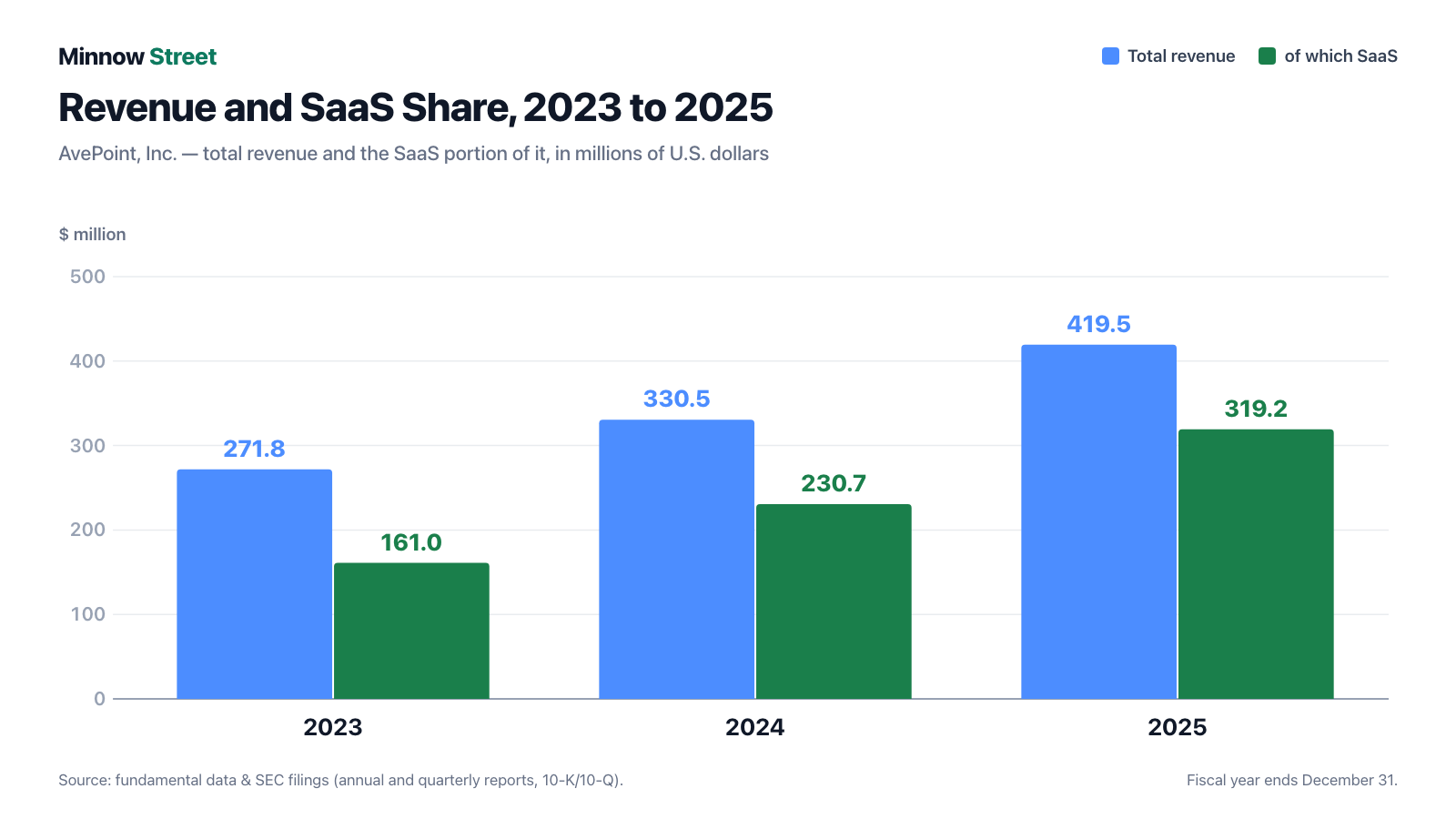
SaaS stands for software as a service — software you rent rather than buy, running on the vendor's systems. In everyday terms: not buying a washing machine, but a subscription at the laundromat. For the vendor it is the most valuable kind of revenue, because it repeats itself every year without a new sale. At AvePoint this line grew 38 percent in 2025 to $319.2 million and now accounts for 76 percent of revenue, up from 70 percent. In the first quarter of 2026 it was already 80 percent. That the old revenue lines are shrinking at the same time — maintenance on legacy licenses fell from $11.2 million to $5.1 million — is intentional and healthy.
The matching steering metric is ARR, annual recurring revenue: the annualized sum of all contracts in force on a given date. It stood at $416.8 million on December 31, 2025 (2024: $327.0 million) and at $435.2 million on March 31, 2026. In everyday terms: that is the rent already signed before the year begins.
The earnings side has turned as well. Operating income — what is left of revenue after all operating costs — went from a $15.4 million loss in 2023 to $7.2 million of income in 2024 and then to $33.0 million in 2025. Operating margin climbed from 2.2 to 7.9 percent; in the first quarter of 2026 it reached 10.9 percent, up from 3.5 percent a year earlier. Operating cash flow — the money the business actually puts in the till — was $85.3 million in 2025, or 20 percent of revenue. To be honest about it: a year earlier it was $88.9 million and 27 percent of revenue, so that ratio fell rather than rose.
And then the balance sheet that carries the fundamental hook. As of March 31, 2026, the books showed $444.1 million in cash, no debt at all, equity of $438.8 million and an undrawn $30.0 million credit line with HSBC. The order book is documented too: remaining performance obligations stood at $542.5 million, of which 59 percent is expected to convert within twelve months. In short: this is the balance sheet of a company that can buy itself time. We took apart what a cash position like that is worth at another data protection vendor — see our Rubrik analysis.
What the filings say — the uncomfortable truths
Uncomfortable truth no. 1: more than half of the swing is accounting
Now we take the threshold illusion apart. The move from a $29.1 million loss in 2024 to $35.1 million of income in 2025 is $64.2 million. Operating income improved by only $25.9 million over the same span, from $7.2 million to $33.0 million. The difference sits in a line almost nobody reads: other income (expense), net. It carried minus $31.6 million in 2024 and plus $7.5 million in 2025.
The reason lies in the blank-check past. When AvePoint merged with Apex Technology Acquisition Corp in 2021, certain legacy holders of stock and options were promised additional shares once the price crossed set thresholds — one million shares each at $12.50, $15.00 and $17.50. Promises like that are carried as a liability and remeasured at every reporting date. If the stock rises, the liability rises — and the increase lands as expense in the income statement. That is exactly what happened:
"In December 2024, the required provisions were met, leading to the issuance of 2,964,658 Company Earn-Out Shares and a payment of $0.6 million to certain holders of common stock and options. […] This resulted in a $35.8 million increase in liability recognized during the year ended December 31, 2024, recorded as other income (expense), net in the consolidated statements of income (loss)."
— AvePoint, Inc., SEC annual report 10-K for 2025, Note 13 "Company Earn-Out and Warrant Liabilities"

Read it fairly: the 2024 expense was non-cash — no money left the building, shares were issued instead. And it was triggered by the stock going up. A loss caused by your own share price rising is a strange kind of loss. But that is precisely why the reverse holds too: the 2024 loss was largely accounting, and so is a large part of the 2025 profit jump. If you want to see the operating story, look one line higher — and it says 2.2 percent margin (2024), 7.9 percent (2025), 10.9 percent (first quarter of 2026). That is a real improvement, and an unspectacular one. Remember the rule: a turnaround you can only see in the bottom line is rarely an operating turnaround.
Uncomfortable truth no. 2: the company buys shares back at the front door while new ones come in the back
Here it gets concrete for shareholders. AvePoint repurchases its own stock, and on a serious scale. In the first quarter of 2026 it bought 5,412,958 shares at an average of $11.29, or $59.8 million. For scale: operating cash flow in that same quarter was $24.3 million. The company therefore spent 2.5 times what the business produced on its own shares — funded from the cash pile, which fell from $481.1 million to $444.1 million.
Buybacks are good news for shareholders in principle: fewer pieces mean more profit per piece. At AvePoint, though, less of that survives than the headline dollar figure suggests. In the same quarter 2,190,661 new shares arrived: 581,088 from exercised options and 1,609,573 from vested employee awards. Net, the share count fell from 215,076,033 to 211,853,736 — a decline of 1.5 percent, for which $59.8 million was paid.
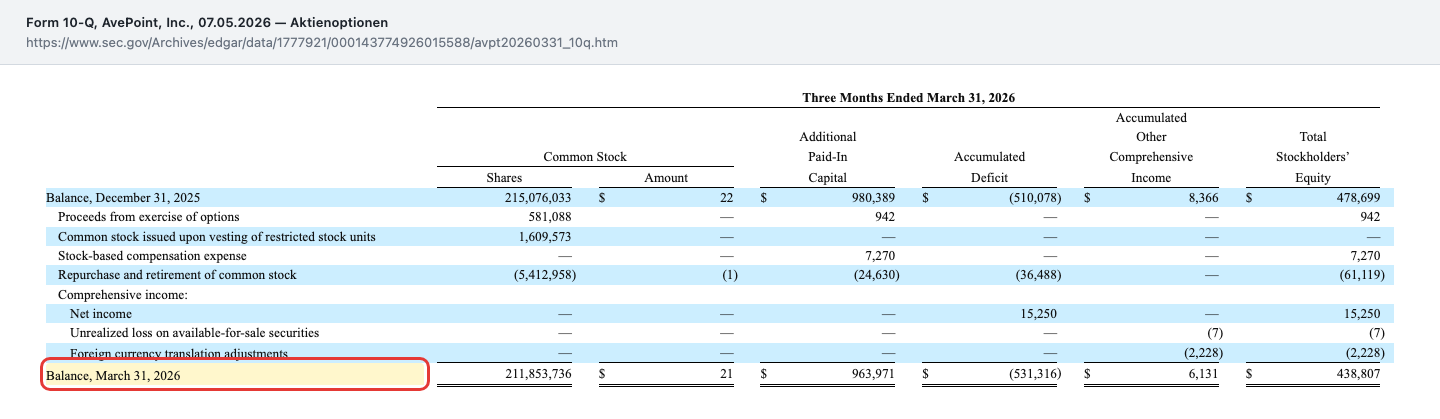
The year before, the ratio was starker still: in 2025 AvePoint repurchased 3,409,119 shares for $49.8 million — and the share count still rose that year, from 194,070,512 to 215,076,033, an increase of 21.0 million shares or 10.8 percent. The driver was warrants left over from the blank-check era, whose exercise brought the company $168.2 million of fresh cash. In fairness: that dilution was paid for. It filled the very cash pile now funding the buybacks. But it also enlarged the number of co-owners.
The forward view matters more. As of March 31, 2026, on top of the shares outstanding, further shares were already promised to employees and executives through options and equity awards:
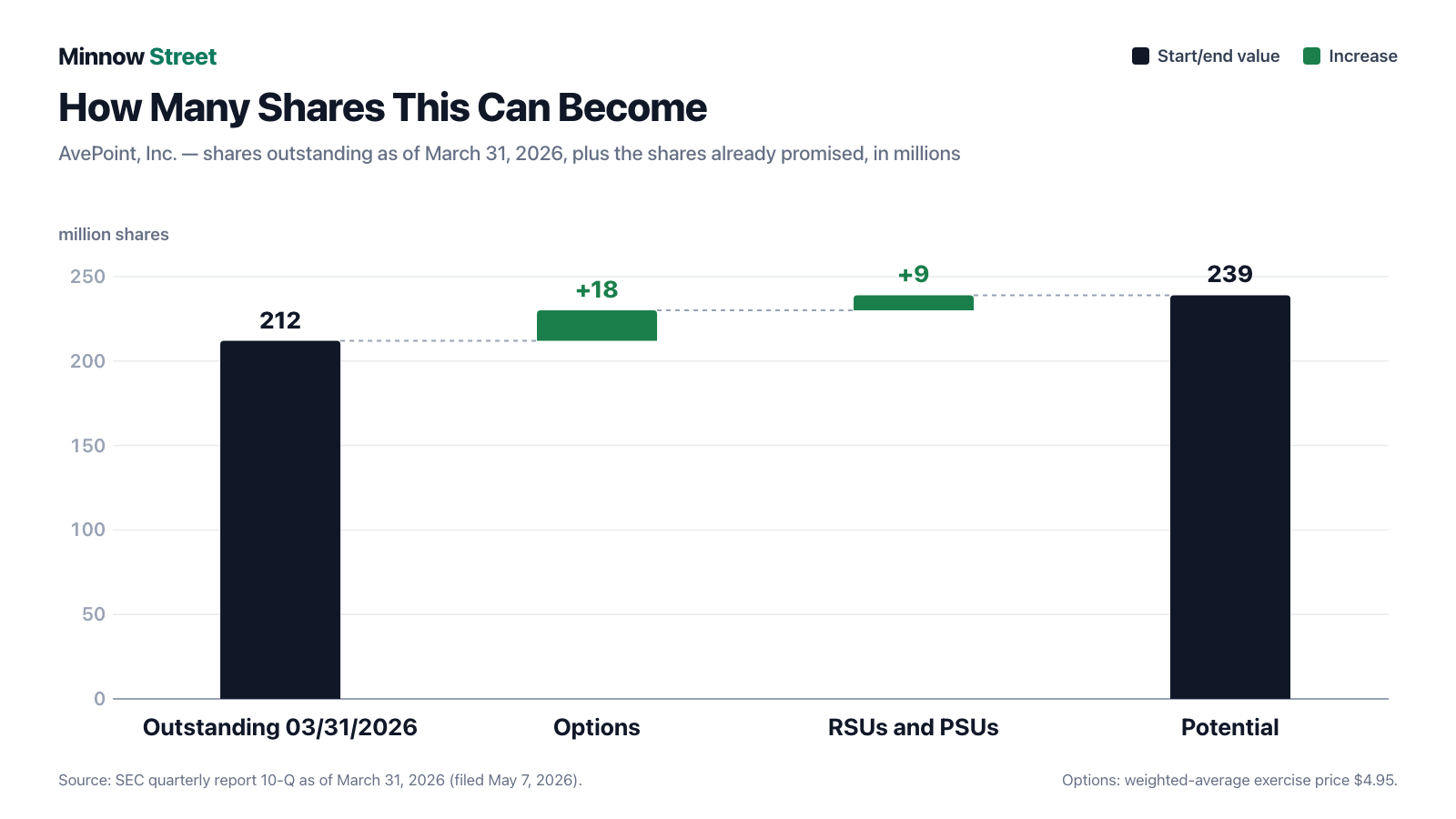
That is roughly 27.6 million additional shares, or 13 percent on top of today's count. In everyday terms: the cake has not been cut yet, but 13 percent of the slices are already spoken for. The options are the striking part: the weighted-average exercise price is $4.95, and 17,187,597 of the 18,414,381 are already exercisable, those at a weighted-average $4.62. The quarterly report itself puts their intrinsic value as of March 31, 2026 at $84.8 million, and $86.4 million across all 18,414,381 options. At the $12.24 anchor price of July 24, 2026 it would be roughly $131 million — our own calculation from the quarterly report's figures.
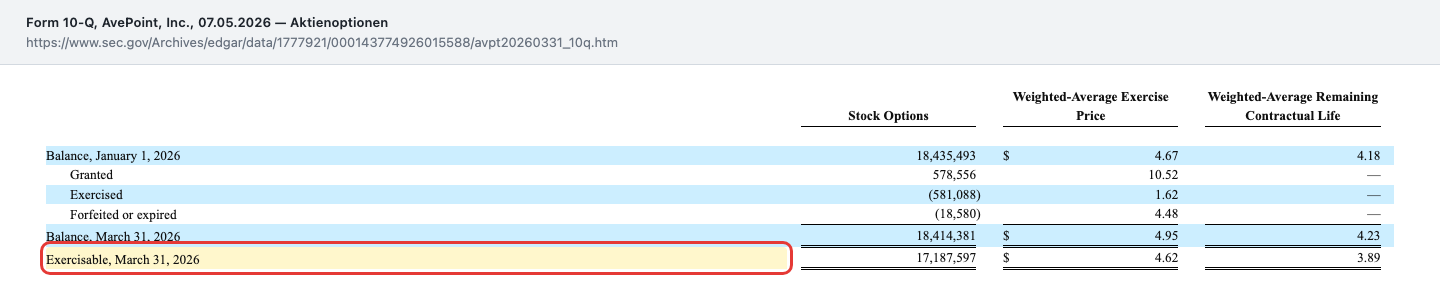
Again, the fair counterweight: exercising an option at $4.95 means paying $4.95 into the company's till — across all 18.4 million options that would be roughly $91 million. Dilution is not expropriation. It is closer to a discount: new co-owners come in at a price the old ones can no longer get. Which is why the annual report shows two earnings per share figures: $0.17 basic and $0.15 diluted, computed on 207.6 million and 229.3 million weighted-average shares for 2025. That is a 12 percent haircut created by counting alone.
Uncomfortable truth no. 3: eleven of every hundred recurring dollars disappear each year
The prettiest sentence about a subscription business is "the revenue comes back by itself." It is only partly true. In the first-quarter 2026 release, filed as an exhibit to the SEC current report 8-K dated May 7, 2026, AvePoint discloses two ratios that appear in no annual report: the dollar-based gross retention rate was 89 percent and the net retention rate 111 percent (110 percent adjusted for currency).
Translated: of $100 of recurring revenue on the books at the start of a year, $89 is still there a year later — $11 has been cancelled or downsized. That net retention is nonetheless 111 percent means the remaining customers buy enough on top to grow the base by 11 percent overall. Put together, the picture is one worth knowing: AvePoint has to replace roughly an eleventh of its base every year before growth even begins. In everyday terms: a bucket being filled faster at the top than it leaks at the bottom. It gets fuller. It also leaks.
For context, without naming peers: in enterprise software embedded deep in workflows, gross retention above 90 percent counts as solid and above 95 percent as strong. 89 percent is fine, not good. The likely reason is the customer mix: AvePoint sells a meaningful share to small and mid-sized businesses, and it sells through partners — where the bar to cancel is naturally lower than at a corporation that has tied its data governance to one platform.
Uncomfortable truth no. 4: $340 million promised to a single vendor
This passage appears in both of the latest filings and reads like administrative prose on a first pass. It is also the largest single number AvePoint has ever signed:
"In December 2025, the Company entered into a five-year agreement under which the Company committed to consume $340.0 million of eligible IT services from December 1, 2025 through November 30, 2030. The agreement includes a Year 1 minimum consumption milestone of $50.0 million, for which the vendor may invoice the Company for any shortfall as a prepayment that will be applied against future consumption."
— AvePoint, Inc., SEC annual report 10-K for 2025, Note 12 "Commitments and Contingencies"

Hold it against the company. AvePoint booked $419.5 million of revenue in 2025 on $108.8 million of total cost of revenue. The $340.0 million commitment therefore equals about 81 percent of one year of revenue and more than three times the annual cost-of-revenue block. Spread over five years it is $68 million a year — more per year than the company spent on running its entire SaaS delivery in 2025 ($57.3 million).
Two readings are possible, and both are legitimate. The friendly one: committing that much volume buys a volume discount — that is exactly why companies do it. AvePoint buys cheaper by committing early, and it backs itself to grow into the volume. The unfriendly one: the contract is a fixed cost block that does not shrink if growth slows. The minimum-payment table also shows how far the load has been pushed out: of $344.2 million of total obligations as of March 31, 2026, $290.0 million falls in 2030 alone. In the first quarter of 2026, $20.0 million was already paid against it. The number to watch is gross margin: it slipped to 72.8 percent in the first quarter of 2026, from 74.3 percent a year earlier.
Valuation — what the market pays for this turnaround
Because daily prices say nothing about the value of a business, here are the orders of magnitude with visible dates. As of July 26, 2026, market capitalization was roughly $2.6 billion — computed on 212,017,196 shares (as of May 6, 2026) and the closing price of $12.24 on July 24, 2026. Subtract the $444.1 million of cash and add the debt, of which there is none, and enterprise value is roughly $2.2 billion.
That gives three anchors. First, the price-to-sales ratio: about 5.8 on trailing twelve-month revenue of $443.7 million, and about 4.9 on enterprise value. Second, the price-to-earnings ratio: about 61 on trailing twelve-month earnings — a figure that says little in a first profitable year, because the base is so small. Third, the forward view: the company guides to 2026 revenue of $509.4 million to $515.4 million and non-GAAP operating income of $91.5 million to $94.5 million. On the midpoint of that range, price-to-sales falls to roughly 5.1, and enterprise value equals about 23 times non-GAAP operating income.
That is not a bargain valuation. It is a normal valuation for a subscription business growing north of 20 percent a year — and that is the message. The stock is not cheap because the business is bad; it got cheaper because expectations came down. A price-to-sales ratio of 5.8 stands against a 52-week high of $19.95, which implied a considerably higher multiple.
The professionals' view: eight analyst estimates produce an average price target of $16.13 as of July 26, 2026 — about 32 percent above the July 24, 2026 close. With eight estimates that is a mood reading more than a consensus; large-cap names are often followed by thirty houses. Institutions hold roughly 66 percent of the shares and insiders roughly 19 percent as of July 26, 2026, while 7 percent of the float is sold short.
Two dated anchors from mandatory filings, because they say more than any daily quote. First: the company bought its own shares in the first quarter of 2026 at an average of $12.90 in January, $10.62 in February and $10.45 in March — and it bought more shares the lower the price went: 1.60 million in January, 1.60 million in February, 2.21 million in March. Second: the company's Chief Legal Officer sold 8,369 shares at $13.00 on July 14, 2026 and 31,631 shares at $13.18 on July 15, 2026, leaving him with 819,664. That is no alarm signal — executives routinely sell part of their compensation. What is notable is the pattern running through this analysis: the company buys shares, individual insiders sell them. We described a similar revolving door at another cloud storage vendor — see our Backblaze analysis.
One last figure belongs in this chapter. Of the $150 million repurchase authorization the board renewed for three more years on February 25, 2025, $100.5 million remained on December 31, 2025 — and only $39.8 million on March 31, 2026. At the first-quarter pace, the authorization would be exhausted within two quarters. Anyone counting on the company remaining the stock's biggest buyer should look for that line in the next quarterly report.
Opportunities and risks at a glance
What speaks for AvePoint:
- The subscription business grows fast and cleanly: SaaS revenue up 38 percent in 2025 to $319.2 million, its share of total revenue up from 70 to 76 percent, and 80 percent already in the first quarter of 2026.
- Annual recurring revenue rose 27 percent in 2025 to $416.8 million and further to $435.2 million by March 31, 2026; remaining performance obligations stood at $542.5 million.
- The balance sheet is a fortress: $444.1 million of cash as of March 31, 2026, no debt, $438.8 million of equity, an undrawn $30.0 million credit line, and an Altman Z-Score of 5.63 (data as of July 26, 2026).
- No customer concentration: more than 28,000 end customers in over 100 countries as of December 31, 2025, none above 10 percent of billings; revenue splits fairly evenly across North America, EMEA and Asia-Pacific at $164.8 million, $134.3 million and $120.4 million.
- Earning power is improving measurably: operating margin from 2.2 percent (2024) to 7.9 percent (2025) and 10.9 percent in the first quarter of 2026; the company guides to non-GAAP operating income of $91.5 million to $94.5 million for 2026.
- The company buys back its own stock, and does so counter-cyclically: $59.8 million in the first quarter of 2026, with rising share counts as prices fell.
What speaks against it:
- The profit jump is largely accounting: of $64.2 million of improvement in the bottom line, only $25.9 million came from operations; 2024 carried $35.8 million of expense for earn-out shares.
- Thirteen percent of dilution sits ready: 18,414,381 options at a weighted-average $4.95 (17,187,597 of them exercisable) plus 9,160,384 unvested employee awards, against 211,853,736 shares outstanding as of March 31, 2026.
- A gross retention rate of 89 percent (quarterly release as of March 31, 2026) means roughly an eleventh of the installed base has to be replaced every year before growth starts.
- The valuation leaves little room: price-to-sales of about 5.8 and price-to-earnings of about 61 on trailing twelve months (data as of July 26, 2026).
- A $340.0 million consumption commitment through November 2030 ties the company to a single vendor; $290.0 million of it falls in 2030 per the quarterly report, and Year 1 carries a $50.0 million minimum.
- Roughly 64 percent of revenue was denominated outside the U.S. dollar in 2025, while only half of expenses are in dollars — currency moves therefore hit revenue and earnings unevenly, and the company names them explicitly as a headwind in its 2026 outlook.
- Operating cash flow fell as a share of revenue: $85.3 million or 20 percent in 2025, after $88.9 million or 27 percent in 2024.
A human conclusion
Back to the threshold illusion. Its problem is not that it leads you to bad companies — AvePoint is not a bad company. Quite the opposite: fast growth, an 80 percent subscription share, 28,000 customers without concentration risk, $444.1 million of cash and no debt. That is more substance than most stocks this size carry. The problem with the illusion is that it claims a change of state where only a line changed. The business was already profitable in 2024; the black number in 2025 arrived partly because an accounting item from the past had finally been cleared away.
So whoever buys AvePoint today is not primarily buying a turnaround. They are buying a solid, fast-growing subscription business at 5.8 times revenue — and buying it together with 27.6 million shares still allowed to come into existence and a $340 million promise to a single vendor. None of it is hidden, none of it is improper, and none of it makes the company bad. It just all lives in footnotes, and nobody reads footnotes when the bottom line is black.
The honest question for you is therefore not "does AvePoint make money now?" but: is the business growing fast enough that earnings per share rise even though the cake is cut into more slices — and even though 11 of every 100 base dollars have to be replaced each year? If your answer is a reasoned yes, every quarterly report hands you three checkpoints: the diluted share count, the gross retention rate and the operating margin. If you have no yes, what you had was a black number. What you make of it is your decision. And that is exactly as it should be.
Sources
Every original document used in this analysis, so you can read it yourself:
- AvePoint, Inc. — SEC quarterly report 10-Q as of March 31, 2026 (filed May 7, 2026)
- AvePoint, Inc. — SEC annual report 10-K for 2025 (filed February 26, 2026)
- AvePoint, Inc. — SEC annual report 10-K for 2024 (filed February 28, 2025)
- AvePoint, Inc. — First-quarter 2026 release, Exhibit 99.1 to the SEC current report 8-K dated May 7, 2026 (ARR, retention rates, 2026 outlook)
- Insider filings (Form 4) dated July 16, 2026, and the notices of proposed sale (Form 144) dated July 14 and 15, 2026: EDGAR filing history for CIK 0001777921 (sec.gov)
- Fundamental data (metrics, valuation, ownership; data as of July 26, 2026), reconciled against the SEC filings.
- Scanner screens: our in-house stock scanner, as of July 26, 2026; the lists are recalculated every day.
Transparency & disclaimer: this analysis is a journalistic contextualization of publicly available information. It is not investment advice, not a regulated financial analysis and not a solicitation to buy or sell securities. Equity investments carry substantial risk up to total loss. All figures without warranty; the as-of date is noted in the text. The author holds no position in AvePoint shares at the time of publication.
Our Bottom Line at a Glance
- Business model and growth positive
- Revenue rose 27 percent in 2025 to $419.5 million, the SaaS share went from 70 to 76 percent and reached 80 percent in the first quarter of 2026. Annual recurring revenue hit $435.2 million on March 31, 2026. More than 28,000 customers in over 100 countries, none above 10 percent of billings — a business without concentration risk.
- Balance sheet positive
- As of March 31, 2026 the books carried $444.1 million of cash without a dollar of debt, plus $438.8 million of equity and an undrawn $30.0 million credit line. An Altman Z-Score of 5.63 and a Piotroski F-Score of 8 out of 9 (data as of July 26, 2026) describe exactly that position.
- Quality of the profit swing neutral
- Of the $64.2 million improvement in the bottom line between 2024 and 2025, only $25.9 million came from operations. The rest sits in other income (expense), net, which carried $35.8 million of expense in 2024 for earn-out shares from the blank-check era. Operationally the margin does improve, but unspectacularly: 2.2 percent (2024), 7.9 percent (2025), 10.9 percent (Q1 2026).
- Dilution negative
- As of March 31, 2026, 18,414,381 options were outstanding at a weighted-average $4.95, 17,187,597 of them immediately exercisable, plus 9,160,384 unvested employee awards — roughly 13 percent on top of 211,853,736 shares. That cuts 2025 earnings per share from $0.17 to $0.15. In 2025 the share count rose 10.8 percent despite $49.8 million of buybacks.
- Customer retention neutral
- Gross retention stood at 89 percent as of March 31, 2026: roughly eleven of every hundred base dollars have to be replaced each year before growth begins. Net retention of 111 percent shows the remaining customers more than make up for it — but 89 percent gross is fine, not good, for enterprise software.
- Valuation and commitments neutral
- As of July 26, 2026 the stock trades at about 5.8 times trailing revenue and 61 times trailing earnings; on the company's own 2026 outlook, price-to-sales falls to roughly 5.1. On top of that sits a $340.0 million consumption commitment through November 2030, of which $290.0 million only falls due in 2030.
AvePoint is not a turnaround but a business that already worked, whose bottom line in 2025 finally shows what began operationally in 2024. In its favor: $419.5 million of revenue (+27 percent), a 76 percent subscription share, $435.2 million of annual recurring revenue as of March 31, 2026, $444.1 million of cash without debt, and a customer base with no concentration risk. Against it: 27.6 million shares still allowed to emerge from options and employee programs, a gross retention rate of 89 percent, a $340.0 million consumption commitment running to 2030, and a price-to-sales ratio of about 5.8. Whoever buys here buys quality at a price that presumes growth. Not investment advice.
What Our Rating Means
Quality confirmed
Business model, numbers and balance sheet hold up to our review. Whether the current price supports an entry is a separate question — it hangs on the price, not on the company.
The business demonstrably carries itself: $419.5 million of revenue in 2025 with 27 percent growth, 76 percent of it recurring, $85.3 million of operating cash flow, and more than 28,000 customers without a single one above 10 percent of billings. As of March 31, 2026 the balance sheet is debt-free, with $444.1 million of cash and $438.8 million of equity. There is no going-concern flag, no interest burden, no accounting or governance breach. The open questions this analysis names — the 13 percent of potential dilution, the 89 percent gross retention rate and the $340.0 million consumption commitment running to 2030 — concern how the profit is divided and what the cost base will look like, not the substance of the company. Hence green: quality on the record, paid for dearly. The decision is yours.
A journalistic assessment by our editorial team at the time of the deep dive, based on public sources — not investment advice and not a solicitation to buy or sell. Your personal circumstances (investment goals, risk capacity, taxes) cannot be taken into account. What our levels mean, how verdicts are formed, and what conflicts of interest exist →
Worth Noting
- AvePoint reached our research list through the fundamental-rank screen of our in-house stock scanner (fundamental score 59, Piotroski 8 of 9, Altman Z of 5.63; as of July 26, 2026). On the same day the stock also appeared on the Fallen Angels, Power Trend, Pros 80 and Quality Growth screens. These lists are recalculated every day.
- Possible confusion: the SEC file under CIK 1777921 was named Apex Technology Acquisition Corp until July 21, 2021 — the blank-check company through which AvePoint went public. Older documents under that name concern the same entity. The stock also carries a secondary listing on the Singapore Exchange (symbol AVP); prices and volumes on the two venues are not identical.
- Valuation figures are dated and evergreen: the $12.24 anchor is the closing price on July 24, 2026 (data as of July 26, 2026). For comparison, mandatory filings document the company's own repurchases at an average $10.45 in March 2026 and insider sales at $13.00 on July 14 and $13.18 on July 15, 2026. Analyses are evergreen; daily prices are not a buy argument.
Frequently Asked Questions
AvePoint, Inc. (Nasdaq: AVPT), headquartered in Jersey City, New Jersey, sells software that lets companies secure, govern and restore their data inside cloud services — above all Microsoft 365, Google Workspace, Salesforce and Amazon Web Services. The products run under the name AvePoint Confidence Platform. As of December 31, 2025, more than 28,000 customers in over 100 countries used the platform; 2025 revenue was $419.5 million.
Yes. Net income was $35.1 million in 2025, after a $29.1 million loss in 2024 and a $21.5 million loss in 2023. Context matters: operating income was already positive in 2024 at $7.2 million. That year's loss came mainly from an earn-out obligation left over from the blank-check merger, which produced $35.8 million of expense without any cash leaving the company.
As of March 31, 2026, 211,853,736 shares were outstanding. On top of that sit 18,414,381 options at a weighted-average exercise price of $4.95 — 17,187,597 of them immediately exercisable — plus 9,160,384 unvested employee share awards. Together that is roughly 27.6 million additional shares, or 13 percent. The 2025 annual report therefore shows $0.17 of basic earnings per share but only $0.15 diluted.
Yes, substantially. In the first quarter of 2026 the company acquired 5,412,958 shares at an average of $11.29, or $59.8 million — 2.5 times the $24.3 million of operating cash flow in the same quarter. Of the $150 million repurchase authorization, renewed on February 25, 2025 for three more years, $39.8 million remained on March 31, 2026.
Very solid. As of March 31, 2026 the books showed $444.1 million of cash, no debt at all, $438.8 million of equity and total assets of $734.2 million. A $30.0 million credit line with HSBC was undrawn. The Piotroski F-Score, a nine-point test for the health of the books, stands at 8 out of 9 (data as of July 26, 2026).
It says how much of the existing recurring revenue is still there a year later, before counting upsells to the same customers. Of $100 on AvePoint's books, $89 remains; $11 is cancelled or downsized. Because the remaining customers expand, net retention as of March 31, 2026 was still 111 percent. In enterprise software, gross retention above 90 percent counts as solid.
In December 2025 the company signed a five-year agreement to consume $340.0 million of eligible IT services through November 30, 2030 — typically the way to lock in volume discounts on cloud infrastructure. Year 1 carries a minimum consumption milestone of $50.0 million. For scale: total 2025 revenue was $419.5 million and total cost of revenue $108.8 million.
Partly. AI is not the technology AvePoint sells but the reason customers buy: turn an AI loose on badly sorted corporate data and you magnify the damage. The 2025 annual report lists its own use cases such as AI Confidence and Readiness and Agentic AI Governance as part of the platform it sells. The company earns money from the order AI requires, not from models themselves.
Found an error?
Did you spot a factual error, an outdated number, or a typo in this deep dive? Let us know briefly — your report goes straight to the editorial team.