Hamilton Insurance Group: The Second Engine Is Five Times Bigger — and Keeps Almost Half for Itself
The label says insurer. And Hamilton Insurance Group delivers as one: the combined ratio came in at 92.9 percent in 2025, and book value per share climbed from $18.58 to $28.50 in two years. The profit, though, mostly comes from somewhere else. Hamilton earned $148.8 million from underwriting in 2025 — and $775.1 million from investments, largely from a hedge fund run by its partner Two Sigma. Of that fund's $564.3 million of income, $263.4 million went to the manager as an incentive allocation. The commitment to that partner was rewritten effective April 1, 2026. Not investment advice — just the question of who really owns the second engine.
 Thomas Mücke
Founder & Publisher
Thomas Mücke
Founder & Publisher
Chart
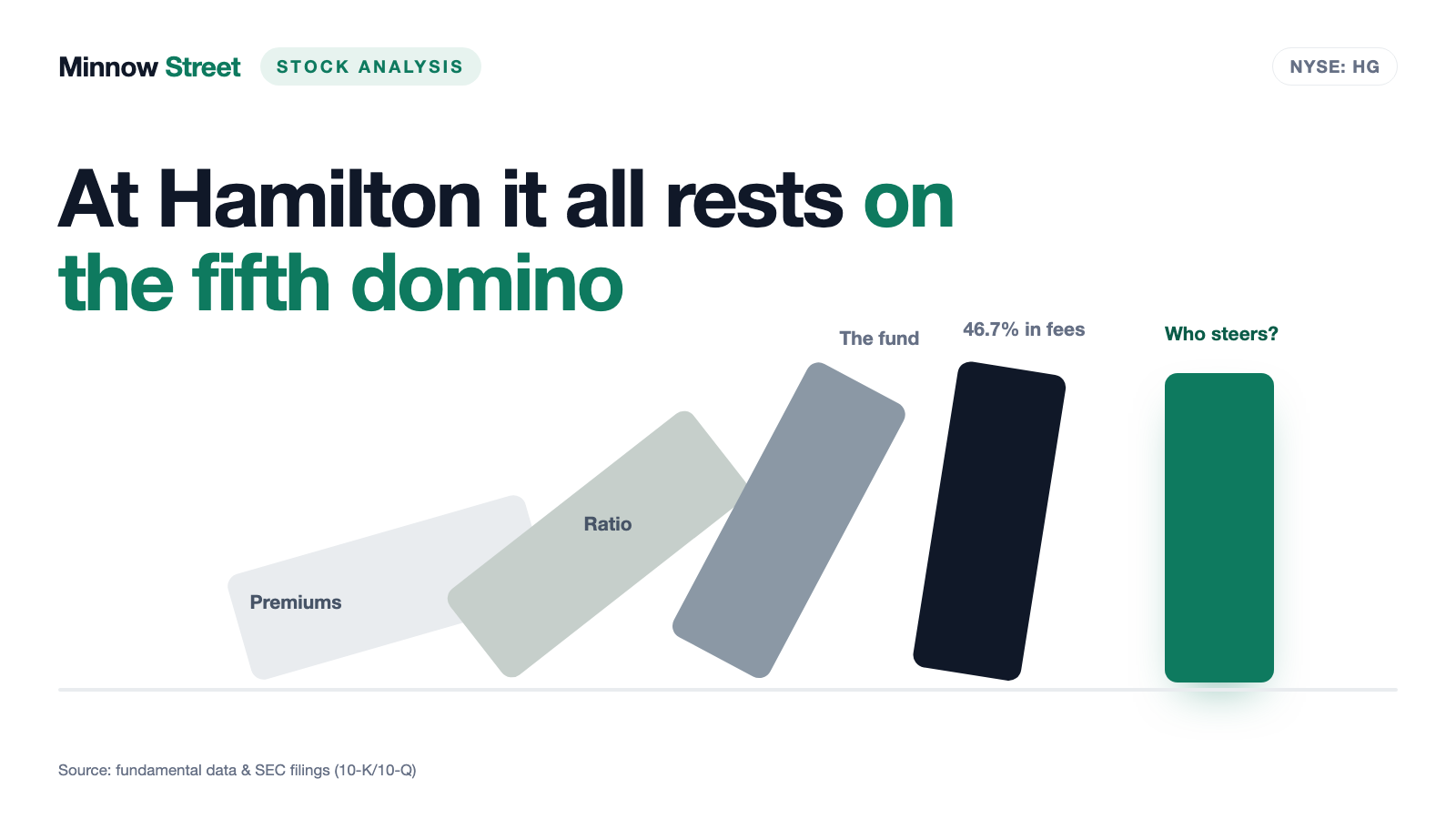
Interactive price chart (TradingView).
Note: pure fact-based analysis, not investment advice and not a solicitation to buy or sell. All figures without guarantee.
There is an investing trap that springs shut before you have read a single number. Call it the label trap. It works like this: a company carries one word — "insurer", "software house", "brewery" — and your brain instantly attaches a whole package of expectations. For "insurer" the package reads: premiums in, claims out, a bond portfolio in the basement, dull and dependable. What the package leaves out is the question of where the profit actually comes from. At Hamilton Insurance Group (NYSE: HG), a specialty insurer and reinsurer based in Bermuda, a large share of it comes from a hedge fund run by somebody else. The stock landed at rank 35 in our in-house Big Earnings Surprise ranking (U.S. selection with 81 hits, as of July 25, 2026). So let us make a deal: before you file a 22.4 percent return on equity under underwriting skill, we open the hood together — using the annual report on Form 10-K for 2025 and the quarterly report on Form 10-Q as of March 31, 2026, both filed with the U.S. securities regulator, the SEC, and both signed under penalty of perjury. What you do with it is your call.
What Hamilton Insurance Group actually does — Bermuda, Lloyd's and a fund
Hamilton insures the things a standard policy cannot handle: a cargo vessel, a power plant, an art collection, the liability of a U.S. corporation — and it reinsures other insurers, taking part of their risk in exchange for part of their premium. That runs through three platforms. Hamilton Global Specialty underwrites through Lloyd's Syndicate 4000 in London and the Irish subsidiary HIDAC; the annual report says Syndicate 4000 has ranked among the most profitable and least volatile syndicates at Lloyd's over the last ten years. Hamilton Select is the U.S. excess and surplus carrier writing hard-to-place casualty cover for small and mid-sized accounts. And Hamilton Re in Bermuda is the reinsurance arm.
The company reports two segments: International (52 percent of 2025 gross premiums written — London, Dublin and the U.S. operations) and Bermuda (48 percent). Hamilton was founded in Bermuda in 2013, acquired the Lloyd's business in 2019, listed on the New York Stock Exchange on November 13, 2023, and was upgraded to an "A" financial strength rating by AM Best in April 2024. As of December 31, 2025 it employed more than 600 people. Chief executive Pina Albo brings more than 30 years of industry experience and previously sat on the Board of Executive Management of Munich Re, according to the annual report. The fiscal year is the calendar year — no shifted year end, no trap.
And then there is the fourth thing, the one no label mentions. Hamilton owns a dedicated fund, the TS Hamilton Fund, managed by Two Sigma — a quantitative investment firm founded in 2001 with roughly $77 billion under management across affiliates and more than 1,700 employees. The fund trades equity and macro strategies through seven vehicles, allocated roughly 70 percent to equities and 30 percent to macro. The annual report states the size:
"As of December 31, 2025, Two Sigma manages $2.2 billion, or 37%, of our total invested assets, via our investment in the TS Hamilton Fund."
— Hamilton Insurance Group, Form 10-K for 2025, Item 1 (Business)
That sets the central tension of this analysis, and it runs through every chapter: Hamilton is a capable underwriter — but the profit lever sits with a partner it neither steers nor can replace, and that partner keeps almost half of every dollar the fund earns.
Where the stock came across our desk
Hamilton Insurance Group sits at rank 35 in the U.S. selection of our in-house stock scanner for large earnings surprises (81 hits, as of July 25, 2026), with a relative strength rating of 74 out of 100. To repeat it yourself: open the Big Earnings Surprise screen, filter to the U.S. selection and read the ranking from the top — the lists are recalculated daily, so today's rank is not tomorrow's.
The filter looks for companies whose reported earnings per share came in well above the analyst consensus. At Hamilton the streak is long: five consecutive quarters above expectations. On May 7, 2025 the result beat the estimate by 126.5 percent, on August 6, 2025 by 44.9 percent, on November 4, 2025 by 79.1 percent, on February 19, 2026 by 96.4 percent and on April 30, 2026 by 45.1 percent. Data as of July 24, 2026. One caveat: consensus series like this run on their own adjusted basis. The quarterly report itself shows diluted earnings of $1.31 per share for the first quarter of 2026 (prior-year quarter: $0.77). What the scanner measures is the distance from the estimate, not the level.
Now the assessment, because naming a metric is not judging it. An earnings surprise measures how wrong the analysts were — not how good the business is. At a reinsurer it very often measures two entirely different things: the weather and the capital markets. Analysts pencil in an average catastrophe load and an average fund return for a quarter; if both storms fail to arrive, earnings beat the estimate without a single contract being priced any better. Remember this one: at Hamilton, an earnings surprise is to a large degree a report on how the fund did.
The numbers over the years — credit where it is due
First the part that genuinely impresses, and there is plenty. Hamilton has turned itself from a fixer-upper into a profitable underwriter in four years. The combined ratio — the central insurance metric, showing how much of every $100 of premium goes out for claims and expenses — was 106.0 percent in the fiscal year ended November 2021 and 102.8 percent in 2022. Both above 100, so an underwriting loss. Then the turn: 90.1 percent (2023), 91.3 (2024), 92.9 percent (2025). Keep the rule of thumb: below 100 an insurer earns money by insuring, above 100 it only earns money in the markets.
Premium grew hard alongside. Gross premiums written rose from $1,446.6 million (fiscal year ended November 2021) through $1,646.7 million (2022), $1,951.0 million (2023) and $2,422.6 million (2024) to $2,923.1 million in 2025 — roughly double in four years. Net income attributable to common shareholders swung from a loss of $98.0 million in 2022 to a profit of $258.7 million (2023), $400.4 million (2024) and $576.7 million (2025). Diluted earnings per share: $2.44, $3.67, $5.55. Return on average common equity: 13.9 percent, 18.3, 22.4 percent.
And the most honest progress gauge for any insurer, book value per share — how much substance stands behind each unit you own — climbed from $16.14 (2022) through $18.58 (2023) and $22.95 (2024) to $28.50 at December 31, 2025. That is 53 percent in two years, and part of it comes from a shrinking share count: from 110,225,103 shares at the end of 2023 to 99,029,434 at the end of 2025. Fewer slices of the same cake means a bigger slice each.
The first quarter of 2026 reads strong too: gross premiums written $940.1 million after $843.3 million, combined ratio 89.8 percent after 111.6 percent, underwriting income of $57.6 million after a loss of $58.3 million, and net income attributable to common shareholders of $133.5 million after $80.9 million. All of it real, audited or reviewed, and readable in an SEC filing.
What the filings say — the uncomfortable truths
Now we turn each of those numbers over.
Uncomfortable truth no. 1: the second engine is five times stronger than the first
Every insurer has two sources of earnings. First, underwriting income: premium minus claims minus expenses — the craft. Second, the investment result: premiums arrive today, claims are paid over years, and the money in between goes to work. At most insurers the investment result is a solid bond portfolio that rounds things out. At Hamilton it is the main event.
The figures from the annual report, by calendar year: underwriting income $129.9 million / $149.4 million / $148.8 million (2023 / 2024 / 2025). Investment result over the same period: $240.1 million / $574.7 million / $775.1 million. In 2025 the second engine was 5.2 times the size of the first. And it is not only larger, it is the more volatile one: underwriting income moved between $129.9 million and $149.4 million over three years, while the investment result tripled.
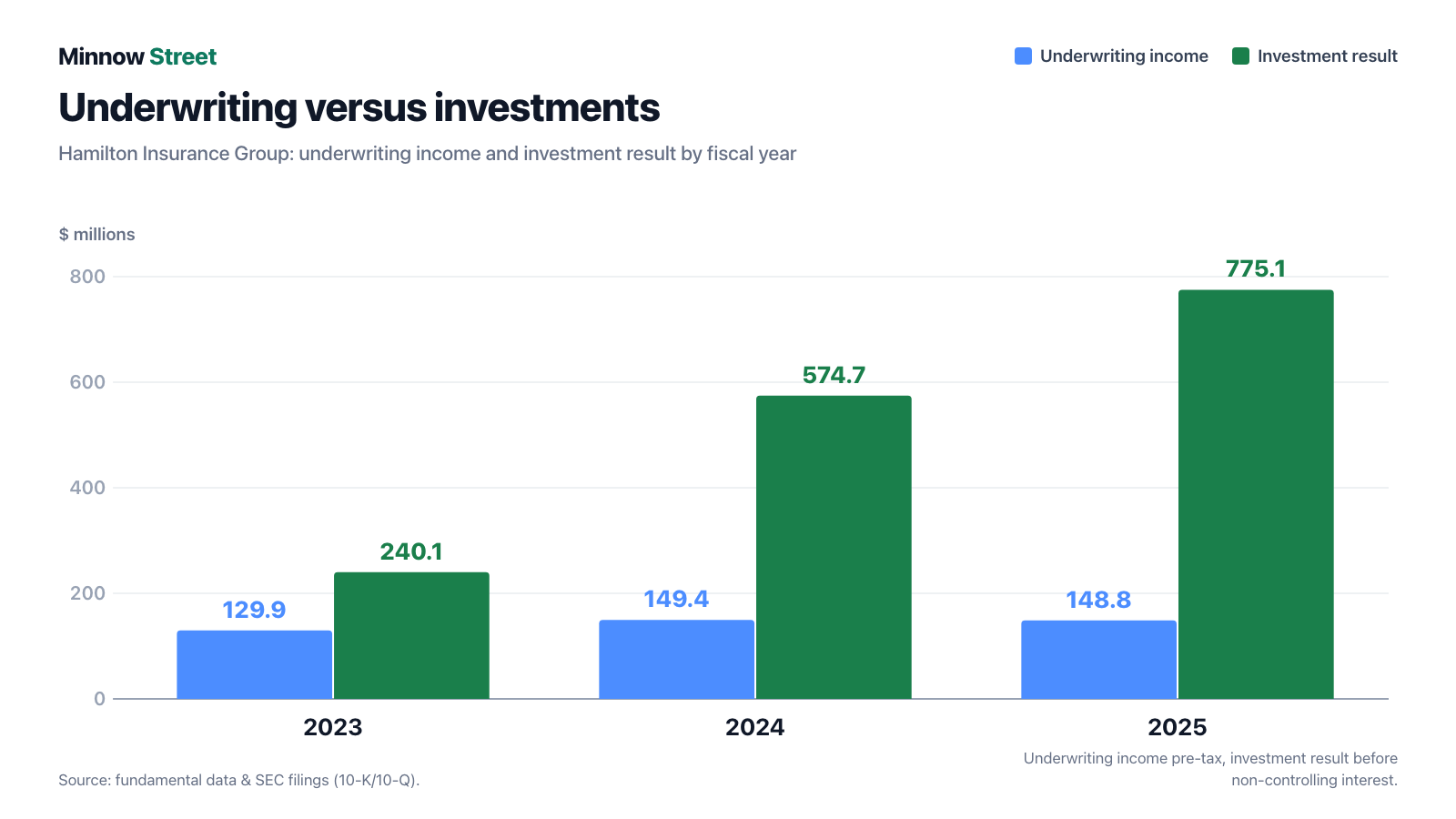
What does that mean for you? The 22.4 percent return on equity in 2025 is not an underwriting result. It is largely a hedge fund result sitting inside an insurance balance sheet. And a hedge fund result cannot be extrapolated the way a premium line can.
Uncomfortable truth no. 2: the manager keeps almost half of every dollar the fund earns
Here is the calculation that sits in the annual report and rarely gets quoted. The TS Hamilton Fund produced $564.3 million of income in 2025 — and that figure is already net of the $52.6 million management fee. Of it, $263.4 million went to the Managing Member, the Two Sigma side, as an incentive allocation. That is 46.7 percent. Hamilton kept $300.9 million. The year before looked similar: $487.2 million of income, $212.7 million of incentive allocation — 43.7 percent. And in the first quarter of 2026: $176.6 million of income, $83.5 million of incentive allocation — 47.3 percent.
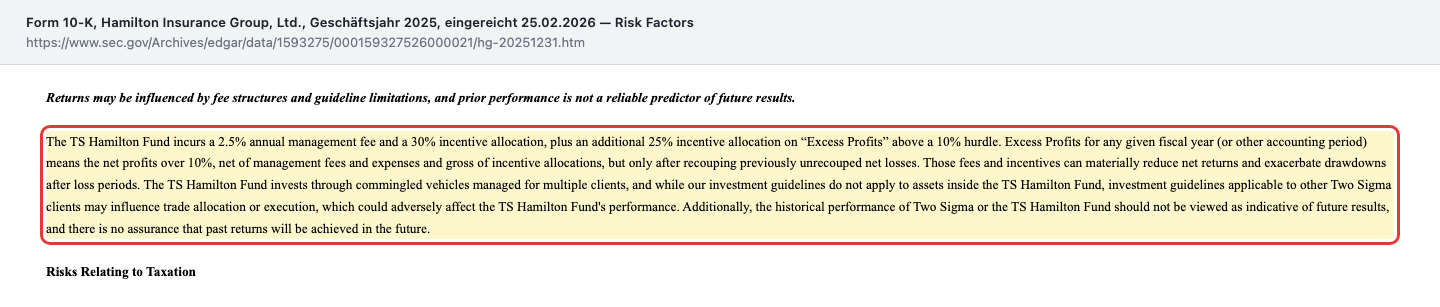
Why so much? Because the fee structure has three floors. The annual report spells it out in its own risk factors:
"The TS Hamilton Fund incurs a 2.5% annual management fee and a 30% incentive allocation, plus an additional 25% incentive allocation on 'Excess Profits' above a 10% hurdle."
— Hamilton Insurance Group, Form 10-K for 2025, Item 1A (Risk Factors)
In everyday terms: you rent your car to your neighbor, he drives it as a cab and brings you the money — but keeps half the fare plus a monthly fee for holding the wheel. It can still pay off, because he drives better than you do. It is simply a different business from "I drive it myself".
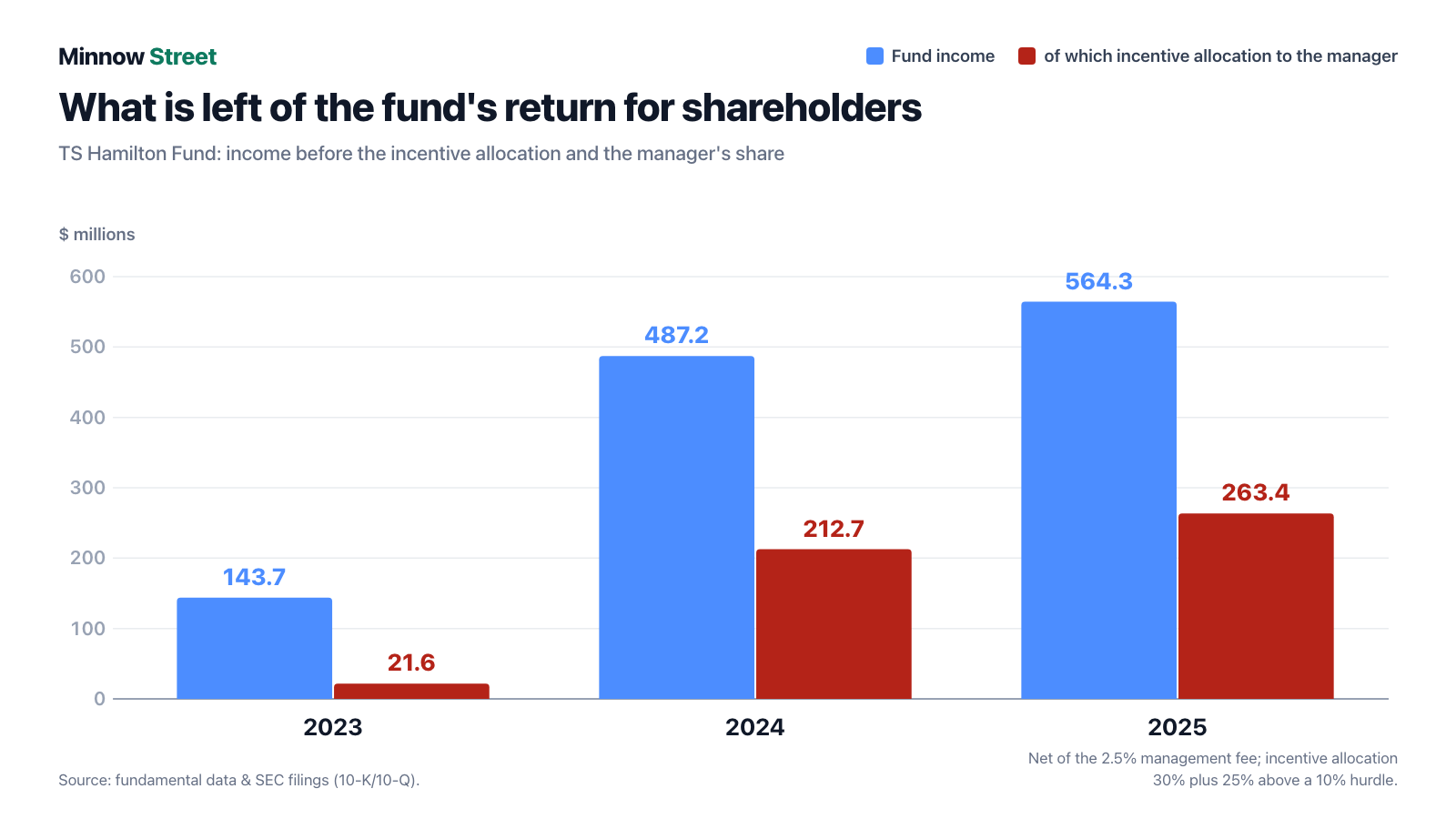
Fairness requires the other side of the ledger: the fund delivered. After management fee and incentive allocation, the return was 16.0 percent in 2025, 16.3 percent in 2024 and 7.6 percent in 2023 — those are the numbers that reached Hamilton, not gross figures. In the first quarter of 2026 it was 4.3 percent after 5.5 percent a year earlier. Compare that net return with a bond portfolio and you understand why Hamilton keeps the arrangement.
Uncomfortable truth no. 3: Hamilton describes the governance fight at Two Sigma itself — and still cannot get out
A partner who keeps almost half the income is a pricing question. A partner you cannot replace is a power question. The 2025 annual report becomes remarkably candid here:
"In recent years there have been a variety of management and governance challenges at Two Sigma and the management committee of Two Sigma's general partner has been unable to reach agreement on a number of topics including corporate governance and oversight matters, as well as the definition of roles, authorities, responsibilities and/or compensation for a range of C-level officers."
— Hamilton Insurance Group, Form 10-K for 2025, Item 1A (Risk Factors)
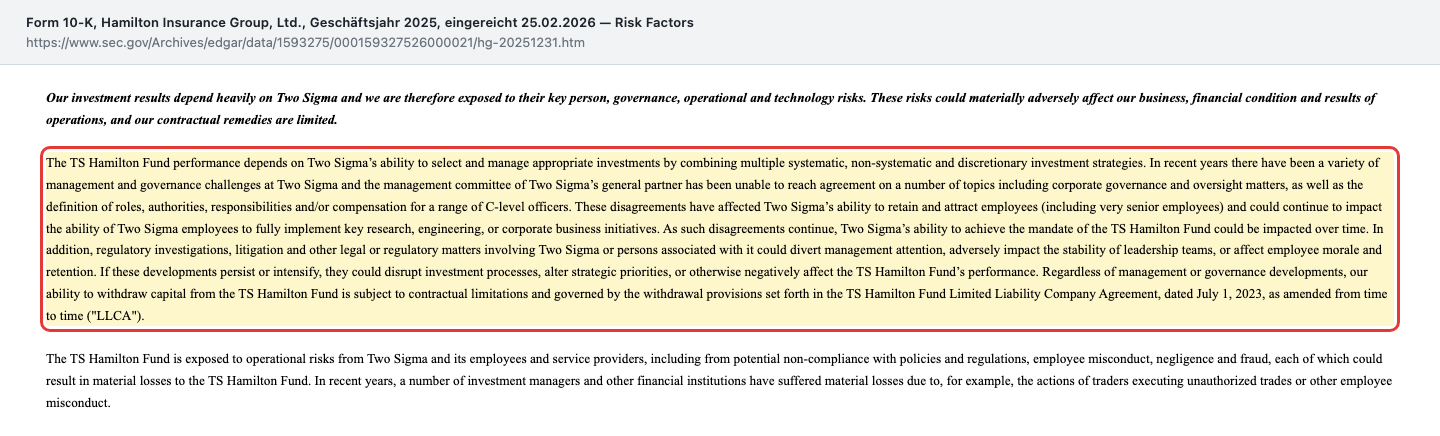
The same section states the consequence: Hamilton controls neither the fund's investment strategy nor its day-to-day operations, has only limited rights to withdraw capital above the minimum commitment, and cannot remove the Managing Member. The minimum commitment is not a footnote either: it is the lesser of $1.8 billion or 60 percent of the group's net tangible assets — roughly two thirds of the $2.72 billion of shareholders' equity reported on March 31, 2026. Capital below that threshold can generally be withdrawn only in extraordinary circumstances, such as severe operating liquidity distress, to prevent an adverse AM Best rating action, or to comply with a Bermuda Monetary Authority directive.
On April 1, 2026 that commitment was rewritten. The quarterly report as of March 31, 2026 discloses it under subsequent events:
"The Investment Agreement amends or eliminates, among other things, minimum commitment provisions, rolling commitment periods, withdrawal mechanics and certain withdrawal rights that were included in the Prior Commitment Agreement."
— Hamilton Insurance Group, Form 10-Q as of March 31, 2026, Note 12 (Subsequent Events)
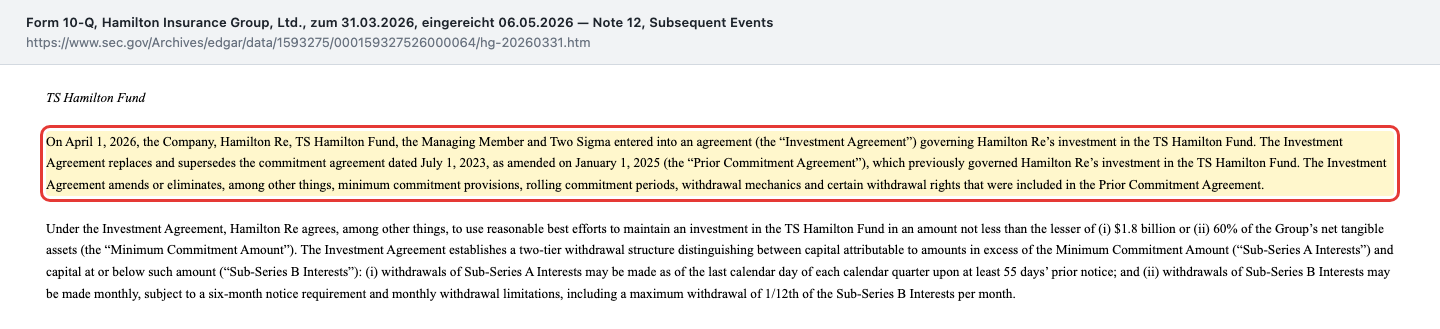
Work the arithmetic: a maximum of one twelfth per month, plus six months' notice, means the committed portion could not be fully freed for at least a year and a half. The agreement took effect one day after the balance sheet date — the second quarter 2026 report is the first to show the fund position under the new rules.
Uncomfortable truth no. 4: the record quarter had zero catastrophe losses — and reserves turned
The 89.8 percent combined ratio in the first quarter of 2026 is a strong number. It rests on an unusual condition: catastrophe losses were zero. No storm, no fire, no earthquake in the accounts, for either the current or prior accident years. In the prior-year quarter the figure was $159.7 million from the California wildfires. For scale: catastrophe losses totalled $159.0 million in full-year 2025 and $87.6 million in 2024 — in each case more than two thirds of the entire year's underwriting income. A quarter without a single catastrophe loss is an exception at a global reinsurer, not a starting point.
Then there is the second line. Insurers set aside reserves for claims that are reported but unpaid — and for claims they do not yet know about. Every quarter the estimate is revisited. If it comes down, the filing calls the development favorable and earnings rise; if it goes up, the development is adverse. Hamilton advertises in its annual report that its reserving approach "has resulted in reserve releases … every year since our inception". In the first quarter of 2026 the sign flipped: prior-year development cost 2.4 percent of net premiums earned, against a 2.9 percent benefit a year earlier — a swing of 5.3 percentage points. The reason is in the filing: new loss information on the Baltimore Bridge collapse.
On its own that is no disaster — $13.9 million against $570.5 million of net premiums earned in the quarter. It gets interesting next to the full-year figure. In 2025 the bottom line showed $64.9 million of favorable development, but it was built from $65.5 million favorable on property contracts and $27.7 million adverse on casualty contracts, the latter driven, per the filing, by discontinued lines of business and additional information on certain large losses. Casualty claims take years to surface. When a house with a growing casualty book — first-quarter 2026 gross premium growth in the Bermuda segment came mainly from casualty reinsurance — already has to top up in that line, that is the number to watch.
And then the same report carries a third sentence that has no number attached at all. Under subsequent events it reads:
"The Company continues to monitor the ongoing uncertainty surrounding the conflict in the Middle East, which commenced on February 28, 2026, and will continue to assess the impact of these events on its loss estimates and financial statements."
— Hamilton Insurance Group, Form 10-Q as of March 31, 2026, Note 12 (Subsequent Events)
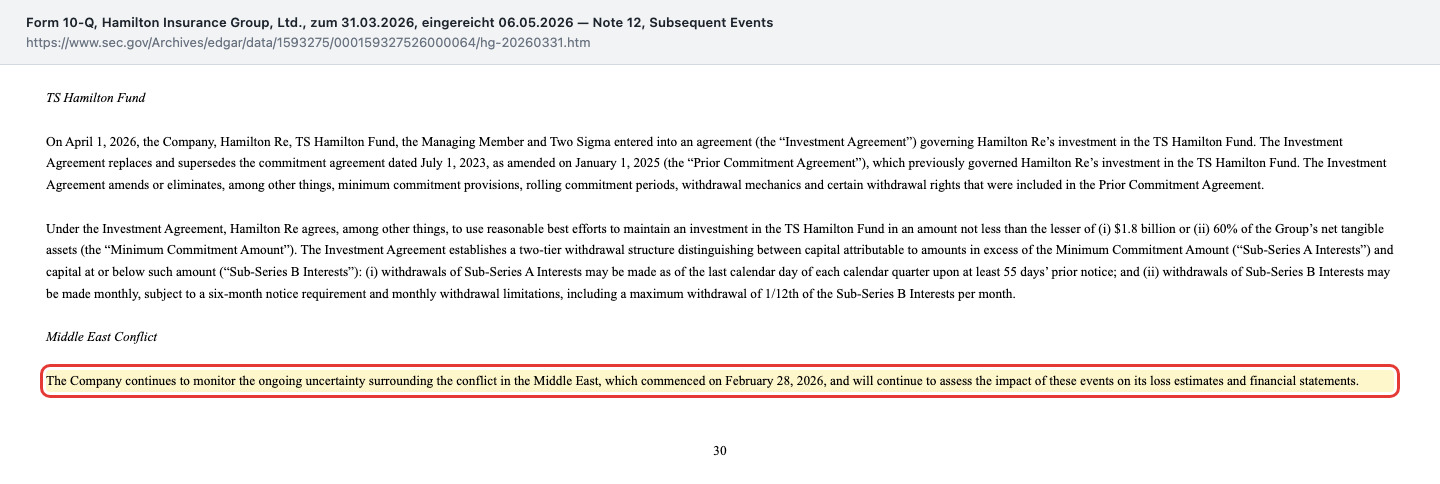
For a house that underwrites marine, energy and specialty risks, that is an open position without an amount. Together with the missing catastrophe losses it makes the first quarter of 2026 a poor base for extrapolation — the test comes with the next quarterly report.
Uncomfortable truth no. 5: buying HG means buying the smaller of three classes
Only the Class B common shares trade on the New York Stock Exchange: 66,532,272 of them as of April 30, 2026. Total shares outstanding on March 31, 2026, however, were 99,273,252 — the rest split between Class A (17,320,078 as of the annual meeting record date of March 17, 2026) and the non-voting Class C (15,403,649 as of December 31, 2025). There is no public market for Class A or Class C. On top of that comes a Bermuda quirk: each holder of Class A or Class B shares may vote at most 9.5 percent of total combined voting power, however many shares they hold — and the board may cut voting rights further at its discretion to avoid adverse tax, legal or regulatory consequences.
Two practical consequences. First, every per-share metric — book value, earnings, market capitalization — has to be computed against the total share count, not the listed class; using 66.5 million instead of 99.3 million inflates any per-share figure by roughly half. Second, Class C shares can be redesignated as Class B on request: 4.0 million shares in 2025 and 7.9 million in 2024. Every conversion enlarges the tradable float.
Valuation — what the market is paying today
Market capitalization stood at roughly $3.59 billion (data as of July 24, 2026). Against book value per share of $27.42 (March 31, 2026) that is a price-to-book ratio of about 1.3. Against trailing twelve-month earnings of $6.31 per share it is a price-to-earnings ratio of around 5.7. A single-digit earnings multiple looks cheap — until you ask what those earnings are made of. Profit that comes largely from a hedge fund returning 16 percent a year simply deserves a different multiple from profit that comes from recurring premiums. The market clearly knows this: it pays a moderate premium on book value and almost nothing on earnings.
The professional view: six analyst houses cover the stock — one "strong buy", three "buy", two "hold" — with an average target price of $35.86 (data as of July 24, 2026). What stands out is not the rating but the level: the target sits practically at the top of the 52-week range of $19.62 to $36.28. On the houses' own numbers, the re-rating of the past year has largely been done. The Piotroski score is 7 out of 9 — good, but not top marks; a genuinely pristine balance sheet scores 8 or 9. Institutions hold 83.6 percent, insiders 5.0 percent, and short interest runs at 2.3 percent of the float. The Altman Z-score in the fundamental data (0.83) carries no meaning for insurers, because the formula was built for industrial companies — we name it, we do not use it.
One warning on dividend yield: if you see a figure above 6 percent quoted for HG, you are looking at the $2.00 special dividend paid on March 30, 2026, annualized. Hamilton pays no regular dividend. As with other insurers in this series — see our analysis of United Fire Group — it pays to check which part of a payout is policy and which part is a one-off.
Opportunities and risks at a glance
Opportunities
- Underwriting has carried its weight for three years: combined ratios of 90.1, 91.3 and 92.9 percent (2023 to 2025) on gross premiums written that grew from $1.95 billion to $2.92 billion.
- Book value per share rose from $18.58 (end of 2023) to $28.50 (end of 2025) and stood at $27.42 on March 31, 2026 — or $29.42 including the $2.00 special dividend.
- The balance sheet carries little debt: the annual report shows a debt-to-capital ratio of 5.0 percent on $2.82 billion of shareholders' equity at December 31, 2025, with subsidiary dividend capacity estimated at $620.1 million.
- The fund delivered even after fees: 16.0 percent in 2025 and 16.3 percent in 2024 — returns a conventional bond portfolio does not offer. The AM Best "A" rating since April 2024 opens additional underwriting opportunities.
- Capital is flowing back to shareholders: $93.4 million of buybacks in 2025, a $205.8 million special dividend in 2026, and $158.8 million still available under the authorization as of March 31, 2026.
Risks
- The profit lever sits outside the insurance business: a $775.1 million investment result against $148.8 million of underwriting income in 2025. A weak fund year hurts more than a heavy storm year.
- Almost half the fund's income stays with the manager: $263.4 million of $564.3 million in 2025, and $83.5 million of $176.6 million in the first quarter of 2026.
- Hamilton itself describes management and governance challenges at Two Sigma in its risk factors, cannot remove the manager, and does not control the investment strategy; the minimum commitment runs to $1.8 billion or 60 percent of net tangible assets.
- The first quarter of 2026 carried zero catastrophe losses — the 2025 full year carried $159.0 million. Prior-year development also turned adverse for the first time, at 2.4 percent, and casualty business developed adversely by $27.7 million in 2025.
- The Middle East conflict that began on February 28, 2026 is named in the March 31, 2026 report but not yet quantified.
- Only the Class B shares trade; voting power is capped at 9.5 percent per holder and the board may restrict it further.
A human bottom line
Back to the label trap. Hamilton Insurance Group is labelled "insurer", and that is not wrong: the company has underwritten profitably for three years, doubled its premium, lifted book value per share by more than half in two years and shrunk the share count while doing it. Look only at that and you see a decent business at a moderate price.
Read on and you find a second company inside the same balance sheet: a $2.2 billion hedge fund that contributed more than five times what the entire insurance operation did in 2025, whose income goes 46.7 percent to the manager, and which Hamilton can neither steer nor terminate without pulling a year and a half of notice. This is not an accusation — the arrangement has made money, and Hamilton discloses it in its filings with unusual candour. It is a statement about which question you have to answer before you invest here. It is not "can Hamilton underwrite?". It is: "Do I trust a partner I do not know, do not steer and cannot replace with roughly two thirds of my equity?"
What you do with that is your call. And that is exactly how it should be.
Sources
- Form 10-Q as of March 31, 2026, filed May 6, 2026 (SEC EDGAR, CIK 0001593275)
- Form 10-K for 2025, filed February 25, 2026
- Form 8-K of April 2, 2026 — new Investment Agreement with Two Sigma, Items 1.01 and 1.02
- Form 8-K of February 19, 2026 — full-year 2025 results and the $2.00 per share special dividend
- Form 8-K of April 30, 2026 — first quarter 2026 results
- Form 8-K of May 6, 2026 — annual meeting, election of directors, share classes on the record date
- Form 8-K of October 24, 2025 — credit facilities supporting Funds at Lloyd's
- Fundamental data (ratios, earnings surprises, analyst coverage), data as of July 24, 2026
- Our in-house stock scanner, Big Earnings Surprise screen, U.S. selection with 81 hits, as of July 25, 2026
This article is journalism and analysis, not investment advice. It is neither an offer nor a solicitation to buy or sell securities. Share prices can move sharply and a total loss of invested capital is possible. All figures come from the primary sources linked above and carry the reporting date stated there. The author holds no position in Hamilton Insurance Group, Ltd. at the time of publication.
Our Bottom Line at a Glance
- Underwriting positive
- The combined ratio fell from 106.0 percent (fiscal year ended November 2021) and 102.8 percent (2022) to 90.1, 91.3 and 92.9 percent in 2023 through 2025, while gross premiums written grew from $1.45 billion to $2.92 billion. In the first quarter of 2026 the ratio came in at 89.8 percent after 111.6 percent a year earlier.
- Dependence on the investment result negative
- In 2025, underwriting income of $148.8 million stood against a $775.1 million investment result — a factor of 5.2. Of that, $564.3 million came from the TS Hamilton Fund. A weak fund year therefore hurts earnings more than a heavy storm season, and fund returns cannot be extrapolated the way a premium line can.
- Price of the arrangement negative
- Of the fund's $564.3 million of income in 2025, $263.4 million — 46.7 percent — went to the manager as an incentive allocation, on top of a $52.6 million management fee. In the first quarter of 2026 it was $83.5 million of $176.6 million (47.3 percent). The terms are 2.5 percent a year, 30 percent of profits, and a further 25 percent above a 10 percent hurdle.
- Control and exit negative
- Hamilton controls neither the fund's investment strategy nor its day-to-day operations and cannot remove the Managing Member; the minimum commitment runs to $1.8 billion or 60 percent of net tangible assets. The 2025 annual report itself describes management and governance challenges at Two Sigma. The new agreement of April 1, 2026 eliminated certain withdrawal rights and frees the committed portion at only one twelfth per month.
- Quality of the record quarter neutral
- Catastrophe losses in the first quarter of 2026 were exactly zero, after $159.7 million in the prior-year quarter and $159.0 million for full-year 2025. At the same time prior-year reserve development turned to 2.4 percent adverse (prior-year quarter: 2.9 percent favorable) on the Baltimore Bridge collapse. The Middle East conflict that began on February 28, 2026 is named but not yet quantified.
- Capital and valuation positive
- Book value per share of $27.42 on March 31, 2026 after $28.50 (end of 2025) and $18.58 (end of 2023), with a $2.00 special dividend in between. Debt-to-capital of 5.0 percent and subsidiary dividend capacity of $620.1 million (December 31, 2025). Roughly $3.59 billion of market capitalization (data as of July 24, 2026) implies a price-to-book ratio of about 1.3, against an average analyst target price of $35.86.
Hamilton Insurance Group has underwritten profitably for three years, doubled gross premiums written since 2021 and lifted book value per share from $18.58 to $28.50 — all of it real and filed. The profit lever, however, sits outside the insurance business: a $775.1 million investment result against $148.8 million of underwriting income in 2025, and of the fund's $564.3 million of income, $263.4 million stayed with manager Two Sigma. Hamilton can neither steer nor remove that partner and must keep up to $1.8 billion in the fund. The first quarter of 2026 was strong at an 89.8 percent combined ratio, but carried zero catastrophe losses and the first adverse reserve development. Not investment advice.
What Our Rating Means
Open questions
The business works in principle, but one material question is open. As long as it stays open, our findings do not carry a quality verdict.
The insurance business carries its own weight: three straight years with a combined ratio below 100 percent (90.1, 91.3 and 92.9 percent from 2023 through 2025), gross premiums written up from $1.45 billion to $2.92 billion, $2.82 billion of equity at a debt-to-capital ratio of 5.0 percent, and an "A" rating from AM Best. Nothing in the filings points to a threat to the company's substance. What is open is an operational question of some weight: the profit is earned largely outside the craft — a $775.1 million investment result against $148.8 million of underwriting income in 2025 — and it comes from a fund whose strategy Hamilton does not steer and whose manager Hamilton cannot remove, a manager that kept $263.4 million of the fund's $564.3 million of income. The strong first quarter of 2026 does not settle the question: the 89.8 percent combined ratio rested on exactly zero catastrophe losses, prior-year reserve development turned adverse for the first time, and the Middle East conflict that began on February 28, 2026 is named but not yet quantified. Earnings whose lever depends this heavily on an externally managed investment are not proven quality — but they are no threat to substance either, hence yellow. The decision is yours.
A journalistic assessment by our editorial team at the time of the deep dive, based on public sources — not investment advice and not a solicitation to buy or sell. Your personal circumstances (investment goals, risk capacity, taxes) cannot be taken into account. What our levels mean, how verdicts are formed, and what conflicts of interest exist →
Worth Noting
- Hook: rank 35 in our in-house Big Earnings Surprise ranking (U.S. selection with 81 hits), relative strength rating 74 out of 100, as of July 25, 2026. The lists are recalculated daily.
- Data as of: SEC figures for December 31, 2025 (Form 10-K, filed February 25, 2026) and March 31, 2026 (Form 10-Q, filed May 6, 2026); ratios and earnings surprises as of July 24, 2026. Filings after the quarterly report were reviewed through July 25, 2026; the most recent entry is an insider report on Form 4 dated May 20, 2026.
- Risk of confusion: "HG" is also the COMEX symbol for copper futures and the ticker of HydroGraph Clean Power on the Canadian CSE. The company analysed here is Hamilton Insurance Group, Ltd., SEC filer number CIK 0001593275, ISIN BMG427061046, Class B common shares listed on the New York Stock Exchange. Copper is quoted per pound, not per share.
- Per-share metrics are computed against total shares outstanding of 99,273,252 (March 31, 2026), not against the 66,532,272 listed Class B shares. Using the Class B count alone would overstate any per-share figure by roughly half.
- The Altman Z-score in the fundamental data (0.83) carries no meaning for insurers because the formula was built for industrial companies; it is named here but not used. A quoted dividend yield above 6 percent reflects the one-off special dividend paid on March 30, 2026, not a regular dividend.
Frequently Asked Questions
Hamilton is a specialty insurer and reinsurer based in Bermuda, founded in 2013 and listed on the New York Stock Exchange since November 13, 2023. It underwrites through three platforms: Hamilton Global Specialty with Lloyd's Syndicate 4000 in London, the U.S. excess and surplus carrier Hamilton Select, and the reinsurance arm Hamilton Re in Bermuda. Gross premiums written reached $2.92 billion in 2025.
Because much of the profit does not come from insuring. In 2025, underwriting income of $148.8 million stood against a $775.1 million investment result, mostly from the Two Sigma-managed TS Hamilton Fund. Fund income swings harder and extrapolates worse than premium income, which is why the market applies a lower multiple to it. On book value per share it still pays a premium of roughly 30 percent.
A dedicated fund of one set up for Hamilton and managed by Two Sigma; it held $2.2 billion, or 37 percent of invested assets, at December 31, 2025. The fees: a 2.5 percent annual management fee, a 30 percent incentive allocation, and a further 25 percent on profits above a 10 percent hurdle. In 2025 that sent $263.4 million of $564.3 million of income to the manager — 46.7 percent.
No. Hamilton Re must keep at least the lesser of $1.8 billion or 60 percent of the group's net tangible assets in the fund. Since the new agreement of April 1, 2026 a two-tier system applies: capital above that threshold can be withdrawn quarterly on at least 55 days' notice, capital at or below it only monthly, with six months' notice and a cap of one twelfth per month.
On the numbers, very good: a combined ratio of 89.8 percent after 111.6 percent, and net income attributable to common shareholders of $133.5 million after $80.9 million. Two caveats sit in the filing itself: catastrophe losses were exactly zero (prior-year quarter: $159.7 million from the California wildfires), and prior-year reserve development cost 2.4 percent of net premiums earned for the first time, because of the Baltimore Bridge collapse.
Not a regular one. On February 18, 2026 the board declared a one-off special dividend of $2.00 per share, or $205.8 million, paid on March 30, 2026. A dividend yield above 6 percent quoted in databases is that single payment annualized. Otherwise capital returns run through buybacks: $93.4 million in 2025 and 674,473 shares in the first quarter of 2026.
Yes, and the confusion is common. "HG" is also the COMEX symbol for copper futures and the ticker of HydroGraph Clean Power on the Canadian CSE. The company analysed here is identified unambiguously by SEC filer number CIK 0001593275, ISIN BMG427061046 and the NYSE listing of its Class B common shares. Copper is quoted per pound, not per share — check any data series at this point.
Only the Class B common shares: 66,532,272 of them as of April 30, 2026. Total shares outstanding on March 31, 2026 were 99,273,252, split across Class A, Class B and the non-voting Class C. There is no public market for Class A or Class C, so per-share metrics must be computed against the total. Voting power is also capped at 9.5 percent per holder.
Found an error?
Did you spot a factual error, an outdated number, or a typo in this deep dive? Let us know briefly — your report goes straight to the editorial team.