AstroNova: $9.40 on the Screen — and $29.00 Once Six Bidders Are in the Room
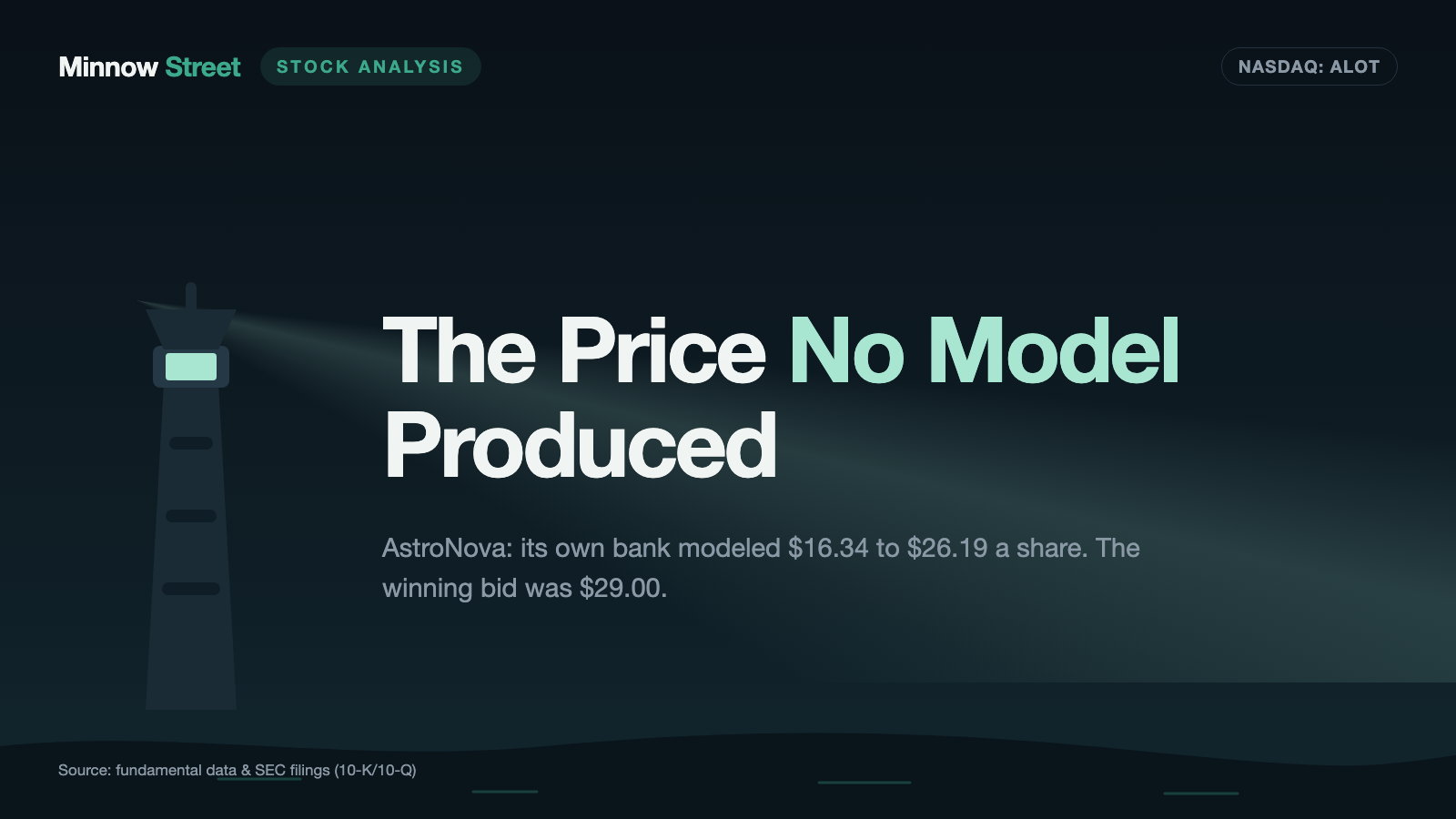
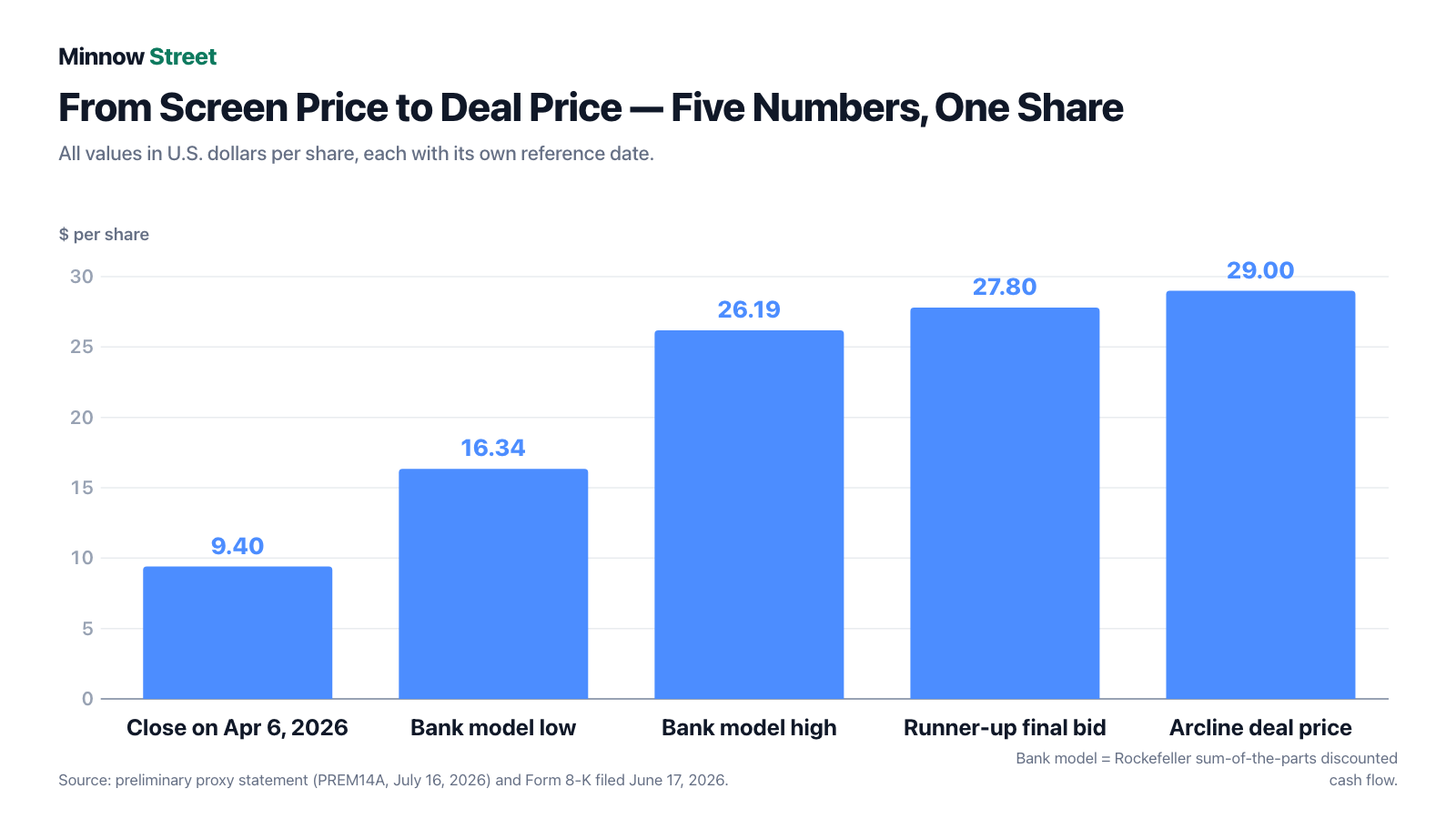
AstroNova builds printers for aircraft cockpits and labels for packaging. On April 6, 2026 the stock closed at $9.40. Ten weeks later the board signed a merger agreement at $29.00 per share in cash, a premium of roughly 209 percent, paid by private equity firm Arcline. Its own investment bank had modeled just $16.34 to $26.19. The filings with the U.S. securities regulator, the SEC, explain how that gap opened: six bidders, one segment delivering 69 percent of revenue and no profit, and a second one carrying the entire earnings on 31 percent of sales. Not a recommendation — just the question of what you are actually buying when the price is already fixed.
 Thomas Mücke
Founder & Publisher
Thomas Mücke
Founder & Publisher
Chart
Interactive price chart (TradingView).
Note: pure fact-based analysis, not investment advice and not a solicitation to buy or sell. All figures without guarantee.
There is an investor weakness that feels like a gift: takeover euphoria. It works like this. A screen hands you a stock that ranks among the strongest performers of the past three months. You look at the chart and it reads like a textbook: sideways, sideways, then one candle that jumps over everything. Your brain says: "Something is happening here. What rises like that keeps rising." And then you buy a stock whose price has in fact been written into a contract for weeks — to the cent, signed, all but immovable. The chart shows you momentum. The contract shows you a ceiling. AstroNova, Inc. (NASDAQ: ALOT) of West Warwick, Rhode Island, is exactly that case. So let us take the long way round, through the papers the company itself filed with the U.S. securities regulator, the SEC: the annual report (10-K) for fiscal 2026, the quarterly report (10-Q) as of April 30, 2026, the current report (8-K) of June 17, 2026 and the preliminary proxy statement (PREM14A) of July 16, 2026. An SEC filing is honest under penalty of law. And these documents describe a price no valuation model produced, two businesses that have nothing to do with each other, and an acquisition in which part of the fixed assets purchased did not exist. In the end you decide for yourself.
What is in this analysis
- What AstroNova actually builds — cockpit printers and label printers
- How the stock landed on our desk
- The numbers over the years — honestly credited
- What the filings say — the uncomfortable truths
- Valuation: what $29.00 per share really means
- Opportunities and risks at a glance
- A human conclusion
- Sources
What AstroNova actually builds — cockpit printers and label printers
AstroNova does something profoundly unglamorous: it builds printers. But two entirely different kinds, for two entirely different worlds — and that is the key to everything that follows.
The Aerospace segment builds printers that sit in the cockpits of commercial aircraft. When a crew needs a weather chart, a revised clearance or a system fault message on paper in flight, it comes out of one of these units. AstroNova calls its own line ToughWriter; on top of that it manufactures printers under license from Honeywell — since 2018 for two aircraft families, and since fiscal 2023 for the Boeing 787 as well. Add networking hardware for the flight deck and data recorders for industrial and military users. Customers include aircraft manufacturers, airlines, the United States Navy, the United States Air Force and the large defense prime contractors. The decisive feature of this business appears in the quarterly report: roughly 68 percent of segment revenue is hardware, and the remaining 32 percent is recurring sales of supplies, parts and service. A printer certified on a Boeing stays there for twenty years — and sells paper for the whole time.
The Product Identification segment does the opposite: label and packaging printers for brand owners, commercial printers and industrial users, sold under the names QuickLabel, TrojanLabel, AstroJet and GetLabels. These are the machines that print the ingredients on a shampoo bottle, the barcode on a carton and the hazard warnings on a chemical drum. In May 2024 AstroNova added Portugal-based MTEX New Solution, S.A. for EUR 17.3 million (about $18.7 million) — machines for higher volumes, direct-to-package printing and flexible film. More on that later, because it may be the most expensive decision in the company's recent history.
Two points of orientation, because research on this name goes astray easily. First, the name: the company has only been called AstroNova since May 2016; before that it was Astro-Med Inc. It has been listed since 1984. There is also a real risk of confusing it with Astronics Corporation, another listed aerospace supplier — which AstroNova's own investment bank uses as a comparable company. Second, the fiscal year: it ends on January 31. When this analysis refers to fiscal 2026, it means February 1, 2025 through January 31, 2026 — essentially calendar 2025. The current fiscal 2027 ends on January 31, 2027.
That sets the central tension of this analysis, and it runs through every chapter: a single share contains one small, high-margin aerospace business with recurring revenue and a second, twice as large printing business that earns nothing. The stock market valued that mixture at $9.40 per share. An auction turned it into $29.00.
How the stock landed on our desk
AstroNova reached our research list through our in-house stock scanner: rank 5 in the Qullamaggie Top Gainers 3M ranking (U.S. selection), with an RS rating of 98, as of July 25, 2026. These lists are recalculated daily, so today's rank is not tomorrow's.
What does such a filter measure? It looks for the strongest price performance over the past three months. The RS rating — relative strength — places a stock on a scale from 1 to 99: a 98 means only two out of a hundred stocks moved more over that period. The idea comes from momentum trading and is sensible enough: where a stock outruns its entire peer group for no obvious reason, there is often information the market is still digesting.
Except that with AstroNova the information is fully published. The jump has one precisely datable cause — the merger agreement of June 16, 2026. A momentum filter cannot see that difference because it reads prices, not contracts. Which is exactly why a high scanner rank is not a reason to buy but an instruction to read. Remember the line: a price chasing a fixed price cannot overtake it. The situation at Allied Gold was similar, where a cash offer likewise put a hard ceiling on the shares. So let us look first at what the company is worth without the contract.
The numbers over the years — honestly credited
Let us start with what genuinely speaks for AstroNova. Precisely stated, that is one single segment.
Aerospace is a good business. In fiscal 2026 the segment generated $46.3 million in revenue and a segment operating profit of $9.8 million — a margin of 21.1 percent, up from 18.6 percent a year earlier. And that despite revenue falling 5.4 percent, because a large backlog of printheads had been shipped in the prior year. The decline was partly offset by defense sales, up 43.1 percent, and commercial aircraft sales, up 3.9 percent. In the first quarter of the current fiscal 2027 (February through April 2026) the pace picked up sharply: $13.275 million in revenue against $11.419 million a year earlier — up 16.3 percent — with segment operating profit of $3.878 million against $1.979 million. That is a 29.2 percent segment margin in a single quarter.
Product Identification is not a good business. In the same fiscal 2026 the segment generated $104.2 million in revenue — more than twice Aerospace — and reported a segment operating loss of $0.5 million. For context: in fiscal 2025 the loss was $11.9 million, though that figure included $13.4 million of goodwill impairment. Here are the two segments side by side:
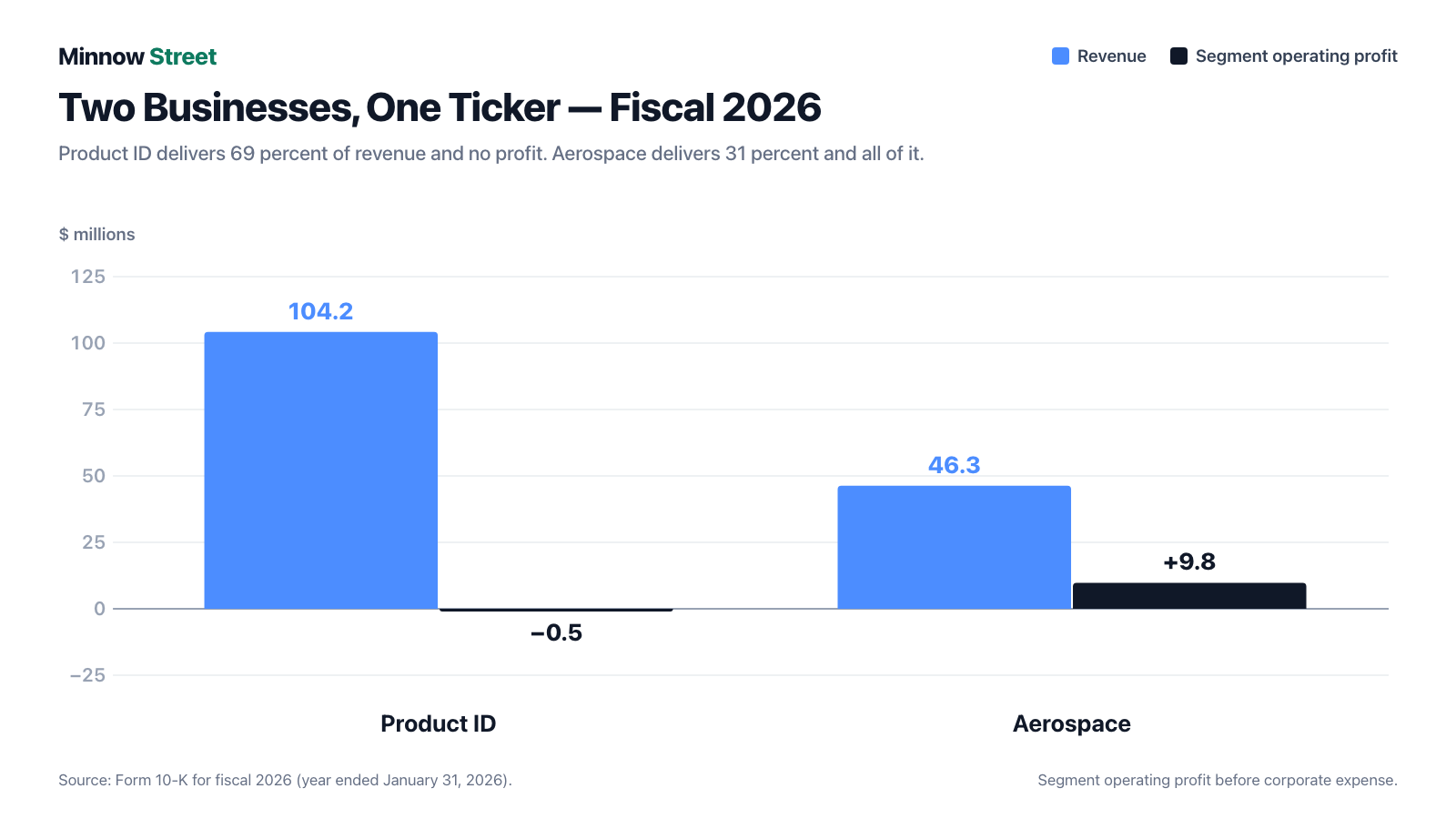
At group level the picture has not moved in three years. Revenue was $148.1 million in fiscal 2024, $151.3 million in fiscal 2025 and $150.5 million in fiscal 2026 — flat. Earnings, by contrast, jumped around: a profit of $4.7 million (2024), a loss of $14.5 million (2025) and a loss of $2.4 million (2026). Operating income in fiscal 2026 was $1.2 million against $3.5 million of interest expense — the company earned less than it paid its banks. On the credit side, cash flow from operations came to $11.7 million with capital expenditures of only $0.3 million. That is an honest strength: the business ties up very little capital.
And the first quarter of fiscal 2027 is the best report in years: revenue of $39.364 million (up 4.4 percent), a gross margin of 36.6 percent against 31.7 percent, operating income of $1.562 million against $0.571 million, and net income of $0.653 million, or $0.08 per diluted share — after a $0.376 million loss in the prior-year quarter. Read that one report and you see a company turning. Read the three years before it and you see why the board sold anyway.
What the filings say — the uncomfortable truths
Uncomfortable truth No. 1: the price came from an auction, not from a model
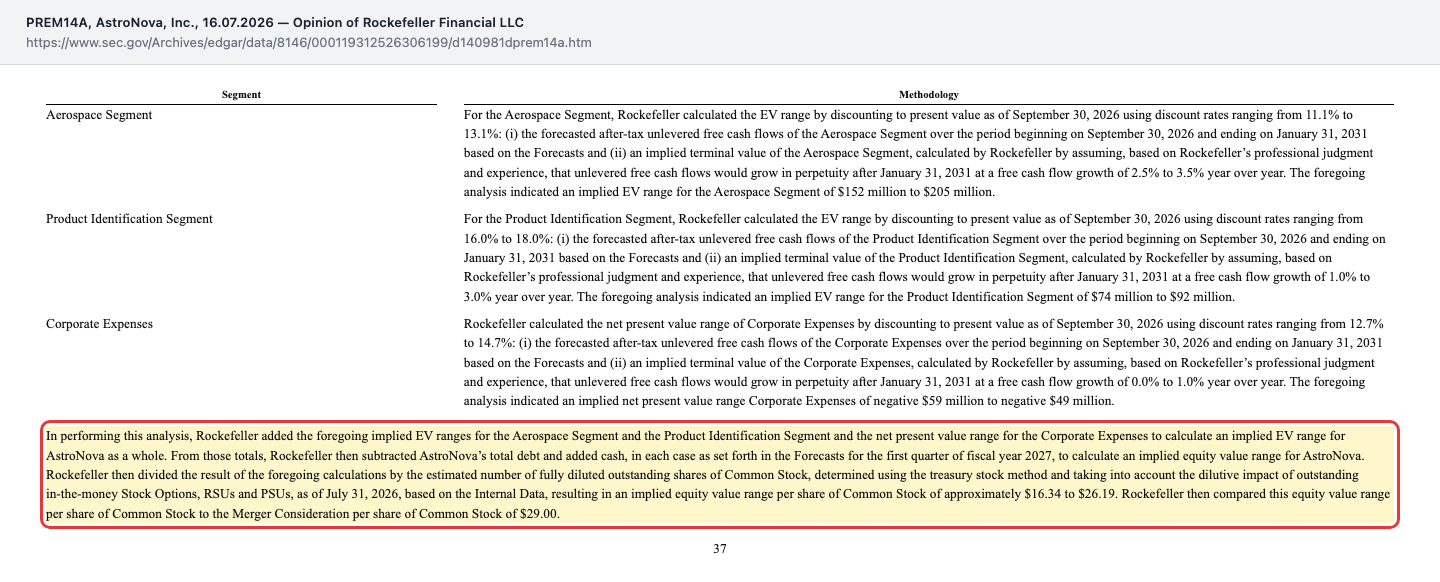
When a company is sold, the board commissions an investment bank to deliver a fairness opinion — a written judgment on whether the price is fair from a financial point of view. Think of it as the appraisal in a house sale. AstroNova hired Rockefeller Financial LLC. The bank valued each segment separately, discounted the projected cash flows through January 31, 2031 back to September 30, 2026, and arrived at an enterprise value of $152 million to $205 million for Aerospace, $74 million to $92 million for Product ID and a present value of corporate expenses of negative $59 million to negative $49 million. After deducting debt, the result was this:
"Rockefeller then divided the result of the foregoing calculations by the estimated number of fully diluted outstanding shares of Common Stock, determined using the treasury stock method and taking into account the dilutive impact of outstanding in-the-money Stock Options, RSUs and PSUs, as of July 31, 2026, based on the Internal Data, resulting in an implied equity value range per share of Common Stock of approximately $16.34 to $26.19."
— AstroNova, Inc., preliminary proxy statement on Schedule 14A, July 16, 2026, "Opinion of Rockefeller Financial LLC" (SEC EDGAR)
So where did the gap come from? From a contest whose course the proxy statement logs day by day. On the company's instruction, Rockefeller approached 13 potential buyers for the whole company and 48 for the Product ID segment; between October 20, 2025 and May 14, 2026 the company signed 30 confidentiality agreements. On June 2, 2026 five revised all-cash proposals were on the table: $25.00 from Arcline, $24.50 from a financial sponsor labeled "Company D", $24.00 from "Company C", $22.00 from "Company E" and $21.70 from "Company B". On June 15 the two remaining bidders raised to $26.00 (Arcline) and $25.50 (Company D). On the morning of June 16 the board asked for more than $27.00; Arcline offered $27.25, and Company D countered with $27.50 — but demanded exclusivity. That evening Arcline went to $29.00, attached a fully negotiated agreement and required the board to decide the same night. It did. On the morning of June 17, shortly before the announcement, Company D raised to $27.80 — too late.
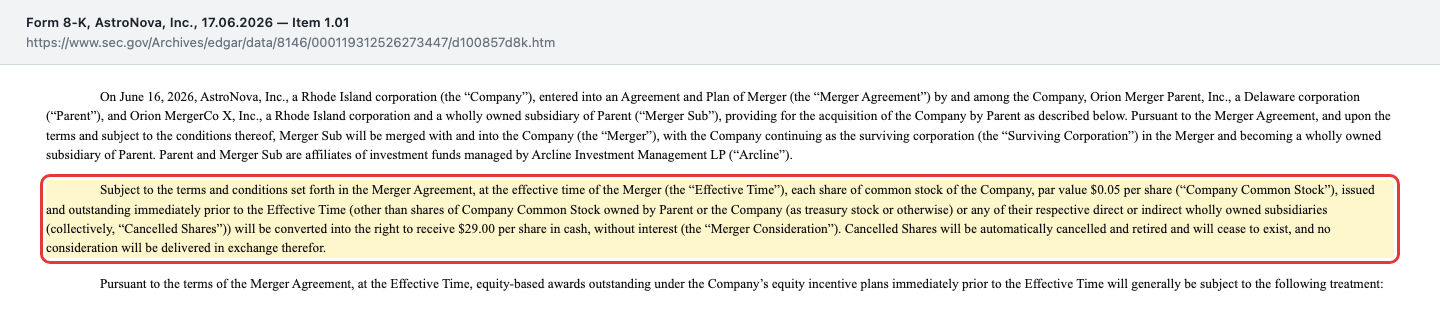
The price itself is stated verbatim in the current report:
"Subject to the terms and conditions set forth in the Merger Agreement, at the effective time of the Merger … each share of common stock of the Company, par value $0.05 per share … issued and outstanding immediately prior to the Effective Time … will be converted into the right to receive $29.00 per share in cash, without interest …"
— AstroNova, Inc., Form 8-K filed June 17, 2026, Item 1.01 (SEC EDGAR)
Uncomfortable truth No. 2: barely anyone would pay more than $40 million for two thirds of revenue
The proxy statement contains a number that appears nowhere in the consolidated accounts — because it is not a book value but a market price. Alongside the bids for the whole company, three offers arrived in May 2026 for the Product Identification segment alone. Two of them valued that business at $30 million to $32.5 million in cash; the third contemplated up to $40 million, partly as deferred consideration.
Set that against the revenue. Product ID generated $104.2 million in fiscal 2026. Prospective buyers were therefore willing to pay roughly one third of a single year of sales for two thirds of group revenue. For comparison, the whole company changes hands at an enterprise value of roughly $272 million, about 1.8 times annual sales. Translated: the buyer is paying almost everything for the smaller segment. The proxy confirms it explicitly — Arcline and all five rival bidders were "primarily interested in the Company's Aerospace business", even though each was evaluating an acquisition of the entire company.
For an investor doing the math without the contract, that is the single most important figure in this analysis. It says the $104.2 million of revenue in the large segment is almost irrelevant to the value of the share. What counts is the $46.3 million in the small one.
Uncomfortable truth No. 3: part of the fixed assets bought with MTEX did not exist
In May 2024 AstroNova acquired Portugal-based MTEX for EUR 17.3 million. What happened next is described in the fiscal 2026 annual report with remarkable candor:
"Subsequent to the acquisition, we discovered facts regarding the financial condition, operations and relationships with its customers that we believe are inconsistent with the representations made to us in connection with the acquisition. As a result of these matters … we have recorded a goodwill impairment charge in both fiscal 2026 and fiscal 2025 for a total of $13.7 million related to the acquisition."
— AstroNova, Inc., Form 10-K for fiscal 2026, Item 1A Risk Factors (SEC EDGAR)
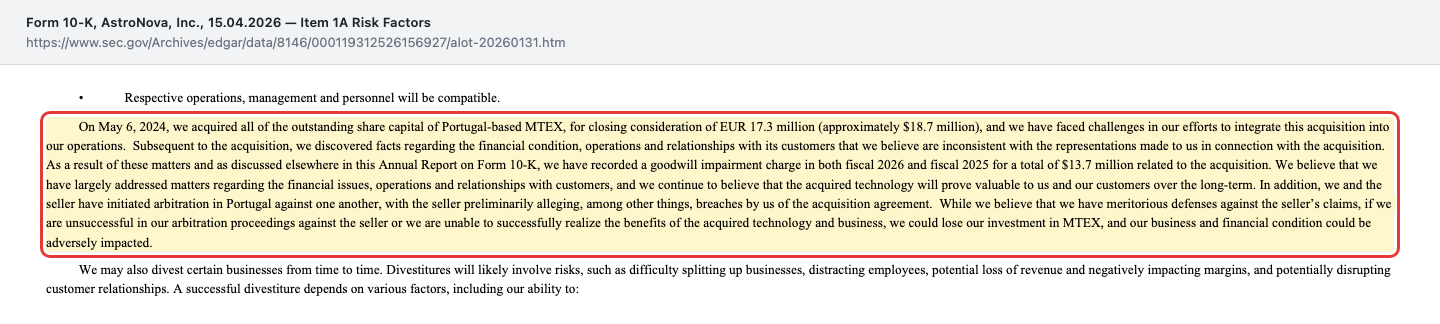
One detail in the notes tops it off. In the third quarter of fiscal 2026 AstroNova corrected the opening balance sheet of the acquisition: property, plant and equipment with a net book value of EUR 1.8 million (about $1.9 million) had to be written off. The stated reason: "In September 2025 we discovered that these assets were either non-existent or obsolete at the acquisition date."
The consequences ran for two years. In March 2025 AstroNova announced it would cut about 10 percent of its global workforce and discontinue roughly 70 percent of the MTEX product portfolio; through April 30, 2026 that cost $1.7 million in restructuring charges, mostly severance, against about $3.0 million of expected annualized savings. Seller and buyer sued each other before an arbitration panel in Oporto: the seller claimed EUR 5.2 million, AstroNova counterclaimed EUR 22.3 million. On May 15, 2026 the parties settled — AstroNova receives an industrial property in Porto that both sides value at EUR 2.5 million ($2.9 million); the arbitration ends once the property is formally registered.
Uncomfortable truth No. 4: the lender has already had to grant waivers
A covenant is a lending condition — a ratio a borrower must keep so the bank cannot call the loan. Think of it as the lender's house rules. AstroNova has to meet two of them, a maximum consolidated leverage ratio and a minimum consolidated fixed charge coverage ratio, tested at the end of every fiscal quarter. The fiscal 2026 annual report contains a sentence worth reading twice:
"At January 31, 2026, we believe we were in compliance with our credit agreement with Bank of America, which governs our outstanding term loans and revolving line of credit. In prior quarters, when we were not in compliance with our credit agreement, we have been able to obtain from Bank of America waivers or amendments that addressed the associated events of default."
— AstroNova, Inc., Form 10-K for fiscal 2026, Item 1A Risk Factors (SEC EDGAR)
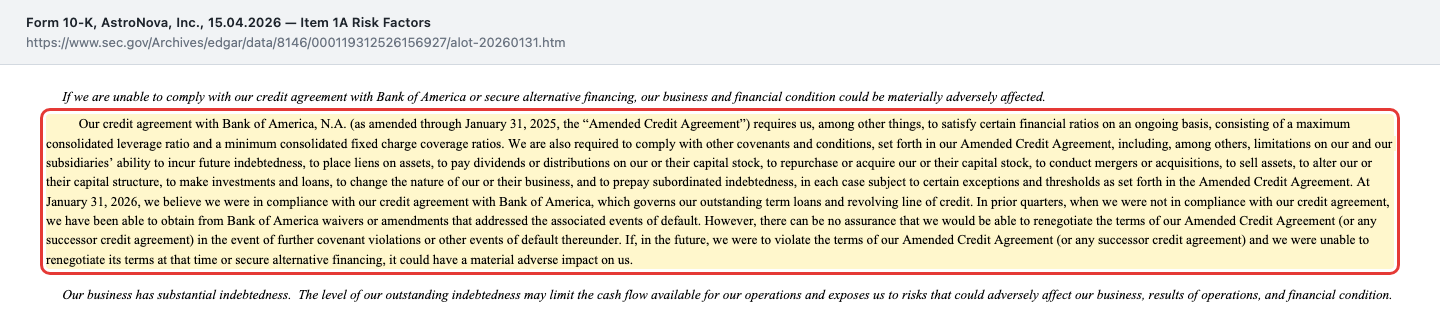
The traces of those negotiations sit in the exhibit list: a Fifth Amendment to Amended and Restated Credit Agreement and Waiver Agreement dated September 8, 2025 and a Sixth Amendment dated October 31, 2025, which eliminated the interim fixed charge coverage test altogether. Two renegotiations in eight weeks is not routine. As of April 30, 2026, total debt of $35.9 million ($15.4 million drawn on the revolver, $4.3 million current portion of term debt, $16.2 million long term) stood against cash of $4.7 million. And one detail that matters in a takeover: a change of control is an express event of default under the credit agreement, so the buyer will have to refinance that debt.
Valuation: what $29.00 per share really means
Let us convert the price into orders of magnitude without touching a single daily quote.
Equity value. As of June 4, 2026 the cover page of the quarterly report showed 7,747,772 shares outstanding. At $29.00 that is $224.7 million. Yet the press release cites an enterprise value of roughly $272 million. The gap can be resolved from the filings themselves: according to the proxy statement, Arcline set the termination fee at 4 percent of the equity value of the transaction, and that fee is $9,648,000. That implies an equity value of $241.2 million and therefore a fully diluted share count of roughly 8.32 million — some 570,000 more than the outstanding count, because options, RSUs and PSUs are cashed out at closing. Add net debt of $31.2 million ($35.9 million less $4.7 million of cash as of April 30, 2026) and you land at $272.4 million — exactly the press release figure. The arithmetic checks out.
The multiples. Against fiscal 2026 revenue of $150.5 million, the buyer is paying roughly 1.8 times annual sales on an enterprise value basis. Against shareholders' equity of $77.5 million as of April 30, 2026, spread over the 7,747,772 shares outstanding, book value is about $10.00 per share — so the price is roughly 2.9 times book. And against what management's own long-range plan projects for the current fiscal 2027 — adjusted EBITDA of $17.9 million — Arcline is paying a little over 15 times. For context: the investment bank considered 12 to 14 times appropriate for the Aerospace segment alone, and the four aerospace comparables it selected traded between 12.1 and 17.2 times. The buyer is paying for the whole group roughly the multiple that the good part earns.
The professional view. The average analyst target price derived from fundamental data stood at $26 on July 25, 2026 — below the agreed deal price. That is not a warning but a curiosity: once a price is contractually fixed, a target price has no function left.
And what is the market pricing in? Market capitalization from fundamental data was roughly $223 million on July 25, 2026, against an offer value of $224.7 million. The gap is less than 1 percent. The market therefore treats completion as near certain. And that is where the real wager lies: there is almost nothing left on the upside, while the unaffected April 6, 2026 close sits at $9.40. Anyone buying today is risking roughly two thirds to gain about 1 percent — assuming the deal closes. The dull distribution business of Global Industrial is built the same way but with the opposite sign: there the margin decides the return, here only the calendar does.
That calendar is precise. The joint press release of June 17, 2026 expects the deal to close in the third calendar quarter of 2026. The outside date of the merger agreement falls 150 days after June 16, 2026, that is November 13, 2026; it can be extended once by 30 days if only regulatory clearance is outstanding. Before then, shareholders must approve the agreement by a majority of all outstanding shares at a special meeting, and the waiting period under the U.S. antitrust rules (the HSR Act) must expire. Dissenting shareholders have no appraisal rights under Rhode Island corporate law.
One piece is still missing. The proxy statement exists only in preliminary form (the PREM14A of July 16, 2026). The meeting date and record date are still blank placeholders in it, and no definitive version had been filed as of July 25, 2026. Until it appears, nobody knows the day of the vote — and therefore not the earliest possible closing date either. There is no separate Rule 13e-3 going-private process here, which would demand extra disclosure in an affiliated buyout: Arcline is an unrelated third party.
Opportunities and risks at a glance
What speaks for the stock:
- The price is in writing: $29.00 per share in cash, signed June 16, 2026, with no financing condition — Arcline confirmed it would fund the transaction entirely from a $6 billion committed fund.
- The board approved unanimously, and Askeladden Capital Management, previously an activist holder, stated in its Schedule 13D amendment of July 23, 2026 that it supports the acquisition.
- A losing bidder is standing by: "Company D" raised to $27.80 per share on the morning of June 17, 2026. Should the Arcline agreement fail, a documented alternative bid is on the record.
- The Aerospace business is real and growing: revenue up 16.3 percent in the first quarter of fiscal 2027, a 29.2 percent segment margin, and 32 percent recurring revenue from parts, paper and service.
- The operating trend has turned: gross margin from 31.7 to 36.6 percent, and the first quarterly profit in some time at $0.08 per diluted share.
What speaks against it:
- The risk-reward is inverted: market capitalization (roughly $223 million as of July 25, 2026) and offer value ($224.7 million) are less than 1 percent apart, while the unaffected April 6, 2026 close was $9.40.
- Without the contract the company is worth less: its own investment bank modeled $16.34 to $26.19 per share, with the top of the range almost 10 percent below the offer.
- Completion risks remain: shareholder approval, antitrust clearance, and the absence of a material adverse effect. The outside date is November 13, 2026, extendable once by 30 days.
- No appraisal rights: under Rhode Island law dissenting shareholders cannot ask a court to review the price.
- The operating substance is thin: three years of revenue stuck around $150 million, two consecutive loss years, $35.9 million of debt against $4.7 million of cash (April 30, 2026), and a credit agreement that required waivers in prior quarters.
- Management and the board are paid on completion: the proxy statement puts golden parachute compensation for the named executives at roughly $12.7 million in total, plus transaction bonuses of up to $3.0 million.
A human conclusion
Back to where we started, to takeover euphoria. The filter that brought AstroNova to us measures price strength — and price strength was abundant here: from $9.40 on April 6, 2026 to a price contractually anchored at $29.00. Only that is not strength, it is news that has long since been digested. The chart is describing a journey that already happened.
What remains is an unusually clean case study in how prices are formed. Three parties valued the same company and produced three completely different numbers. The stock market said $9.40. A discounted cash flow with segment discount rates between 11.1 and 18.0 percent said $16.34 to $26.19. And an auction with six bidders, five of whom mainly wanted the smaller segment, said $29.00 on the evening of June 16, 2026 — after standing at $25.00 barely two weeks earlier. None of those three numbers is wrong. They simply answer different questions.
Whoever owns the stock today does not really own a printer manufacturer any more; they own a contract with a due date. Whoever buys it today is buying the difference between market capitalization and offer value — and the risk that the contract comes to nothing. And anyone who finds the company genuinely interesting because a printer from Rhode Island hangs in the cockpit of a Boeing 787 will only be able to follow it from a distance after closing: AstroNova will then be a private company. What you make of that is your decision. And that is exactly as it should be.
Sources
- Annual report on Form 10-K for fiscal 2026, filed April 15, 2026 — segment figures, MTEX, credit agreement, headcount, risk factors
- Quarterly report on Form 10-Q as of April 30, 2026, filed June 8, 2026 — most recent periodic report: balance sheet, first-quarter segment results, share count, covenants, Honeywell license, settlement with the MTEX seller
- Current report on Form 8-K filed June 17, 2026, Items 1.01 and 7.01 — merger agreement with Orion Merger Parent, Inc., consideration, termination fee, outside date; Exhibit 99.1 press release with enterprise value and premiums
- Preliminary proxy statement on Schedule 14A, filed July 16, 2026 — background of the merger, opinion of Rockefeller Financial LLC, long-range plan, golden parachute compensation, absence of appraisal rights
- Current report on Form 8-K filed May 18, 2026, Item 1.01 — settlement of the MTEX arbitration, industrial property in Porto
- Current report on Form 8-K filed April 16, 2026, Item 5.02 — amendment of stock-settled performance awards to permit cash settlement
- Schedule 13D/A No. 3 by Askeladden Capital Management, filed July 23, 2026 — exit filing below the 5 percent threshold, support for the acquisition
- EDGAR index of all AstroNova, Inc. filings (CIK 0000008146)
- Fundamental data (market capitalization, share count, analyst target price, headcount; data as of July 25, 2026)
- Our in-house stock scanner, Qullamaggie Top Gainers 3M ranking (U.S. selection), rank 5, RS rating 98, as of July 25, 2026
Journalistic analysis, not investment advice and not a solicitation to buy or sell securities. Shares can fall to a total loss, and that applies to announced takeovers as well if they fail. All figures come from the original documents linked above and carry their own reference dates. The author holds no position in AstroNova, Inc. at the time of publication. No warranty is given.
Our Bottom Line at a Glance
- Price certainty positive
- The merger agreement of June 16, 2026 fixes $29.00 per share in cash with no financing condition; Arcline stated it would fund the deal entirely from a $6 billion committed fund and delivered a limited guarantee. The board approved unanimously, and a formerly activist holder explicitly supports the transaction (Schedule 13D/A filed July 23, 2026).
- Risk-reward negative
- Market capitalization stood at roughly $223 million on July 25, 2026 against an offer value of $224.7 million (7,747,772 shares times $29.00) — the remaining gap is under 1 percent. The unaffected close on April 6, 2026 was $9.40. Anyone entering today is risking roughly two thirds for about 1 percent.
- Operating substance neutral
- The Aerospace business is strong: a 21.1 percent segment margin in fiscal 2026, revenue up 16.3 percent with a 29.2 percent margin in the first quarter of fiscal 2027, and 32 percent recurring revenue. The Product ID business, twice as large, earned nothing in fiscal 2026 (a $0.5 million loss on $104.2 million of revenue); third parties bid only $30 million to $40 million for it.
- Balance sheet and funding negative
- As of April 30, 2026, $35.9 million of debt stood against $4.7 million of cash; the fiscal 2026 annual report concedes that covenants were breached in prior quarters and that waivers were obtained from Bank of America (amendments dated September 8 and October 31, 2025). Interest expense of $3.5 million in fiscal 2026 exceeded operating income of $1.2 million.
- Acquisition record and governance negative
- Of the MTEX purchase price (EUR 17.3 million, May 2024), $13.7 million of goodwill was written off within 20 months; in September 2025 the company found that EUR 1.8 million of property, plant and equipment in the opening balance sheet did not exist or was obsolete at the acquisition date. Golden parachute compensation for the named executives totals roughly $12.7 million, plus transaction bonuses of up to $3.0 million.
- Valuation level neutral
- About 1.8 times annual revenue on an enterprise value basis and about 2.9 times book value is ambitious for an industrial printer maker but not absurd; measured against management's planned fiscal 2027 adjusted EBITDA of $17.9 million the buyer is paying a little over 15 times — roughly the multiple the investment bank applied to the Aerospace segment alone (12 to 14 times).
AstroNova is no longer a stock analysis in the usual sense but a case study in how a price is formed. Three parties valued the same company and produced three numbers: the stock market $9.40 (close of April 6, 2026), the company's own bank $16.34 to $26.19 in a discounted cash flow, and an auction with six interested parties $29.00 on the evening of June 16, 2026. Behind it sits a group with three years of revenue stuck around $150 million, two loss-making years, a failed acquisition with $13.7 million of goodwill written off — and one small aerospace business delivering a 21.1 percent margin, which is what the buyers actually came for. Whoever holds the stock today holds a contract due November 13, 2026. Not investment advice.
What Our Rating Means
Substance risk
We found at least one documented issue that threatens the company itself — regardless of how the stock is currently valued.
The price strength that put this stock in our ranking is fully explained and fully priced in: market capitalization on July 25, 2026 (roughly $223 million) and offer value ($224.7 million) are less than 1 percent apart, while the unaffected April 6, 2026 close was $9.40. Anyone entering now is no longer betting on cockpit printers but on shareholder approval and antitrust clearance arriving before November 13, 2026 — for a single-digit percentage gain against a double-digit multiple of downside. Anyone watching should track three things: the definitive proxy statement with the meeting date and record date, the expiry of the HSR waiting period, and whether the losing bidder returns with its $27.80. The decision is yours.
A journalistic assessment by our editorial team at the time of the deep dive, based on public sources — not investment advice and not a solicitation to buy or sell. Your personal circumstances (investment goals, risk capacity, taxes) cannot be taken into account. What our levels mean, how verdicts are formed, and what conflicts of interest exist →
Worth Noting
- The essential context first: AstroNova is being acquired. On June 16, 2026 the company signed a merger agreement with Orion Merger Parent, Inc., an affiliate of Arcline Investment Management — $29.00 per share in cash, with closing expected in the third calendar quarter of 2026 according to the press release and an outside date of November 13, 2026. The share price has been pinned to the offer ever since, so every statement about valuation in this analysis is a statement about the contract, not about the operating business. On completion AstroNova will be a private company and will no longer trade on NASDAQ.
- AstroNova reached our research list through our in-house stock scanner: rank 5 in the Qullamaggie Top Gainers 3M ranking (U.S. selection) with an RS rating of 98, as of July 25, 2026. These lists are recalculated daily, so today's rank is not tomorrow's. The high rank here is entirely attributable to the takeover announcement of June 17, 2026.
- Reference dates: segment and annual figures come from the annual report for fiscal 2026 (year ended January 31, 2026), balance sheet and quarterly figures from the quarterly report as of April 30, 2026 (filed June 8, 2026), and transaction details from the Form 8-K of June 17, 2026 and the preliminary proxy statement of July 16, 2026. Market capitalization, share count and analyst target price carry a data date of July 25, 2026.
- Risk of confusion: AstroNova was called Astro-Med Inc. until May 2016 and is not the same company as Astronics Corporation, another aerospace supplier — which the investment bank uses as a comparable. The non-calendar fiscal year (ending January 31) shifts every year-on-year comparison by eleven months.
Stock Watch
This analysis is as of July 25, 2026. Stock Watch will tell you what's changed at ALOT since then.
Later $1 a month per stock — signing up is free, and you'll be the first to know when it launches.
Frequently Asked Questions
The buyer is Orion Merger Parent, Inc., an affiliate of investment funds managed by Arcline Investment Management LP. The merger agreement was signed on June 16, 2026 and provides for $29.00 per share in cash, without interest. The press release puts the enterprise value at roughly $272 million. On completion AstroNova will become a privately held company.
Because the price jumped, not the business. The premium of about 209 percent over the unaffected April 6, 2026 close of $9.40 was created in a single day by the takeover announcement. Momentum filters read prices, not contracts, so the high rank in our in-house Qullamaggie Top Gainers 3M ranking (rank 5, RS rating 98, as of July 25, 2026) is a consequence of the offer, not a sign of further upside.
Rockefeller Financial LLC valued each segment separately in a discounted cash flow and arrived at $16.34 to $26.19 per share. The price paid did not come from that model but from an auction: 13 potential buyers contacted for the whole company, five revised bids on June 2, 2026 between $21.70 and $25.00, and a final sprint on June 16 between Arcline ($27.25, then $29.00) and a second financial sponsor ($27.50).
Almost entirely in the Aerospace segment with flight-deck printers, networking hardware and data recorders. In fiscal 2026 it generated $46.3 million of revenue and $9.8 million of segment operating profit, a 21.1 percent margin. The Product Identification segment, twice as large, generated $104.2 million of revenue and a segment operating loss of $0.5 million.
On January 31. Fiscal 2026 ran from February 1, 2025 through January 31, 2026 and therefore largely covers calendar 2025. The current fiscal 2027 ends on January 31, 2027, and its first quarter covers February through April 2026. Anyone comparing AstroNova's annual figures with those of other companies has to allow for that shift.
The agreed price falls away. The agreement provides an outside date of 150 days after June 16, 2026, that is November 13, 2026, extendable once by 30 days. If completion fails on the company's side, a termination fee of $9,648,000 becomes payable; in specified antitrust scenarios the buyer pays the same amount. A losing bidder most recently offered $27.80 per share.
No. The proxy statement states explicitly that holders of common stock are not entitled to dissenters' rights or appraisal rights under the Rhode Island Business Corporation Act in connection with this merger. Shareholders who vote against the transaction still receive only the $29.00 per share.
AstroNova acquired Portugal-based MTEX New Solution, S.A. in May 2024 for EUR 17.3 million. After closing, the company says it discovered facts inconsistent with the seller's representations; $13.7 million of goodwill was written off, about 70 percent of the product portfolio was discontinued, and an arbitration in Oporto was settled on May 15, 2026 with the transfer of an industrial property valued at EUR 2.5 million.
Found an error?
Did you spot a factual error, an outdated number, or a typo in this deep dive? Let us know briefly — your report goes straight to the editorial team.