Arrow Electronics Stock: The AI Wave Hits the Wholesale Shelf — 39 Percent Growth, Four Extra Shipping Days, an Interim CEO
Arrow Electronics moves chips and enterprise IT to tens of thousands of business customers — and lit up our momentum run of July 17, 2026, with 27 scanner hits, about 4 percent below its all-time high. We read the annual report (10-K) for 2025, the quarterly report (10-Q) as of April 4, 2026, and the 8-K on the CEO departure: a record quarter with 39 percent growth that contained four extra shipping days, a net margin of less than two cents per revenue dollar, non-cancellable IT purchase obligations running through 2032 — and a chief executive seat filled only on an interim basis since September 2025. Not investment advice — just four shipping days, a base effect, and the honest question of how much of this is really AI.
 Thomas Mücke
Founder & Publisher
Thomas Mücke
Founder & Publisher
Chart
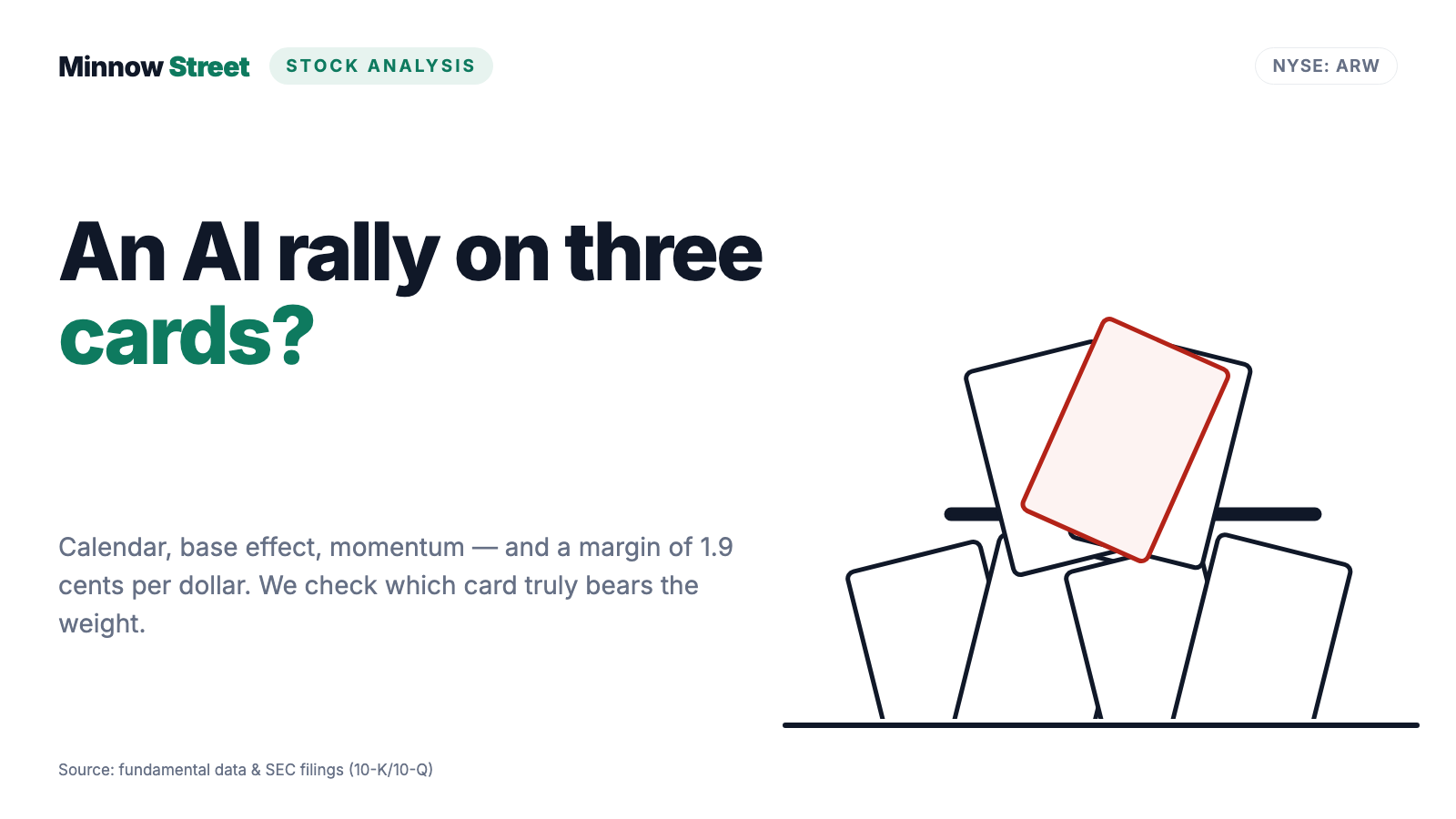
Interactive price chart (TradingView).
Note: pure fact-based analysis, not investment advice and not a solicitation to buy or sell. All figures without guarantee.
There is an investor trap built especially for bargain hunters, and it booms in every boom: the proxy trap. It works like this: the locomotive of a boom — say, Nvidia — looks far too expensive to you. So you walk down the train looking for a "cheap" car that must surely profit from the same ride. A supplier, an equipment maker, a middleman. A price-to-earnings ratio of 15 instead of 50 — and suddenly boarding the AI train feels prudent. In the summer of 2026, Arrow Electronics, Inc. (NYSE: ARW) fits that pattern like a glove: one of the world\'s largest technology wholesalers, its stock more than doubled since the start of the year, just about 4 percent below its all-time high — and its quarterly report really does contain the word everyone wants to hear: AI. So let\'s make a deal: before you board the "cheap AI car," we read together what Arrow itself reported, under penalty of law, to the U.S. securities regulator, the SEC — the annual report (10-K) for 2025, the quarterly report (10-Q) as of April 4, 2026, and the 8-K (the SEC\'s form for material current events) on the departure of the chief executive. Beyond the AI story, these filings tell three others: about four extra shipping days, about contracts running through 2032, and about a CEO seat filled only on an interim basis. In the end, you decide for yourself.
What Arrow actually does — and for whom
Arrow is the kind of company whose products you never see but whose work sits inside almost every device: a wholesaler for technology, incorporated in New York in 1946, today with roughly 22,230 employees, over 140 sales facilities and 39 distribution and value-added centers serving more than 85 countries (annual report 10-K for 2025). The business has two floors. The larger one, Global Components (2025: $21.5 billion of revenue, about 70 percent), distributes electronic components — semiconductors, connectors, passive parts — from hundreds of manufacturers to device makers in industrial, automotive and communications markets, plus engineering and supply chain services. The smaller one, Global ECS ($9.4 billion, about 30 percent), supplies value-added resellers and IT service providers with enterprise IT: servers, storage, software, cloud subscriptions — orchestrated through the company\'s ArrowSphere platform. Translated, Arrow is the middleman of the technology age: it owns neither the chip fab nor the data center, but the shelf, the logistics and the customer file in between. Which is why one number belongs at the top of this analysis: of every dollar of revenue in 2025, Arrow kept 1.9 cents as net income. That is not a flaw — it is the physics of the business model; distribution lives on volume, not margin. In our company-specific AI rating we still classify Arrow as "sells AI", because the filings document AI-related revenue in black and white: the quarterly report explicitly attributes the growth of both segments to AI demand, and ArrowSphere includes an AI-enabled go-to-market platform (more below). Remember the central tension of this analysis: the momentum is real and the valuation is modest — but Arrow keeps less than two cents per dollar of the AI boom, its record quarter contained four extra shipping days, and the company has been run by an interim chief since September. What this business model looks like in its purest form is something we dissected at direct competitor TD SYNNEX — and how AI demand lands at a manufacturer instead of a middleman, at Micron.
Where the stock shows up in our scanner
Every day we run about 3,500 stocks through our scanners. Arrow reached the research list through the momentum run of July 17, 2026 — with 27 hits across the categories. The most striking ones: the stock sits in a Stan Weinstein stage-2 uptrend (price above a rising 200-day average — the section of a price cycle where trend followers even start to engage), belongs to the RS leaders above 90 with a relative strength of 91 (it outran 91 percent of all stocks over the trailing twelve months), passes the Minervini trend template, trades above both the 50- and the 200-day lines and only about 4 percent below its all-time high. Behind that stand plus 54 percent in three months, plus 91 percent in six and plus 78 percent in twelve (data as of July 17, 2026). The remarkable part, though, is what fires alongside the trend filters: the price-to-sales ranking — the list of the cheapest stocks measured by revenue. A price-to-sales ratio of roughly 0.36 at a price near the all-time high: that combination is delivered almost exclusively by wholesale, where billion-dollar revenues meet penny margins. The fundamental lens reports respectable readings too: a fundamental grade of B, a Piotroski F-score of 7 of 9 (a nine-point test of the direction of the books; 7 means most metrics are improving), an Altman Z-score around 5.5 (an early-warning gauge of insolvency risk; the danger zone historically starts below 1.8) and a trailing price-to-earnings ratio around 15. To replicate it yourself: open the Arrow stock page or browse the stage-2 scanner. And remember for everything that follows: a scanner measures how a stock is running — not how much of its best quarter was paid for by the calendar.
The numbers over the years — honestly appraised
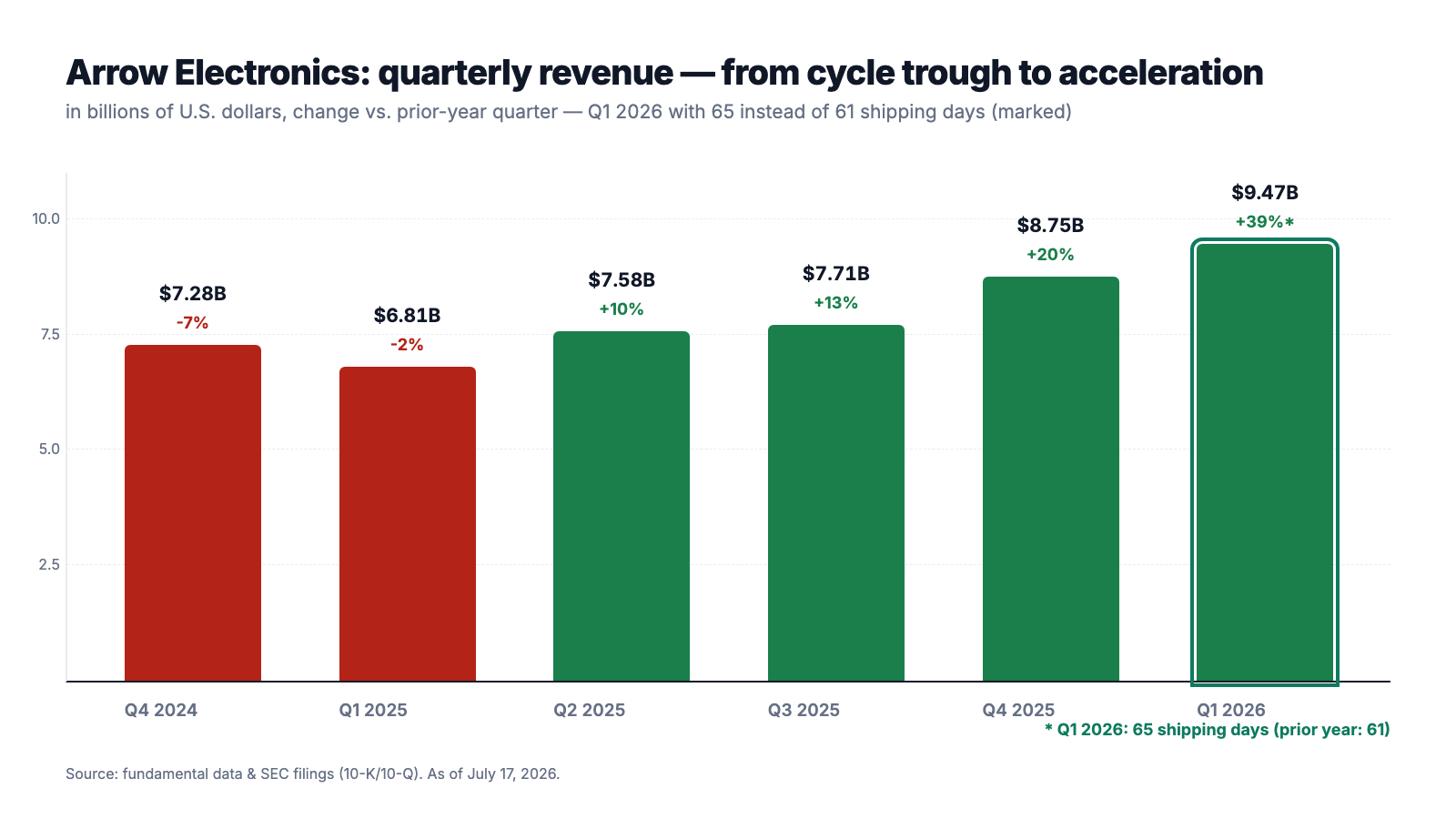
First, what genuinely impresses. Arrow turned the corner in 2025: after two down years, revenue grew again by 10.5 percent to $30.9 billion, with the Global ECS IT segment up 17.8 percent. Net income rose 46 percent to $571 million, earnings per share climbed 50 percent to $10.93 — helped by ongoing buybacks shrinking the share count. And then the first quarter of 2026 (through April 4) raised the bar again: $9.47 billion of revenue, up 39 percent, both segments in lockstep, earnings per share tripled to $4.55. The quarterly report names the driver outright — the "widespread rapid expansion of AI infrastructure," lifting demand for components and data-center IT alike, complete with pockets of tight inventory and longer lead times. Whoever holds this stock holds no fantasy, but a company demonstrably earning along the AI build-out. But first, look at the whole mountain:
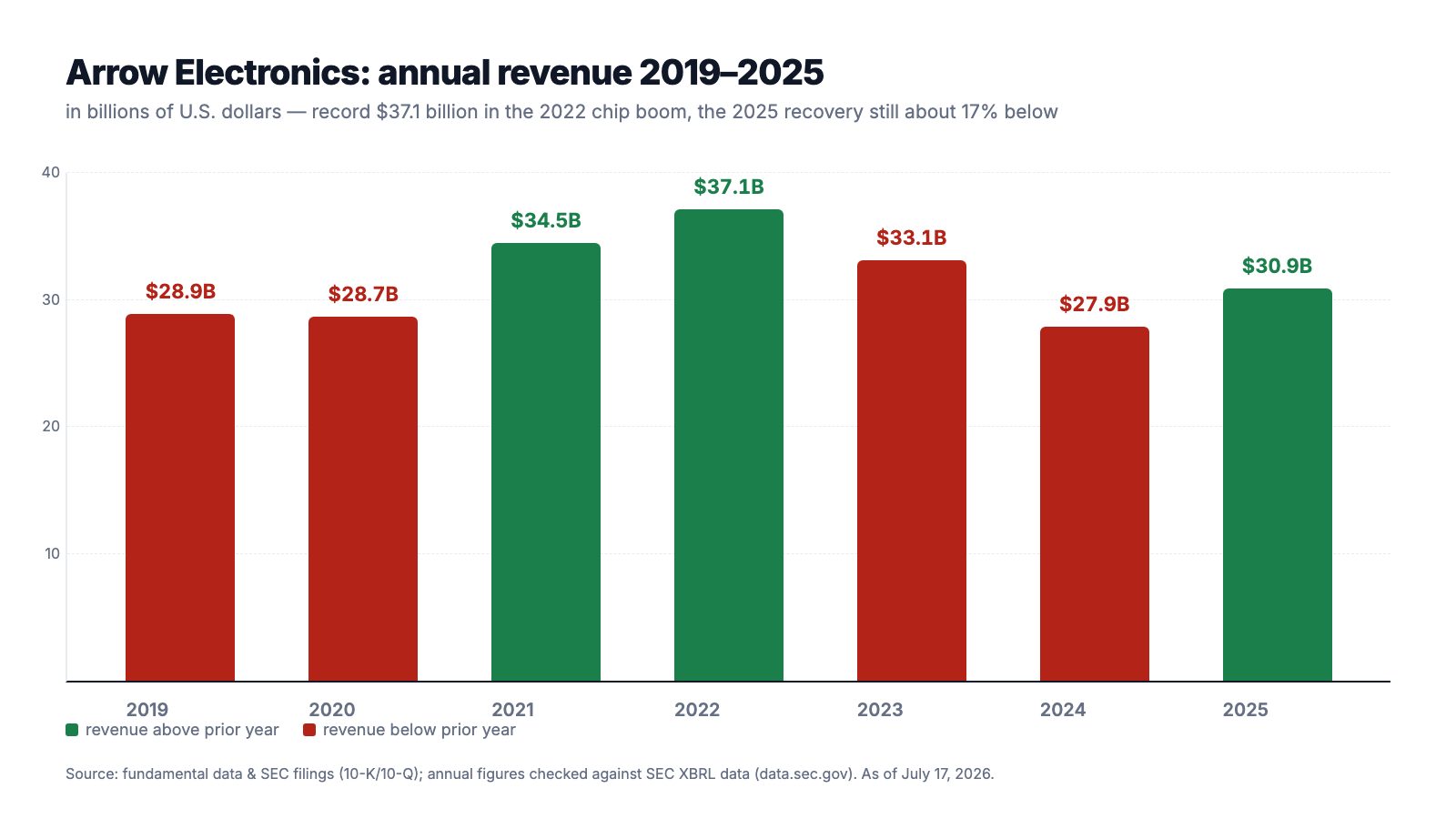
The mountain tells the real story: Arrow is a cycle company. In the chip shortage of 2021/2022, revenue shot to the record of $37.1 billion and net income to $1.43 billion — then customers ran down their inventories, and by 2024 revenue had shrunk a quarter to $27.9 billion while profit fell almost three quarters to $392 million. The 2025 recovery is real, but it is a partial recovery: revenue still sits about 17 percent, profit about 60 percent below the 2022 records. Gross margin — thin in wholesale to begin with — slipped further in 2025: from 11.8 to 11.2 percent, per the annual report mainly because the regional mix shifted toward Asia, where margins are lower. Remember the rhythm: at a distributor, customers order double in the upswing and nothing in the downswing — Arrow\'s curve therefore swings harder than the technology market itself. Which brings us to the uncomfortable truths.
What the filings say — the uncomfortable truths
Uncomfortable truth no. 1: The 39-percent quarter had four extra shipping days — and a soft yardstick
Thirty-nine percent growth at a $30 billion company — that looks like a state of emergency. Part of it, however, is simply the calendar. Arrow closes its quarters not on month-ends but on a Saturday calendar, and Note A of the quarterly report puts it on the record:
"The first quarter of 2026 includes the period from January 1, 2026, through April 4, 2026. There were 65 shipping days for the first quarter of 2026 and 61 shipping days for the first quarter of 2025."
— Arrow Electronics, Inc., SEC quarterly report 10-Q as of April 4, 2026, Note A "Basis of Presentation"

Four extra shipping days are over 6 percent more selling time — for a distributor that ships every day, that is hard cash. Add currency: in constant currency, Arrow itself reports growth of 33.7 instead of 39.0 percent. And finally the yardstick: the prior-year quarter was the cycle trough — $6.8 billion of revenue, just $80 million of net income, weighed down by restructuring charges. Against a bar that low, even a good quarter jumps spectacularly; the famous "plus 201 percent in earnings per share" is above all a base effect. In fairness: even adjusted for calendar and currency, this remains a genuine double-digit growth quarter with a clearly improved operating margin (3.8 after 2.3 percent) — the recovery is not an invention. But remember the mechanics: whoever buys 39 percent growth without reading Note A buys four calendar days and a base effect along with it.
Uncomfortable truth no. 2: The AI demand is documented — but it flows through a business with penny margins
The AI passage of the quarterly report is refreshingly concrete — and it is the reason Arrow carries the "sells AI" label in our AI rating:
"In the first quarter of 2026, Global Components and Global ECS benefitted from increased demand related to AI, due to widespread rapid expansion of AI infrastructure. This increased demand is contributing to pockets of constrained inventory and extended lead times. The company expects the AI demand trend to continue in the coming quarters, but results will depend on future developments that are highly uncertain and cannot be predicted with confidence."
— Arrow Electronics, Inc., SEC quarterly report 10-Q as of April 4, 2026, Item 2 "Business environment and other trends"

So much for the good news. The uncomfortable part sits in the income statement next to it: of the $9.47 billion of quarterly revenue, 11.5 percent gross margin and $235 million of net income remained — roughly 2.5 cents per revenue dollar, and 1.9 cents for the full year 2025. Picture it this way: Arrow runs the toll booth on the AI highway — the more traffic, the better, but only a few cents per vehicle stay in the till, and the highway belongs to others. When Nvidia, Broadcom and the hyperscalers set their prices, Arrow negotiates with bigger players on both sides; the company offers no AI chip, no model, no data center of its own — ArrowSphere\'s AI component is a go-to-market platform, not a product with pricing power. That is what separates the middleman from the manufacturer: at Micron, AI demand lifts the margin; at Arrow, it lifts the throughput. Remember the toll-booth image — it explains why a P/S of 0.36 is no bargain signal here, but simply the correct translation of penny margins into a purchase price.
Uncomfortable truth no. 3: Non-cancellable IT purchase obligations through 2032 — with the first losses already booked
The most interesting passage of the quarterly report has nothing to do with AI. It describes how Arrow is rebuilding part of its business model in the IT segment — from flexible middleman to contractually bound exclusive partner:
"Within Global ECS, the company entered into certain non-cancellable multi-year purchase obligations through 2032, designating it as the exclusive partner for certain products and granting it the right to sell a broad set of IT solutions. In the first quarter of 2026, the company recorded a loss due to lower profit expectations on a certain underperforming contract which negatively impacted gross profit margins. […] the company is anticipating there could be additional losses in the coming quarters on certain agreements."
— Arrow Electronics, Inc., SEC quarterly report 10-Q as of April 4, 2026, Item 2 "Business environment and other trends"
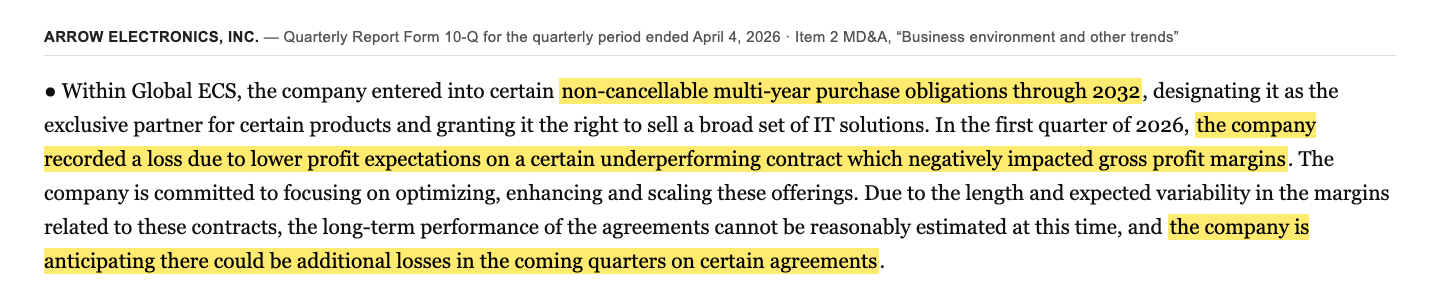
Why this matters: a distributor\'s traditional strength is that it trades someone else\'s risk — if a product does not sell, it simply is not reordered. With purchase obligations that run through 2032 and cannot be cancelled, Arrow reverses that principle for part of its IT business: the company guarantees manufacturers volume and carries the risk when demand or margin fails to cooperate — the first losses are already booked, more are possible per the filing, and the long-term performance "cannot be reasonably estimated at this time," in the company\'s own words. The annual report supplies the dimension of the total purchasing package: purchase obligations of $21.3 billion — non-cancellable inventory purchase orders and future payments under IT distribution arrangements — with $11.4 billion due within twelve months. Most of that is ordinary merchandise buying with matching demand behind it; still, the sum clearly exceeds the market value of roughly $12.2 billion, and the annual report explicitly lists the risk that sales may not suffice to cover these obligations. Translated: part of the "flexible middleman" you are buying here is by now a contract book running through 2032.
Uncomfortable truth no. 4: The company has been run by an interim chief since September — and calls that a risk itself
On September 16, 2025, in the middle of the recovery, Arrow lost its chief executive — from one day to the next. The 8-K reads:
"On and effective as of September 16, 2025 (the “Effective Date”), the Board of Directors (the “Board”) of the Company appointed William (“Bill”) F. Austen, age 66, as the Company’s Interim President and Chief Executive Officer (“CEO”). Mr. Austen succeeds Sean Kerins who separated from the Company as a Director, President and CEO as of the Effective Date."
— Arrow Electronics, Inc., SEC current report 8-K filed September 17, 2025, Item 5.02

The details of the separation agreement do not quite fit a long-planned handover: Kerins received no severance, his unvested equity awards were forfeited — but he got a consulting arrangement at $61,000 per month for the transition, and Arrow used the same 8-K to preemptively reaffirm its quarterly outlook so nobody would read the exit as a profit warning. Interim chief Austen has sat on the board since 2020, but his executive career was at a packaging maker (Bemis) — not a distribution man. Two weeks before the CEO change, the chief accounting officer had changed as well. And the annual report for 2025 turns the personnel file into a risk factor of its own: "The company is currently conducting a search for a permanent President and CEO" — leadership changes "may create uncertainty, divert resources and management attention, or impact public or market perception" (Item 1A "Risk Factors"). As of the scanner run of July 17, 2026, no permanent CEO had been announced — the company whose stock is running at its all-time high has been searching for a chief for ten months. That need not hurt the rally; interim setups with seasoned directors often run smoothly. But whoever buys today buys the strategic decisions — such as the ECS contract book from truth no. 3 — from a management team whose permanent line-up is open.
Valuation: $12.2 billion of market value for $30.9 billion of revenue — cheap is a property here, not a mispricing
In mid-July 2026 the Arrow share cost about $229, for a market value of roughly $12.2 billion (data as of July 17, 2026). Measured against earnings that is moderate: a trailing price-to-earnings ratio around 15, price-to-book around 1.6 — and measured against revenue downright tiny: a price-to-sales ratio of 0.36. But beware the "cheap" reflex: a revenue dollar of which 1.9 cents stick must be valued cheaply — comparing a wholesaler\'s P/S with a software company\'s is like comparing the odometer of a bicycle and an airplane. The more honest question is: what does the price assume? Analyst estimates (6 estimates, data as of July 17, 2026) see roughly $19.90 of earnings per share for 2026 — nearly a doubling versus 2025, extrapolating the first quarter\'s momentum; that implies a forward price-to-earnings ratio around 11 to 12. If the AI-driven recovery keeps rolling, the stock is not expensive even after doubling. If the cycle turns — see 2023/2024 — the "cheap" entry quickly becomes an entry just before the earnings get cut in half. The balance sheet belongs in that picture: $3.1 billion of debt against just $306 million of cash, interest expense of $215 million in 2025 (about a quarter of operating income), and receivables that swelled from $13.0 to $19.7 billion within a year — largely a pass-through item of the supply chain services, as the annual report explains, but with a real consequence: operating cash flow in 2025 was just $64 million, after $1.13 billion the year before, because growth in distribution first fills shelves and receivables. On the plus side: Arrow keeps buying back its own shares ($149.9 million in 2025; $147.9 million remaining under the authorization as of April 4, 2026), and the share count has been falling for years. The next test is already on the calendar: the quarterly report due at the end of July 2026 — the first quarter in which the shipping-day effect disappears again.
Opportunities and risks at a glance
What speaks for Arrow:
- Documented AI demand instead of an AI label: the quarterly report explicitly attributes the growth of both segments to the expansion of AI infrastructure; in our AI rating, Arrow runs as "sells AI" (10-Q as of April 4, 2026).
- The recovery has breadth: 2025 revenue up 10.5 percent to $30.9 billion, ECS up 17.8 percent; Q1 2026 up 39 percent with both segments in lockstep and operating margin at 3.8 after 2.3 percent.
- A rare scanner confluence of trend and substance: 27 hits in the momentum run of July 17, 2026 — stage 2, RS 91, Minervini template — alongside fundamental grade B, Piotroski 7 of 9, Altman-Z around 5.5 and a P/E around 15.
- Moderate valuation with downside cushion: P/S around 0.36, P/B around 1.6; analysts see roughly $19.90 of earnings per share for 2026 (forward P/E around 11 to 12; data as of July 17, 2026).
- Shareholder-friendly routine: ongoing buybacks ($149.9 million in 2025, $147.9 million remaining as of April 4, 2026) with a share count that has fallen for years.
What speaks against it:
- The showcase quarter is smaller than it looks: 65 instead of 61 shipping days, 33.7 instead of 39.0 percent growth in constant currency, and a comparison base at the cycle trough with just $80 million of net income (10-Q as of April 4, 2026).
- Penny margins without pricing power: 11.2 percent gross and 1.9 percent net margin in 2025, gross margin declining on the Asia mix — the AI wave flows through; it does not stick.
- A contract book instead of flexibility: non-cancellable ECS purchase obligations through 2032 with a loss already booked and possible follow-on losses announced; total purchase obligations of $21.3 billion (10-Q/10-K).
- A leadership vacuum in the middle of the rally: interim CEO since September 16, 2025, predecessor separated same-day, the CEO search listed as a risk factor in the 10-K — no successor announced as of July 17, 2026.
- Cycle and interest burden: minus 25 percent revenue from 2022 to 2024 as the most recent reminder; $3.1 billion of debt against $306 million of cash, $215 million of interest expense and just $64 million of operating cash flow in 2025.
A human conclusion
Back to the proxy trap from the opening. Its core is not that proxy stocks are bad investments — its core is a labeling fraud in your own head: you buy the cheap car and tell yourself you bought the locomotive. Arrow is a real, competently run, moderately valued beneficiary of the AI build-out — but as the toll booth, not the highway operator: 1.9 cents of net income per revenue dollar, a record quarter with four gifted shipping days, an IT business binding itself to purchase volumes through 2032, and a chief executive seat filled only on an interim basis since September. Whoever buys after a 91-percent six-month run is not buying "AI at a discount" — they are buying a cyclical near its all-time high, hoping the cycle carries further this time. It might: the analyst estimates, the order mix and the company\'s own AI passage all argue the wave is still rolling. But 2023 and 2024 stand in the same filings as a reminder of how quickly plus 39 turns back into minus 7 — and then none of the three cards holds: not the calendar, not the base effect, not the momentum. So do not test whether Arrow profits from the AI boom (it does, documented) — test whether you want to hold a penny-margin cyclical at its high when the wave breaks. What you make of it is your decision. And that is exactly as it should be.
Sources
All original documents used in this analysis — for your own reading:
- Arrow Electronics, Inc. — SEC annual report 10-K for 2025 (filed February 11, 2026)
- Arrow Electronics, Inc. — SEC annual report 10-K for 2024 (filed February 11, 2025)
- Arrow Electronics, Inc. — SEC quarterly report 10-Q as of April 4, 2026 (filed May 7, 2026)
- Arrow Electronics, Inc. — SEC quarterly report 10-Q as of September 27, 2025 (filed October 30, 2025)
- Arrow Electronics, Inc. — SEC current report 8-K filed September 17, 2025 (CEO change, separation agreement, reaffirmed Q3 outlook)
- Arrow Electronics, Inc. — SEC current report 8-K filed August 29, 2025 (change of chief accounting officer)
- Complete SEC filing history of Arrow Electronics, Inc.: EDGAR overview (sec.gov)
- Fundamental data (metrics, quarterly series, valuation, analyst estimates; data as of July 17, 2026), reconciled with the SEC filings; annual revenues 2019–2025 additionally checked against SEC XBRL data (data.sec.gov).
- Screener and rating data: in-house stock scanner, momentum run of July 17, 2026.
Transparency & disclaimer: This analysis is a journalistic contextualization of publicly available information and is not investment advice, not a financial analysis in the regulatory sense, and not a solicitation to buy or sell securities. Stock investments carry substantial risks up to and including total loss. All information without guarantee; the data cut-off is noted in the text. The author holds no position in Arrow shares at the time of publication.
Our Bottom Line at a Glance
- Momentum & scanner confluence positive
- 27 hits in the momentum run of July 17, 2026 — Stan Weinstein stage-2 uptrend, relative strength 91, Minervini trend template, about 4 percent below the all-time high, plus 91 percent in six months — alongside fundamental grade B, Piotroski 7 of 9 and Altman-Z around 5.5: trend and balance-sheet direction point the same way.
- AI demand & market position positive
- The AI demand is SEC-documented and carries both segments ("widespread rapid expansion of AI infrastructure," 10-Q as of April 4, 2026); as one of the world's largest technology distributors with over 140 facilities, Arrow is a real beneficiary of the infrastructure build-out — "sells AI" in our AI rating.
- Margins & pass-through economics negative
- A 1.9 percent net margin in 2025, gross margin declining to 11.2 percent (Asia mix), no pricing power of its own between chip makers and large customers; the 39-percent quarter contained 65 instead of 61 shipping days, 33.7 percent in constant currency, against a comparison base at the cycle trough (10-Q as of April 4, 2026).
- Leadership & contract risks negative
- Interim CEO since September 16, 2025 (predecessor separated same-day, 8-K of 09/17/2025), the CEO search carried as a risk factor in the 10-K, no successor announced as of July 17, 2026; in parallel, the ECS business binds itself to non-cancellable purchases through 2032 — first loss booked, more possible per the filing.
- Valuation & balance sheet neutral
- P/E around 15 trailing, around 11 to 12 on 2026 estimates, P/S 0.36 — moderate, but system-appropriate at penny margins; against that, $3.1 billion of debt versus $306 million of cash, $215 million of interest expense and just $64 million of operating cash flow in 2025 (inventory and receivables build; 10-K 2025).
Arrow delivers the rare combination of textbook momentum and a moderate valuation: a stage-2 trend near the all-time high, SEC-documented AI demand in both segments, a P/E around 15. But what you buy is a pass-through business keeping 1.9 cents of net income per revenue dollar, whose showcase quarter contained four extra shipping days and a base effect, whose IT business binds itself to non-cancellable purchases through 2032 — and whose chief executive seat has been filled on an interim basis since September 2025. The rally has substance, but it also has fine print. Not investment advice.
What Our Rating Means
- If you don't own the stock
- As long as the question raised in the bottom line stays open, we see no basis for an entry.
- If you hold it in your portfolio
- Our findings offer no acute reason to sell — the checkpoints named remain decisive.
A journalistic assessment by our editorial team at the time of the deep dive, based on public sources — not investment advice and not a solicitation to buy or sell. Your personal circumstances (investment goals, risk capacity, taxes) cannot be taken into account. What our categories mean, how verdicts are formed, and what conflicts of interest exist →
Worth Noting
- ARW reached the research list through the momentum/stage-2 run of our in-house stock scanner on July 17, 2026 (27 hits) — no Reddit hook: this stock is a momentum case, not a meme.
- Scanner metrics (P/E, P/S, Piotroski, Altman-Z, fundamental grade, relative strength) are computed on trailing twelve-month figures; the shipping-day effect of the first quarter of 2026 is baked in, its normalization from the second quarter on naturally is not. Next quarterly report: end of July 2026.
- Price and valuation figures dated July 17, 2026 (about $229, about $12.2 billion market value); analyses are evergreen, daily prices are not a buy argument. A company-specific AI dossier for ARW ("sells AI", as of 07/07/2026) lives on the stock page.
Frequently Asked Questions
Arrow Electronics (NYSE: ARW) of Centennial, Colorado, is one of the world's largest technology distributors: the Global Components segment moves electronic components (semiconductors, connectors, passive parts) to device makers, the Global ECS segment enterprise IT (servers, software, cloud) to value-added resellers. In 2025, about 70 percent of the $30.9 billion in revenue came from components and 30 percent from ECS; the company employs roughly 22,230 people across more than 85 countries.
The quarterly report (10-Q) as of April 4, 2026, names increased demand related to the expansion of AI infrastructure, which lifted both segments. Three effects belong to the full picture, though: the quarter contained 65 instead of 61 shipping days, constant-currency growth was 33.7 percent, and the prior-year quarter was the cycle trough with $6.8 billion of revenue and $80 million of net income.
In our company-specific, SEC-sourced AI rating we classify Arrow as "sells AI": the quarterly report as of April 4, 2026, explicitly attributes the revenue growth of both segments to AI demand, and the company's ArrowSphere platform includes an AI-enabled go-to-market component. But Arrow earns along the AI build-out as a middleman, not a manufacturer — in 2025, 1.9 cents of every revenue dollar remained as net income.
Because distribution is a volume business: Arrow buys technology from manufacturers and resells it at a thin markup. In 2025 the gross margin was 11.2 percent (after 11.8 percent in 2024, pressured by the growing Asia share), the operating margin 2.7 percent and the net margin 1.9 percent. Such margins are typical for the industry — but they mean that even small shifts in prices, mix or interest rates move the bottom line noticeably.
Since September 16, 2025, William F. Austen (67), a long-serving board member and former CEO of packaging maker Bemis, has led the company as interim president and CEO. Predecessor Sean Kerins separated from all roles the same day per the 8-K — with no severance, but a consulting agreement. The 2025 annual report lists the ongoing search for a permanent CEO as a risk factor of its own; as of July 17, 2026, no successor had been announced.
In the Global ECS IT segment, Arrow has entered into non-cancellable multi-year purchase obligations through 2032 and in return became the exclusive partner for certain products. In the first quarter of 2026 the company already recorded a loss on one of these contracts and warns of possible additional losses in coming quarters. In total, the 2025 annual report discloses purchase obligations of $21.3 billion, $11.4 billion of which is due within twelve months.
Optically yes: a trailing price-to-earnings ratio around 15, price-to-sales around 0.36, price-to-book around 1.6 at a market value of roughly $12.2 billion (data as of July 17, 2026). But a low P/S is normal at penny margins, not a bargain signal. The cycle decides: analyst estimates see roughly $19.90 of earnings per share for 2026 (forward P/E around 11 to 12) — if the cycle turns as it did in 2023/2024, the cheap optics fade quickly.
Found an error?
Did you spot a factual error, an outdated number, or a typo in this deep dive? Let us know briefly — your report goes straight to the editorial team.