Anterix Stock: The Insider Buy That Is Already History — and $2 Billion Riding on $6.5 Million of Revenue
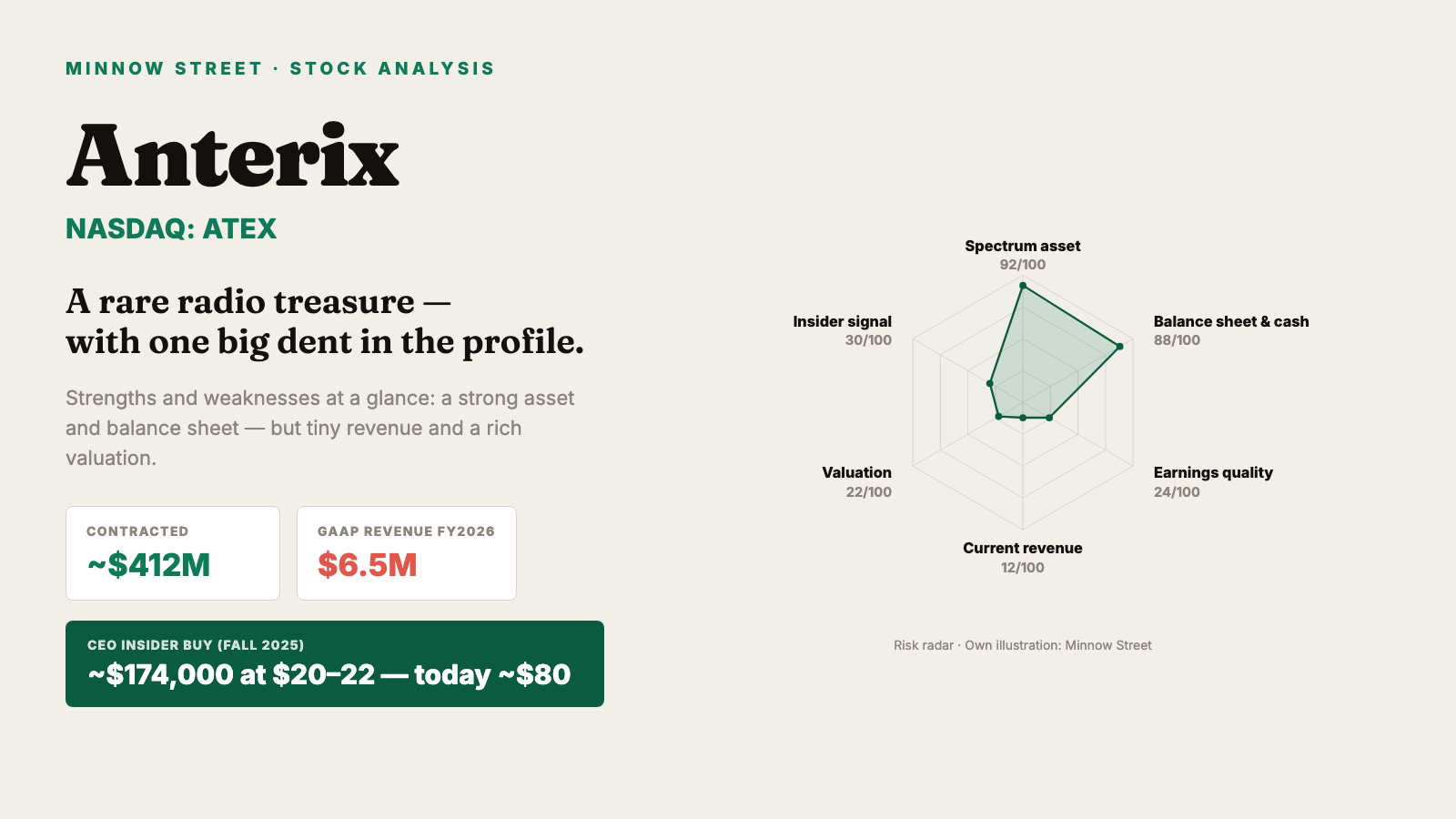
Anterix (Nasdaq: ATEX) owns the largest contiguous block of 900 MHz radio spectrum in the United States and leases it to utilities. Our in-house stock scanner lights up four times at once: "CEO buys", "insiders buy (net)", "institutions + CEO buy", "institutional + insider build-up". We read the insider filings (Form 4) and the annual and quarterly reports: the CEO did buy — for about $174,000, but at $20 to $22 in the fall of 2025; at roughly $80 the same insiders are now selling. And the net income is a one-off from spectrum sales, while recurring revenue is just $6.5 million — against more than $2 billion of market value. A radio message that reaches you long after the sender moved on. Not investment advice — just the difference between a real asset and the price you pay for it today.
 Thomas Mücke
Founder & Publisher
Thomas Mücke
Founder & Publisher
Chart
Interactive price chart (TradingView).
Note: pure fact-based analysis, not investment advice and not a solicitation to buy or sell. All figures without guarantee.
Picture a strong signal coming in over the radio: "Buy! The people at the top are stepping in themselves." It sounds loud and convincing — so you reach for the stock. What you do not hear: the transmitter sent that message months ago, from a different world in which the shares cost $20. By now they trade at $80, and the same transmitter has long been broadcasting the opposite. Call it the signal from the past: a buy signal that reaches you only after the price has moved somewhere else entirely. With Anterix, Inc. (Nasdaq: ATEX) the trap is unusually fitting, because Anterix lives on radio — it owns the largest contiguous block of 900 MHz spectrum in the United States. And our in-house stock scanner lights up four times at once: "CEO buys", "insiders buy (net)", "institutions + CEO buy", "institutional + insider build-up". So let's make a deal: before you follow the signal, we read together when it was sent, how large the buy was — and what actually stands behind the more than $2 billion of market value in the way of revenue. In the end, you decide for yourself.
So you know where we are heading, here is the central tension that runs through the whole analysis: Anterix owns a real, rare treasure — spectrum you cannot simply build a copy of, plus a debt-free balance sheet and hundreds of millions of prepayments already collected. At the same time, almost everything driving the stock right now is a look in the rear-view mirror: an insider buy from the lows, a profit made of one-off items, and a revenue line that is tiny. Substance versus story, past versus price. Remember this tension — it returns at the end.
What Anterix actually does
Imagine you own a specific, legally protected frequency in the airwaves — a "lane" on the radio highway that no one else may use. That is Anterix: the company holds nationwide licenses for the 900 MHz band, and specifically the largest contiguous slice of it in the United States (plus Hawaii, Alaska and Puerto Rico). Anterix builds no network of its own and sells no handsets. It leases or sells this radio lane to utilities — electric, gas and water companies — so they can run their own private wireless network over it. Why would a utility want that? Because their grids are becoming ever more digital (smart grid, remote maintenance, sensors on every line) and they need a network that belongs to them alone and does not collapse when everyone on the public cellular network is on the phone at once.
Two things make this business special. First, it is capital-light — Anterix has just 63 employees and runs no factory; the value sits in the license. Second, and here is the catch: the contracts are long and slow. A utility pays a large sum up front, but the network switch takes years, and in accounting terms a 20-year lease is spread across its entire life. Remember the image: a landlord with a first-class, scarce property who collects 30 years of rent in advance — but is only allowed to show one-thirtieth of it in the income statement each year. Exactly that gap between "collected" and "reported" is the core of the whole Anterix story. First, though, let's see why the stock lands on our radar at all.
Where the stock shows up in our scanner
Every day we run thousands of stocks through our in-house stock scanner. Anterix trips a whole row of filters (data as of July 10, 2026), and two families stand out. One is momentum: the stock is a "stage-2 leader", trades above its moving averages, and shows up in "power trend", "Qullamaggie top gainers 6M" and "RS leader (≥90)" — no surprise, the price rose about 260 percent in six months. The other, more interesting family is the insider signal: "CEO buys", "insiders buy (net)", "institutions + CEO buy" and "institutional + insider build-up". To replicate it yourself: open one of those filters in the scanner and look for the ATEX row.
Now the honest part the "signal reflex" likes to skip: a scanner name tells you THAT an insider bought — not WHEN and HOW MUCH. And this is exactly where the insider filings (Form 4), which every officer and director must file, earn their keep. What do they say? The only genuine open-market buys (transaction code "P") came from CEO Scott Lang: 4,650 shares at $21.28 (September 19, 2025), 2,450 at $20.41 (December 10, 2025) and 1,160 at $21.61 (December 19, 2025) — together roughly 8,260 shares for about $174,000. Add a token buy by the then-CFO Timothy Gray (50 shares, about $1,100). Put it in proportion: Lang's purchase equals about 4.6 percent of his annual pay of $3.81 million (fiscal year 2026, per the proxy statement). That is more than a pure alibi — and he bought near the low. But it is no all-or-nothing, millions-on-the-line commitment. How little a single insider buy carries on its own is the same lesson a loud crowd taught us at AMC Entertainment: attention is not a number.
And here is the part that turns the signal into a message from the past: these buys happened at $20 to $22. When the stock stood at roughly $80 half a year later (May/June 2026), the same insiders did the opposite — CEO Lang, new CFO Elena Marquez and chief legal officer Gena Ashe exercised options and sold shares in size (Ashe alone roughly 17,700 shares at $81 to $82). The insider picture is therefore split in two: bought at the bottom, distributed at the top. The scanner's "insiders buy" signal is real — but it describes the fall of 2025, not the summer of 2026. A buy signal that reaches you after a quadrupling is an echo, not a live transmission. So let's look at what the numbers themselves say.
The numbers over the years
Let's start with what genuinely impresses — because Anterix has locked in customers you do not win easily. Over the past several years the company has signed contracts with roughly ten utilities whose total volume adds up to about $412 million: leases to Ameren, Evergy, Xcel Energy and Tampa Electric (TECO), plus sales to San Diego Gas & Electric, Oncor (a single $102.5 million deal), the Lower Colorado River Authority, CPS Energy and others. And the best part: of that $412 million, roughly $360 million has already arrived as cash — most of it sits in the bank or as a prepayment on the balance sheet. For a company with 63 employees and no meaningful debt, that is remarkable substance. The chart below shows the flip side at once:
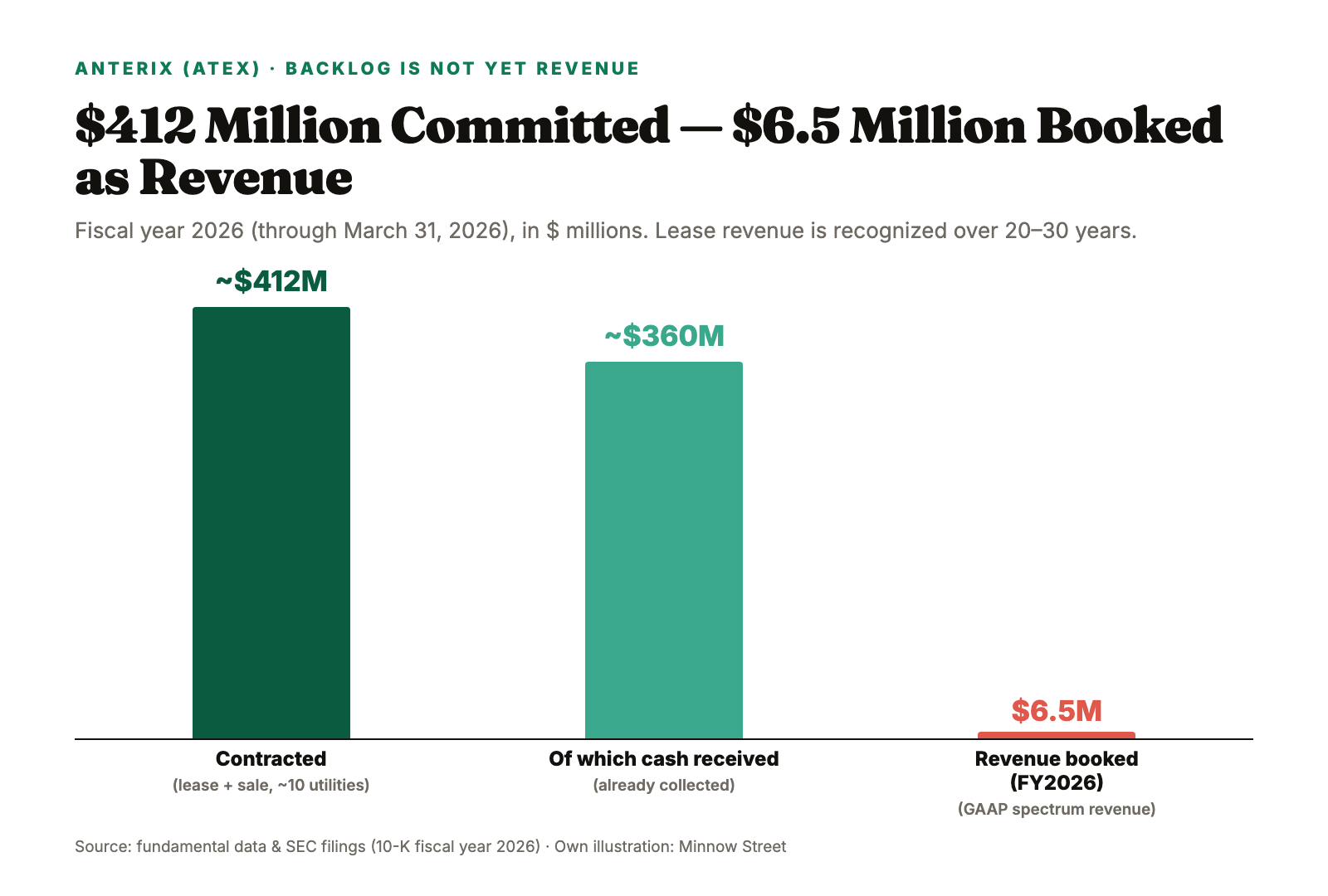
Read the chart slowly: the left bar is huge, the right one almost invisible. Why the gap? Because Anterix is not allowed to show a lease as revenue right away — it must stretch it over the contract term, and that term is long. The company says so itself; we get to the verbatim quote in a moment. The second chart explains why the company still reports a fat profit for fiscal year 2026 — and why that profit should be handled with care:
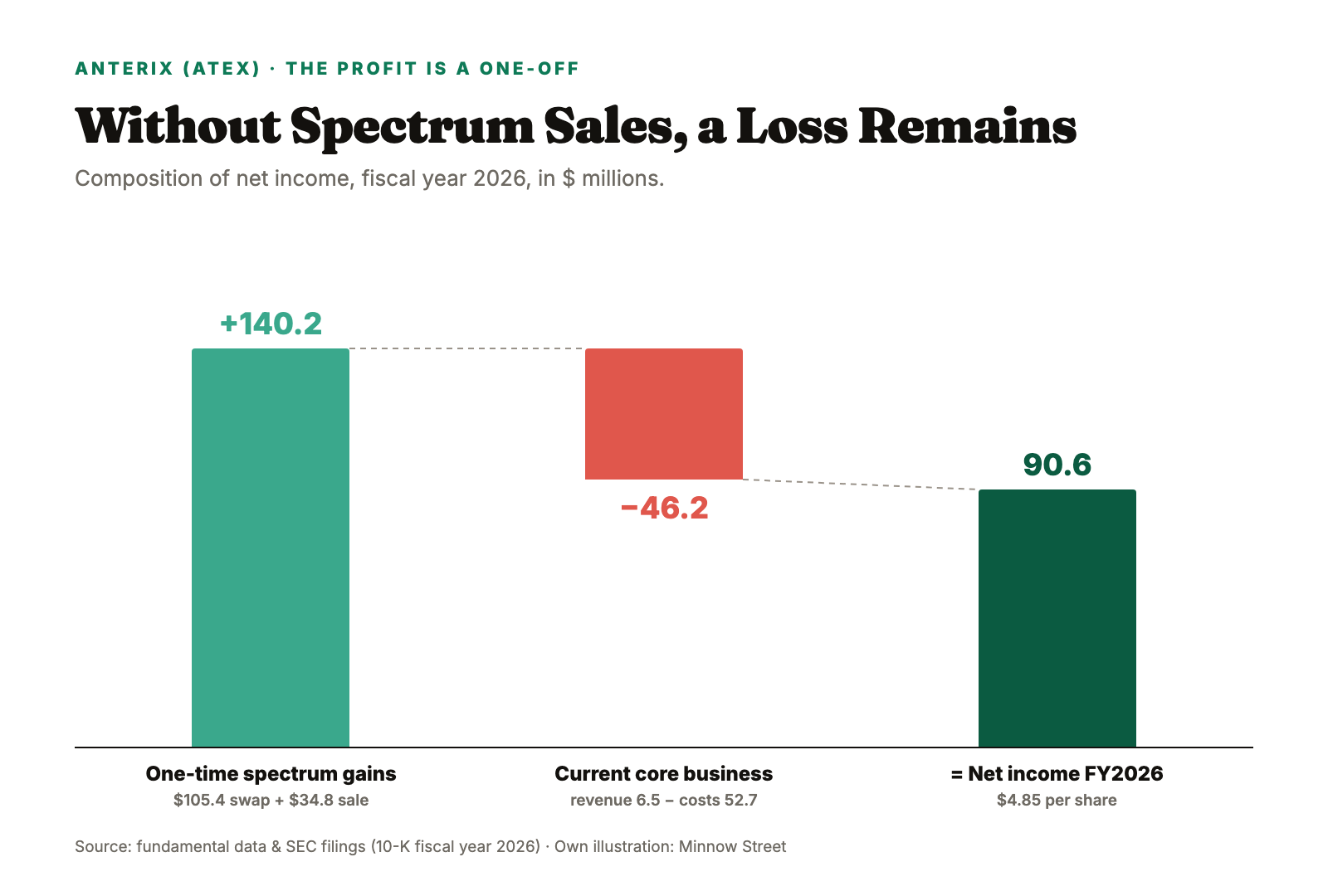
This is the second, decisive gap: net income of $90.6 million (fiscal year 2026, $4.85 per share) sounds like a company that has completed its turnaround. In truth it comes almost entirely from one-off items — Anterix swapped and sold individual pieces of spectrum and booked gains of roughly $140 million on them. Strip those out and the recurring business, with about $6.5 million of revenue against $52.7 million of costs, is clearly a loss-maker. That said, the balance sheet is a fortress — practically no debt, $98.5 million in cash as of March 31, 2026, plus the prepayments already collected. Now to the three uncomfortable truths the signal reflex likes to talk over.
What the filings say — the uncomfortable truths
Uncomfortable truth no. 1: The backlog is impressive — but it only trickles into revenue
The pretty contract story has a catch that Anterix describes soberly itself: lease payments are not booked when they are collected but spread across the entire, very long contract term. The annual report (10-K) puts it plainly:
"For spectrum lease agreements, we record these advanced payments as deferred revenue on our Consolidated Balance Sheets and recognize revenue over the term of the lease, which is typically 20 to 30 years."
— Anterix, Inc., SEC annual report 10-K for fiscal year 2026, Item 7 "Management's Discussion and Analysis"
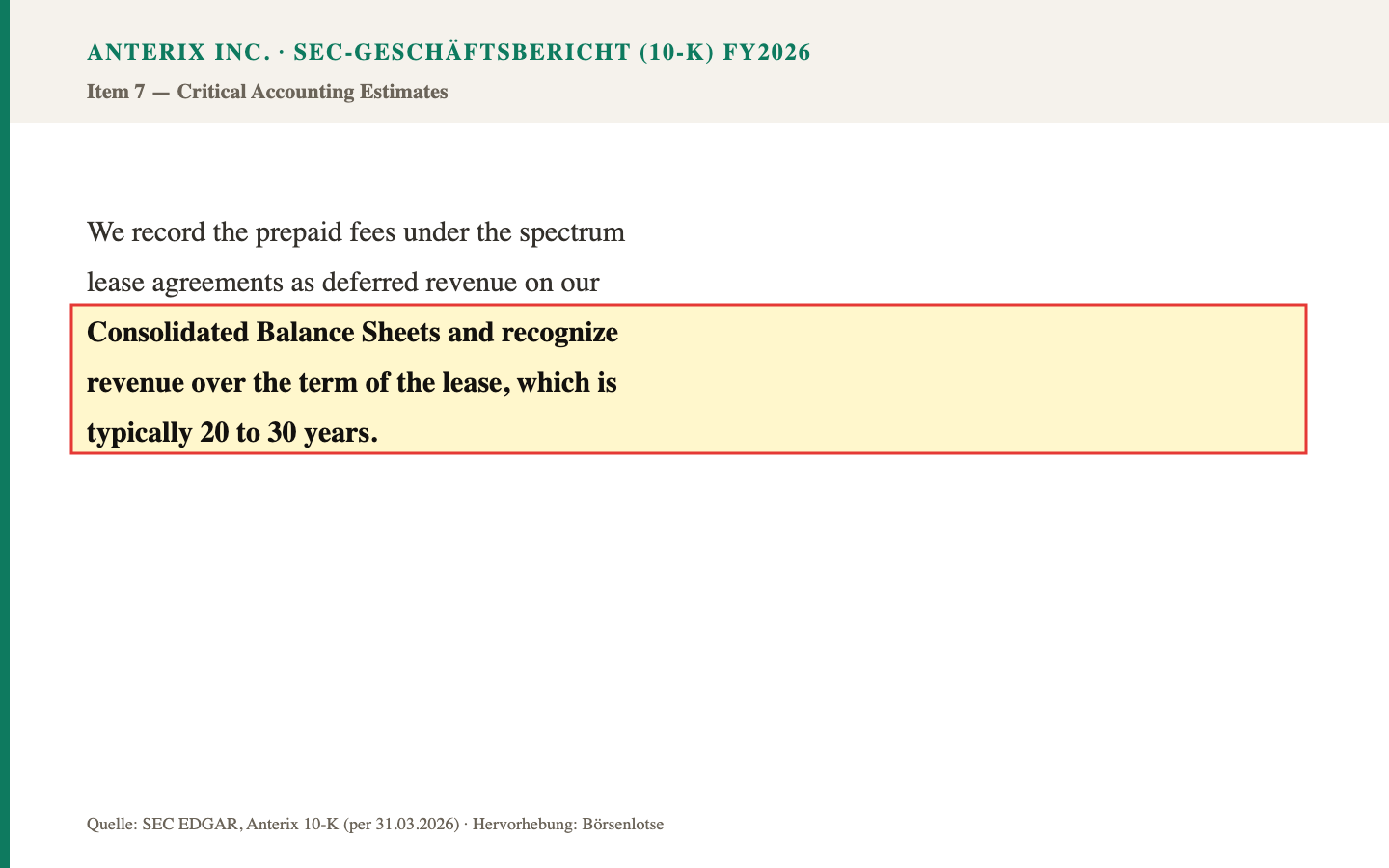
In fairness: this is not a trick but correct accounting — and the money is largely already in hand. But it explains perhaps the most startling figure in the whole analysis: on a market value of about $2.08 billion and reported revenue of $6.5 million, the price-to-sales ratio is roughly 320. For comparison, a normal growth company sits at 5 to 15. That 320 can only be justified if you measure the value not against today's revenue but against the asset value of the spectrum and the hope that the trickle one day becomes a stream. How a large headline number can shrink to a thin present is something we also walked through at fiber supplier Clearfield, where the market likewise pays for a future the filings do not date.
Uncomfortable truth no. 2: Without the one-time gains, the core business has lost money since inception
The fat profit of fiscal year 2026 hides the fact that Anterix has never made money on an ongoing basis. The company says so itself, with striking candor, in its risk factors:
"we have had net losses most years since our inception and may not achieve or maintain profitability in the future"
— Anterix, Inc., SEC annual report 10-K for fiscal year 2026, Item 1A "Risk Factors"
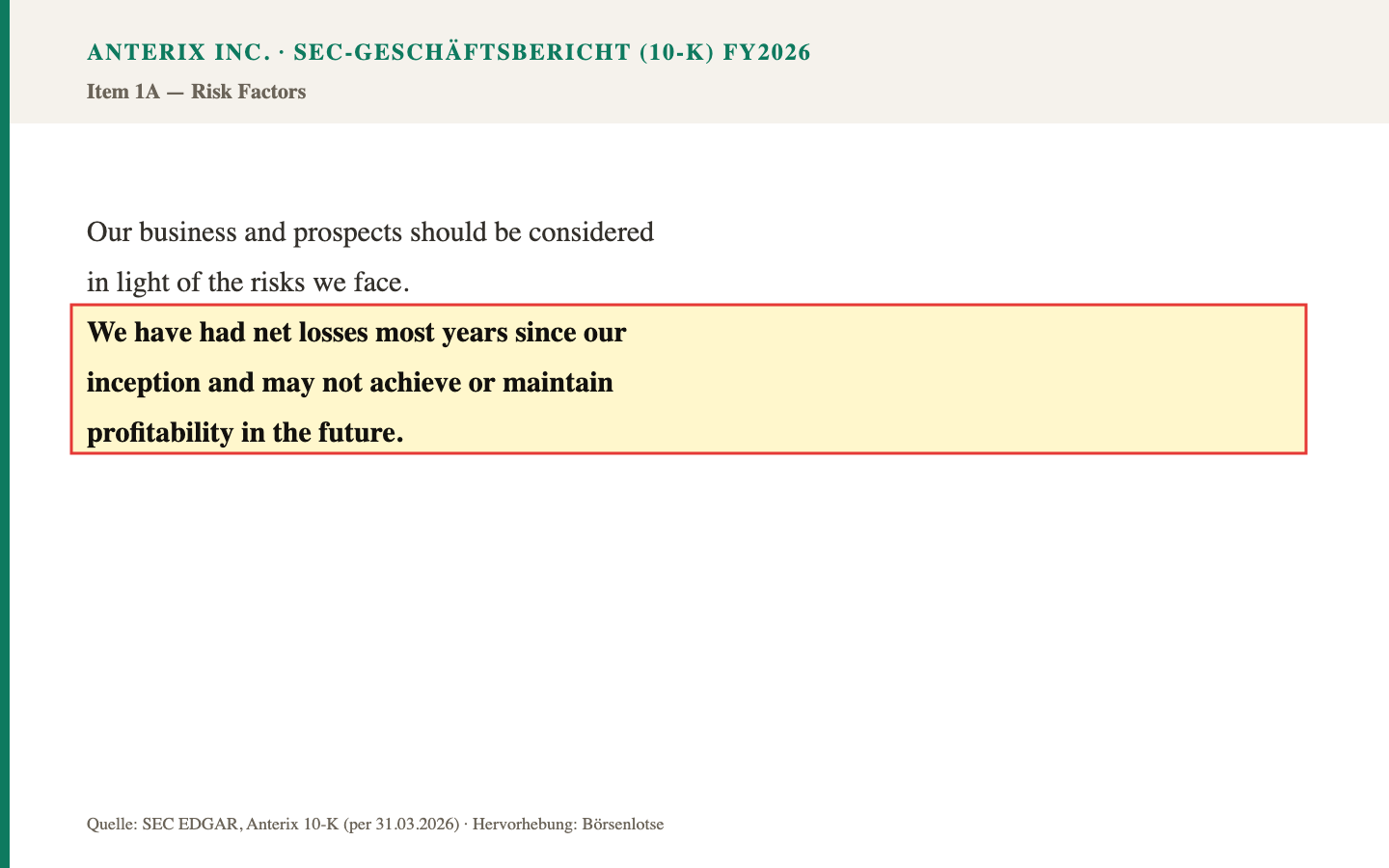
This is the sober truth behind the jump in profit: the prior year still showed an $11.4 million net loss; only the spectrum sales flipped the sign. As long as Anterix has more recurring costs than recurring income, every annual profit depends on the company continuing to sell the family silver — pieces of its valuable spectrum. That can be smart (you turn a dormant asset into cash), but it is not a self-sustaining, growing business. Remember: a profit that comes from selling assets is a different animal from a profit that comes from running the business.
Uncomfortable truth no. 3: Few utilities, a slow switch, and the FCC holds the key
Anterix hangs on a handful of large customers and on a regulatory process. Its revenue is so thin and so concentrated that, per the notes, essentially every spectrum customer except one individually cleared 10 percent of total revenue — the company states the concentration itself:
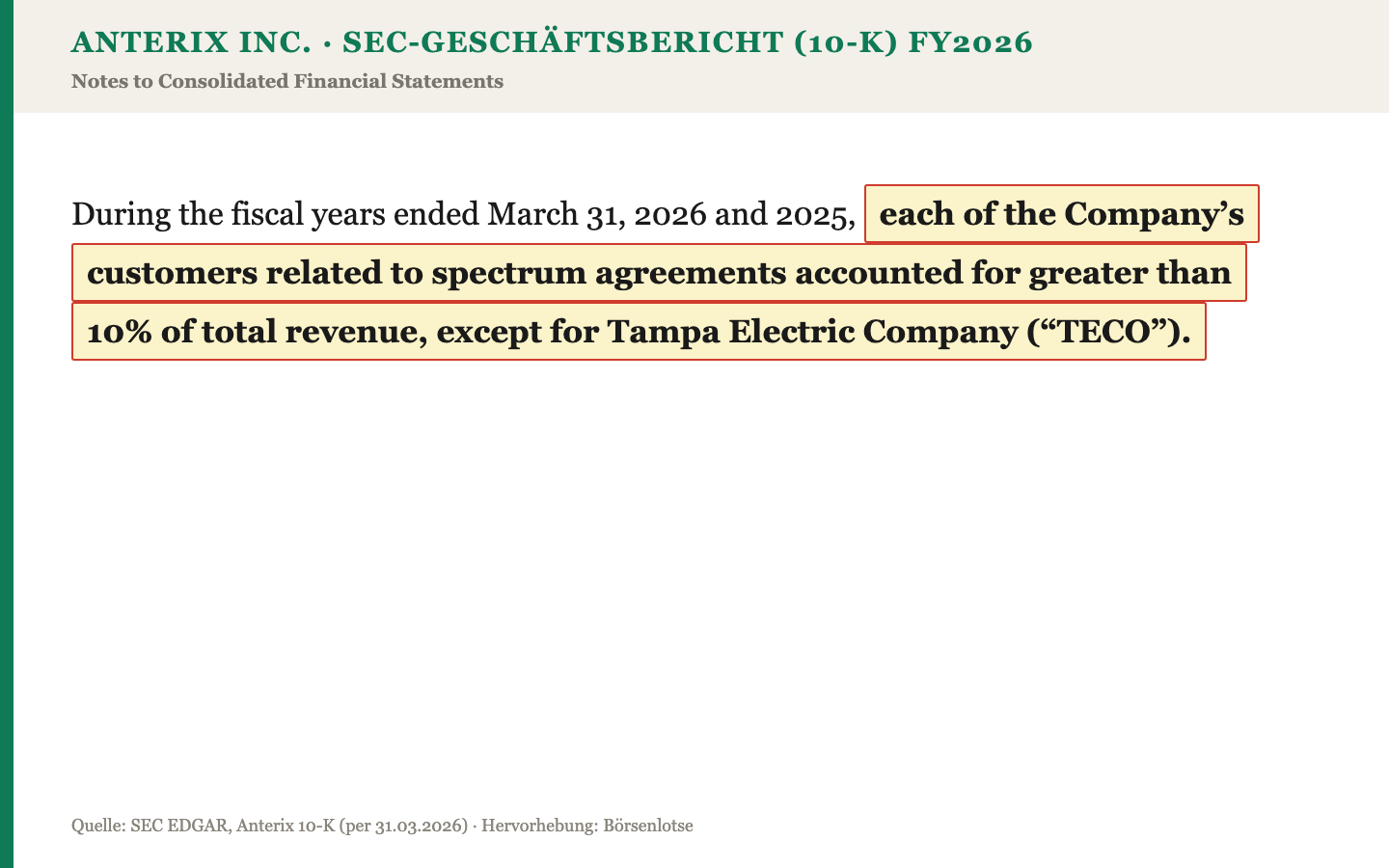
"During the years ended March 31, 2026 and 2025, each of the Company's customers related to spectrum agreements accounted for greater than 10% of total revenue, except for Tampa Electric Company ("TECO")."
— Anterix, Inc., SEC annual report 10-K for fiscal year 2026, Notes to Consolidated Financial Statements, "Concentrations"
In fairness: the counterparties are creditworthy, regulated utilities — default risk is low, and a large share of the money has already been received. But the concentration remains a cluster risk: a few large contracts carry almost everything, and each utility decides in its own slow time whether and when to switch its network. On top of that comes a factor Anterix does not control at all: the U.S. Federal Communications Commission (FCC) has to clear and organize the spectrum's use. To be fair, the FCC recently delivered — it widened the broadband band from 6 to 10 MHz, which makes Anterix's spectrum more valuable. But it shows: a piece of the fate rests with an agency, not with the company.
Valuation — what the price really claims
Now the price question, and it is unusual for Anterix. Classic ratios run into the void: the price-to-sales ratio of about 320 is absurdly high; the price-to-earnings ratio of about 19 to 22 looks optically normal — but only because the denominator holds the one-time gain that does not repeat every year. Both numbers are of little use. The only sensible yardstick for Anterix is the asset value of the spectrum: how much is the scarce, nationwide 900 MHz license worth as more and more utilities have to modernize their grids? That is exactly what the market is betting on when it pays $2.08 billion for a company with $6.5 million of recurring revenue. It can work out — spectrum is a finite good, and Anterix holds the largest piece. But it can also become an expensive test of patience if the utilities keep taking years.
And the professionals' view? Only a handful of analysts cover the stock; the average price target sits in the neighborhood of $80 — roughly at the level last reached, after the stock gained about 260 percent in six months. In plain terms: the market has already priced in the good spectrum story and the FCC expansion. It is also notable that roughly 15 percent of the float is sold short — a tangible bet against the move. Remember the tension: a unique asset, but a price that already generously anticipates that asset.
Opportunities and risks at a glance
What speaks for Anterix:
- A unique, scarce asset: the largest contiguous block of 900 MHz spectrum in the United States — hard to replicate, with a structural tailwind from utilities modernizing their grids; the FCC widened the broadband band from 6 to 10 MHz.
- A balance-sheet fortress: practically debt-free, $98.5 million in cash, plus roughly $360 million of prepayments already collected on contracts worth about $412 million in total.
- A capital-light model: just 63 employees, no factory; the CEO bought his own shares near the low in the fall of 2025 for about $174,000, and the $250 million buyback program is only lightly used.
- A strategic pivot with effect: through targeted spectrum sales to utilities, Anterix turns dormant family silver into cash — and booked gains of roughly $140 million on it most recently.
What speaks against it:
- An extreme valuation: a price-to-sales ratio of about 320 on just $6.5 million of recurring revenue; the price already generously anticipates the spectrum's asset value (analyst target roughly at the current price, about 15 percent of the float sold short).
- A profit made only of one-off items: the $90.6 million net income (fiscal year 2026) comes from spectrum swaps and sales; the recurring core business loses money — "net losses most years since our inception".
- The backlog-versus-actual gap and a slow switch: lease revenue is stretched over 20 to 30 years; a few large utilities (TECO the exception below 10 percent of revenue, the top three contracts more than half of the contract volume) set the pace, and the FCC holds part of the key.
- The insider signal is a rear-view mirror: the buys landed at $20 to $22; at around $80 the same insiders sold (option exercises). Add governance turbulence: activist Heard Capital on the board (since August 2024), a contested 2025 annual meeting and a change at the top.
A human conclusion
Remember the signal from the past from the opening — the loud buy signal that reaches you only after the sender has moved on? After reading the insider filings you can now place it cleanly. The CEO really did buy, for about $174,000, and he did it well: near the low at $20 to $22. But that message dates from the fall of 2025. At around $80 the same people are broadcasting the opposite — they are selling. The scanner's "insiders buy" signal is genuine and was once valuable; today it is an echo.
And the company itself? It is the opposite of a hollow story: a unique, rare asset, a debt-free balance sheet, hundreds of millions of prepayments already collected. That is the strong, substantial half of the tension. The other half sits in the fine print: recurring revenue of just $6.5 million, a profit from one-time sales, a quadrupling of the price that already generously prices in the asset value. Anterix owns a real treasure — the question is no longer whether the treasure exists, but how much you pay for it today and how long you have to wait for it to be lifted.
What you make of that is your decision. And that is exactly as it should be. What matters is that you know what you are betting on: not on a fresh insider commitment and not on a self-sustaining profit engine, but on the asset value of a scarce radio spectrum — at a price that already largely anticipates that value. The scanner shows you that insiders bought and the price is running. When they bought, and what stands behind the profit, it does not tell you — that is in the filings, and now you know both sides.
Sources
- Anterix, Inc. — SEC annual report 10-K for fiscal year 2026 (period ended March 31, 2026; filed June 25, 2026)
- Anterix, Inc. — SEC quarterly report 10-Q as of December 31, 2025 (filed February 11, 2026)
- Anterix, Inc. — SEC proxy statement DEF 14A (June 25, 2026) — CEO Scott Lang compensation, board including William E. Heard
- Anterix, Inc. — SEC insider filings (Form 4) 2025/2026 — CEO buys (code "P") at $20–22 and sales at around $80
- Anterix, Inc. — SEC Schedule 13D of Heard Capital LLC (William E. Heard, July 29, 2024)
- Fundamental data (metrics, valuation, analyst consensus, share and float data); in-house stock scanner, data as of July 10, 2026.
Transparency & disclaimer: This analysis is a journalistic contextualization of publicly available information and is not investment advice, not a financial analysis in the regulatory sense, and not a solicitation to buy or sell securities. Stock investments carry substantial risks up to total loss. All information without guarantee; the data cut-off is noted in the text in each case. The author holds no position in Anterix stock at the time of publication.
Our Bottom Line at a Glance
- Insider signal — timing & size neutral
- Real, but a rear-view mirror: the only genuine open-market buys (code "P") came from CEO Scott Lang — roughly 8,260 shares for about $174,000 at $20–22 in the fall of 2025 (about 4.6 percent of his $3.81 million annual pay). At around $80 (May/June 2026) the same insiders exercised options and sold. The four-fold scanner signal describes the fall of 2025, not the summer of 2026 — an echo, not a fresh commitment.
- Spectrum asset & balance sheet positive
- The strong side: the largest contiguous 900 MHz spectrum block in the U.S. — scarce, hard to replicate, with a structural tailwind from grid modernization; the FCC widened the broadband band from 6 to 10 MHz. Plus a balance-sheet fortress: practically debt-free, $98.5 million in cash and roughly $360 million of prepayments already collected (contracts worth about $412 million).
- Backlog-vs-actual & earnings quality negative
- Backlog is not yet revenue: lease income is stretched over 20 to 30 years, and reported revenue in fiscal year 2026 was only $6.5 million. The $90.6 million net income comes almost entirely from one-time spectrum gains ($105.4 + $34.8 million); the recurring core business loses money, "net losses most years since our inception".
- Concentration & regulation negative
- A few large utilities carry almost everything: revenue is so thin that each spectrum customer except TECO cleared 10 percent of total revenue, and the three largest contracts (Oncor, Xcel, San Diego) make up more than half of the contract volume. Each customer moves at its own slow pace; the FCC holds part of the key. Add governance turbulence: activist Heard Capital on the board (since August 2024), a contested 2025 annual meeting and a change at the top.
- Valuation & market negative
- Extreme: a price-to-sales ratio of about 320 on $6.5 million of recurring revenue; the price-to-earnings ratio of about 19–22 is distorted by the one-time gain. The price already generously anticipates the spectrum’s asset value — the analyst target sits roughly at the current price (after +260 percent in six months), with about 15 percent of the float sold short as a counter-bet.
Anterix is a substance riddle: it owns the largest contiguous 900 MHz spectrum block in the United States, is practically debt-free, and has already collected about $360 million on contracts worth roughly $412 million — real substance. Yet almost everything driving the stock is a rear-view mirror: the four-fold scanner insider signal rests on CEO buys of about $174,000 at $20–22 in the fall of 2025, while the same insiders sold at around $80; net income of $90.6 million came from one-time spectrum sales, and recurring revenue is just $6.5 million (price-to-sales about 320). The treasure exists — the question is how much you pay for it today and how long you wait for it to be lifted. Not investment advice.
What Our Rating Means
- If you don't own the stock
- As long as the question raised in the bottom line stays open, we see no basis for an entry.
- If you hold it in your portfolio
- Our findings offer no acute reason to sell — the checkpoints named remain decisive.
A journalistic assessment by our editorial team at the time of the deep dive, based on public sources — not investment advice and not a solicitation to buy or sell. Your personal circumstances (investment goals, risk capacity, taxes) cannot be taken into account. What our categories mean, how verdicts are formed, and what conflicts of interest exist →
Worth Noting
- Materiality gate (July 10, 2026) — finding by finding: (1) Extreme valuation (price-to-sales ~320): a price finding, weighty because after +260 percent in six months it already anticipates the entire spectrum asset value (analyst target roughly at the current price) → shifts the verdict, not an existential finding. (2) Profit only from one-off items ($105.4 + $34.8 million of spectrum gains carry the $90.6 million net income; core business loss-making): a structure/quality finding — real, but not existential given the debt-free, cash-backed balance sheet. (3) Backlog-vs-actual gap ($412 million committed, ~$360 million cash in hand, but only $6.5 million GAAP revenue, leases stretched over 20–30 years): a structure finding, systematic, not fraud. (4) Customer concentration (each spectrum customer except TECO over 10 percent of revenue; top-three contracts Oncor/Xcel/San Diego over half the volume) with creditworthy, regulated utilities and most of the money already received → structure finding, mitigated. (5) Insider signal stale (bought at the bottom, sold at the top): devalues the scanner’s bull case, but is signal quality, not a company-existence finding. Result: no existential finding (hence not "caution"), but several stacked price/structure findings plus a devalued signal against a richly priced asset → "watch" (not "buy"/"hold", because there is no margin of safety at the current level).
- Insider-buy verification (Form 4): open-market buys (transaction code "P") — CEO Scott A. Lang 4,650 shares at $21.28 (09/19/2025), 2,450 at $20.41 (12/10/2025), 1,160 at $21.61 (12/19/2025) = ~8,260 shares / ~$174,000; former CFO Timothy Gray 50 shares at $22.07 (~$1,100). Counter-check: at around $80 (May/June 2026) option exercises (code "M") and sales (code "S") by Lang, CFO Elena Marquez and CLO Gena Ashe (Ashe ~17,700 shares at $81–82). CEO total compensation FY2026 $3,808,874 per the DEF 14A (June 25, 2026); Lang holding roughly 564,000 shares.
- Backlog build-up: lease contracts Ameren $47.7 / Evergy $30.2 / Xcel $80.0 / TECO $34.5 million = $192.4 million; sale contracts SDG&E $50.0 / LCRA $30.0 + $13.5 extension / Oncor $102.5 / CPS $13.0 / TNMP $3.2 / NWE $7.7 million = $219.9 million; total roughly $412 million, of which ~$360 million payments received, ~$52 million outstanding (10-K FY2026, spectrum lease/sale tables). Deferred revenue on the balance sheet roughly $161 million. Cash $98.5 million (03/31/2026), debt-to-equity ~0.02.
- Special-situation screening (EDGAR submissions, re-checked July 17, 2026): activist Heard Capital LLC (William E. Heard) filed a Schedule 13D on July 29, 2024, and has sat as an independent director since August 2024; the 2025 annual meeting was contested (DEFN14A / non-management proxy). As of mid-July 2026 the governance situation is still live: additional proxy materials (DEFA14A, July 17, 2026) for the annual meeting scheduled for August 4, 2026, and an amended activist filing (Schedule 13D/A, July 8, 2026) from Heard Capital — consistent with the contest described above; a formal, announced sale process of the whole company was NOT evidenced in the filings. The FY2026 10-K figures remain the basis of this analysis. The FCC report and order widened the 900 MHz broadband segment from 6 to 10 MHz.
- Price and valuation figures are dated to mid-2026 (market value about $2.08 billion on roughly 19.5 million shares); analyses are evergreen, daily prices are not a buy argument. AI classification: category "neutral" (rated July 10, 2026) — no AI revenue source, no concrete AI business risk, no documented operational use of AI; AI appears only in passing as a possible customer application ("AI-enabled edge applications"). Anterix’s fiscal year ends March 31 — every quarterly reference carries that offset.
Frequently Asked Questions
Anterix, Inc. (Nasdaq: ATEX) owns the largest contiguous block of 900 MHz radio spectrum in the United States and leases or sells it to utilities (electric, gas and water companies). Those utilities run their own private LTE / broadband network over it to modernize their grids (smart grid). Anterix builds no network itself — the value sits in the scarce radio license. The company has just 63 employees and is based in Woodland Park, New Jersey; its fiscal year ends March 31.
Because lease income is spread across the contract term in accounting terms — per the annual report (10-K), typically 20 to 30 years. The utilities’ large prepayments (about $360 million already received, on contracts worth roughly $412 million) sit on the balance sheet as deferred revenue and are released as revenue only in slices. Reported revenue in fiscal year 2026 was therefore only $6.5 million — backlog is simply not yet revenue.
Real, but a rear-view mirror. Per the insider filings (Form 4), CEO Scott Lang made the only genuine open-market buys (code "P"): roughly 8,260 shares for about $174,000 — but at $20 to $22 in the fall of 2025, near the low. That is about 4.6 percent of his $3.81 million annual pay. Importantly, when the stock stood at around $80 in May/June 2026, the same insiders exercised options and sold. The scanner’s "insiders buy" signal therefore describes the fall of 2025, not the summer of 2026.
Only on paper, and only through one-off items. Net income of $90.6 million (fiscal year 2026, $4.85 per share) came almost entirely from one-time spectrum gains ($105.4 million on a swap, $34.8 million on sales). The recurring core business (revenue of $6.5 million against $52.7 million of costs) loses money; per its own annual report, Anterix has had "net losses most years since our inception". The prior year showed an $11.4 million net loss.
Because classic ratios run into the void at Anterix. The market is not valuing the tiny recurring revenue but the asset value of the scarce 900 MHz spectrum and the hope that more and more utilities lease or buy it. On a market value of about $2.08 billion and $6.5 million of revenue, that works out to a price-to-sales ratio of about 320. The bet can pay off (the spectrum is finite and valuable), but the price already anticipates much of it — the analyst target sits roughly at the current price, and about 15 percent of the float is sold short.
No, not as a business of its own. In the SEC filings we reviewed there is no AI revenue source, no concrete AI business risk to its own model and no documented operational use of AI; AI is mentioned only in passing as a possible application that utilities might run over the private network ("AI-enabled edge applications"). In our AI classification, ATEX is therefore rated "neutral".
Found an error?
Did you spot a factual error, an outdated number, or a typo in this deep dive? Let us know briefly — your report goes straight to the editorial team.