Allient Stock: Earned Strength at the All-Time High — and What the Optimism Costs
In twelve months, motion-technology specialist Allient has nearly tripled and fires in 23 of our scanners — from the all-time high to institutional accumulation. This time the strength is real: the operating margin climbed from 5.7 to 7.9 percent, order intake grew 15 percent, net income 70 percent. We read the annual and quarterly reports — and also did the math that tends to drown in the cheering: $134 million of goodwill from the acquisitions, $140 million of net debt, cyclical end markets — and a price-to-earnings ratio around 62 that makes even the analysts frown. Whoever buys a winner pays for good news that has already happened.
 Thomas Mücke
Founder & Publisher
Thomas Mücke
Founder & Publisher
Chart
Interactive price chart (TradingView).
Note: pure fact-based analysis, not investment advice and not a solicitation to buy or sell. All figures without guarantee.
There is a thinking error that grabs us investors precisely when everything is going well: we take the recent past and simply extend it into the future. Psychologists call it recency bias — the brain weights what happened last far more heavily than the long history before it. A stock that has nearly tripled in a year therefore feels like a certainty: "It's working, it will keep working." At Allient (Nasdaq: ALNT), that reflex is exactly this tempting — the chart sits at the all-time high, our scanners glow green, the numbers point up. So let's make a deal: before you chase a winner, we read together what the company filed with the U.S. securities regulator, the SEC — and what the optimism costs. An annual report is honest under penalty of law. In the end, you decide for yourself.
So you know where this is going, here is the tension that runs through the whole analysis: at Allient the strength is real — unlike many a scanner hit, a genuine operational turnaround hides here. The question is not whether the company is good, but whether the price has already baked in the good news. Remember this sentence: an all-time high is strength and altitude in one.
What Allient actually does
When a machine moves — a robot arm, a hospital bed, a pump, a military vehicle — somewhere inside sits a component that creates and controls that movement. Allient builds exactly that: "controlled motion". Picture it as the muscles and nerves of machines — the muscles are the electric motors and drives (they generate the force), the nerves are the controllers, encoders and motion controls (they tell the muscle how fast, how far, how precisely). Concretely, Allient sells servo motors, brushless and torque motors, gear motors, digital drive amplifiers, motion controllers, optical encoders and — increasingly important — power-quality filters that keep the electricity clean for sensitive equipment. It sells into four end markets: industrial, vehicles, medical, and aerospace & defense.
Until August 2023 the company was called Allied Motion Technologies, and it has grown for years through acquisitions — a classic buy-and-build strategy: acquire many small specialists and merge them under one roof (Allient calls it "One Allient"). That explains the strength (technology breadth, diversification) and the burden (debt and goodwill) we will get to in a moment, both at once. A neat detail on the side: the current demand wave comes, of all places, from data centers — Allient's power-quality solutions safeguard the electricity there. It is the same infrastructure wave we have traced at FuelCell Energy and at Solaris Energy — only Allient sells no AI, but the drives and the clean power underneath.
Where the stock shows up in our scanner
Every day we run thousands of stocks through our in-house stock scanner. Allient is one of the strongest hits we have come across in weeks: 23 filters fire at the same time (data as of July 10, 2026). And they are not just any filters — it is a confluence of trend, strength and capital flow that you rarely see this cleanly:
- "Best of All" — the umbrella filter for stocks that lead in an unusually large number of quality and trend criteria. Allient posts one of the highest scores of all here.
- the all-time-high screen and "near 52-week high" — the price sits at or just below its highest level ever.
- "stage-2 leader" and "Stan Weinstein: Stage 2" — technically, the stock is in its advancing phase (above its rising moving averages).
- "institutional accumulation" — big money is buying; institutions in fact hold roughly 79 percent of the shares.
- Plus a whole bundle of momentum filters: "Qullamaggie top gainers", "Mike Webster power trend", "RS leader 90" and "Mark Minervini trend criteria".
Translated, that means: the price rose roughly 184 percent in twelve months and sits less than one percent below the all-time high — and the relative strength versus the broad market is exceptionally high. Here is how you get there yourself: on minnowstreet.com, open the "Scanner" menu, pull up the "Best of All" filter and look for the ALNT row. But — and now comes the honest part that recency bias likes to skip — many scanner hits do not mean "guaranteed winner". They describe what was: a strong trend that has held until today. Whether it keeps holding is decided not by the chart but by the business. So let's look at the business.
The numbers over the years
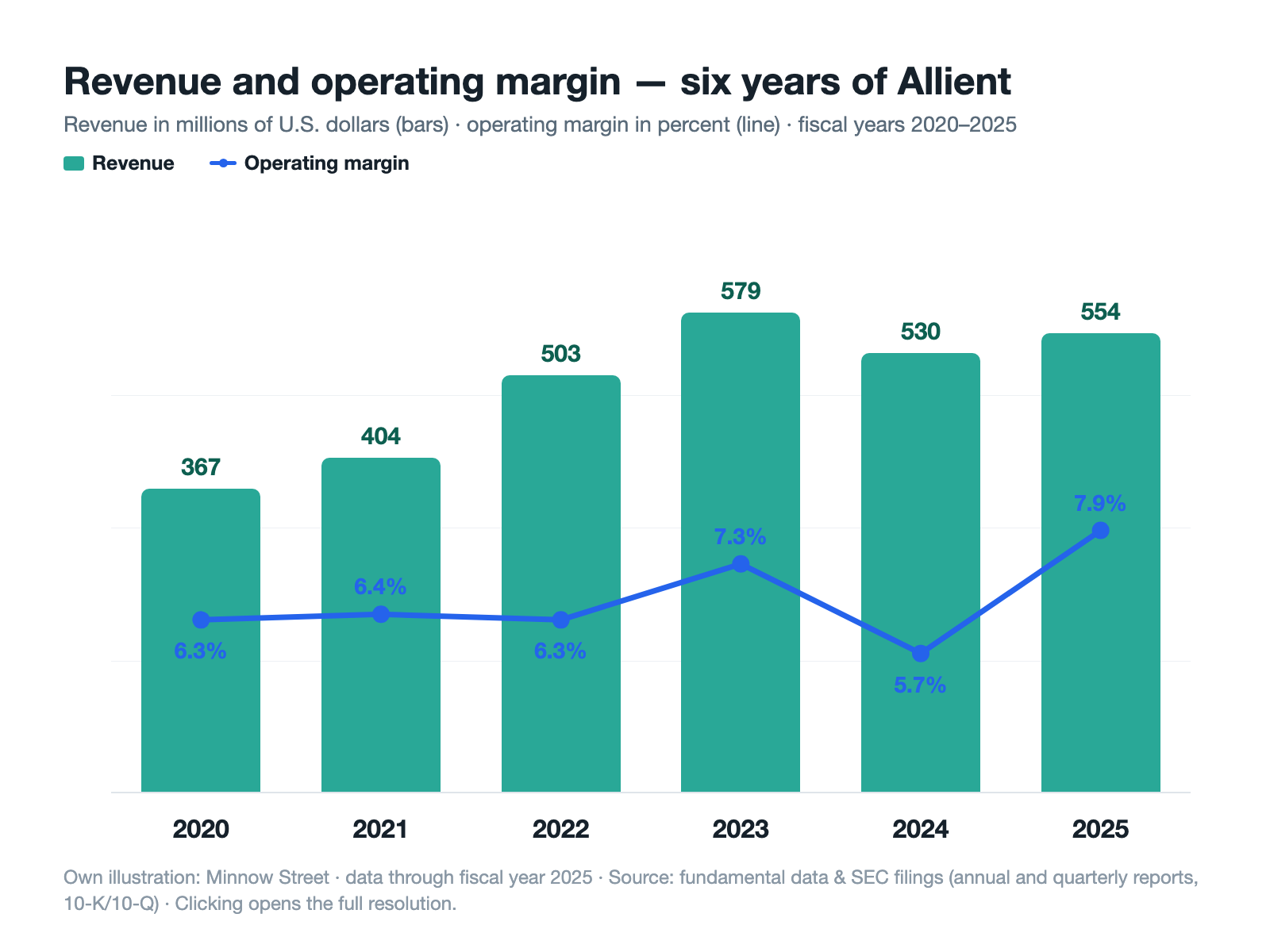
Let's start with what genuinely impresses — and at Allient, honestly, that is a lot. Revenue has grown over the years (with a dip in 2024), but the real story is the margin: the restructuring program launched in 2024, "Simplify to Accelerate NOW" — consolidating plants, streamlining the organization — has worked. The operating margin jumped from 5.7 percent (2024) to 7.9 percent (2025); the gross margin rose 150 basis points to 32.8 percent. On the bottom line, Allient earned roughly $22.0 million in 2025 ($1.32 per share) — 70 percent more than the year before.
Even more important for the future than yesterday's profit is the order intake: bookings rose 15 percent in 2025 to $550.9 million, the backlog to $232.9 million. The book-to-bill ratio — new orders relative to billed revenue — sits above one, meaning more comes in than is worked off. And the first quarter of 2026 confirmed the trend: revenue +4.6 percent to $138.9 million, net income +51 percent to $5.4 million, bookings up another 15 percent, backlog at $251.0 million. That is not a cycle illusion; that is operating substance. Which is exactly why Allient is no pretender — and exactly why we have to look all the more closely at the flip side.
The uncomfortable truths
With a loss-making company, the uncomfortable truths are obvious. With a winner they are quieter — but no less important. They are the shadow sides of a stock that has run well: the price the buy-and-build strategy leaves on the balance sheet, the cyclicality of the business, and the valuation after the rally.
Uncomfortable truth no. 1: Nearly a quarter of the balance sheet is goodwill
Growth through acquisitions has a price, and it sits on the balance sheet. When you buy a company for more than its tangible assets (machines, inventories, patents) are worth, the premium is booked as goodwill — simplified: the price of the hope that the whole is worth more than the sum of its parts. Goodwill is not money in the till but a balance-sheet item that is tested for its value once a year. If the test fails, an impairment follows that can hit earnings in one blow. At Allient this item has reached a remarkable size:
"As of December 31, 2025, we have $134,332 of goodwill recorded on our consolidated balance sheet, representing approximately 23% of total assets. … changes to the factors considered above could affect the estimated fair value of our reporting unit and could result in a goodwill impairment charge in a future period."
— Allient Inc., SEC annual report 10-K for fiscal year 2025, Item 1A "Risk Factors"
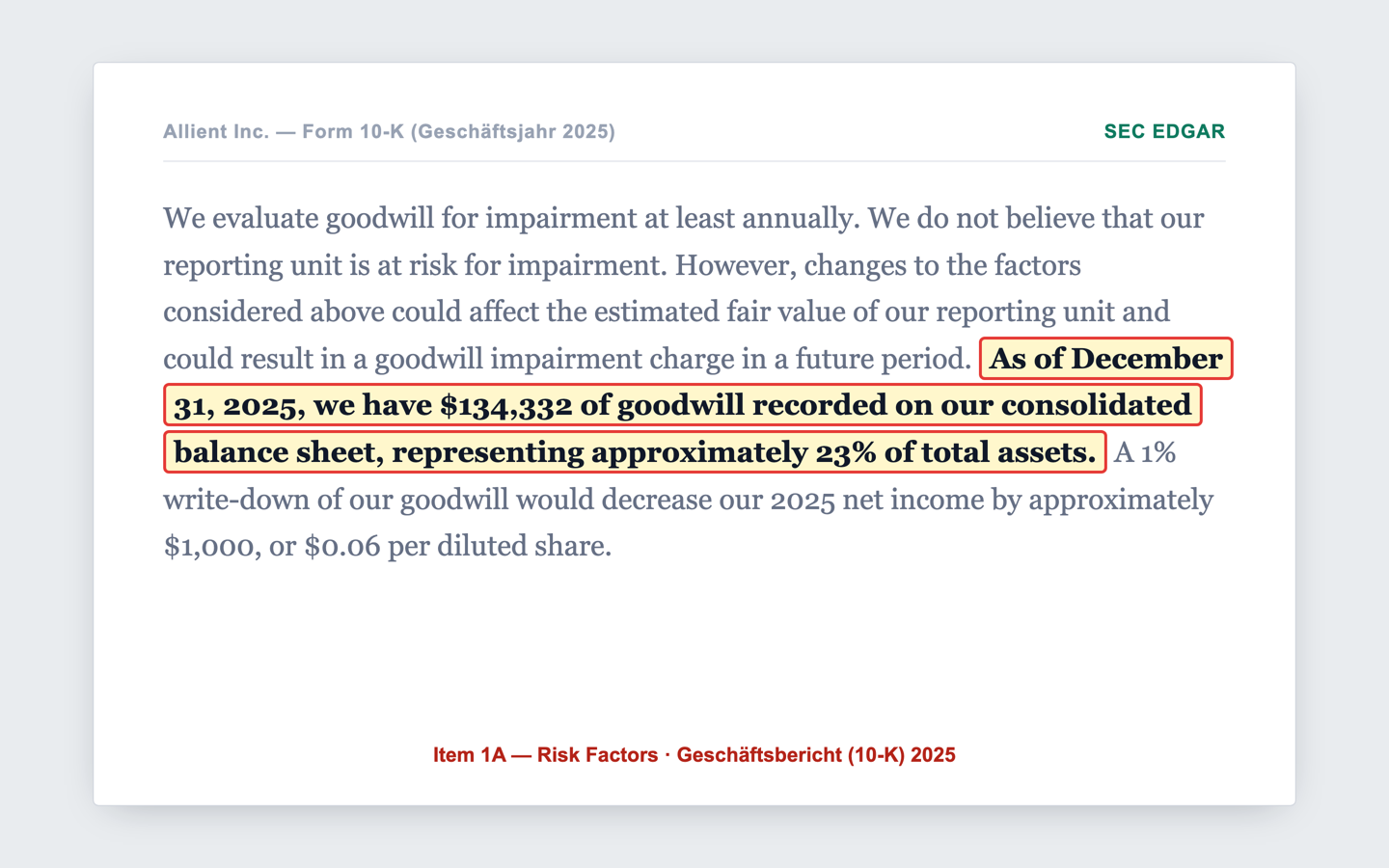
To be fair: Allient passed the annual test and sees no acute impairment danger. But 23 percent of the balance sheet — and roughly 45 percent of equity — hangs on the assumption that the acquisitions remain worth their price. In a weaker year, with a falling stock and gloomier end markets, precisely that assumption can turn. Remember: goodwill is the materialized confidence of past purchase decisions — and confidence is the item that gets written off first in a crisis.
Uncomfortable truth no. 2: The acquisitions ride on debt — with an interest bill and covenants
The second side of the buy-and-build coin: acquisitions cost money, and Allient paid for them in good part with loans. That is no drama, but it is a tether the company itself names openly:
"Our indebtedness may limit our operations and our use of our cash flow, and any failure to comply with the covenants that apply to our indebtedness could adversely affect our liquidity and financial results."
— Allient Inc., SEC annual report 10-K for fiscal year 2025, Item 1A "Risk Factors"
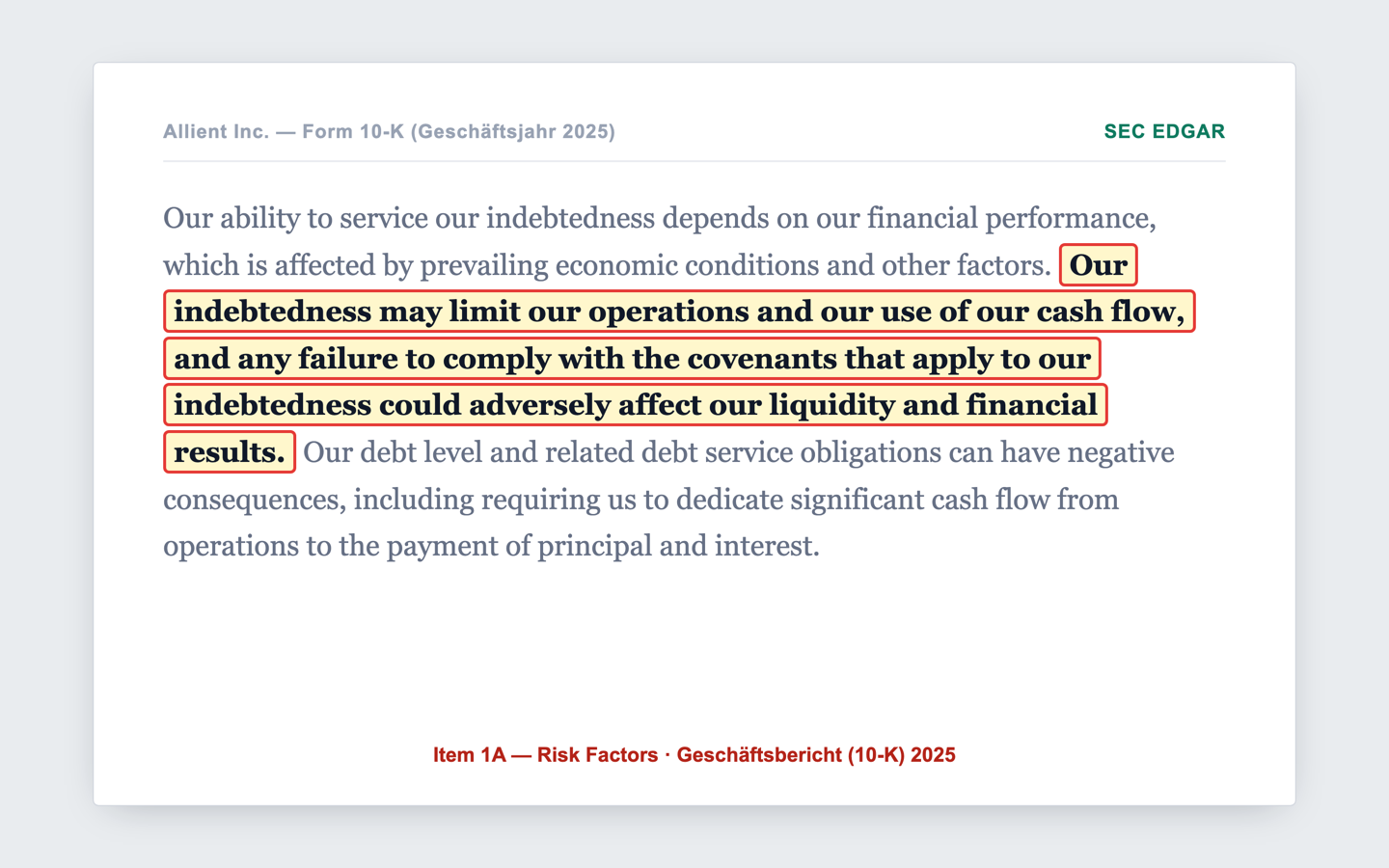
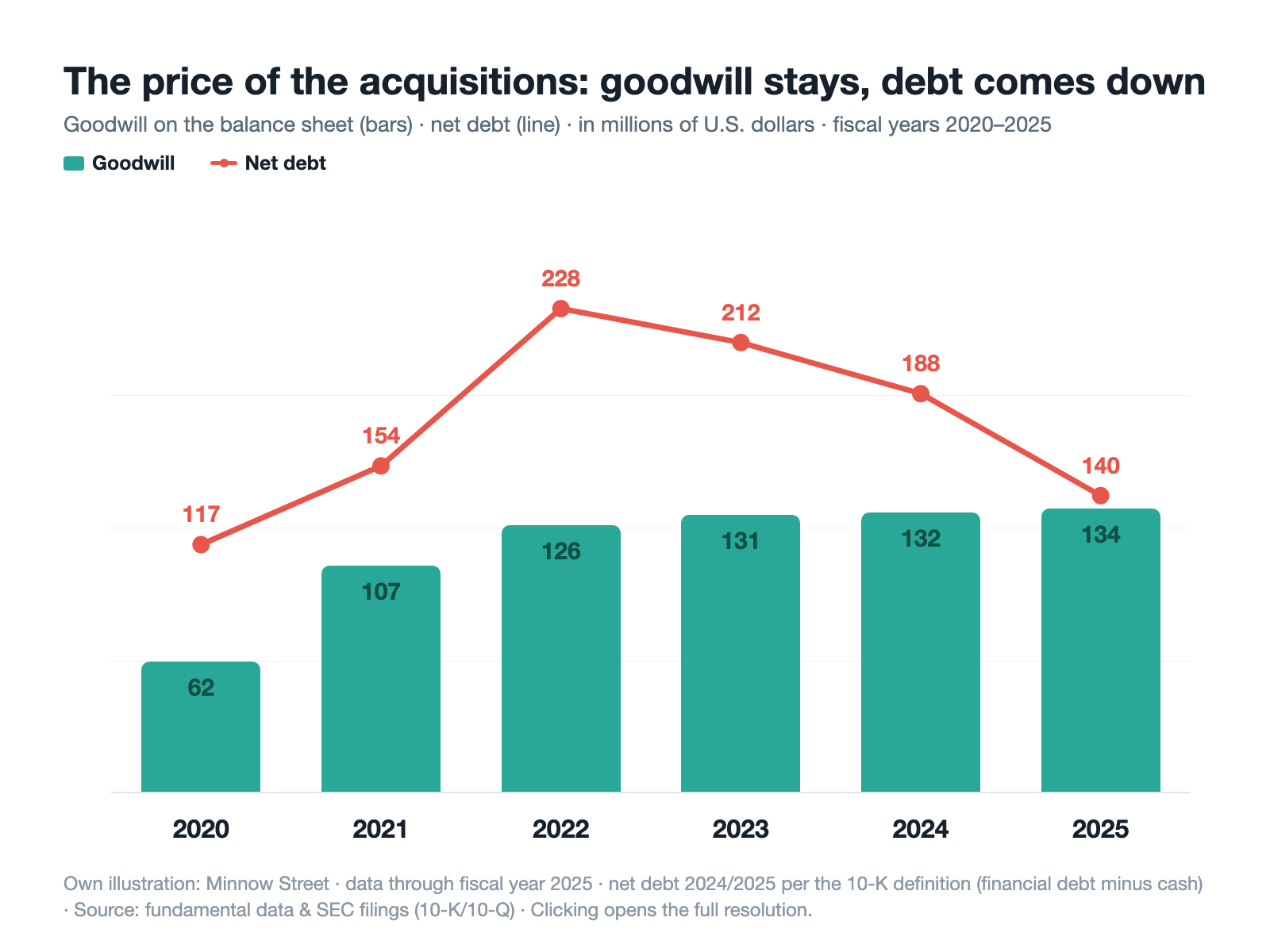
The numbers behind it — and here the good news is honestly told along with the bad: at the end of 2025, net debt stood at $139.7 million, down markedly from $188.1 million a year earlier, because Allient repaid briskly out of its operating cash flow. Measured against operating earnings (net debt to EBITDA around two times), that is solid, and the loan covenants — leverage of at most 3.75 times, interest coverage of at least three times — are comfortably met. But: the interest bill of $13.2 million consumes roughly 30 percent of operating income. And the following chart shows the pattern of the strategy over the years — debt piled up with the acquisitions into a mountain through 2022 and has been carved down since, while the goodwill stays put on the balance sheet:
Uncomfortable truth no. 3: The end markets run in cycles
Allient sells into industrial, vehicle, medical and defense markets — broadly positioned, yes, but in the end demand hangs on the economy and on its customers' appetite to invest. The company says so itself with refreshing clarity:
"We operate in industries that may experience periodic, cyclical downturns. Demand for our products and solutions is also sensitive to changes in customer order patterns, which may be affected by announced price changes, new product introductions and customer inventory levels."
— Allient Inc., SEC annual report 10-K for fiscal year 2025, Item 1A "Risk Factors"
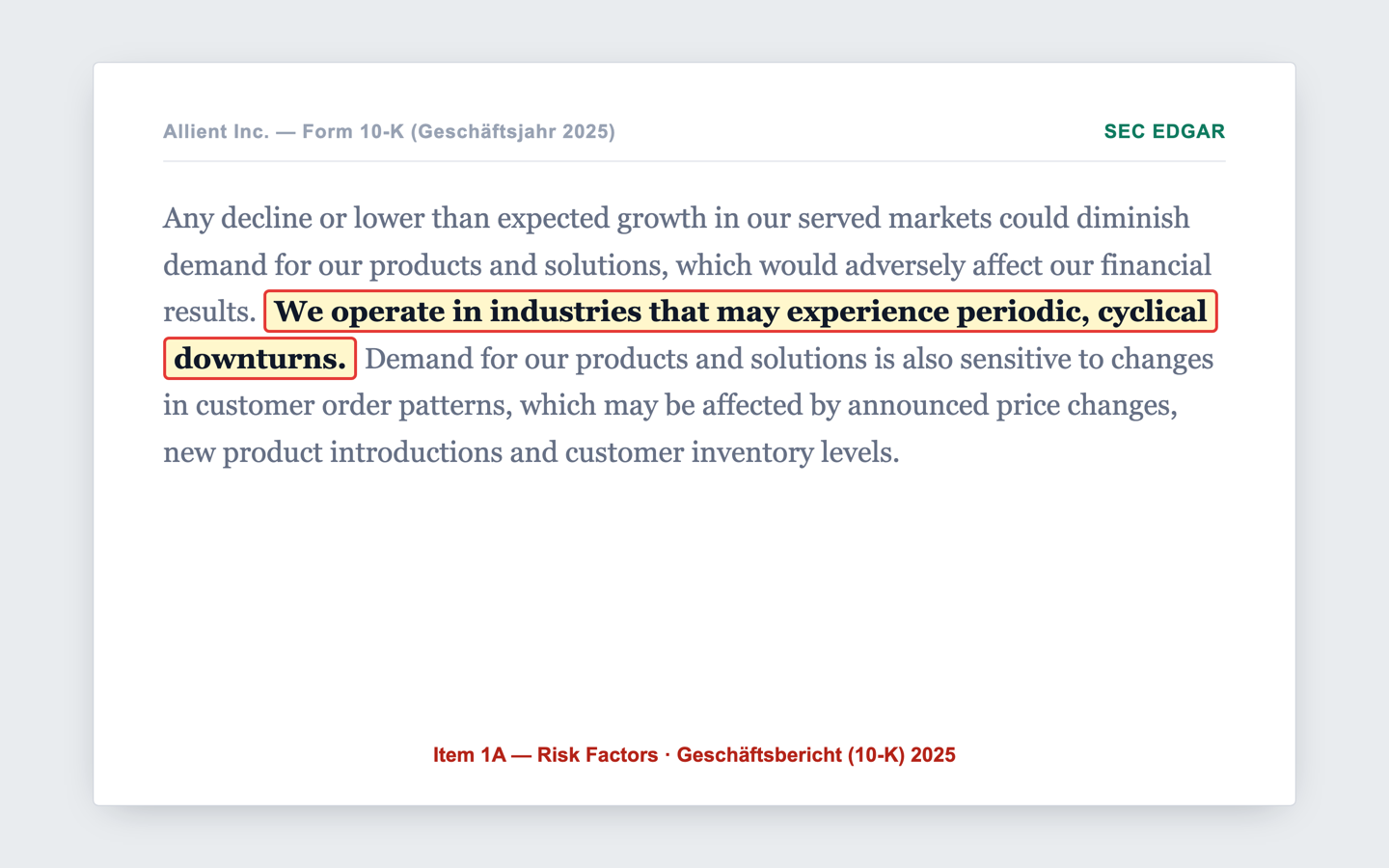
How real that is, 2025 itself showed: while industrial boomed (data centers!), the vehicle business shrank noticeably — demand from powersports and truck applications fell away. That the company could absorb this within the same year speaks for the diversification. But a year in which several end markets weaken at once is, for a cyclical supplier, not a theory — it is a matter of time. And recency bias will happily whisper that the current tailwind is the normal state. It is not.
Valuation — what the optimism costs
Now to the core question that recency bias so gladly skips: not "is Allient good?" (it is), but "is the price fair after the stock has nearly tripled?". And here it gets uncomfortable. As of mid-2026, Allient weighs in at roughly $1.4 billion of market value. Against the earnings of the past twelve months, that works out to a price-to-earnings ratio around 62 — a multiple you otherwise see on pure growth stocks, not on an industrial supplier with a single-digit operating margin. Even against the earnings expectation for the current year (a forward P/E around 34), the stock remains ambitiously valued. Enterprise value runs at roughly 24 times operating earnings (EV/EBITDA), the price-to-sales ratio sits around 2.5, price-to-book around 4.8.
How to weigh that? Part of the high multiple is deserved: earnings rose 70 percent in 2025, margins are expanding, the backlog is growing — the market pays for the expectation that the operational turnaround continues. Growth may cost something. But perhaps the most honest data point is the professionals' view: the average analyst price target sits at roughly $73.80 — and thus below the recent price level. Of the few analysts covering Allient, only a handful advise buying, one holding. Put differently: even the optimists among the professionals see barely any upside left after the rally. When the average price target has already been reached (or passed), you are no longer buying the future cheaply — you are paying for good news that has already happened. That, precisely, is the price of the optimism.
Opportunities and risks at a glance
What speaks for Allient:
- A genuine operational turnaround: gross margin up 150 basis points to 32.8 percent, operating margin from 5.7 to 7.9 percent, net income +70 percent — carried by the "Simplify to Accelerate NOW" program, not by one-off effects.
- Demand tailwind with substance: order intake +15 percent, backlog at $233 million, book-to-bill above one; in the first quarter of 2026, net income +51 percent. The data-center wave supports the industrial segment.
- A balance sheet on the mend: net debt cut from $188.1 million to $139.7 million within a year, loan covenants comfortably met, a small, steadily paid dividend (payout ratio only 9 percent).
- Broad positioning across four end markets and many niche technologies; high institutional ownership (roughly 79 percent) and a technically versed chief executive in office since 2006.
What speaks against it:
- An expensive valuation after the rally: price-to-earnings around 62 (forward around 34), EV/EBITDA around 24 — and the average analyst price target sits below the recent price.
- The buy-and-build burden: $134.3 million of goodwill (roughly 23 percent of total assets, 45 percent of equity) with impairment risk; $139.7 million of net debt with a $13.2 million interest bill that ties up roughly 30 percent of operating income.
- Cyclical end markets: in 2025 the vehicle business was already shrinking; a broad downturn would hit a single-digit-margin supplier hard. With a beta around 1.6, the stock swings widely.
- An all-time high means maximum altitude: whoever buys at or near the high has no historical cushion below — and recency bias makes exactly that easy to forget.
A human conclusion
Remember the recency bias from the opening — the reflex to simply extend recent strength into the future? After the look into the filings, you now know why it is especially treacherous here: not because Allient is weak, but precisely because it is strong. The operational turnaround is real, the backlog is growing, the balance sheet is getting healthier. All of that is true — and exactly that is what makes it so easy to overlook the price you pay for it.
Because the other half of the truth is just as real: nearly a quarter of the balance sheet is goodwill from acquisitions, the debt from the same strategy costs interest, the end markets run in cycles — and after nearly tripling, the stock trades at a price-to-earnings ratio around 62, with an average analyst price target below the recent price. An excellent company and an excellent stock are simply not the same thing: the first depends on the business, the second also on your entry price.
What you make of it is your decision. And that is exactly as it should be. What matters is only that you know what you are betting on: not on the question of whether Allient is good — but on the operational turnaround continuing so forcefully that it catches up with an already very optimistic price. The chart shows you what was. Whether it also shows what is coming, nobody knows — least of all your own recency bias.
Sources
- Allient Inc. — SEC annual report 10-K for fiscal year 2025 (as of December 31, 2025; filed March 5, 2026)
- Allient Inc. — SEC quarterly report 10-Q as of March 31, 2026 (filed May 6, 2026)
- Allient Inc. — proxy statement DEF 14A of March 26, 2026 (compensation, beneficial ownership, Warzala family tie); additionally the 10-K for fiscal year 2024 (filed March 5, 2025).
- Fundamental data (metrics, valuation, annual and quarterly series); in-house stock scanner, data as of July 10, 2026.
Disclaimer: This analysis is a journalistic contextualization of publicly available information and is not investment advice. It is not a recommendation to buy or sell securities. Stocks are subject to price fluctuations; a total loss is possible. Make your investment decisions on your own responsibility and seek independent advice when in doubt.
Our Bottom Line at a Glance
- Operating quality & turnaround positive
- A genuine, documented improvement: gross margin up 150 basis points to 32.8 percent, operating margin from 5.7 to 7.9 percent, net income +70 percent — carried by the "Simplify to Accelerate NOW" program, not by one-off effects. In the first quarter of 2026, net income grew 51 percent.
- Order book & demand positive
- Order intake +15 percent to $550.9 million, backlog at $233 million, book-to-bill above one. Demand around data centers (power-quality solutions) supports the industrial segment and provides visibility beyond the day.
- Balance sheet: goodwill & debt negative
- The price of the buy-and-build strategy: $134.3 million of goodwill is roughly 23 percent of total assets and about 45 percent of equity (impairment risk). $139.7 million of net debt — reduced from $188.1 million, to be fair — with a $13.2 million interest bill that ties up roughly 30 percent of operating income. Covenants comfortably met.
- Cyclicality of the end markets neutral
- Broad positioning across four end markets cushions swings, yet demand remains tied to the economy: in 2025 the industrial side boomed while the vehicle business (powersports, trucks) shrank. A broad downturn would hit the single-digit-margin supplier noticeably; beta around 1.6.
- Valuation & price negative
- Expensive after nearly tripling: price-to-earnings around 62 (forward around 34), EV/EBITDA around 24, price-to-sales around 2.5. The average analyst price target of roughly $73.80 sits below the recent price — the professionals see barely any upside. An all-time high means maximum altitude.
Allient is a genuine strength story: the motion-technology specialist has delivered a documented operational turnaround (operating margin from 5.7 to 7.9 percent, net income +70 percent, order intake +15 percent) and fires in 23 scanners for good reason, from "Best of All" to the all-time high. The honest flip side is the price of that strength: $134 million of goodwill (23 percent of total assets) and $140 million of net debt from the buy-and-build strategy, cyclical end markets — and a stock that, after nearly tripling, is valued at a price-to-earnings ratio around 62 while the average analyst price target sits below the recent price. A very good company; the question is the entry price. Not investment advice.
What Our Rating Means
- If you don't own the stock
- At the current price level, we don't see a sufficient margin of safety for an entry.
- If you hold it in your portfolio
- Our findings offer no reason to sell.
A journalistic assessment by our editorial team at the time of the deep dive, based on public sources — not investment advice and not a solicitation to buy or sell. Your personal circumstances (investment goals, risk capacity, taxes) cannot be taken into account. What our categories mean, how verdicts are formed, and what conflicts of interest exist →
Worth Noting
- Price and valuation figures dated mid-2026; analyses are evergreen, daily prices are not a buy argument. The market value of roughly $1.4 billion refers to roughly 17.0 million shares outstanding.
- Net debt per the annual report (10-K) definition: financial debt of $180.4 million minus cash of $40.7 million equals $139.7 million (prior year: $224.2 minus $36.1 = $188.1 million). Under a broader definition including lease liabilities, net debt comes out somewhat higher; the multi-year chart uses this broader, consistent series for 2020–2023.
- Allient reports in a single operating segment; the split by end markets (industrial, vehicles, medical, A&D) is a revenue disaggregation, not segment reporting. No single customer reached ten percent of revenue in 2025 or 2024 — a customer concentration risk expressly does not exist.
- AI classification: neutral. The SEC filings reviewed contain no material AI exposure; the only mention of "artificial intelligence" is a generic cybersecurity boilerplate. The demand around data centers is an AI-adjacent end-market narrative, not a sale of own AI products.
Frequently Asked Questions
Allient (Nasdaq: ALNT, formerly Allied Motion Technologies) builds motion, drive and control technology — the "muscles and nerves" of machines: electric motors, drives, motion controllers, encoders and power-quality filters. It sells into four end markets: industrial, vehicles, medical, and aerospace & defense. The company has grown for years through acquisitions (buy-and-build) and is headquartered in Amherst, New York.
Two things came together: a genuine operational turnaround and strong momentum. The restructuring program "Simplify to Accelerate NOW" lifted the operating margin from 5.7 to 7.9 percent, net income rose 70 percent in 2025, order intake 15 percent — carried among other things by demand around data centers. In consequence, the price rose roughly 184 percent in twelve months, and the stock fires in 23 of our scanners, including "Best of All" and the all-time-high screen.
It is ambitiously valued. The price-to-earnings ratio around 62 (forward around 34) and an EV/EBITDA around 24 are high for an industrial supplier. Part of that is covered by the earnings growth. What should make you sit up, though: the average analyst price target of roughly $73.80 sits below the recent price level — the professionals see little upside after the rally. That is not a statement about quality, but about the price.
As of December 31, 2025, goodwill stood at $134.3 million — roughly 23 percent of total assets and about 45 percent of equity; that carries impairment risk. Net debt was $139.7 million, down from $188.1 million a year earlier. The interest bill of $13.2 million ties up roughly 30 percent of operating income; the loan covenants are comfortably met.
Distinctly cyclical. Allient itself writes in its annual report that it operates in industries that experience "periodic, cyclical downturns". In 2025 the industrial side boomed (data centers), while the vehicle business (powersports, trucks) shrank at the same time. The broad positioning across four end markets cushions that, but does not replace the dependence on the economy — a broad downturn would hit the single-digit-margin supplier noticeably.
Yes, Allient pays a small, steady dividend of $0.12 per share annually at a low payout ratio of roughly 9 percent — the focus is on growth and debt reduction. Roughly 79 percent of the shares sit with institutions, about 15 percent with insiders. Chief executive and board chairman is the long-time industry veteran Richard S. Warzala.
Found an error?
Did you spot a factual error, an outdated number, or a typo in this deep dive? Let us know briefly — your report goes straight to the editorial team.