Alliance Laundry Stock: The World's Washing-Machine Champion Is Still Paying Off Its Owner's $900 Million Dividend
Alliance Laundry of Ripon, Wisconsin, has built commercial washers since 1908 and estimates it holds about 40 percent of the North American market — 2025 revenue: $1.71 billion at a roughly 26 percent adjusted EBITDA margin. The stock has traded on the NYSE since October 2025 — but the IPO tells a second story: in August 2024, private-equity owner BDT and management paid themselves a $900 million dividend funded by a $2,075 million loan, and the IPO's $505.7 million in net proceeds went almost dollar for dollar into repaying that very loan. We read the annual report (10-K), the quarterly reports (10-Q), the IPO prospectus and the proxy statement: a first-rate business, a shrinking but still heavy debt load — and a controlling owner with 71 percent and special rights. Not investment advice — just an honest accounting of how much legacy baggage a clean business can carry.
 Thomas Mücke
Founder & Publisher
Thomas Mücke
Founder & Publisher
Chart
Interactive price chart (TradingView).
Note: pure fact-based analysis, not investment advice and not a solicitation to buy or sell. All figures without guarantee.
There is a shortcut in every investor's head that feels like experience but is really just a drawer: "Private-equity IPO? Hard pass." The logic sounds airtight — when a professional seller wants out, he wants out at your expense; whoever buys at the IPO inherits a squeezed lemon with a backpack full of debt. The treacherous part of that drawer is not that it is always wrong. The treacherous part is that it ends the thinking before the thinking starts — in both directions. In the summer of 2026, hardly any stock lends itself better to this self-test than Alliance Laundry Holdings (NYSE: ALH): the world's largest maker of commercial laundry systems, listed since October 2025, owned for the prior decade by the merchant bank BDT — with a debt-funded $900 million dividend in its recent past and a business that has grown reliably since 1908. Both facts sit in the same documents. So let's make a deal: we keep the drawer shut and read together what the company itself reported, under penalty of law, to the U.S. securities regulator, the SEC — the annual report (10-K) for 2025, the quarterly reports (10-Q), the IPO prospectus and the proxy statement (DEF 14A). In the end, you decide for yourself whether the drawer fits here.
What Alliance Laundry actually does — laundry as infrastructure
Alliance Laundry does not build the washers you know from the appliance aisle. The company from Ripon, Wisconsin — founded in 1908 with a hand-operated washer, stainless-steel tubs under the Speed Queen brand since 1938 — sells commercial laundry systems: machines with load capacities up to 400 pounds, built for continuous duty. The annual report puts it confidently, and, as we will see, backs it with numbers: "We are the world's largest designer and manufacturer of commercial laundry systems." Customers sort into three end markets: on-premise laundries (hospitals, hotels, fire stations — anywhere clean laundry is a condition of doing business), laundromats and communal laundry rooms (which earn money per wash cycle and lose revenue every hour a machine is down), and "commercial in-home" — households that put the indestructible commercial machine in their basement. Distribution runs through roughly 600 distributors worldwide plus direct sales; 94 percent of North American distributors have been on board for at least ten years. The result of that persistence: by its own estimate the company holds about 40 percent of the North American commercial laundry market ("We estimate that we hold approximately 40% of the commercial laundry market in North America", 10-K 2025, Item 1) — plus the no. 1 position in Latin America and Asia-Pacific (excluding China) and no. 3 in Europe. Two side businesses complete the picture: a parts and service operation feeding off decades of installed machines, and an in-house financing arm that lends laundromat operators the money for the machines — $49.6 million of revenue in 2025, refinanced through the company's own securitization entities. Remember that built-in bank; it resurfaces in the balance sheet later. Which brings us to the central tension of this analysis, and it runs through every chapter: a 117-year-old world-champion business with a 26 percent adjusted EBITDA margin and dependable replacement demand — but the balance sheet still carries the former owner's bill, the IPO mostly funded debt repayment, and BDT keeps 71 percent along with special rights. How a fundamentally good industrial business can suffer under an inherited debt backpack is something we dissected at turbocharger maker Garrett Motion — and what it means to sit next to an overpowering anchor shareholder as a minority investor, at forklift maker Hyster-Yale.
Where the stock shows up in our scanner
Every day we run about 3,500 stocks through our scanners. Alliance Laundry landed on the research list via the substance filter "FCF/Market Cap": it hunts for companies generating unusually high free cash flow relative to their market value — and there ALH ranked no. 12 among the U.S. hits on July 18, 2026. Free cash flow is the money actually left over after every bill and every investment — the most honest of all metrics, because cash is much harder to dress up than earnings. The scanner adds two more hits (data as of July 8, 2026): "EPS acceleration" — earnings per share are not just growing, the growth is speeding up; in the first quarter of 2026 earnings came in 19.9 percent above analyst estimates — and "Pros 80", which fires when institutional investors hold the stock at scale and have recently been adding (11 funds net buyers). To replicate it yourself: open the "FCF/Market Cap" filter in the scanner menu on minnowstreet.com and look for the ALH row. And now the honest framing that belongs with every scanner observation: three hits is thin confluence. In other analyses, twelve or fourteen filters light up at once — there the chart supports the thesis too. Here the scanner mostly says "lots of cash flow, accelerating earnings, professionals on board" — not "strong trend". That fits a stock that has been public for only nine months and (data as of July 8, 2026) traded around $21, below its $22.00 IPO price. Why earnings are accelerating and where the cash flow comes from, however, is not in the scanner. It is in the filings. So that is where we go.
The numbers over the years — honestly appraised
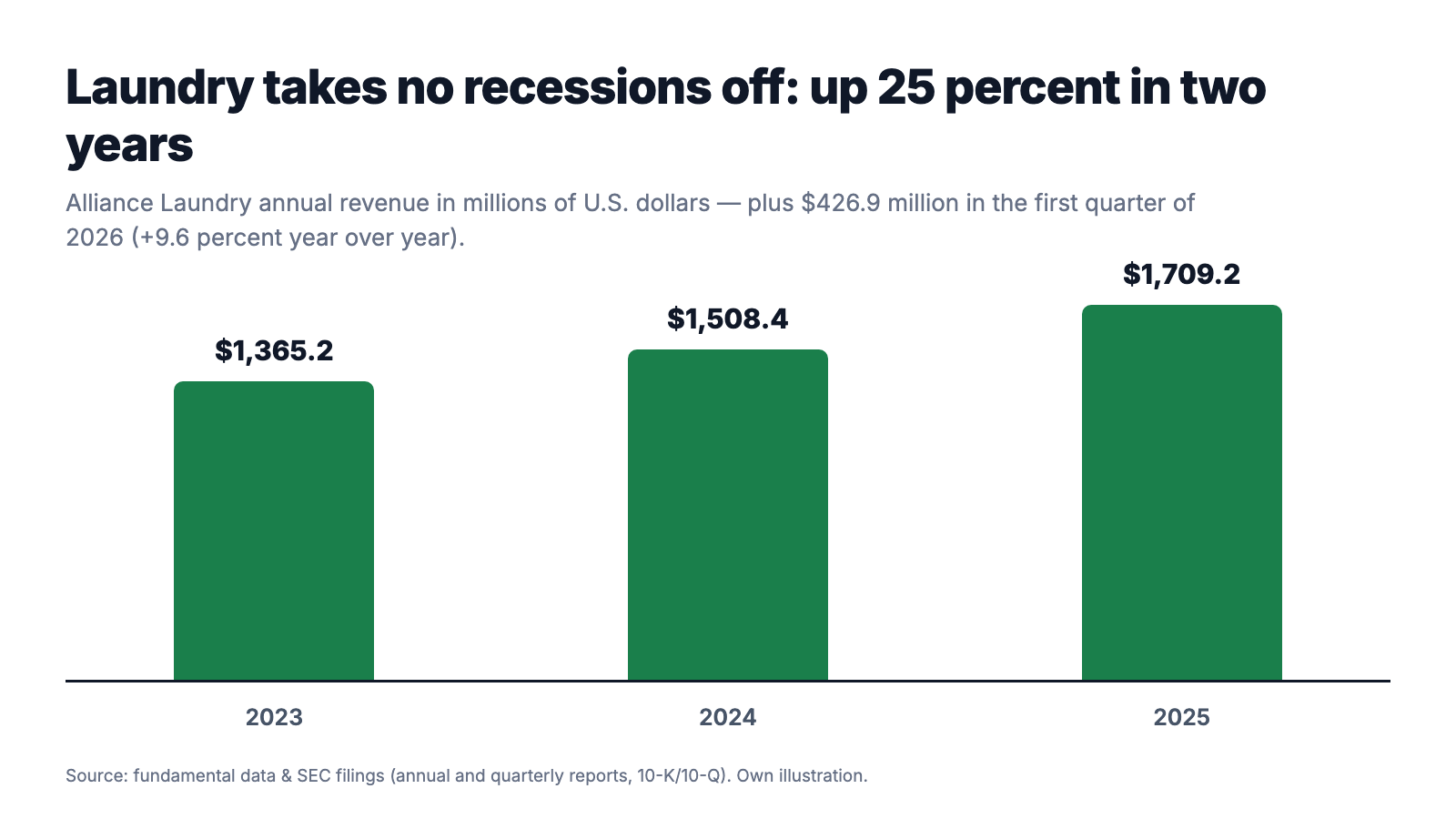
First, what genuinely impresses — and here that is quite a lot. Revenue climbed from $1,365.2 million (2023) through $1,508.4 million (2024) to $1,709.2 million in 2025 — up 25 percent in two years, without a single down year, in a market fed by the replacement cycle of a huge installed base (about 1.1 million laundromat machines in the United States alone, per the annual report). The first quarter of 2026 continued seamlessly at $426.9 million (+9.6 percent). Profitability is remarkable for a machinery maker: $436.5 million of adjusted EBITDA in 2025 — roughly 26 percent of revenue, with the North America segment at 28.5 percent. Capital needs stay small (capital expenditures of about 3 percent of revenue, $53.7 million in 2025), which is why $211.7 million of operating cash flow became roughly $158 million of free cash flow in 2025; the first quarter of 2026 alone delivered $74.7 million ($79.9 million operating minus $5.2 million capex). And net income? 2023: $88.2 million. 2024: $98.3 million. 2025: $101.8 million — solid, but strikingly thin next to a 26 percent EBITDA margin: a net margin of about 6 percent. The explanation sits one line higher in the income statement: $150.5 million of net interest expense in 2025 alone ($132.0 million in 2024, $123.4 million in 2023). This company earns beautifully — and hands a large slice of it to its lenders. Here is the sunny side:
Now the second chart — same company, different axis. It shows how you can tell two stories are running here at the same time:
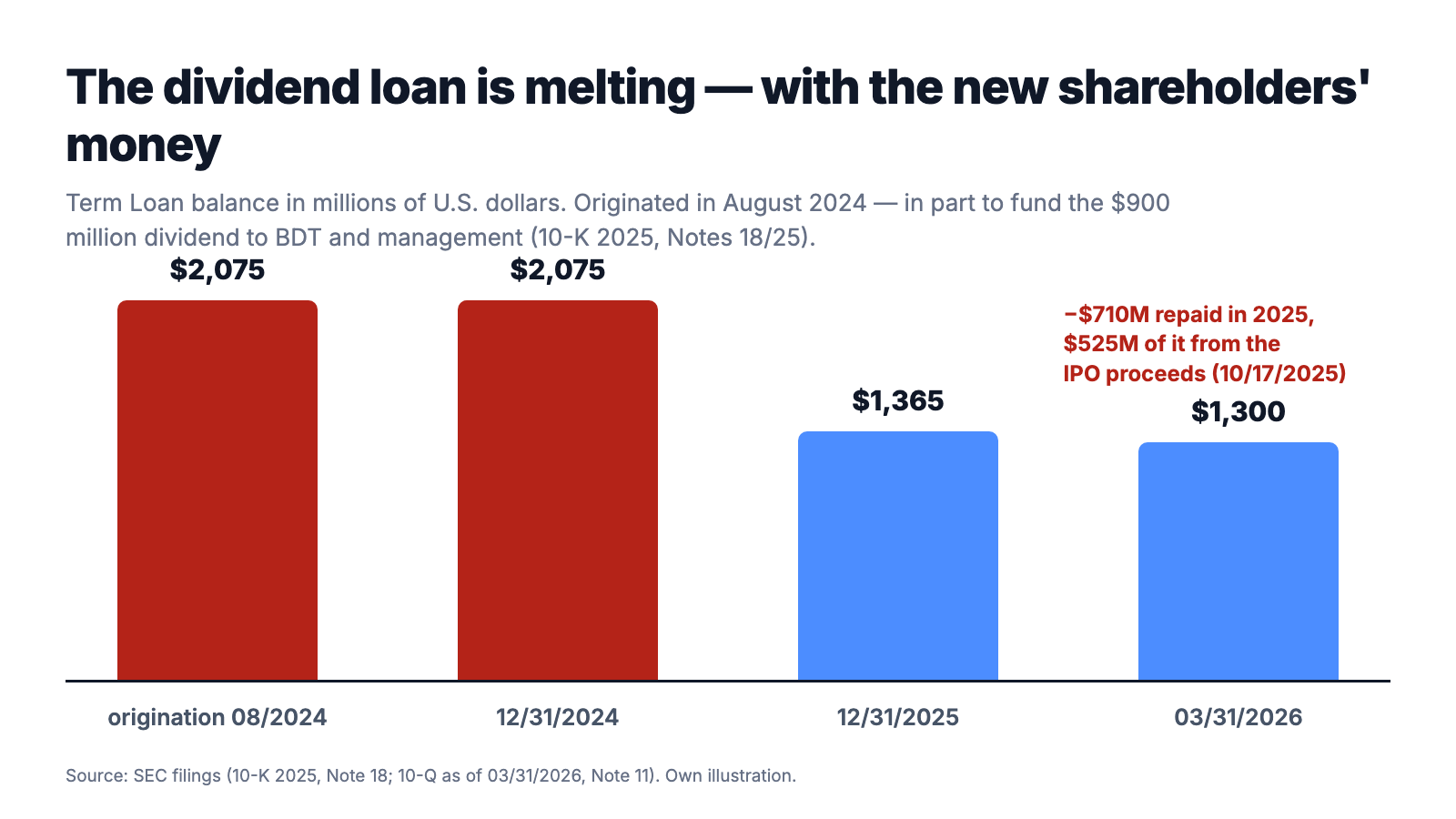
The falling blue bars are good news with a double bottom: the company is deleveraging fast — but why was there a $2 billion loan in the first place? The interest effect, in any case, is dramatic: in the first quarter of 2026, net interest expense fell to $17.9 million from $44.9 million a year earlier — and net income promptly tripled from $17.2 million to $56.9 million (diluted earnings per share: $0.28 after $0.10). That is exactly where the scanner's "EPS acceleration" comes from: it is not a revenue explosion but the mechanical tailwind of a shrinking interest bill. It will blow for a while yet — but it is finite: at some point the loan is repaid or the effect is priced in. Remember the pattern: when earnings grow faster than revenue, the business is not suddenly earning better — it is merely losing a weight off its leg. Where that weight came from is uncomfortable truth no. 1.
What the filings say — the uncomfortable truths
Uncomfortable truth no. 1: The $2 billion loan funded a $900 million dividend to the owner
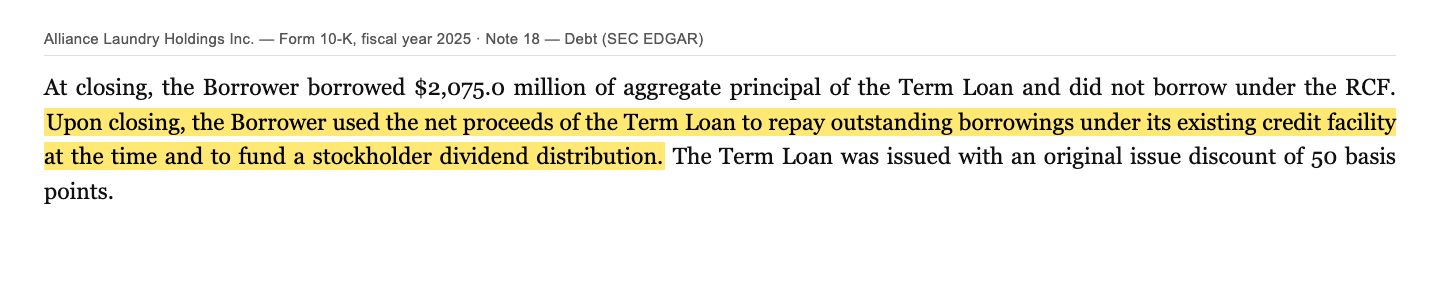
In August 2024 — a good year before the IPO — Alliance Laundry took out new debt: a $2,075 million Term Loan plus a $250 million revolving credit facility. What for? Note 18 of the annual report says it without ceremony:
"Upon closing, the Borrower used the net proceeds of the Term Loan to repay outstanding borrowings under its existing credit facility at the time and to fund a stockholder dividend distribution."
— Alliance Laundry Holdings Inc., SEC annual report 10-K for fiscal year 2025, Note 18 "Debt"
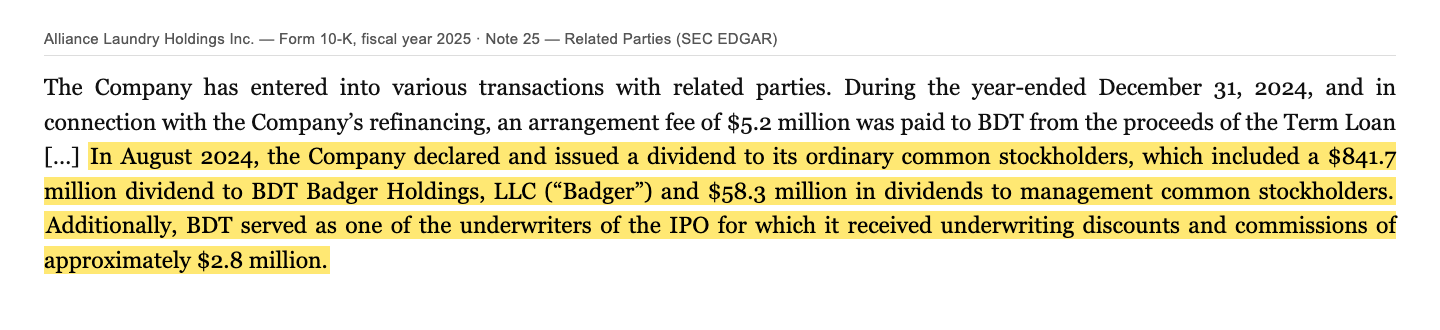
How large that dividend was, and who received it, sits in Note 25 — the related-party footnote:
"In August 2024, the Company declared and issued a dividend to its ordinary common stockholders, which included a $841.7 million dividend to BDT Badger Holdings, LLC (“Badger”) and $58.3 million in dividends to management common stockholders."
— Alliance Laundry Holdings Inc., SEC annual report 10-K for fiscal year 2025, Note 25 "Related Parties"
This mechanism has a trade name — "dividend recapitalization" — and a plain one: a dividend on credit. The owner has the company pay out a special distribution funded not from its cash box but from new borrowings — as if your landlord took out a mortgage on the building, wired himself the money, and had your rent service the installments from then on. For BDT (and, with $58.3 million, for management) it was a partial cash-out ahead of the IPO; for the company it meant $150.5 million of interest expense in 2025. In fairness: none of this is illegal, all of it is disclosed, and such recaps are standard practice in private equity. But whoever buys the ALH share should know: the debt whose repayment is currently propelling earnings was never needed by the business — it was the former owner's payout.
Uncomfortable truth no. 2: The IPO proceeds did not go into the business — they repaid the dividend loan
On October 10, 2025, Alliance Laundry listed on the NYSE at $22.00 per share. 43.2 million shares were sold — but only 24.4 million of them were new shares issued by the company (net proceeds: $505.7 million); the remaining 18.8 million were sold by the longtime owner for its own account, including the fully exercised overallotment option. And what happened to the company's half-billion? The annual report:
"The net proceeds from our initial public offering along with cash on hand were used to repay $525.0 million of our indebtedness outstanding under the Term Loan on October 17, 2025."
— Alliance Laundry Holdings Inc., SEC annual report 10-K for fiscal year 2025, Item 5 (Use of Proceeds)

Run the chain end to end: in 2024, $900 million flows to owner and management, funded by a loan. In 2025, the IPO collects a good $500 million from new shareholders — and repays the loan. Economically, the IPO buyers thereby paid for a large part of the owner's dividend after the fact. Nothing from the offering was left for new plants, products or acquisitions; the proceeds of the 18.8 million secondary shares (a gross $400 million plus) went straight to BDT anyway. And yet the honest ledger has a credit side too: the deleveraging works — faster than the contract demands. In 2025 the company voluntarily prepaid $710 million in total ($525 million of it from the IPO), another $65 million in the first quarter of 2026; the banks rewarded it with two margin cuts (from SOFR plus 3.5 to SOFR plus 2.25 percent, a 5.92 percent effective rate as of March 31, 2026), the credit agreement forces additional repayments through an excess-cash-flow sweep while leverage stays high, and Moody's upgraded the rating from B2 to B1 on June 29, 2026 — still deep in junk territory, but pointing the right way. As of March 31, 2026, the balance sheet still carries a $1,300 million Term Loan (due August 2031) plus $620.3 million of securitization borrowings from the financing arm, against $129.3 million of cash. The backpack is getting lighter. It is nowhere near empty.
Uncomfortable truth no. 3: BDT keeps 71 percent — and even served as an underwriter of its own IPO
Whoever bought at the IPO became a minority shareholder in a company controlled by a single investor. The annual report says it in one dry sentence in the risk factors:
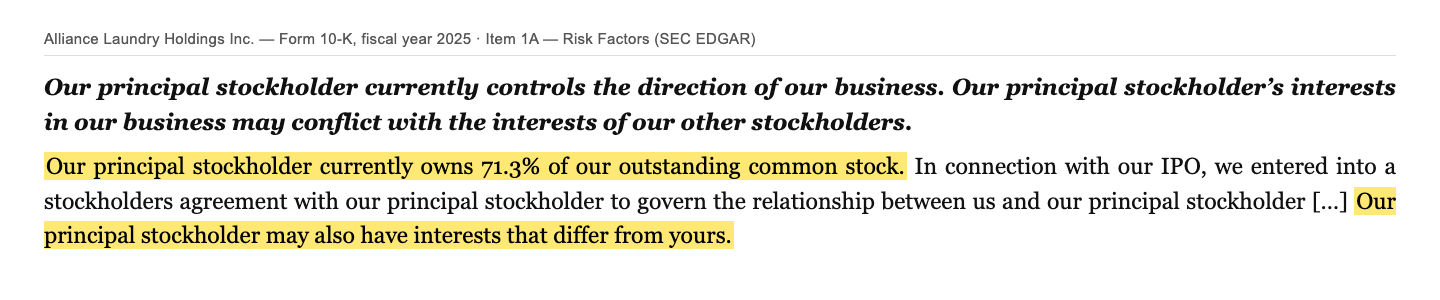
"Our principal stockholder currently owns 71.3% of our outstanding common stock. […] Our principal stockholder may also have interests that differ from yours."
— Alliance Laundry Holdings Inc., SEC annual report 10-K for fiscal year 2025, Item 1A "Risk Factors"
What that means in practice is set out in a stockholders agreement dated October 8, 2025: as long as BDT owns at least 40 percent, BDT nominates the majority of the board; down to 25 percent it still appoints and removes the chairman. As a "controlled company" under NYSE rules, Alliance Laundry could even drop the requirement of a majority-independent board (it currently does not — but expressly reserves the right). The charter opts out of Delaware's takeover protection (Section 203) — BDT can therefore sell its controlling stake to any third party without board or shareholder approval — and includes a corporate-opportunity waiver: business opportunities BDT learns about may be kept for itself or handed to its other portfolio companies instead of being offered to Alliance Laundry. And then there is the footnote you read twice: per Note 25, BDT served as one of the underwriters of its own IPO, earning about $2.8 million in underwriting fees for placing its own shares — after already collecting a $5.2 million arrangement fee on the 2024 dividend loan; entities affiliated with BDT also hold a controlling interest in a vendor from which Alliance Laundry buys raw materials ($7.2 million in 2025). Seller, loan arranger, underwriter, supplier — all disclosed, none of it illegal. But it paints the picture of an IPO in which one party sat on remarkably many chairs at once. A free float of less than a quarter of the shares also means: every future BDT placement can weigh on the price — and per the insider filings (Forms 4 and 144), the first such sales began in June 2026, after the lock-up had expired.
Uncomfortable truth no. 4: Equity is thin — and there is a small bank inside the company
The $900 million dividend left traces beyond the loan: it was paid out of the company's substance, so book equity is correspondingly thin — against the market value that works out to a price-to-book ratio around 12 (data as of July 8, 2026), a multiple of what is normal for industrial companies. That is not a valuation signal but balance-sheet archaeology: the book value is missing because it was distributed in 2024. One more item belongs in the full debt picture: Alliance Laundry runs an in-house financing arm that lends laundromat operators the purchase price of their machines and securitizes those receivables through bankruptcy-remote special-purpose entities — the associated equipment facility was raised to $500.0 million in May 2025. As of March 31, 2026, this business accounted for $620.3 million of "asset backed borrowings" on the balance sheet — debt that is backed by customer receivables, but that also imports the credit risk of laundromat operators (the provision for credit losses rose to $2.1 million in the first quarter of 2026 from $0.6 million a year earlier — unremarkable, but worth watching). A machinery maker with a built-in bank is no flaw — Caterpillar and John Deere run the same play — but whoever judges the leverage must see both buckets: a $1.3 billion Term Loan plus $0.6 billion of securitization debt, together nearly $2 billion of borrowings against a $4.2 billion market value (data as of July 8, 2026).
Valuation: a $4.2 billion market cap — and the question of which year you extrapolate
In early July 2026 the ALH share cost about $21 — below the $22.00 IPO price — valuing the company at roughly $4.2 billion (data as of July 8, 2026). The trailing price-to-earnings ratio of about 37 looks expensive but misleads: it contains the full 2025 interest bill of $150.5 million, a growing share of which is already history. Extrapolate the first quarter of 2026 instead ($0.28 diluted earnings per share) and you land roughly at a P/E around 19 — rather moderate for a world market leader with 26 percent EBITDA margins and low capital needs. The cash lens: $158 million of 2025 free cash flow puts the market value at about 27 times free cash flow — on the strong first quarter of 2026 ($74.7 million) it would be considerably less. That very spread is the heart of the valuation question: how much of the interest tailwind is durable, and how much is already in the price? On top come the structural discounts you now know: 71 percent with one shareholder, a small free float with placement overhang, nearly $2 billion of total borrowings, a B1 rating. And a dividend? Alliance Laundry pays none — every free dollar currently goes into repayment. After everything you have read, you know: in this particular story, that is the best news of the entire chapter.
Opportunities and risks at a glance
What speaks for Alliance Laundry:
- World market leadership in an unspectacular, resilient niche: about 40 percent North America market share, no. 1 in Latin America and Asia-Pacific (excluding China), no. 3 in Europe; 117 years of company history and brands like Speed Queen with, per the annual report, the highest Net Promoter Score in North America (10-K 2025).
- Reliable growth at strong margins: revenue up 25 percent in two years to $1,709.2 million (2025), Q1 2026 up 9.6 percent; adjusted EBITDA of $436.5 million (a roughly 26 percent margin), capital expenditures of only about 3 percent of revenue — $158 million of free cash flow in 2025, $74.7 million in Q1 2026 alone.
- The replacement cycle works for the incumbent: a huge installed base (about 1.1 million laundromat machines in the U.S. alone), 94 percent of U.S. distributors on board for over ten years, parts and service as recurring revenue.
- Deleveraging runs faster than required: $710 million of voluntary prepayments in 2025 plus $65 million in Q1 2026, two credit-margin cuts (to SOFR plus 2.25 percent, 5.92 percent effective), a Moody's upgrade to B1 (June 29, 2026); net interest expense fell from $44.9 million to $17.9 million in Q1 2026 — the main driver of the earnings jump to $0.28 per share.
- The scanner confirms the substance thesis: no. 12 among U.S. hits in the FCF/market cap scanner (as of July 18, 2026), plus EPS acceleration (earnings 19.9 percent above estimates in Q1 2026) and "Pros 80" with 11 funds as net buyers (data as of July 8, 2026).
What speaks against it:
- The origin of the debt: the $2,075 million Term Loan of August 2024 funded a dividend of $841.7 million to BDT and $58.3 million to management (10-K 2025, Notes 18 and 25) — 2025 interest bill: $150.5 million, which is why the net margin is only about 6 percent.
- The IPO proceeds ($505.7 million net) went almost entirely into repaying that loan ($525 million on October 17, 2025) — no fresh money for growth; BDT sold another 18.8 million shares for its own account in the same offering.
- Power imbalance: BDT owns 71.0 percent (DEF 14A, April 16, 2026), nominates the board majority, appoints the chairman; the charter opts out of Delaware takeover protection and contains a corporate-opportunity waiver; BDT also served as an underwriter of its own IPO ($2.8 million in fees) and holds a controlling interest in a vendor (Note 25).
- Small free float with an overhang: less than a quarter of the 198.2 million shares trades freely; after the lock-up expired, insider sales began in June 2026 per Forms 4 and 144 — any larger BDT placement can pressure the price.
- Still nearly $2 billion of borrowings ($1,300 million Term Loan due 2031 plus $620.3 million of securitization debt, March 31, 2026) against only $129.3 million of cash, thin equity (price-to-book around 12) and a B1 rating; the earnings tailwind from falling interest is finite and is not a business model.
A human conclusion
Back to the drawer from the beginning. "Private-equity IPO — hard pass" would have spared you a lot at Alliance Laundry: the indignation over a $900 million dividend on credit, offering proceeds that landed at the lender instead of in the company, and a former owner who even earned underwriting fees on his own IPO. All true, all documented. But the same drawer would also have kept you from seeing the rest: a century-old business holding 40 percent of its home market, growing at 26 percent margins, needing hardly any capital — and whose biggest problem, the debt load, measurably shrinks every quarter, faster than the loan contract demands. So the honest question is not whether BDT looked after itself at the IPO (beyond doubt), but: at about $21, do you get enough company for the legacy baggage you inherit? The coming quarterly reports (10-Q) hand you three verifiable checkpoints: the Term Loan line (does it keep shrinking toward $1.2 billion?), net interest expense (does it stay below $20 million a quarter?), and BDT's ownership stake (every placement shows up in a Form 4 or a prospectus supplement). If those three lines keep moving the right way, a deleveraged world market leader is growing out of its private-equity costume here. If not, you will know early — the evidence is on public display. What you make of it is your decision. And that is exactly as it should be.
Sources
All original documents used in this analysis — for your own reading:
- Alliance Laundry Holdings Inc. — SEC annual report 10-K for fiscal year 2025 (filed March 13, 2026)
- Alliance Laundry Holdings Inc. — SEC quarterly report 10-Q as of March 31, 2026 (filed May 12, 2026)
- Alliance Laundry Holdings Inc. — SEC quarterly report 10-Q as of September 30, 2025 (filed November 13, 2025; first report as a public company)
- Alliance Laundry Holdings Inc. — IPO prospectus (424B4) dated October 9, 2025
- Alliance Laundry Holdings Inc. — Proxy statement (DEF 14A) dated April 27, 2026 (ownership: BDT at 71.0 percent; compensation)
- Alliance Laundry Holdings Inc. — SEC report 8-K dated June 29, 2026 (Moody's upgrade to B1)
- Complete SEC filing history of Alliance Laundry Holdings Inc.: EDGAR overview (sec.gov)
- Fundamental data (metrics, quarterly series, valuation; data as of July 8, 2026), reconciled against the SEC filings.
- Screener and rating data: in-house stock scanner (FCF/market cap ranking: as of July 18, 2026; other scanner data: as of July 8, 2026).
Transparency & disclaimer: This analysis is a journalistic contextualization of publicly available information and is not investment advice, not a financial analysis in the regulatory sense and not a solicitation to buy or sell securities. Equity investments carry substantial risks up to and including total loss. All information without guarantee; the data cut-off is noted in the text. The author holds no position in ALH shares at the time of publication.
Our Bottom Line at a Glance
- Business model & market position positive
- World's largest maker of commercial laundry systems with about 40 percent North America market share, 117 years of history and five established brands; the replacement cycle of a huge installed base plus parts, service and financing delivers recurring revenue (10-K 2025, Item 1).
- Growth & margins positive
- Revenue up 25 percent in two years to $1,709.2 million (2025), Q1 2026 up 9.6 percent; adjusted EBITDA of $436.5 million (a roughly 26 percent margin, North America at 28.5 percent), capital expenditures of only about 3 percent of revenue — $158 million of free cash flow in 2025, $74.7 million in Q1 2026.
- Debt load & its origin negative
- The $2,075 million Term Loan of August 2024 funded a $900 million dividend to BDT and management (Notes 18/25); despite repayment down to $1,300 million (03/31/2026) plus $620.3 million of securitization borrowings, nearly $2 billion of debt remains against $129.3 million of cash, thin equity and a B1 rating — 2025 interest bill: $150.5 million.
- Governance & free float negative
- BDT owns 71.0 percent, nominates the board majority and the chairman ("controlled company"); the charter opts out of Delaware takeover protection and includes a corporate-opportunity waiver; BDT served as an underwriter of its own IPO and holds a controlling stake in a vendor (Note 25) — a small free float with placement overhang, and insider sales since June 2026 (Forms 4/144).
- Deleveraging dynamics & scanner signals neutral
- Repayment runs faster than contractually required ($710 million in 2025, $65 million in Q1 2026), two credit-margin cuts, a Moody's upgrade to B1 (06/29/2026), net interest expense halved from $44.9 million to $17.9 million in Q1 2026 — that is what feeds the earnings jump (EPS $0.28 after $0.10). The scanner's 3 hits (FCF/market cap no. 12 U.S., EPS acceleration, Pros 80) confirm the substance thesis, not trend strength; the interest tailwind is finite.
Alliance Laundry is that rare combination of a first-rate business and a loaded past: world market leadership, 26 percent margins and strong free cash flow on one side — on the other, a debt pile that never financed a single investment but rather the former owner's $900 million dividend, an IPO whose proceeds went into repayment, and a 71 percent shareholder with special rights who even earned underwriting fees on his own offering. The deleveraging is measurable and faster than required, and earnings jump with every repaid tranche — but that tailwind is finite, and the free float stays small. Not investment advice.
What Our Rating Means
- If you don't own the stock
- As long as the question raised in the bottom line stays open, we see no basis for an entry.
- If you hold it in your portfolio
- Our findings offer no acute reason to sell — the checkpoints named remain decisive.
A journalistic assessment by our editorial team at the time of the deep dive, based on public sources — not investment advice and not a solicitation to buy or sell. Your personal circumstances (investment goals, risk capacity, taxes) cannot be taken into account. What our categories mean, how verdicts are formed, and what conflicts of interest exist →
Worth Noting
- ALH reached the research list via our in-house FCF/market cap scanner (no. 12 among U.S. hits as of July 18, 2026); EPS acceleration and "Pros 80" (data as of July 8, 2026) provided the confluence — scanner compositions drift daily, and this analysis is deliberately written evergreen.
- IPO caveat: a young filing history (first listed 10/10/2025) — only one 10-K (FY 2025) and two 10-Q filings exist; comparison figures before 2023 come from the IPO prospectus (424B4). The company was named ALH Holding Inc. until July 2025 (EDGAR former names).
- Price and valuation figures dated July 8, 2026 (about $21, about $4.2 billion market value); analyses are evergreen, daily prices are not a buy argument. The trailing P/E is distorted by the 2025 interest bill; what matters are cash flow, repayment pace and the interest line.
Frequently Asked Questions
Alliance Laundry (NYSE: ALH) of Ripon, Wisconsin, is, per its own annual report, the world's largest maker of commercial laundry systems — washers and dryers for hospitals, hotels, fire stations, laundromats and communal laundry rooms, sold under the brands Speed Queen, UniMac, Huebsch, IPSO and Primus through about 600 distributors. Parts, service and an in-house financing arm complete the model. Revenue 2025: $1,709.2 million (+13 percent), with an estimated 40 percent North America market share.
The IPO priced at $22.00 per share and closed on October 10, 2025 on the NYSE. The company itself issued 24.4 million new shares (net proceeds $505.7 million); another 18.8 million shares were sold by longtime owner BDT for its own account. On October 17, 2025, Alliance Laundry used the proceeds plus cash to prepay $525 million of its Term Loan — virtually nothing from the offering stayed in the company for growth investment (10-K 2025, Item 5).
From a dividend on credit: in August 2024 the company took out a $2,075 million Term Loan and used it, besides refinancing old debt, to fund a distribution of $841.7 million to owner BDT Badger Holdings and $58.3 million to management stockholders (10-K 2025, Notes 18 and 25). As of March 31, 2026, $1,300 million remains outstanding (due August 2031 at a 5.92 percent effective rate), plus $620.3 million of securitization borrowings from the financing arm.
Mostly because the interest bill collapsed: net interest expense fell from $44.9 million in the first quarter of 2025 to $17.9 million in the first quarter of 2026, after the company prepaid $710 million of the Term Loan during 2025 ($525 million of it from IPO proceeds) and negotiated two margin cuts. Net income rose from $17.2 million to $56.9 million ($0.28 diluted per share) — on just 9.6 percent revenue growth. That tailwind is real, but finite.
Merchant bank BDT (BDT Capital Partners via BDT Badger Holdings) owned 71.0 percent of the 198.2 million shares as of April 16, 2026; CEO Michael Schoeb another 5.6 percent. That makes Alliance Laundry a "controlled company" under NYSE rules: BDT nominates the board majority, appoints the chairman and could rely on exemptions from certain independence requirements. The charter also opts out of Delaware's takeover protection and grants BDT a corporate-opportunity waiver (10-K 2025, Item 1A; DEF 14A 2026).
No. Alliance Laundry currently pays no dividend to public shareholders; free cash flow goes into repaying the Term Loan ($710 million of voluntary prepayments in 2025, another $65 million in the first quarter of 2026). The only large dividend of recent company history was paid in August 2024 — before the IPO and funded by debt — with $841.7 million going to former owner BDT and $58.3 million to management stockholders.
It depends on the lens: the trailing P/E around 37 (data as of July 8, 2026) still contains the full 2025 interest bill of $150.5 million; annualizing the first quarter of 2026 ($0.28 per share) puts the multiple closer to 19. Against that stand nearly $2 billion of total borrowings, a B1 rating, thin equity (price-to-book around 12 as a consequence of the $900 million distribution of 2024) and a small free float beneath a 71 percent owner. At about $21 in July 2026, the stock traded below its $22.00 IPO price.
Found an error?
Did you spot a factual error, an outdated number, or a typo in this deep dive? Let us know briefly — your report goes straight to the editorial team.