Allegro Stock: Revenue Up 23 Percent, a Second Straight Loss Year — and One Shareholder Still Owns a Third
Chips from Allegro MicroSystems sit inside almost every new car on the road: tiny magnetic sensors that tell the steering, the brakes and the electric motor exactly where they are. In fiscal 2026 revenue rose 22.8 percent to $890.1 million and gross margin recovered from 44.3 to 46.3 percent — and the company still ended the year $14.9 million in the red. Automotive suppliers account for 70.6 percent of sales, the celebrated data center business was 14 percent of a single quarter, and Japan's Sanken Electric still holds 59,732,782 shares. We read the filings in the order they were submitted — and look for the line where recovery ends and expectation begins.
 Thomas Mücke
Founder & Publisher
Thomas Mücke
Founder & Publisher
Chart
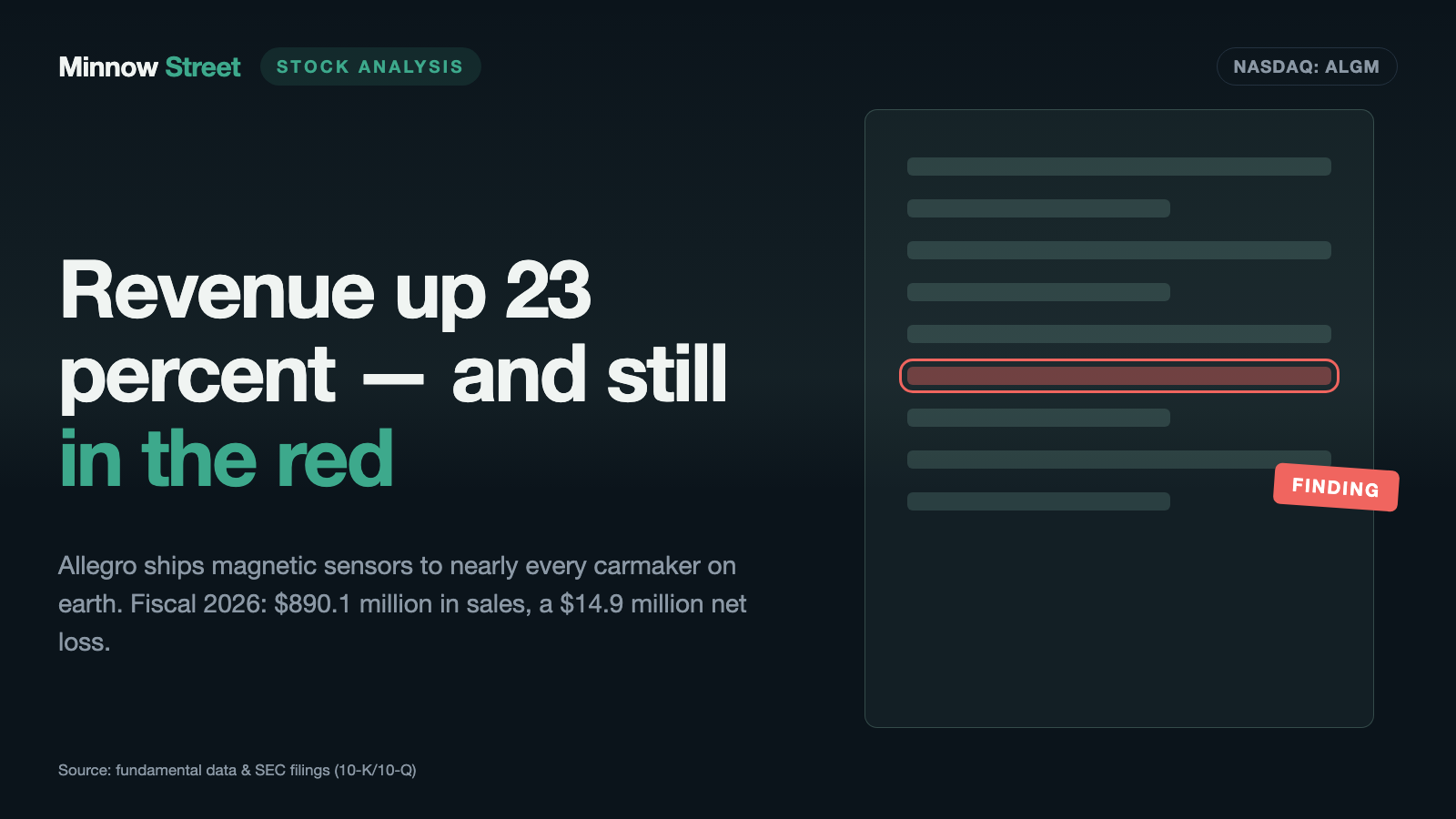
Interactive price chart (TradingView).
Note: pure fact-based analysis, not investment advice and not a solicitation to buy or sell. All figures without guarantee.
There is an investor trap that looks unusually sensible, which is exactly what makes it dangerous: the catch-up trap. It works like this. You look at a line that fell for two years and is now rising again, and your mind quietly finishes the sentence: "The worst is behind them." The word "again" does all the work — growing again, better margins again, confidence again. Nobody checks whether "again" also means "like before." Allegro MicroSystems, Inc. (NASDAQ: ALGM) of Manchester, New Hampshire is a textbook case. Fiscal 2026 revenue jumped 22.8 percent to $890.1 million, gross margin climbed from 44.3 to 46.3 percent, operating income returned to positive territory. And yet revenue still sits 15.2 percent below the record fiscal 2024, the bottom line shows a second consecutive loss year, and suppliers to the automotive industry carried 70.6 percent of the business. So let us make a deal: before you trust the curve, we read together what Allegro told the U.S. securities regulator, the SEC — the annual report on Form 10-K for fiscal 2026, the quarterly report on Form 10-Q as of December 26, 2025, the current reports on Form 8-K and the June 2026 proxy statement on Form DEF 14A. An SEC filing is honest under penalty of law. And this one tells the story of a genuine market leader, of a shareholder holding 32 percent, of an acquisition proposal that no longer exists — and of a calculation that does not yet add up.
What Allegro actually does — the car's sense organs
Allegro builds two kinds of chips, and both can be explained without jargon. The first are magnetic sensor integrated circuits. Picture a car that constantly needs to know how far the steering wheel is turned, how fast a wheel is spinning, how much current is flowing through the battery cable. A sensor that measures this through a mechanical contact wears out. A magnetic sensor reads the magnetic field without touching anything — nothing rubs, nothing degrades. Allegro calls its portfolio the broadest in the industry and describes itself as the world's leading supplier of magnetic sensor ICs by market share. The second kind are power integrated circuits: parts that drive motors, regulate voltages and convert power — from the fan in a data center to the on-board charger in an electric vehicle.
The scale, from the fiscal 2026 annual report: more than 1,500 products, roughly 2.1 billion units shipped a year, more than 15,000 customers, about 1,860 active patents (1,005 of them in the United States), 27 locations across four continents and about 4,250 full-time employees as of March 27, 2026 — 760 in research and development and 2,950 in operations and quality, most of them at the company's own assembly and test plant in the Philippines. The wafers themselves are outsourced, to UMC, Polar Semiconductor, Tower Semiconductor and TSMC. That is the fabless model — you design the chip, someone else bakes it. The upside is very little tied-up capital. The price is dependence on a handful of plants.
The narrative that carried the share price through 2026, however, is not "cars" but AI data centers. And it is not invented — it is written into the annual report:
„The emergence of AI data centers is driving increased demand for our sensor and power ICs in both cooling and power supply applications. Our motor drivers are widely used in data center cooling systems, including fans and pumps, to provide air or liquid cooling of digital processors, power supplies, or network switches.“
— Allegro MicroSystems, Inc., annual report on Form 10-K for fiscal 2026, Item 1 Business
One qualifier matters here: Allegro does not build AI chips. It sells the components that spin the fans and measure the current inside the data center — profitable, real, growing, but technologically a very different thing from an accelerator. That names the central tension of this analysis, and it runs through every chapter: the share price is paying for a data center story while the income statement is still written by the automotive cycle — and that cycle has just handed the company two consecutive loss years.
How the stock landed on our desk — rank 22 in the weekly list
Allegro did not reach us through a press release but through a ranking produced by our in-house stock scanner. In the list Richard Moglen: 1 Week Top Performers (U.S. selection) the stock sits at rank 22 of 28, with a relative strength rating of 92 out of 100, as of July 25, 2026. That list is recalculated every day — the ranking is a snapshot of that day, not a standing condition.
The three conditions behind the list, translated and judged. At least 15 percent price gain over four trading days — pure momentum; it says nothing about the company, only about demand for its shares that week. Average dollar volume of at least $10 million a day — this filter keeps out paper you cannot get out of again; in the weeks before July 24, 2026 between one and four million Allegro shares changed hands on a typical day, which is real liquidity. A relative strength rating of at least 70 — the measure compares a stock's move with the broad market on a scale to 100. A reading of 92 means only 8 percent of tracked stocks did better. Impressive — and also the only item on that list that requires no look at the books. Remember the sentence early: a momentum scanner finds movement, not quality. How violently such lists swing is visible in another chip house, in our analysis of Lattice Semiconductor. So let us open the books.
The numbers over the years — honestly credited
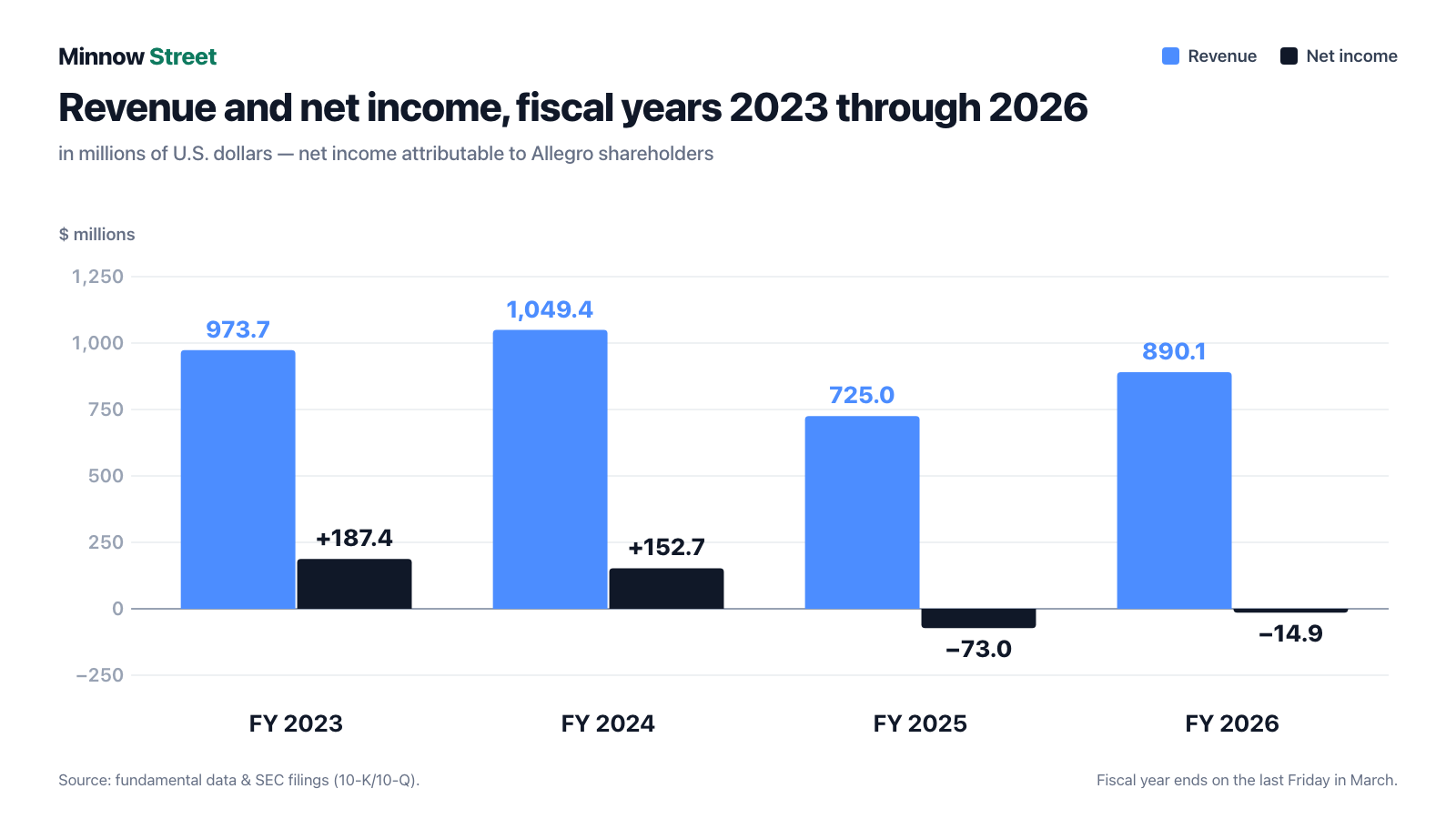
First what genuinely speaks for Allegro, and it is more than the red bottom line suggests. Fiscal 2026 was a real recovery: revenue rose 22.8 percent to $890.1 million, gross profit rose 28.1 percent to $412.0 million, and a $19.8 million operating loss turned into $18.5 million of operating income. Revenue grew for five consecutive quarters; the final quarter delivered $243.2 million, up 26 percent from the year-ago quarter.
For a chip house the cash statement matters even more than the income statement, and it reads well. Operating cash flow rose in fiscal 2026 to $163.1 million, from $61.9 million. Capital spending stayed low at $38.2 million because Allegro has its chips made rather than building its own fabs. What is left is free cash flow of $124.9 million — against $22.0 million the year before. Remember this: Allegro's income statement shows a loss while its cash account shows an inflow. That is not a contradiction but the consequence of heavy amortization on acquired technology and of stock-based compensation — both cost earnings, neither costs cash.
And the third asset: the balance sheet. As of March 27, 2026, $168.8 million of cash stood against a $285.0 million term loan priced at Term SOFR plus 1.75 percent, not due until October 31, 2030 and requiring no scheduled amortization until then. Add an undrawn revolving facility of $256.0 million. Net debt of roughly $116 million sits against $954.7 million of equity. That is not a stretched balance sheet; it is a calm one.
What the filings say — the uncomfortable truths
Uncomfortable truth no. 1: Operating income does not reach the interest line
Operating income returned to positive territory in fiscal 2026 at $18.5 million, an operating margin of 2.1 percent. In the same year Allegro paid $22.1 million of interest. On the arithmetic, operating income covered only 84 percent of the interest expense. On top of that came a $9.4 million loss from an equity investment and $3.2 million of currency losses. The result: a pre-tax loss of $14.9 million, a net loss of $14.7 million and, attributable to Allegro shareholders, minus $14.9 million or $0.08 per diluted share.
For context — and this is the fair part: that ratio describes an earnings problem, not a liquidity problem. Against $22.1 million of interest stands $163.1 million of operating cash flow, a factor of seven. A company with $168.8 million of cash, $256 million of undrawn revolver and no amortization obligation until October 2030 does not have a funding problem. What it does have is a profitability problem: in fiscal 2024 this company earned $152.7 million. Two years later that has become a loss — on revenue only 15 percent lower. Operating leverage cuts both ways, and in a downturn it cuts hard.
A second look is worth it on the gap between reported and adjusted figures. Under U.S. accounting rules the fiscal 2026 operating margin was 2.1 percent; in its own release of May 7, 2026 Allegro reports 14.1 percent — excluding amortization of acquired technology, stock-based compensation and restructuring costs. Both numbers are correct and each tells a different story: one says what was left over, the other what the ongoing business would earn without legacy items. Read only one of them and you read the company wrong.
Uncomfortable truth no. 2: Seven of every ten dollars still come from cars
The data center narrative is real, but it is small. The annual report quantifies the automotive dependence in its own risk section, and it does so bluntly:
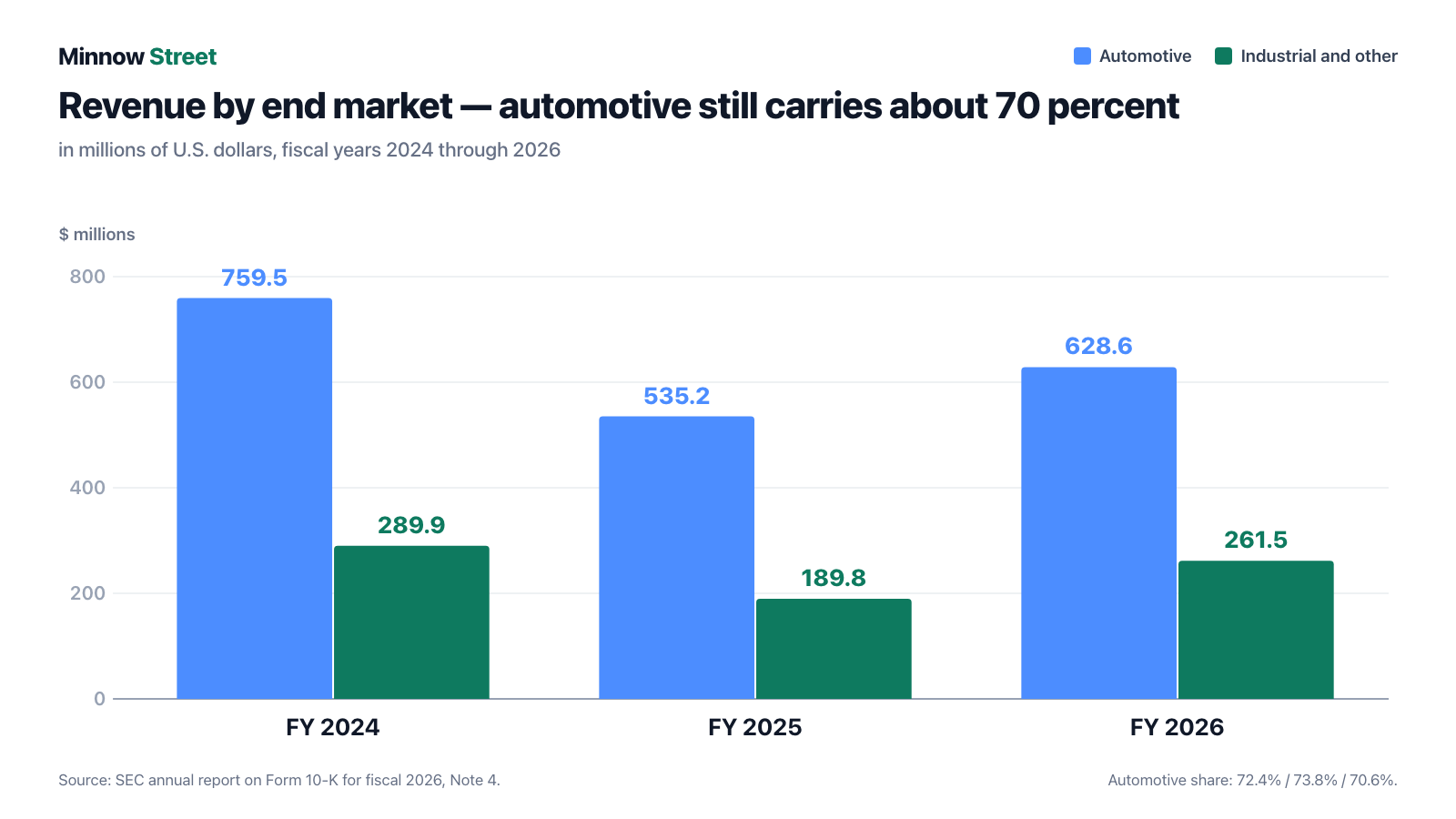
„Our customers that supply various systems and components to automotive OEMs accounted for 70.6%, 73.8%, and 72.4% of our total net sales in fiscal years 2026, 2025, and 2024, respectively. This concentration of sales exposes us to the risks associated with the automotive market and automotive industry.“
— Allegro MicroSystems, Inc., annual report on Form 10-K for fiscal 2026, Item 1A Risk Factors

In absolute terms: $628.6 million of automotive revenue against $261.5 million from industrial and other in fiscal 2026. The industrial line grew far faster, at 37.8 percent versus 17.4 percent for automotive — but it starts from a quarter of the base. And the data center business that fuels the imagination is only part of that quarter: in the final quarter of fiscal 2026 it reached, per company disclosure, a record 14 percent of the $243.2 million quarterly revenue, roughly $34 million in that one quarter. Across the full fiscal year the share was lower — 14 percent was expressly reported as a record, not an average.
There is a geographic tilt as well: 89.7 percent of fiscal 2026 revenue went to customers outside the United States, with $249.4 million to Greater China alone — 28 percent of group revenue. How quickly that turns into a live issue is spelled out in the annual report itself: Chinese export restrictions on rare earth elements and magnets, including samarium, have disrupted the company's ability to source materials. For the electric vehicle side of the same equation, see our analysis of Chinese EV maker XPeng.
Uncomfortable truth no. 3: One shareholder owns a third — and gets a say
Allegro was for years majority-owned by Japan's Sanken Electric Co., Ltd. In July and August 2024 Sanken cut that position sharply: Allegro repurchased 38,767,315 of its own shares from Sanken in two closings for a combined $853.8 million, funding it through an equity offering of 28,750,000 shares at $24.00 ($665.9 million net) and a new term loan. Sanken contributed a $35.0 million facilitation fee toward the transaction.
Sanken has not gone away. In the proxy statement dated June 24, 2026 the company appears with 59,732,782 shares, or 32.1 percent, as by far the largest holder — more than twice the size of the next one (FMR at 14.7 percent). Under a stockholders agreement dated July 23, 2024, Sanken may designate members of the board; it last exercised that right on June 17, 2026. What such a block can mean for the share price is written by Allegro itself, in the risk section:
„Future sales of substantial amounts of our common stock in the public market by our largest stockholders, or the perception that these sales could occur, could cause the market price of our common stock to decline and impair our ability to raise capital through the sale of additional shares.“
— Allegro MicroSystems, Inc., annual report on Form 10-K for fiscal 2026, Item 1A Risk Factors

Translated: a block of 59.7 million shares was worth roughly $2.75 billion at the July 24, 2026 close and equals about 32 percent of all shares outstanding. The freely tradable float stands at about 124.9 million shares (data as of July 25, 2026). Whether and when Sanken sells more, nobody knows but Sanken. But the possibility is always in the room — and it is written in black and white in the annual report.
Uncomfortable truth no. 4: The acquisition proposal is history — and it was below today's price
On March 5, 2025, rival ON Semiconductor confirmed in its own SEC filing that it had delivered to Allegro's board a proposal to acquire all outstanding shares for $35.10 per share in cash. The filing was submitted on Form 425 — the form used to register acquisition communications — and names Allegro expressly as the subject company. On April 14, 2025, ON Semiconductor withdrew the proposal, saying there was no actionable path forward.
For the present the picture is unambiguous, and we checked it: since that single March 2025 communication, Allegro's SEC filings contain no further Form 425, no merger agreement and no merger proxy. ON Semiconductor's next acquisition campaign, documented in a series of Form 425 filings in June 2026, concerns a different company. Anyone buying Allegro today is therefore not buying a live takeover story — but a company that has a $35.10 proposal behind it and whose stock closed at $46.03 on July 24, 2026, roughly 31 percent above that number. The market has since overtaken the old bid. Whether that is a compliment to management or a warning to the buyer will be decided by the earnings of the next few years.
Uncomfortable truth no. 5: The company warns about the AI overshoot itself
The most striking passage in the fiscal 2026 annual report is one you would not expect from a beneficiary of the AI wave. Allegro writes into its risk section that front-loaded AI investment is precisely what can make semiconductor cycles more violent:
„Moreover, expectations and front-loaded investment related to AI Technologies may increase the magnitude and volatility of semiconductor industry cycles, making downturns more abrupt, and if customer spending on AI Technologies moderates, is delayed, or declines more rapidly than anticipated, we could face a more pronounced downturn.“
— Allegro MicroSystems, Inc., annual report on Form 10-K for fiscal 2026, Item 1A Risk Factors

It bears reading twice: a supplier into AI data centers is telling its own shareholders that AI euphoria can make the next downturn worse. That is not boilerplate — it is a sober description of a cyclical business. And the annual report lists more fault lines right after it: Chinese export restrictions on rare earths, two of the four contract foundries in earthquake-prone Taiwan, and the escalation of armed conflict involving the United States, Israel and Iran from early 2026, which has raised freight costs and contributed to a declared state of energy emergency in the Philippines, where Allegro's main assembly plant sits.
Uncomfortable truth no. 6: An investment loss ate two thirds of the annual result
Allegro owns roughly 10.2 percent of Polar Semiconductor — a chip plant that is at the same time one of the company's four contract foundries. Because the stake is carried under the equity method, Allegro's share of that plant's result lands straight in its own income statement:
„(Loss) income in earnings of equity investment reflected loss of $9.4 million and income of $1.2 million in the fiscal years ended March 27, 2026 and March 28, 2025, respectively, related to our equity investment in PSL (PSL Parent following its recapitalization in September 2024).“
— Allegro MicroSystems, Inc., annual report on Form 10-K for fiscal 2026, Item 7 MD&A

The reported consolidated net loss was $14.7 million. About two thirds of it therefore came from a holding unrelated to the ongoing chip business. Its carrying value fell within one year from $31.7 million to $22.3 million; on top of that, $15.0 million of advance payments to Polar appear on the balance sheet for the first time. This is no scandal — but it is a line worth knowing before you charge the loss to the operating business.
Valuation — what the price already pays for
First the order of magnitude rather than a daily quote: with 186.3 million shares and a closing price of $46.03 on July 24, 2026, market capitalization stood at roughly $8.58 billion. Cross-checked against the share count on the cover page of the annual report — 186,222,406 shares as of May 18, 2026 — the figure comes to $8.57 billion; the deviation is below 1 percent, so the order of magnitude holds.
Three anchors follow. First, price to sales: about 9.6 on fiscal 2026 revenue of $890.1 million. For comparison: in the record fiscal 2024, with $1,049.4 million of revenue and $152.7 million of profit, the same market value would have been 8.2 times sales. The market is paying more per dollar of revenue today than in the best year in the company's history. Second, price to earnings: not calculable, because fiscal 2026 ended in a loss. On analyst estimates for the current fiscal year the forward multiple works out to roughly 49 (data as of July 25, 2026) — and that is an estimate, not an actual. Third, book value: about $5.12 per share, which puts price to book at roughly 9.0.
The professional view, as context rather than as a verdict: eleven analyst firms cover the stock, the consensus target is $56.55 (data as of July 25, 2026), and the recommendations break down into eight strong buys, two buys and one hold — not a single sell. That is remarkably unanimous for a company that has reported two consecutive loss years. Two further anchors say more than any target price: rival ON Semiconductor thought $35.10 was reasonable enough for a public proposal in March 2025. And in the twelve months to July 24, 2026 the stock traded between $22.41 and $71.77 — a factor of more than three. Anyone stepping in here should be able to sit through that range.
Opportunities and risks at a glance
What speaks for Allegro:
- Genuine market leadership: the company says it is the world's largest supplier of magnetic sensor ICs by market share, shipping roughly 2.1 billion units a year to more than 15,000 customers, with about 1,860 active patents as of March 27, 2026.
- The recovery is real: revenue up 22.8 percent in fiscal 2026, five consecutive quarters of growth, gross margin from 44.3 to 46.3 percent, operating income back in the black.
- Cash is coming in: $163.1 million of operating and $124.9 million of free cash flow in fiscal 2026, against $61.9 million and $22.0 million a year earlier.
- A calm balance sheet: $954.7 million of equity, $168.8 million of cash, a $285.0 million term loan with no amortization until October 31, 2030, and $256.0 million of undrawn revolver.
- The second leg grows faster: industrial and other up 37.8 percent to $261.5 million, power ICs up 40.4 percent to $351.6 million, data center at a record 14 percent of the final quarter's revenue.
- Little capital tied up: a fabless model with only $38.2 million of capital spending in fiscal 2026 on $890.1 million of revenue.
What speaks against it:
- Two consecutive loss years: minus $73.0 million (fiscal 2025) and minus $14.9 million (fiscal 2026) attributable to Allegro shareholders; operating income of $18.5 million does not cover $22.1 million of interest.
- Revenue far below the peak: $890.1 million versus $1,049.4 million in fiscal 2024 — a 15.2 percent gap, three years on.
- Automotive concentration: 70.6 percent of fiscal 2026 revenue; the company flags this risk in the annual report itself.
- Geopolitics in the supply chain: 89.7 percent of revenue from outside the United States, $249.4 million to Greater China, two of four contract foundries in Taiwan, the main assembly plant in the Philippines, and Chinese export restrictions on rare earths.
- A shareholder with 32.1 percent: Sanken Electric holds 59,732,782 shares and may designate directors; the annual report explicitly warns about the price impact of large sales.
- Investment risk: a $9.4 million loss from the Polar stake in fiscal 2026 after $1.2 million of income the year before; carrying value down from $31.7 million to $22.3 million.
- The price: about 9.6 times sales and 9.0 times book for a company with no reported annual profit; a twelve-month range of $22.41 to $71.77.
A human bottom line
Back to the catch-up trap. At Allegro the catch-up is genuine — nothing in these filings argues otherwise. Revenue is growing again, margin is rising, cash is coming in, the balance sheet holds. Anyone who looked in 2025 saw a company in free fall; anyone looking today sees a company climbing. Both were true in their moment.
What makes the trap so mean is the second half of the sentence, the half our minds tend to swallow: "better again" is not the same as "good." Three years after the record year, revenue is still 15 percent lower, gross margin is still eight and a half points lower, and the bottom line is negative. At the same time the market is paying more per dollar of revenue than it ever did in this company's best year. The recovery is already in the price — and a good part of what is supposed to come next as well.
The decisive question sits in the next few quarterly reports and is refreshingly simple: can the industrial and data center business grow fast enough to lift a 2.1 percent operating margin into double digits before the automotive cycle turns again? If yes, the price move was justified in hindsight. If no, the market mistook a recovery for a turnaround. What you make of that is your decision. And that is exactly as it should be.
Sources
- Allegro MicroSystems, Inc., annual report on Form 10-K for fiscal 2026 (period ended March 27, 2026, filed May 21, 2026), CIK 0000866291 — Item 1 Business, Item 1A Risk Factors, Item 7 MD&A, Notes 4, 12 and 21.
- Allegro MicroSystems, Inc., annual report on Form 10-K for fiscal 2025 (period ended March 28, 2025, filed May 22, 2025) — comparative figures for fiscal 2023 through 2025.
- Allegro MicroSystems, Inc., quarterly report on Form 10-Q as of December 26, 2025 (filed January 30, 2026) — interim balance sheet and the quarterly path through fiscal 2026.
- Allegro MicroSystems, Inc., current report on Form 8-K dated May 7, 2026, Exhibit 99.1 — fourth-quarter and full-year fiscal 2026 results, adjusted metrics, the data center share and the outlook for the first quarter of fiscal 2027 (quarter ending June 26, 2026).
- Allegro MicroSystems, Inc., current report on Form 8-K dated June 18, 2026 — Item 5.02, board designation by Sanken under the stockholders agreement dated July 23, 2024.
- Allegro MicroSystems, Inc., proxy statement on Form DEF 14A dated June 24, 2026 — beneficial ownership as of the record date, board composition, auditor.
- ON Semiconductor Corporation, Form 425 dated March 6, 2025 (subject company Allegro MicroSystems, Inc.) — public proposal of $35.10 per share in cash; ON Semiconductor announced the withdrawal of that proposal on April 14, 2025.
- Rankings from our in-house stock scanner: Richard Moglen: 1 Week Top Performers (U.S. selection, rank 22 of 28, relative strength rating 92), as of July 25, 2026; the lists are recalculated daily.
- Fundamental data (market capitalization, valuation metrics, analyst consensus, share count, twelve-month range), data as of July 25, 2026, closing price of July 24, 2026.
Disclaimer: This article is journalistic analysis of publicly available company data. It is not investment advice, not a recommendation to buy or sell, and not a solicitation to buy or sell securities. Share prices can fall sharply at any time and a total loss is possible. All figures come from the primary sources linked above and carry the reporting date stated there. The author holds no position in the stock discussed at the time of publication.
Our Bottom Line at a Glance
- Market position and technology positive
- In its fiscal 2026 annual report Allegro describes itself as the world's leading supplier of magnetic sensor ICs by market share: more than 1,500 products, roughly 2.1 billion units shipped a year, more than 15,000 customers and about 1,860 active patents as of March 27, 2026. Its customer base includes virtually all major global automotive manufacturers and leading tier-one suppliers.
- Earning power negative
- A second consecutive loss year: minus $14.9 million in fiscal 2026 after minus $73.0 million, both attributable to Allegro shareholders. Operating income of $18.5 million does not cover the $22.1 million interest expense, and revenue sits 15.2 percent below the record fiscal 2024, a year that still produced $152.7 million of profit.
- Cash flow and balance sheet positive
- Operating cash flow rose in fiscal 2026 to $163.1 million and free cash flow to $124.9 million. As of March 27, 2026 the company held $168.8 million of cash and $954.7 million of equity against a $285.0 million term loan at Term SOFR plus 1.75 percent, not due until October 31, 2030 and free of scheduled amortization, plus an undrawn $256.0 million revolving facility.
- Concentration and supply chain risk negative
- In fiscal 2026, suppliers to the automotive industry accounted for 70.6 percent of revenue and customers outside the United States for 89.7 percent, including $249.4 million from Greater China. Wafers come from four contract foundries, two of them in Taiwan; assembly runs largely through the company plant in the Philippines, for which the annual report notes a declared state of energy emergency.
- Ownership structure neutral
- Sanken Electric held 59,732,782 shares, or 32.1 percent, as of the record date of the proxy statement dated June 24, 2026 and may designate directors under the stockholders agreement dated July 23, 2024 — most recently on June 17, 2026. The annual report itself warns about the price impact of large sales. ON Semiconductor's $35.10 acquisition proposal was withdrawn on April 14, 2025.
- Valuation negative
- At the July 24, 2026 closing price of $46.03, market capitalization stood at roughly $8.58 billion — about 9.6 times sales and 9.0 times book for a company with no reported annual profit. In the record fiscal 2024 the same market value would have equalled 8.2 times sales.
Allegro is the catch-up trap in its purest form: everything that improved really did improve — revenue up 22.8 percent to $890.1 million in fiscal 2026, gross margin from 44.3 to 46.3 percent, free cash flow from $22.0 million to $124.9 million, operating income back in the black. And everything that is still missing is still missing: revenue sits 15.2 percent below the record fiscal 2024, the bottom line marks a second consecutive loss year, and $18.5 million of operating income does not reach the $22.1 million interest line. Add 70.6 percent of revenue riding on cars, a shareholder holding 32.1 percent, and a valuation of roughly 9.6 times sales. Not investment advice.
What Our Rating Means
Open questions
The business works in principle, but one material question is open. As long as it stays open, our findings do not carry a quality verdict.
The business carries its own weight: documented leadership in magnetic sensor ICs, $163.1 million of operating cash flow in fiscal 2026, $954.7 million of equity against a $285.0 million term loan with no amortization obligation until October 2030 and an undrawn $256.0 million revolver — there is no sign of a threat to the company itself. What remains open is a clearly operational question, and it carries weight: two consecutive fiscal years ended in a loss, and the recovered operating income of $18.5 million covers only 84 percent of the $22.1 million interest expense. The reason that does not amount to a solvency issue lies in the cash account rather than the income statement: against that interest stands $163.1 million of operating cash flow. On top of it sits dependence on a single end market for 70.6 percent of revenue. That is not documented quality, but it is not a substance finding either — hence yellow. The decision is yours.
A journalistic assessment by our editorial team at the time of the deep dive, based on public sources — not investment advice and not a solicitation to buy or sell. Your personal circumstances (investment goals, risk capacity, taxes) cannot be taken into account. What our levels mean, how verdicts are formed, and what conflicts of interest exist →
Worth Noting
- Allegro reached our research list through our in-house stock scanner: rank 22 of 28 in the list "Richard Moglen: 1 Week Top Performers" (U.S. selection) with a relative strength rating of 92, as of July 25, 2026. The list is recalculated daily; it measures four-day price momentum, liquidity and relative strength — that is, demand for the shares, not the quality of the business.
- Every figure carries its own reporting date: annual figures from the annual report on Form 10-K for fiscal 2026 (period ended March 27, 2026, filed May 21, 2026), quarterly and adjusted figures from the current report on Form 8-K dated May 7, 2026, ownership from the proxy statement on Form DEF 14A dated June 24, 2026, share count from the annual report cover page (May 18, 2026). Valuation metrics as of July 25, 2026 on the closing price of July 24, 2026 — meant to be evergreen, with no daily quote used as an argument.
- Room for confusion: the ticker ALGM belongs to Allegro MicroSystems, Inc. of Manchester, New Hampshire (CIK 0000866291), not to its Japanese major shareholder Sanken Electric Co., Ltd. and not to contract foundry Polar Semiconductor, in which Allegro holds about 10.2 percent. The fiscal year ends on the last Friday in March: "fiscal 2026" maps largely onto calendar year 2025.
Frequently Asked Questions
Allegro designs two kinds of chips: magnetic sensor integrated circuits that measure position, speed, angle and current without physical contact, and application-specific power ICs that drive motors and convert power. The parts sit in the steering, braking and drivetrain systems of cars as well as in data center cooling and power supplies. In fiscal 2026 the company shipped roughly 2.1 billion units to more than 15,000 customers.
Allegro reports on a 52- or 53-week fiscal year ending on the last Friday in March. Fiscal 2026 covered 52 weeks from March 29, 2025 to March 27, 2026, and therefore maps largely onto calendar year 2025. Anyone comparing Allegro with chip companies that report on the calendar year is comparing periods offset by roughly one quarter.
Fiscal 2026 revenue rose 22.8 percent to $890.1 million and operating income returned to positive territory at $18.5 million. Below that line came $22.1 million of interest expense, a $9.4 million loss from the equity stake in Polar Semiconductor and $3.2 million of currency losses. The bottom line was a $14.9 million loss attributable to Allegro shareholders.
Sanken Electric Co., Ltd. of Japan held 59,732,782 shares, or 32.1 percent, according to the proxy statement dated June 24, 2026 — more than twice the size of the second-largest holder. In the summer of 2024 Allegro had repurchased 38,767,315 shares from Sanken. Under a stockholders agreement dated July 23, 2024, Sanken may still designate members of the board.
The company does not give an annual figure, only a quarterly share: in the fourth quarter of fiscal 2026 the data center business reached a record 14 percent of the $243.2 million quarterly revenue, roughly $34 million. Across the full fiscal year the share was lower. For comparison, suppliers to the automotive industry accounted for 70.6 percent of annual revenue.
No. ON Semiconductor confirmed a proposal of $35.10 per share in cash in an SEC Form 425 on March 5, 2025 and withdrew it on April 14, 2025. Allegro's SEC filings have contained no further Form 425, no merger agreement and no merger proxy since. The Form 425 filings ON Semiconductor submitted in June 2026 concern a different target company.
Under U.S. accounting rules the fiscal 2026 operating margin was 2.1 percent. In its own release dated May 7, 2026 Allegro additionally reports 14.1 percent on an adjusted basis, which excludes amortization of acquired technology, stock-based compensation and restructuring costs. The first number shows what was left over, the second what the ongoing business would earn without legacy items.
In fiscal 2026, 89.7 percent of revenue went to customers outside the United States, including $249.4 million to Greater China — about 28 percent of group revenue. Two of the four contract foundries are located in Taiwan. The annual report also names Chinese export restrictions on rare earth elements such as samarium as a concrete disruption to the company's own material supply.
Found an error?
Did you spot a factual error, an outdated number, or a typo in this deep dive? Let us know briefly — your report goes straight to the editorial team.