Allegiant: The Airline Never Stopped Earning — Something Else Always Lost the Money
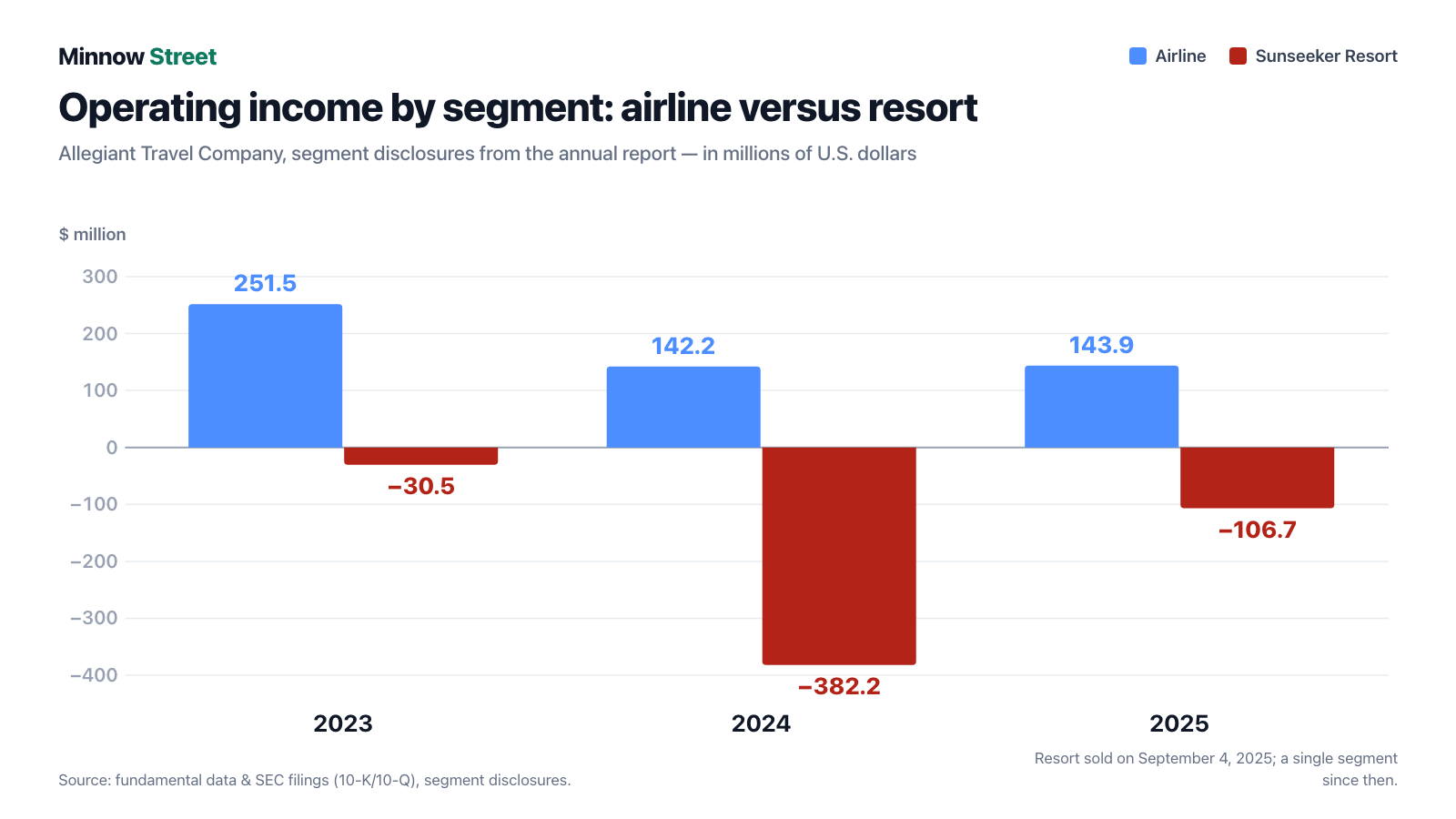
Allegiant Travel Company flies Americans from small towns straight to the beach, and it does so profitably: the airline segment posted positive operating income in 2023, 2024 and 2025 ($251.5 million, $142.2 million and $143.9 million). The group still reported a net loss of $240.2 million in 2024 and $44.7 million in 2025. The culprit was a Florida resort the company sold to Blackstone affiliates on September 4, 2025 — after a $321.8 million impairment and a $100.4 million write-down. Since May 13, 2026 Sun Country Airlines belongs to the group, paid for with cash, new shares and, in June, $650 million of 7.125 percent notes. Not a recommendation — just the arithmetic that actually sits in the filings with the U.S. securities regulator, the SEC.
 Thomas Mücke
Founder & Publisher
Thomas Mücke
Founder & Publisher
Chart
Interactive price chart (TradingView).
Note: pure fact-based analysis, not investment advice and not a solicitation to buy or sell. All figures without guarantee.
There is one story investors almost always buy before they check it: the turnaround story. It has an irresistible shape — things were bad, now they get better — and the ending is settled before it happens. Psychologists call it the narrative bias: we judge an outcome more likely when it makes a good story. Allegiant Travel Company (Nasdaq: ALGT) tells beautifully. So let us make a deal: we read the annual report (10-K) for 2025, the quarterly report (10-Q) as of March 31, 2026, and six current reports (8-K) filed since — and see what survives.
Here is the central tension of this analysis, and it runs through every chapter: this company's airline never stopped making money. Something else always lost it — first a resort in Florida, and the next bet is already placed: an entire airline, paid for with cash, new shares and notes at 7.125 percent.
Contents
- What Allegiant actually does
- How the stock landed on our desk
- The numbers over the years — given their due
- What the filings say — five uncomfortable truths
- Valuation: what you get for your money
- Opportunities and risks at a glance
- A human conclusion
- Sources
What Allegiant actually does — a tour operator that happens to own aircraft
Founded in 1997 and listed on the Nasdaq since December 8, 2006, Allegiant flies people from small and mid-sized American cities directly to the beach. No connections, no hubs, no business travelers. As of February 1, 2026 that meant 539 active routes between 88 origination cities and 33 leisure destinations across 42 states, plus 39 new routes announced for 2026. On three quarters of the more than 1,400 additional routes the company has identified, nobody flies nonstop today.
The model stands on two legs, and only one of them is a plane ticket. The average total fare in 2025 was $133.25 — of which only $56.89 was the flight itself, $68.62 came from ancillary items such as bags, seat assignments and travel protection, and $7.73 from third-party products such as rental cars and hotels. Translated: Allegiant sells the flight close to cost and earns on everything else. Those ancillary revenues have grown from $5.87 per passenger in 2004 to $76.35 per passenger in 2025. Then there is a business that has nothing to do with flying: the Allegiant-branded credit card, issued by Bank of America, delivered $139.6 million in 2025 — up 3.6 percent — with 21 million loyalty members. That agreement runs to 2031.
The second leg is cost. Allegiant mostly owns its aircraft, flies them sparingly (2025: 7.2 block hours per aircraft per day) and sells 92.3 percent of its tickets on its own website — no global distribution systems, no agency commissions. The result is operating cost of 8.04 cents per available seat mile excluding fuel and special charges (2024: 8.56 cents), a level only ultra-low-cost carriers reach in the United States. As of December 31, 2025 the fleet counted 123 aircraft — 79 Airbus A320s, 28 A319s and 16 Boeing 737-8200s — flown by 5,616 full-time equivalent employees.
And then there was the resort. In 2021 Allegiant began building its own leisure property at Charlotte Harbor on Florida's Gulf Coast — hotel, golf course, restaurants — to house its own passengers. The logic sounded tidy. What became of it is below.
How the stock landed on our desk
Allegiant reached our research list through our in-house stock scanner Turnaround Candidates. The scanner looks for beaten-down stocks whose business is measurably turning: at least 50 percent below the all-time high, survival secured, and at least 6 of 8 points on a checklist it calls the turnaround check. If you want to repeat it: open the scanner, set the market filter to the United States, look at the turnaround check column.
Now the honest version, because rankings seduce. As of July 27, 2026 the scanner lists 60 hits in the U.S. selection — identical on both of our brands. Allegiant scores 6 of 8 on the turnaround check. That is the entry ticket, but it is also the bottom of the field: 44 of the 60 hits score exactly 6 as well, 15 score 7, and a single name scores 8. Within that tie group the order is an arbitrary database sort that shifts with every overnight recalculation. Only the 25 strongest names are displayed — and Allegiant is currently not among them. The stock came to us from the full hit list, not from the front page. Anyone looking for it there may not find it; the lists are recalculated daily.
What the scanner saw can be recomputed. The share price stood at $98.08 on July 24, 2026; the all-time high closing price was $268.81 on March 15, 2021 — nearly two thirds below, so the 50 percent hurdle is cleared comfortably (the scanner itself measures on dividend-adjusted prices and reports 58.7 percent). Shareholders' equity is positive, and the equity ratio stood at 24.8 percent on March 31, 2026. Over the twelve months to July 24, 2026 the stock traded between $42.56 and $123.63. Allegiant also shows up in our price-to-cash-flow ranking: market capitalization equals roughly 6.3 times operating cash flow of the last four quarters (data as of July 24, 2026) — a low figure for a capital-hungry business like an airline.
Two metrics from that data set did not survive a check against the annual accounts — see uncomfortable truth number five.
The numbers over the years — given their due
Start with what genuinely impresses. Revenue rose in each of the last three years: $2,509.9 million (2023), $2,512.6 million (2024), $2,606.6 million (2025). In 2025 Allegiant carried 18.74 million passengers — 10.3 percent more than the year before — using the same fleet: the average number of operating aircraft was 124.8 against 124.7. Utilization rose from 6.3 to 7.2 block hours per aircraft per day. That is not cosmetics; that is hard operating work: more revenue from the same capital.
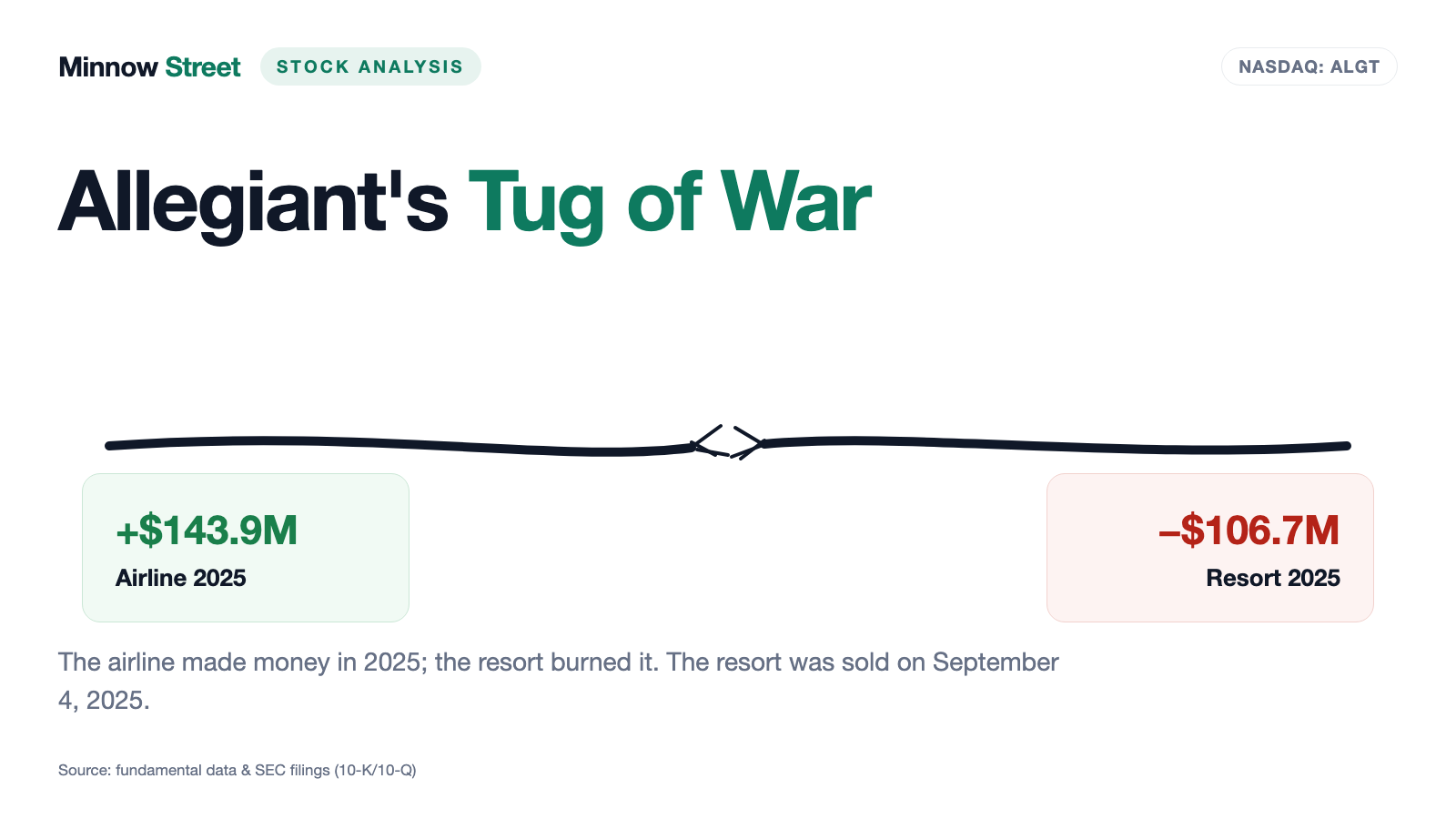
The segment view makes it sharper. The airline alone generated $143.9 million of operating income in 2025, after $142.2 million in 2024 and $251.5 million in 2023. On a pre-tax basis the airline still cleared $75.3 million in 2025 ($94.3 million in 2024, $188.1 million in 2023). And in the first quarter of 2026 — the first quarter without the resort — the group reported revenue of $732.4 million (up 4.8 percent), operating income of $81.1 million and net income of $42.5 million, or $2.30 per diluted share, even though fuel at $3.04 per gallon cost 16.5 percent more than a year earlier.
Now the other side of the same table. At group level 2024 closed with a net loss of $240.2 million and 2025 with a loss of $44.7 million — after net income of $117.6 million in 2023. Group operating income flipped to minus $240.0 million in 2024 and recovered only to plus $37.2 million in 2025. The gap between segment and group has a name, and it fills the next chapter.
What the filings say — five uncomfortable truths
Uncomfortable truth no. 1: The resort cost $562 million pre-tax in three years
Sunseeker Resort at Charlotte Harbor was Allegiant's attempt to extend its own value chain. The result is legible to the dollar in the segment disclosures of the annual report (10-K): operating losses of $30.5 million (2023), $382.2 million (2024) and $106.7 million (2025). Pre-tax — that is, including the interest on the construction loan — the figures were $29.1 million, $402.7 million and $130.2 million: $562.0 million in three years. For context, the entire group's shareholders' equity stood at $1,052.7 million at the end of 2025. A resort consumed well over half of book value while the airline next door kept earning. Revenue it barely produced: $60.7 million in 2025, $71.8 million in 2024.
The exit itself was expensive again. Allegiant wrote down $321.8 million in the fourth quarter of 2024, and a further $100.4 million in the second quarter of 2025 when the resort was reclassified as held for sale.

Uncomfortable truth no. 2: Sold is sold — $189.9 million came back out of $200 million, after building for a multiple of that
Allegiant signed the purchase agreement on July 3, 2025; the money arrived on September 4, 2025. The buyers were affiliates of Blackstone Real Estate Group, the price $200.0 million before adjustments.
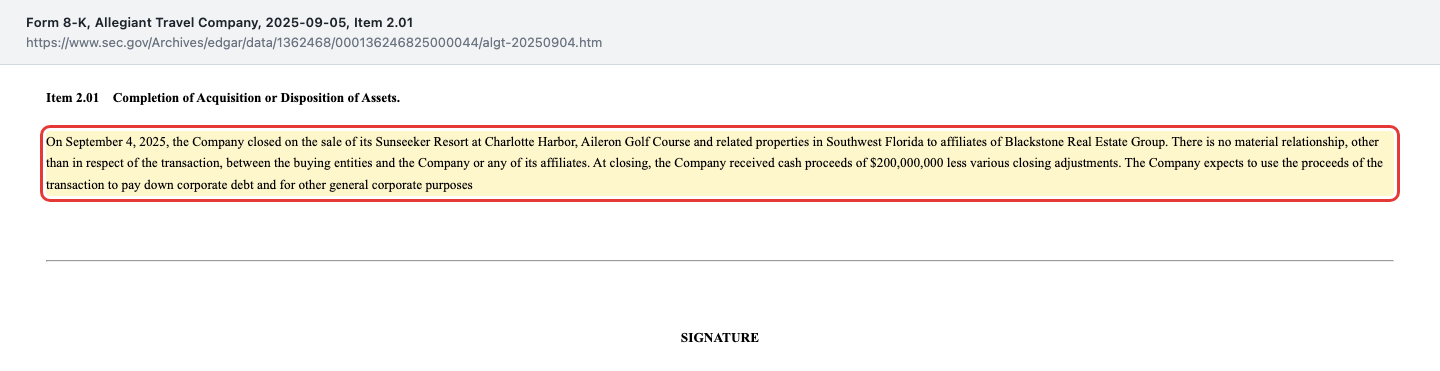
After adjustments, the notes to the annual report put the proceeds at $189.9 million. Against that stood a construction loan of $350.0 million, taken out in October 2021 and repaid in two steps — $250.0 million during 2024 and the final $100.0 million in February 2025. In 2023 alone, $321.0 million of capital spending went into the resort. The good news: this construction site is closed. Since September 2025 the group runs a single segment.
Uncomfortable truth no. 3: Free cash flow covers capital spending — with a $2.2 million cushion
An airline is a business that eats capital continuously. At Allegiant the 2025 arithmetic looked like this: $389.8 million of operating cash flow against $387.6 million of capital expenditures including deposits on aircraft on order. That leaves $2.2 million. 2024 was similarly tight ($338.5 million against $335.2 million), and 2023 showed a wide gap: $423.1 million in against $870.5 million out — the year the resort was being built alongside.
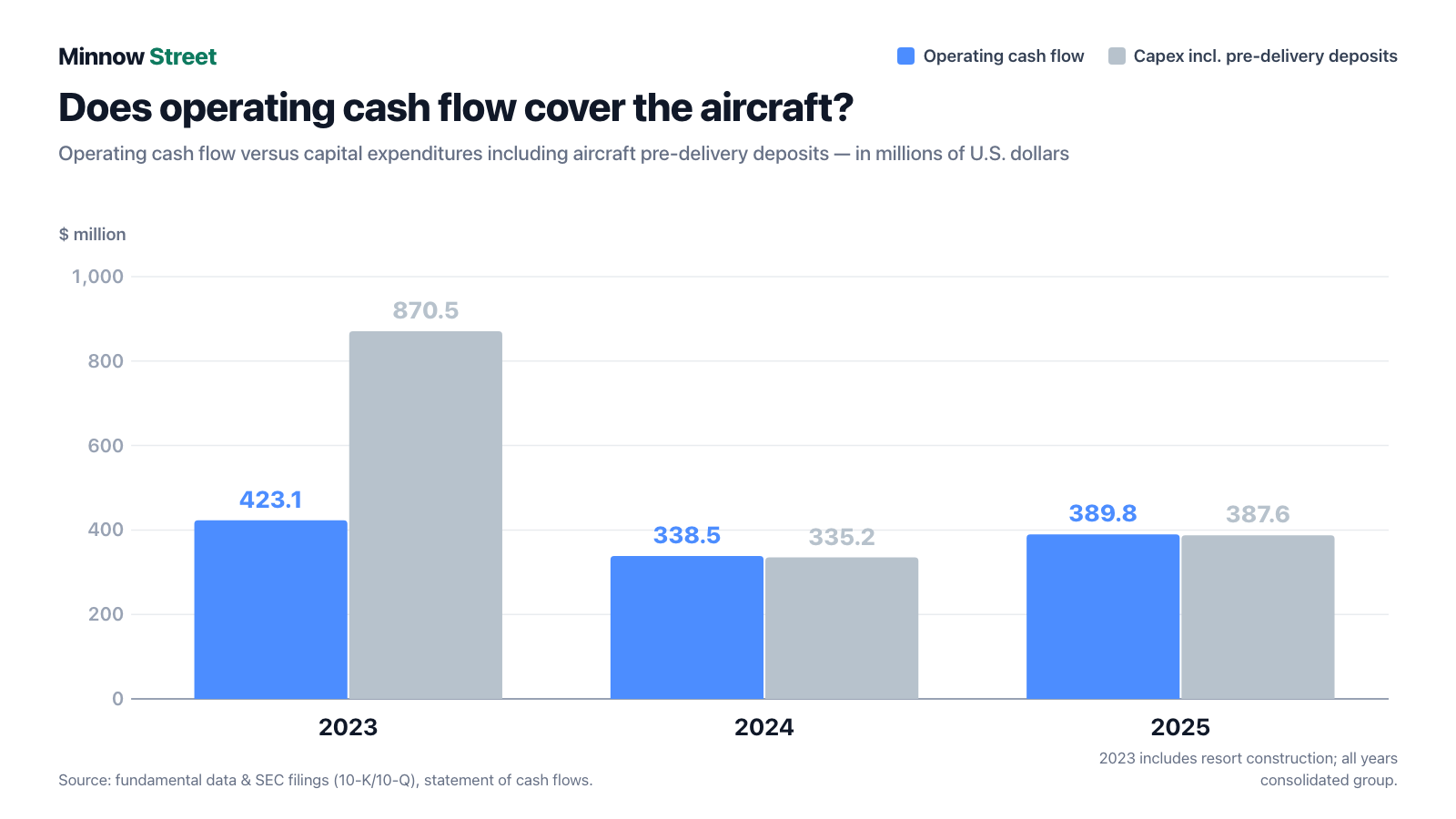
Remember: a cushion of 0.6 percent is not a cushion, it is a pinpoint landing. And the next landings are already scheduled.
Uncomfortable truth no. 4: $3.71 billion of obligations against $1.05 billion of equity
The annual report contains a table many readers skip: contractual obligations. As of December 31, 2025 they added up to $3,713.8 million — $1,824.1 million of debt including scheduled interest, $504.3 million of finance leases, $82.1 million of operating leases and $1,303.3 million for aircraft on order. Of that, $632.2 million falls due in 2026, another $601.1 million in 2027 and $70.1 million in 2028.

Those 34 aircraft are what remains of an order for 50 Boeing 737 MAX placed in December 2021; twelve arrived in 2025. They are the reason the fleet keeps getting younger despite retirements — and the reason the cash register never rests. Allegiant did reduce leverage recently: debt and finance lease obligations net of issuance costs fell from $2.08 billion at the end of 2024 to $1.82 billion at the end of 2025; the company raised $638.9 million and repaid $906.3 million during 2025. That is real deleveraging. It lasted until June 2026.
Uncomfortable truth no. 5: Two metrics in the data set do not survive the annual accounts
A turnaround scanner judges survival partly by the Altman Z-score — a bankruptcy early-warning model built from several balance sheet ratios and originally calibrated on manufacturers — and by the Piotroski F-score, a nine-point checklist of balance sheet quality. Our data set carries an Altman Z of 4.30 and a Piotroski score of 8 out of 9 for Allegiant (data as of July 24, 2026). We recomputed both against the annual accounts, and both are too generous.
The Piotroski score fails at the first of its nine tests: it requires positive net income — Allegiant reported a net loss of $44.7 million in 2025, and over the last four quarters a loss of $1.92 per share. It also fails the test for a falling long-term debt ratio (39.9 percent of total assets at the end of 2025 against 36.4 percent at the end of 2024). Our own reconstruction from the annual accounts arrives at 6 out of 9 — respectable, but not "rock solid," which would be 8 or 9. The Altman Z gap is wider: running the classic formula on the balance sheet as of March 31, 2026 produces roughly 1.6 rather than 4.30. The cause is not manipulation but a choice of variant — the version carried in the data set includes a fixed 3.25-point add-on intended for non-manufacturers.
And here is the more important point: for an airline, the Altman Z is of limited use anyway. The formula penalizes negative working capital — and negative working capital is the normal state at airlines, because customers pay months in advance: as of March 31, 2026 the balance sheet carried $488.8 million of air traffic liability for tickets sold but not yet flown. What we computed ourselves and consider reliable: the equity ratio was 25.0 percent at December 31, 2025 and 24.8 percent at March 31, 2026, shareholders' equity is positive and rising ($1,052.7 million to $1,096.1 million), and cash plus short-term investments came to $902.2 million at March 31, 2026. Survival is not the question. Return on capital employed is.
What happened after the last quarterly report — and changed everything
The most recent quarterly report is dated May 6, 2026. Seven days later, Allegiant was a different company.
"On May 13, 2026 (the 'Closing Date'), Allegiant Travel Company, a Nevada corporation ('Allegiant'), completed the previously announced acquisition of Sun Country Airlines Holdings, Inc., a Delaware corporation ('Sun Country')."
— Allegiant Travel Company, SEC current report 8-K dated May 13, 2026, Item 2.01
The arithmetic sits in the pro forma exhibit filed on June 9, 2026: for 54,208,163 Sun Country shares Allegiant paid $4.10 in cash each and issued 0.1557 of its own shares each — together $222.6 million in cash and roughly 8.45 million new Allegiant shares, valued at the $75.21 closing price on the closing date. Including the settlement of an $80.5 million tax receivable liability, assumed employee equity awards and the settlement of an Amazon warrant, preliminary consideration transferred came to $976.0 million. The share count rose from 18,437,290 (as of April 29, 2026) to a little over 27 million — roughly 47 percent more shares. Your slice of the pie shrank; in exchange the pie grew: on a pro forma basis the two airlines together would have booked $3,738.4 million of revenue in 2025 instead of $2,606.6 million for Allegiant alone.
Six weeks later came the funding. On June 9, 2026 Allegiant announced a $500 million offering, priced $650.0 million at 7.125 percent the same day, and used it to retire most of an older 7.25 percent issue.

The notes brought a covenant that made no headline:
"… at the end of each calendar quarter, it will maintain a minimum aggregate amount of liquidity of $300.0 million. If the Company fails to deliver such quarterly compliance certificate within the prescribed time period or the certificate demonstrates that such liquidity is less than $300.0 million, then the Company will be required to pay additional interest on all outstanding Notes in an amount equal to 2.0% per annum."
— Allegiant Travel Company, SEC current report 8-K dated June 29, 2026, Item 1.01 (indenture)
Between April and May 2026 Allegiant also took on four aircraft financings: $25.1 million as the final draw on a pre-delivery deposit facility, $115.0 million over three years, $44.0 million from a $176 million facility over ten years and $40.6 million from an $85.6 million facility over twelve years — all floating rate. The $150 million revolving credit facility remains undrawn.
Then, on June 30, 2026, came the number that explains the share price in 2026: Allegiant now expects second-quarter adjusted earnings of at least $1.25 per share for the combined entity — after guiding on April 30 to an adjusted loss of roughly $0.50 per share for Allegiant standalone. The company's reasons: demand held up at both airlines, and fuel got cheaper in June.
Valuation: what you get for your money
A price-to-earnings ratio cannot be formed meaningfully for Allegiant right now — the last four quarters show a loss of $1.92 per share. That leaves three anchors, all as of July 24, 2026.
First, revenue. With roughly 27 million shares at $98.08, market capitalization is about $2.66 billion. Measured against revenue of the last four quarters ($2.64 billion) that is a price-to-sales ratio of roughly 1.0; measured against combined pro forma revenue for 2025 ($3.74 billion) it is roughly 0.7. For an airline, neither is cheap nor expensive — it is the band in which U.S. low-cost carriers usually trade.
Second, book value. With book equity of $59.97 per share, you pay roughly 2.3 times book. For a company whose principal asset — aircraft — has a liquid secondhand market, that is a premium only future earning power can justify.
Third, cash flow. Market capitalization equals 6.3 times operating cash flow of the last four quarters. That is the figure that put the stock on our valuation ranking in the first place — and it is more honest than any earnings multiple, because it does not hide the heavy depreciation of an aircraft fleet; it passes it through.
What the professionals think. Eleven analysts cover the stock with an average price target of $137 (data as of July 24, 2026) and expect roughly $7.56 per share for the current fiscal year and roughly $12.12 for the next. Those estimates assume the Sun Country integration goes without major friction — which is precisely the open question. Anyone adopting a consensus number adopts its assumptions too. One aside worth noting: insider filings over the last twelve months show six sales and zero purchases, and roughly 7.2 percent of the float is sold short.
Opportunities and risks at a glance
Opportunities
- The distraction is gone: since September 2025 there is a single segment. The airline earned $143.9 million of operating income and $75.3 million pre-tax in 2025 — with no resort drag at all.
- Scale helps in this industry. On a pro forma basis the two airlines together would have booked $3,738.4 million of revenue and $79.2 million of operating income in 2025; in the first quarter of 2026 the combined figures would have been $1,072.3 million of revenue and $125.5 million of operating income.
- Sun Country brings businesses Allegiant does not have: cargo flying and long-term charter contracts — $155.0 million of cargo revenue and $224.2 million of fixed-fee revenue in 2025. That softens the seasonality of a pure leisure carrier.
- The cost advantage is real and measured: 8.04 cents of operating cost per available seat mile excluding fuel and special charges in 2025, 92.3 percent direct distribution and $139.6 million from the credit card partnership.
- Demand picked up recently: on June 30, 2026 the company raised its second-quarter outlook to at least $1.25 of adjusted earnings per share, after previously guiding to roughly a $0.50 loss per share for Allegiant standalone.
Risks
- Integrating two airlines is the hardest exercise in the business — a single operating certificate, merged pilot seniority lists, one system. The company itself lists failure to realize expected synergies as a risk.
- Leverage is back: roughly $247 million more bond debt after the June exchange, at 7.125 percent, plus a covenant requiring $300.0 million of liquidity at each quarter-end.
- $1,303.3 million is committed for 34 aircraft on order, $632.2 million of it in 2026 — against free cash flow that came to $2.2 million last year.
- The pilots' collective bargaining agreement has been amendable since 2021; pilots make up 23.6 percent of full-time equivalent employees. A deal costs money; no deal costs peace.
- Fuel remains the wild card: $3.04 per gallon in the first quarter of 2026 against $2.61 a year earlier, and the company assumes roughly $4.20 for the second quarter of 2026.
- A leisure carrier lives on its customers' discretionary income. Load factor has already fallen from 85.9 percent (2023) to 82.0 percent (2025), and the average total fare from $142.15 to $133.25.
A human conclusion
Remember the narrative from the opening — things were bad, now they get better? At Allegiant the first half of that sentence is true, but not in the way it is usually told. Flying was never the problem. The airline earned money in every single year, including 2024, when the group reported a $240 million loss. What went wrong was a side bet — a resort that consumed $562 million pre-tax and was handed over for $189.9 million.
That is exactly what makes the stock interesting and risky at once. Interesting, because a healthy operating core now stands alone on the balance sheet for the first time in years. Risky, because management refilled the vacated space immediately: with an entire airline, 47 percent more shares, $650 million of notes at 7.125 percent and 34 aircraft on order. The question is not whether Allegiant can fill airplanes — it has done that for twenty years. The question is whether the same people who built the resort handle the next big commitment better.
A comparison helps with the framing: if you want to see how a leisure company climbs back after a balance sheet crisis, our Carnival analysis shows the same mechanism on a larger scale. And if you wonder who actually earns money on aging aircraft fleets, our AAR Corp. analysis covers the maintenance and parts business on the other side of the same ledger.
What you make of it is your decision. And that is exactly how it should be.
Sources
- Annual report 10-K for 2025, Allegiant Travel Company, filed February 26, 2026 (CIK 0001362468)
- Quarterly report 10-Q as of March 31, 2026, filed May 6, 2026
- Current report 8-K dated September 5, 2025 — sale of Sunseeker Resort (Items 1.01, 2.01)
- Current report 8-K dated May 13, 2026 — closing of the Sun Country Airlines acquisition (Items 2.01, 5.02, 5.03)
- Current report 8-K dated June 9, 2026 — pro forma financial information for the combined company and aircraft financings (Items 7.01, 8.01)
- Current report 8-K dated June 10, 2026 — upsizing and pricing of the notes (Item 8.01)
- Current report 8-K dated June 29, 2026 — issuance of the 7.125 percent notes due 2031 and the minimum-liquidity covenant (Items 1.01, 2.03, 8.01)
- Current report 8-K dated June 30, 2026 — raised outlook for the second quarter of 2026 (Item 8.01)
- Source: fundamental data & SEC filings (annual and quarterly reports, 10-K/10-Q) — metrics, price history and analyst estimates as of July 24, 2026; scanner readings as of July 27, 2026
Journalistic analysis, not investment advice and not a solicitation to buy or sell securities. Share prices can move sharply; a total loss is possible. All figures come from the primary documents linked above and carry the reporting date stated there. The author holds no position in Allegiant Travel Company at the time of publication.
Our Bottom Line at a Glance
- Earning power of the core business positive
- The airline segment was profitable in each of 2023, 2024 and 2025: $251.5 million, $142.2 million and $143.9 million of operating income, and $188.1 million, $94.3 million and $75.3 million pre-tax. In the first quarter of 2026 — the first without the resort — it produced $81.1 million of operating income and $42.5 million of net income despite fuel costing 16.5 percent more.
- Cost position and business model positive
- Operating cost of 8.04 cents per available seat mile excluding fuel and special charges (2025, after 8.56 cents in 2024), 92.3 percent direct distribution through its own website and $76.35 of ancillary revenue per passenger make the model durable. The credit card partnership added $139.6 million in 2025 with 21 million loyalty members.
- Capital allocation negative
- The Sunseeker resort cost $562.0 million pre-tax between 2023 and 2025, after a $350 million construction loan and a $321.8 million impairment; the September 4, 2025 sale returned only $189.9 million. Barely was the space free when the next large bet followed — the acquisition of Sun Country for a preliminary $976.0 million.
- Balance sheet and obligations negative
- Against $1,096.1 million of shareholders' equity (March 31, 2026, a 24.8 percent equity ratio) stand contractual obligations of $3,713.8 million (December 31, 2025), including $1,303.3 million for 34 aircraft on order with $632.2 million due in 2026 alone. Free cash flow in 2025 was $2.2 million; the June notes add roughly $247 million of bond debt at 7.125 percent.
- Data quality and metrics neutral
- The Piotroski score of 8 out of 9 and the Altman Z of 4.30 carried in our data set (as of July 24, 2026) do not survive a check against the annual accounts: our reconstruction gives 6 out of 9 and roughly 1.6 on the classic formula. What is reliable are the equity ratio (24.8 percent), liquidity ($902.2 million) and cash flow — for airlines the Altman Z is distorted anyway by customer prepayments.
- Sun Country integration neutral
- The combination closed on May 13, 2026, three Sun Country representatives joined a board expanded to eleven, and the June 30, 2026 outlook (at least $1.25 of adjusted earnings per share for the second quarter) came in far above the April 30 standalone guidance. What is documented so far is the start, not the synergy — a single operating certificate is still outstanding.
Allegiant is the turnaround story where you have to look closely at what actually turned. The airline never ran badly — it earned money throughout 2023 to 2025 ($251.5 million, $142.2 million and $143.9 million of operating income). What lost money was a resort that cost $562.0 million pre-tax and went to Blackstone affiliates for $189.9 million on September 4, 2025. Since then the healthy core has stood alone for the first time — but only for a few months: since May 13, 2026 Sun Country Airlines belongs to the group, paid for with $222.6 million in cash, roughly 47 percent more shares and $650 million of notes at 7.125 percent. Investing here is not a bet on the airline; it is a bet that the same management handles the next large commitment better than the last one. Not investment advice.
What Our Rating Means
Open questions
The business works in principle, but one material question is open. As long as it stays open, our findings do not carry a quality verdict.
The business demonstrably carries its own weight: the airline segment was profitable throughout 2023, 2024 and 2025 ($251.5 million, $142.2 million and $143.9 million of operating income), operating cash flow reached $389.8 million in 2025, the cost position is documented at 8.04 cents per available seat mile excluding fuel and special charges, and cash plus short-term investments stood at $902.2 million on March 31, 2026 with equity positive and rising ($1,096.1 million, a 24.8 percent equity ratio). Two real questions remain open: capital allocation — the resort cost $562.0 million pre-tax from 2023 to 2025 and returned only $189.9 million on the sale — and the load of $3,713.8 million in contractual obligations (December 31, 2025), including $1,303.3 million for 34 aircraft on order, against free cash flow of $2.2 million last year. Red would require a substance finding, and there is none: no covenant breach, no going-concern doubt, an undrawn $150.0 million revolving facility. Green is out of reach while the balance sheet is unfinished, especially with bond debt back up by roughly $247 million at 7.125 percent since June 2026 and the Sun Country integration only just beginning. The decision is yours.
A journalistic assessment by our editorial team at the time of the deep dive, based on public sources — not investment advice and not a solicitation to buy or sell. Your personal circumstances (investment goals, risk capacity, taxes) cannot be taken into account. What our levels mean, how verdicts are formed, and what conflicts of interest exist →
Worth Noting
- Allegiant reached our research list through our in-house stock scanner "Turnaround Candidates" (U.S. selection, as of July 27, 2026, 60 hits). The stock scores 6 of 8 on the turnaround check — exactly like 44 of the 60 hits; 15 score 7 and one scores 8. Within that tie group the order is an arbitrary database sort, and only the 25 strongest names are displayed: Allegiant is currently not among them. The lists are recalculated daily.
- Metric caveat: the Piotroski score (8 of 9) and Altman Z (4.30) from our data set could not be confirmed against the annual accounts, so the text uses balance sheet ratios we computed ourselves (equity ratio 25.0 percent at December 31, 2025 and 24.8 percent at March 31, 2026, classic Altman Z roughly 1.6, Piotroski reconstruction 6 of 9). For airlines the Altman Z is structurally distorted because customers pay for tickets months in advance.
- Timing: the most recent periodic report is the quarterly report (10-Q) as of March 31, 2026, filed May 6, 2026. The Sun Country closing (May 13, 2026), the notes issuance (June 24, 2026) and the raised outlook (June 30, 2026) came afterwards and are taken from current reports (8-K). Do not confuse the names: Sun Country Airlines Holdings (formerly Nasdaq: SNCY) has been a wholly owned subsidiary since May 13, 2026 and no longer trades on its own.
Frequently Asked Questions
Allegiant is a U.S. leisure airline based in Las Vegas. It flies people from small and mid-sized cities nonstop to vacation destinations — 539 routes between 88 origination cities and 33 destinations as of February 1, 2026. The average scheduled fare in 2025 was $56.89; the company makes its money on ancillary items, third-party products and its own credit card.
The losses came from the Sunseeker resort in Florida. The airline segment posted operating income of $142.2 million in 2024 and $143.9 million in 2025. The resort lost $382.2 million and $106.7 million over the same period — including a $321.8 million impairment in the fourth quarter of 2024 and a $100.4 million write-down in the second quarter of 2025.
It lost money. On a pre-tax basis the resort cost $562.0 million between 2023 and 2025. The construction loan totaled $350.0 million and was fully repaid by February 2025. The resort was sold on September 4, 2025 to affiliates of Blackstone Real Estate for a contractual $200.0 million; $189.9 million arrived after closing adjustments.
Each of the 54,208,163 Sun Country shares received $4.10 in cash and 0.1557 of a new Allegiant share. That amounts to $222.6 million of cash and roughly 8.45 million new shares at the $75.21 closing price on the closing date. Including the settlement of an $80.5 million tax receivable liability and assumed employee equity awards, preliminary consideration transferred came to $976.0 million.
Substantially. As of April 29, 2026 there were 18,437,290 Allegiant shares outstanding; the acquisition added roughly 8.45 million new shares, taking the count to a little over 27 million — about 47 percent more. Your stake shrank. In exchange, combined 2025 revenue on a pro forma basis would have been $3,738.4 million instead of $2,606.6 million for Allegiant alone.
As of December 31, 2025 contractual obligations totaled $3,713.8 million: $1,824.1 million of debt including scheduled interest, $504.3 million of finance leases, $82.1 million of operating leases and $1,303.3 million for 34 aircraft on order. Of that, $632.2 million falls due in 2026 — against shareholders' equity of $1,052.7 million.
Only just. In 2025, $389.8 million of operating cash flow met $387.6 million of capital expenditures including aircraft pre-delivery deposits — a surplus of $2.2 million. In 2024 it was $338.5 million against $335.2 million. In 2023 there was a gap of roughly $447 million because the resort was being built at the same time.
Only partly. The Piotroski score of 8 out of 9 carried in our data set cannot be reproduced from the annual accounts — the first test requires positive net income, and 2025 showed a $44.7 million loss. Our reconstruction gives 6 out of 9. The Altman Z of 4.30 includes a fixed add-on; the classic formula produces roughly 1.6. For airlines the metric is distorted anyway, because customers pay months in advance.
Found an error?
Did you spot a factual error, an outdated number, or a typo in this deep dive? Let us know briefly — your report goes straight to the editorial team.