AAR Stock: Record Revenue, a Sinking Profit — and a Comeback That Leans on Three One-Off Gains
AAR is the spare-parts warehouse and repair shop of aviation — and it shows up in the top 20 of our "Joshua" growth scanner (rank 11, as of July 17, 2026), just below its all-time high after a 94 percent gain in twelve months. We read the annual reports (10-K) for fiscal years 2024 and 2025 and the quarterly report (10-Q) as of February 28, 2026: revenue that rose over three years from $1,990 million to $2,780 million while net income crashed from $90 million to $12 million — a $55.6 million corruption settlement, a 67.9 percent tax rate, and a record quarter in which nearly half the pre-tax profit came from one-off items. Not investment advice — just the question of how much earning power is left once you strip out the asterisks.
 Thomas Mücke
Founder & Publisher
Thomas Mücke
Founder & Publisher
Chart
Interactive price chart (TradingView).
Note: pure fact-based analysis, not investment advice and not a solicitation to buy or sell. All figures without guarantee.
There is an investor trap that catches the optimists in particular: the comeback trap. It runs on a thinking error psychologists call the recency effect — we weight the most recent thing we saw far too heavily. A stock has just had a miserable year, then comes a record quarter, the price shoots up — and in our heads a straight line to the upper right appears instantly: "The turnaround is on, here we go." Hardly any industrial stock feeds that trap in the summer of 2026 as textbook-perfectly as AAR Corp (NYSE: AIR) from Wood Dale, Illinois: an aviation supplier that just posted a record quarter after a profit collapse, trades roughly 94 percent above where it stood twelve months earlier, and clings to just below its all-time high. In our "Joshua" growth scanner the stock sits in the top 20 (rank 11, as of July 17, 2026). So let’s make a deal: before you extend that straight line into the future, we read together what the company itself reported, under penalty of law, to the U.S. securities regulator, the SEC — the annual reports (10-K) for fiscal years 2024 and 2025 and the quarterly report (10-Q) as of February 28, 2026. And these filings tell a story of real growth, an expensive corruption case, and a record quarter that had nearly half its pre-tax profit handed to it. In the end, you decide for yourself.
What AAR actually does — and for whom
AAR is not a plane maker and not an airline — AAR is what sits in between and what laypeople never see: the spare-parts warehouse, the repair shop and the logistics hub of aviation. The industry calls it the "aftermarket": it earns money not from selling new jets but from the fact that every flying jet must be maintained, repaired and supplied with parts for decades. Concretely, AAR runs four segments. Parts Supply (spare-parts distribution, $1,099.6 million of revenue in FY 2025) trades in new and in used, refurbished parts — from an entire dismantled retired aircraft down to a single component. Repair & Engineering ($884.9 million) runs maintenance hangars and component shops. Integrated Solutions ($695.3 million) delivers logistics, program management and software to airlines, lessors and governments. Expeditionary Services ($100.7 million) builds mobile systems such as pallets and containers, mostly for defense customers. Translated, AAR is something like the combination of a parts dealer, a repair garage and a parts logistics firm — only for airliners and military aircraft. It manufactures and maintains worldwide; as of May 31, 2025, the company employed roughly 5,600 people, 4,200 of them in the United States. Customers are 71 percent commercial aviation firms, 29 percent government and defense. One quirk belongs right at the start because it trips up every casual reader of the numbers: AAR’s fiscal year ends on May 31. When this analysis says "fiscal year 2025," it means June 2024 through May 2025 — and the "third quarter of fiscal year 2026" covers December 2025 through February 2026. Which brings us to the central tension of this analysis, and it runs through every chapter: the operating aftermarket business is healthy and growing — but reported profit is a roller coaster of acquisitions, a corruption settlement and one-off items, and the art is to back out the true earning power from the noise. How tightly a supplier hangs on its end customers’ cycle is something we dissected at aerospace-electronics maker Astronics — and how one-off charges and acquisitions can distort an industrial’s reported numbers, in our look at AZZ.
Where the stock shows up in our scanner
Every day we run about 3,500 stocks through our scanners. AAR reached the research list through the "Joshua" growth scanner — it looks for stocks that combine strong trend with solid growth, and AIR sits there at rank 11 of the top 20 (as of July 17, 2026). Behind it stands a striking confluence: the stock trades above both the 50- and the 200-day averages, sits in a Stan Weinstein stage-2 uptrend, clings to its all-time high (about 1.4 percent below it), shows institutional accumulation (10 funds adding against 7 trimming) and — the thing that sets AAR apart from many trend rockets — also appears in the quality growth filter. Behind that stand plus 32 percent in three months, plus 65 percent in six and roughly plus 94 percent in twelve months, plus a relative strength of 91 out of 100 (data as of July 17, 2026). So much for the trend lens. A second lens of the same scanner clouds the picture at one point you should not read past: the insiders were selling. In the filings we reviewed there were 17 insider sales against not a single purchase, and the chief executive was among the sellers (data as of July 17, 2026). Remember this fingerprint: when the price sits at an all-time high and the people who know the numbers best are handing over their own shares, that is not a sell signal — but a reason to look more closely at what the market is pricing in. That is exactly what we do now.
The numbers over the years — honestly appraised
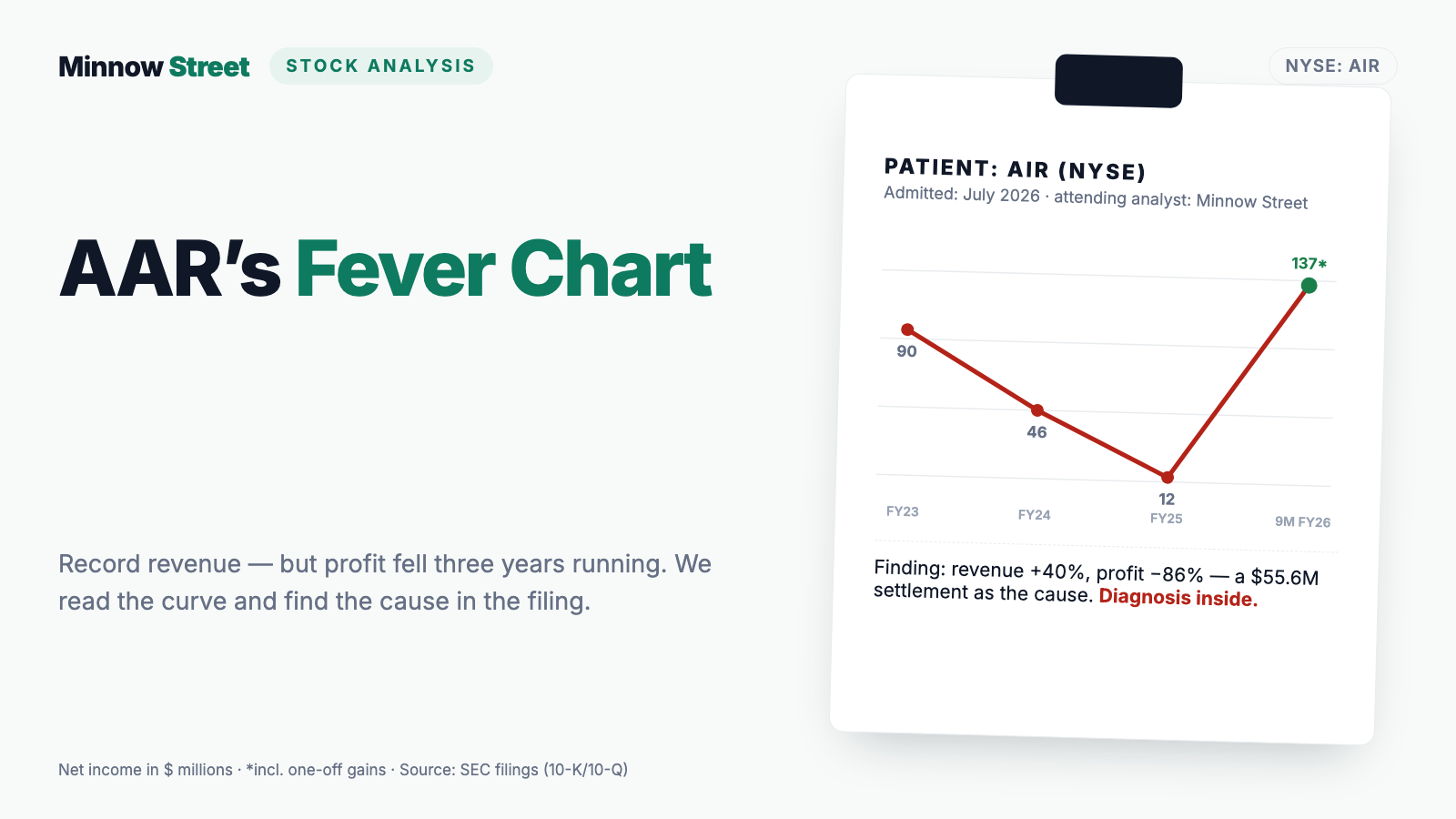
First, what genuinely impresses. Over three fiscal years AAR delivered one of the cleanest revenue curves in its industry: from $1,990.5 million in fiscal year 2023 through $2,318.9 million (FY 2024) to $2,780.5 million in fiscal year 2025 — up 19.9 percent in the last year alone. That is carried partly by the strong aftermarket cycle (airlines fly their fleets longer and maintain them more intensively), partly by one large acquisition: the Product Support business of Triumph Group, which AAR absorbed in the fourth quarter of fiscal year 2024. Gross profit grew 19.3 percent to $527.7 million in FY 2025, and the current fiscal year 2026 continues the curve: in the first nine months (through February 28, 2026), revenue climbed 17.5 percent to $2,380.0 million. If you read only these lines, you see a supplier on a growth track. But now look at what happened on the profit line:
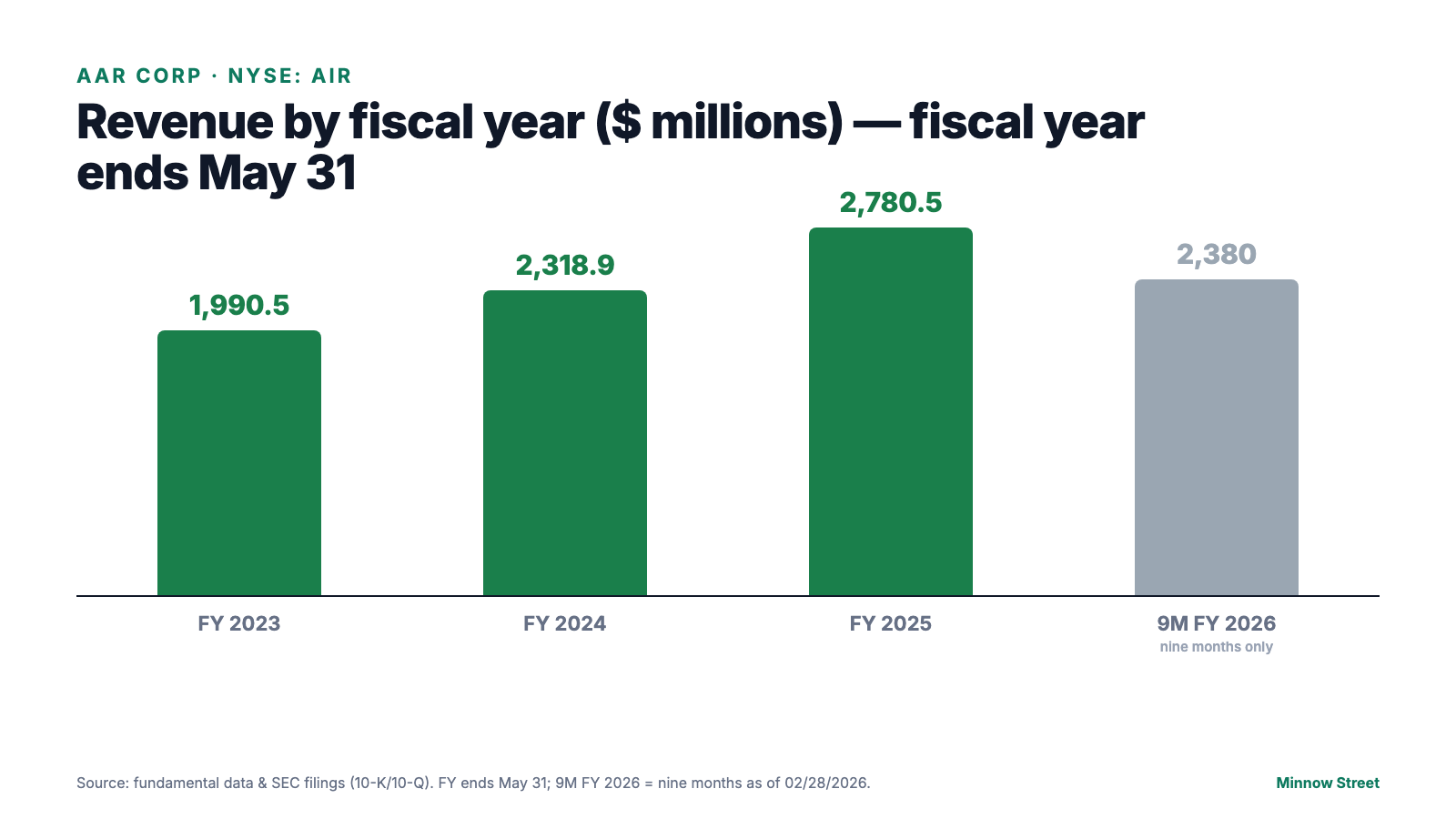
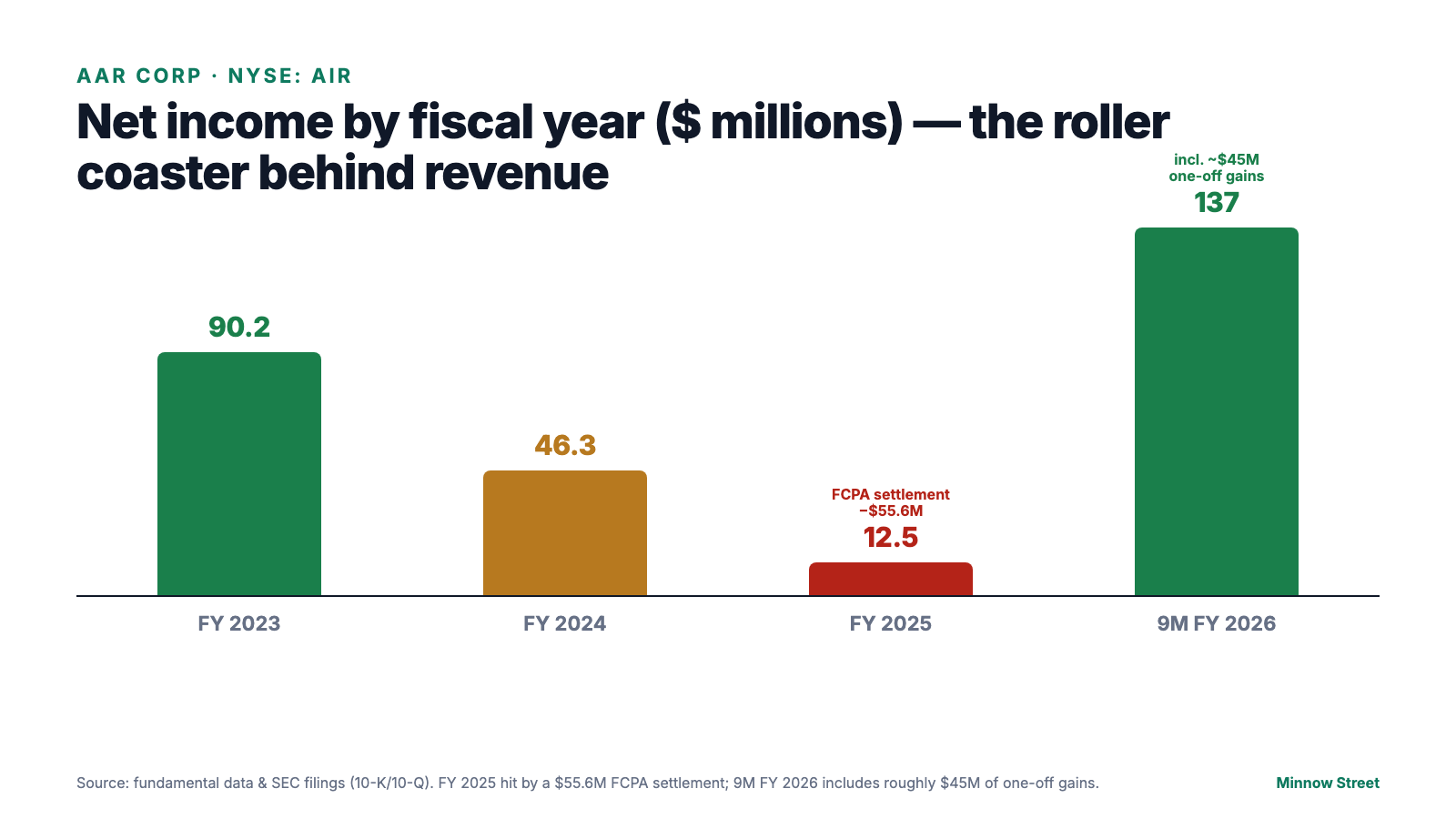
Because net income went exactly the opposite way: from $90.2 million in fiscal year 2023 through $46.3 million (FY 2024) to just $12.5 million in fiscal year 2025 — diluted earnings per share from continuing operations fell from $2.52 through $1.29 to $0.35. A company that grows its revenue by 40 percent and loses seven-eighths of its profit doing so: that is the kind of scissors you have to understand before you celebrate a comeback. Part of the explanation is harmlessly mechanical (more interest on the acquisition debt, amortization of acquired intangibles), part is anything but harmless. Remember the rhythm: at AAR, revenue pushes up while three special factors tug at the profit — and whoever understands the stock has to know all three individually. Which brings us to the uncomfortable truths.
What the filings say — the uncomfortable truths
Uncomfortable truth no. 1: A $55.6 million corruption settlement ate almost the entire year’s profit
Why does the profit of a growing supplier collapse to one-twelfth? The single largest cause sits in the filings and goes by four letters: FCPA, the Foreign Corrupt Practices Act — the U.S. anti-corruption law that bars American firms from bribery abroad. AAR, by its own account, had violations to work through and settled with the U.S. Department of Justice (via a Non-Prosecution Agreement, meaning a waiver of prosecution subject to conditions) and with the securities regulator, the SEC. The price sits plainly in the annual report:
"In the second quarter of fiscal 2025, we recognized a charge for the $55.6 million under the NPA and SEC Order."
— AAR Corp, SEC annual report 10-K for fiscal year 2025, notes "Legal Proceedings"

And it did not stop there — the settlement struck a second time. Fines are, as a rule, not tax-deductible, so AAR could not book a tax benefit on the settlement charge. The result is a number you rarely see:
"In fiscal 2025, our effective income tax rate was 67.9% as the majority of the FCPA settlement charge was nondeductible for income tax purposes resulting in no income tax benefit."
— AAR Corp, SEC annual report 10-K for fiscal year 2025, MD&A "Income Taxes"

For fairness, the context: a settlement is a one-time event, the Non-Prosecution Agreement runs for 18 months (from December 2024), and after that the item disappears from the income statement — which is exactly why fiscal year 2026 looks so much better on the profit line. But two things remain. First, corruption in a company that does a meaningful part of its business with foreign governments and in high-risk countries is not an accident but a structural risk — the annual report itself names "jurisdictions that pose a high risk of potential FCPA violations." Second, a separate enforcement proceeding is running in parallel in Nepal against more than 35 parties, including an AAR subsidiary. The settlement is paid; the reputation-and-compliance chapter is not quite closed.
Uncomfortable truth no. 2: The record quarter had nearly half its pre-tax profit handed to it
Now to the comeback itself — the quarter that lit the price rocket. In the third quarter of fiscal year 2026 (December 2025 through February 2026), net income jumped to $68.0 million, after a $8.9 million loss in the prior-year quarter (which still carried the FCPA charge). Sounds like a breakthrough. But read the income statement line by line and you find two items that normally are not there:
"Bargain purchase gain 35.7 … Gain on sale of headquarters building 9.8"
— AAR Corp, SEC quarterly report 10-Q as of February 28, 2026, Condensed Consolidated Statements of Income
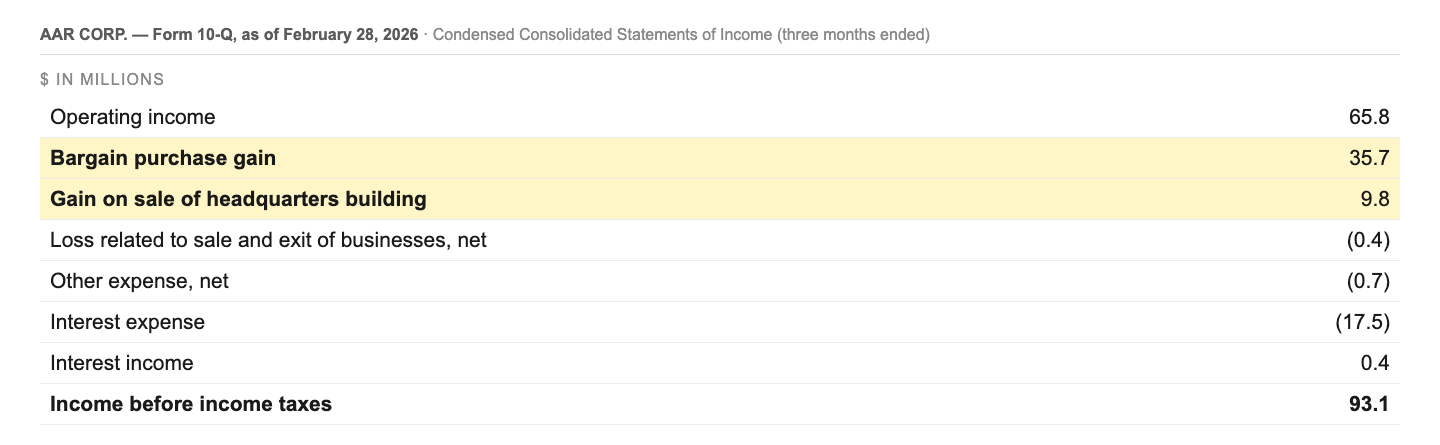
A bargain purchase gain is a book gain with no cash flow: it arises when a buyer pays less for a company than its net assets are worth. AAR explains itself that the seller was "highly motivated to divest the business." Concretely it was HAECO Americas, acquired on November 3, 2025. Together with the $9.8 million gain from selling its own headquarters, roughly $45 million of the $93.1 million pre-tax income came from one-off items — almost half. The operating core business (operating income) was $65.8 million in the quarter, a solid but far more sober figure. The lesson is not that AAR is playing tricks — both items are cleanly disclosed, and bargain purchase gains are legitimate. The lesson is: whoever extends the record quarter linearly into the future also extends profits that only happen once. The next quarter has no second headquarters to sell.
Uncomfortable truth no. 3: The growth is built on debt — and the interest clock is ticking
Where did the revenue jump come from? Largely from acquisitions — and those cost money AAR had to borrow. To pay for Triumph’s Product Support business, the company issued a $550 million note at 6.75 percent interest (due 2029) on March 1, 2024; by February 28, 2026 the note volume had been increased to $700 million, plus $195 million drawn on the revolving credit line, for $888.3 million of long-term debt. What that means for profit, the annual report says directly:
"Interest expense in fiscal 2025 increased $32.2 million primarily reflecting the impact of higher average borrowings used to fund investments in the business, including our acquisition of Product Support businesses in the fourth quarter of fiscal 2024."
— AAR Corp, SEC annual report 10-K for fiscal year 2025, MD&A "Interest Expense"

For a fair counterweight: AAR keeps its leverage in check. The credit agreement allows net debt up to 3.75 times operating earnings (EBITDA), and equity grew to $1,643.4 million by February 28, 2026 — total assets were $3,332.5 million. The acquisitions are no blind flights either: the aftermarket is a proven, margin-stable business, and AAR is one of the few independent consolidators in it. But the 6.75 percent note turns part of the growth into a bet: the aftermarket has to throw off enough extra profit to earn the interest — otherwise the company is buying revenue that shareholders repay via the interest line. And AAR pays no dividend; cash flow goes to interest, integration and occasional buybacks that the company itself describes as not guaranteed.
Valuation: a quality stock at an all-time high — with a distorted profit as the denominator
How expensive is the stock? The most honest sentence first: on the price-to-earnings ratio you have to be careful, because trailing profit is artificially small from the FCPA charge and artificially large from the latest quarter’s one-off gains — depending on which twelve-month window you take. As an order of magnitude (data as of July 17, 2026): the market values AAR at roughly 31 times trailing earnings (P/E), 1.8 times revenue (P/S) and 3.5 times book value (P/B) — which corresponds to a market value on the order of a rough $5 billion. The stock sits about 1.4 percent below its all-time high, after plus 94 percent in twelve months. That is no bargain-bin valuation, but no bubble either — it is the price of a quality growth the market has by now recognized. For comparison: return on equity (ROE) stands at a modest 12.1 percent, depressed by the special items of recent years. Translated: the market is paying today for the normalized earning power of a growing aftermarket company — not for the reported book profit, which is too jumpy to pin a P/E on. So the interesting question is not "is the stock cheap?" (it is not), but: how high is the true, recurring profit once the settlements are paid and the book gains are booked? A look at the profit roller coaster helps frame the question:
Opportunities and risks at a glance
What speaks for AAR:
- A structurally attractive end market: the aviation aftermarket grows with aging fleets, high utilization and parts scarcity — AAR is one of the few large independent players, with revenue up 19.9 percent in FY 2025 and 17.5 percent in the first nine months of FY 2026.
- Diversification across four segments and two customer worlds: 71 percent commercial aviation, 29 percent government and defense — two demand cycles that rarely slump at the same time.
- Quality plus trend in the scanner: AIR sits in the "Joshua" growth filter and simultaneously in "quality growth," in a stage-2 uptrend, above the 50- and 200-day averages, with institutional accumulation and a relative strength of 91 (data as of July 17, 2026).
- Growth lever Trax: the maintenance-software subsidiary bought in 2023 is digitizing MRO workflows and experimenting with artificial intelligence — a higher-margin, scalable building block in an otherwise capital-intensive business.
- The FCPA settlement is paid and one-off: from fiscal year 2026 the $55.6 million charge disappears from the income statement — the normalized earning power becomes more visible.
What speaks against it:
- Reported profit is jumpy: FCPA settlement (FY 2025), bargain purchase and building gains (Q3 FY 2026) — whoever does not back out the special items is valuing phantom profits.
- Growth on debt: $888.3 million of long-term debt, a 6.75 percent note, plus $32.2 million of interest expense in FY 2025 — part of the revenue growth is repaid via the interest line.
- Structural compliance risk: a meaningful share of business in "high-risk jurisdictions" for FCPA violations, an 18-month Non-Prosecution Agreement running to mid-2026, and a separate enforcement proceeding in Nepal against more than 35 parties including an AAR subsidiary.
- Insiders are selling: 17 insider sales against no purchase, the chief executive among the sellers — with the stock at an all-time high (data as of July 17, 2026).
- No dividend, buybacks not guaranteed: cash flow goes primarily to interest and integration; direct capital returns to shareholders are secondary.
A human conclusion
Back to the comeback trap from the opening. Its core is not that comebacks are never real — AAR’s aftermarket business is real, growing and set in one of the industry’s most reliable end markets. Its core is that our minds automatically turn the last, most dramatic number into a trend line: a record quarter after a weak year, and we draw the straight line up. The filings tell a soberer story — a company whose operating heart beats healthily but whose reported profit was, in three consecutive years, first crushed by a corruption settlement and then inflated by one-off gains. The good news: from fiscal year 2026 the FCPA shadow lifts, and what remains is a solid, growing aftermarket business with a digital sliver of upside called Trax. So the honest question for you is not "is the turnaround on?" (the operating business is running), but: are you paying 31 times a profit at an all-time high that you first have to adjust for two corrections — and do you trust the recurring earning power enough to look past the acquisition debt and the insider selling? If yes, you are buying a quality consolidator in a growth market. If no, you wait for a quarter or two without asterisks that show how high the true profit really is. What you make of it is your decision. And that is exactly as it should be.
Sources
All original documents used in this analysis — to read for yourself:
- AAR Corp — SEC annual report 10-K for fiscal year 2025 (ended May 31, 2025; filed July 22, 2025)
- AAR Corp — SEC annual report 10-K for fiscal year 2024 (ended May 31, 2024; filed July 19, 2024)
- AAR Corp — SEC quarterly report 10-Q as of February 28, 2026 (Q3 FY 2026; filed March 25, 2026)
- AAR Corp — SEC quarterly report 10-Q as of November 30, 2025 (Q2 FY 2026; filed January 7, 2026)
- AAR Corp — SEC quarterly report 10-Q as of August 31, 2025 (Q1 FY 2026; filed September 23, 2025)
- AAR Corp’s complete SEC filing history: EDGAR overview (sec.gov)
- Fundamental data (metrics, quarterly series, valuation; data as of July 17, 2026), reconciled with the SEC filings.
- Screener and rating data: in-house stock scanner (data as of July 17, 2026); "Joshua" growth scanner (link).
Transparency & disclaimer: This analysis is a journalistic contextualization of publicly available information and is not investment advice, not a financial analysis in the regulatory sense, and not a solicitation to buy or sell securities. Stock investments carry substantial risks up to total loss. All information without guarantee; the data cut-off is noted in the text in each case. The author holds no position in AAR stock at the time of publication.
Our Bottom Line at a Glance
- End market & business model positive
- The aviation aftermarket is a structural growth market (aging fleets, high utilization, parts scarcity), and AAR is one of the few large independent players, with four segments and two customer worlds (71% commercial, 29% government/defense). Revenue FY 2025 +19.9% to $2,780.5 million, 9M FY 2026 +17.5% (10-K FY 2025, 10-Q as of 02/28/2026).
- Earnings quality & special items negative
- Reported profit is distorted three years running: a $55.6 million FCPA settlement (pushed FY 2025 to $12.5 million net income, a 67.9% tax rate), then a $35.7 million bargain purchase plus a $9.8 million building gain in Q3 FY 2026 — roughly $45 of the $93.1 million pre-tax income are one-off. Whoever does not adjust is valuing phantom profits.
- Balance sheet & financing neutral
- $888.3 million of long-term debt (6.75% note due 2029, increased to $700 million) against $1,643.4 million of equity (02/28/2026); interest expense FY 2025 +$32.2 million — the acquisition-driven growth is built on debt, but leverage is contained with a 3.75x EBITDA covenant. No dividend.
- Compliance & governance negative
- FCPA settlement with the DoJ (an 18-month Non-Prosecution Agreement to mid-2026) and the SEC (both 12/19/2024); a meaningful share of business in "high-risk jurisdictions"; a separate Nepal proceeding against more than 35 parties including an AAR subsidiary. Plus 17 insider sales against no purchase at an all-time high (data as of July 17, 2026).
- Valuation & technicals neutral
- A stage-2 uptrend, above the 50-/200-day averages, "Joshua" and "quality growth" hits, plus 94% in twelve months meet a P/E around 31, a P/S around 1.8 and a P/B around 3.5 (data as of July 17, 2026) — a quality stock at an all-time high whose profit denominator is jumpy from special items.
AAR is the spare-parts warehouse and repair shop of aviation — a growing, independent aftermarket consolidator in a structurally attractive end market. The operating business is healthy (revenue +19.9% in FY 2025), but reported profit is a roller coaster: a $55.6 million corruption settlement crushed FY 2025 (a 67.9% tax rate), and roughly $45 million of one-off gains inflated the Q3 FY 2026 record quarter. On top come $888 million of acquisition debt, no dividend, and insiders selling at an all-time high. Whoever invests here buys a quality consolidator — but has to back out the true, recurring profit from the noise. Not investment advice.
What Our Rating Means
- If you don't own the stock
- As long as the question raised in the bottom line stays open, we see no basis for an entry.
- If you hold it in your portfolio
- Our findings offer no acute reason to sell — the checkpoints named remain decisive.
A journalistic assessment by our editorial team at the time of the deep dive, based on public sources — not investment advice and not a solicitation to buy or sell. Your personal circumstances (investment goals, risk capacity, taxes) cannot be taken into account. What our categories mean, how verdicts are formed, and what conflicts of interest exist →
Worth Noting
- AIR reached our research list via the "Joshua" growth scanner (rank 11 of the top 20, as of July 17, 2026) and a confluence of stage-2 trend, "quality growth," above the 50-/200-day averages and institutional accumulation in our in-house stock scanner.
- Mind the calendar: AAR’s fiscal year ends May 31 — every quarterly reference carries that fiscal-year offset (FY 2025 = June 2024 through May 2025).
- Reported net income is distorted by special items (FCPA settlement Q2 FY 2025; bargain purchase and building gains Q3 FY 2026) — trailing metrics such as the P/E should be read with caution accordingly. Price and valuation figures are dated to July 17, 2026; analyses are evergreen, daily prices are not a buy argument.
Frequently Asked Questions
AAR Corp (NYSE: AIR) of Wood Dale, Illinois, is an independent aviation aftermarket provider: it trades in new and used aircraft parts, repairs components and maintains whole aircraft (MRO), delivers logistics and software, and serves airlines, lessors and the U.S. government. Four segments: Parts Supply, Repair & Engineering, Integrated Solutions and Expeditionary Services. Revenue in fiscal year 2025 (ended May 31, 2025): $2,780.5 million.
AAR’s fiscal year ends May 31. "Fiscal year 2025" therefore covers June 2024 through May 2025, and the "third quarter of fiscal year 2026" means December 2025 through February 2026. Anyone comparing AAR figures with calendar-year numbers of other companies should keep that offset in mind.
In fiscal year 2025, net income fell to $12.5 million (after $46.3 million in FY 2024 and $90.2 million in FY 2023), even though revenue rose 19.9 percent. The main cause was a $55.6 million settlement charge for an FCPA corruption case (a Non-Prosecution Agreement with the U.S. Department of Justice and an SEC Order dated December 19, 2024). Because the settlement was largely non-deductible, the effective tax rate climbed to 67.9 percent. Higher interest on acquisition debt added to the pressure.
In the third quarter of fiscal year 2026 (as of February 28, 2026), AAR reported $68.0 million of net income after a loss in the prior year. But roughly $45 million of the $93.1 million pre-tax income came from one-off items: a $35.7 million bargain purchase gain from the acquisition of HAECO Americas and a $9.8 million book gain from selling the headquarters building. Operating income was a more sober $65.8 million.
AAR settled on December 19, 2024, with the U.S. Department of Justice (via a Non-Prosecution Agreement with an 18-month term) and the securities regulator, the SEC (a Cease-and-Desist Order), over violations of the Foreign Corrupt Practices Act, the U.S. anti-corruption law. AAR booked a $55.6 million charge for it. In parallel, a separate enforcement proceeding is running in Nepal against more than 35 parties, including an AAR subsidiary.
As of February 28, 2026, AAR had $888.3 million of long-term debt, including a note at 6.75 percent (due 2029, increased to $700 million) and $195 million drawn on the credit line. Against that stood $1,643.4 million of equity and $78.5 million of cash. The credit agreement allows net debt up to 3.75 times EBITDA. AAR pays no dividend.
By classic yardsticks, no: the stock sits just below its all-time high (after plus 94 percent in twelve months), at a P/E around 31, a P/S around 1.8 and a P/B around 3.5 (data as of July 17, 2026). Reported profit is distorted by special items, so the P/E should be taken with caution. The market is paying for the normalized earning power of a growing aftermarket company, not the book profit.
Found an error?
Did you spot a factual error, an outdated number, or a typo in this deep dive? Let us know briefly — your report goes straight to the editorial team.