Red Cat: The Army Contract Arrived — the Margin Did Not
Since November 2024 Red Cat has what every small defense company wants: a U.S. Army Program of Record. Revenue jumped to $40.7 million in fiscal 2025. Only $1.3 million of it survived as gross profit — 3.1 percent — against operating expenses of $67.9 million and a net loss of $72.1 million. Three quarters of revenue came from a single customer, management rates its own controls "not effective", and in May 2026 the company raised roughly $245 million of fresh equity. Not investment advice — just the arithmetic behind the order.
 Thomas Mücke
Founder & Publisher
Thomas Mücke
Founder & Publisher
Chart
Interactive price chart (TradingView).
Note: pure fact-based analysis, not investment advice and not a solicitation to buy or sell. All figures without guarantee.
There is an investor trap that closes especially often around small defense companies, and it has a very human core: the contract trap. It works like this. You read that a tiny company has won an order from the U.S. Army — not just any order, but a "Program of Record", a procurement line permanently anchored in the budget. Something then happens in your head that has nothing to do with arithmetic: the size of the customer's name replaces the calculation. If the U.S. Army is buying, you think, the product must be good, the money must be safe, and profit must be a matter of time. Red Cat Holdings (NASDAQ: RCAT) of South Salt Lake, Utah is the textbook case: its subsidiary Teal Drones was selected in November 2024 as a winner of the U.S. Army's Short Range Reconnaissance program, and the stock has had a one-sentence story ever since. So let us make a deal: before you believe that story, we read together what the company itself has told the U.S. Securities and Exchange Commission — the annual report (10-K) for 2025, the quarterly report (10-Q) as of March 31, 2026, and everything filed since. Those documents are honest under penalty of law. And they tell a second story alongside the first: of an order that really is there — and a margin that is not.
What Red Cat actually builds — drones for the troops, made in Utah
Red Cat Holdings is a drone manufacturer, and one whose most important selling point is not the technology but the country of origin. Since the United States sharply restricted government purchases of Chinese drones and components, "built in America" has become a market-access argument in its own right. The annual report describes the company as a provider of all-domain drone and robotic solutions — air, land, sea — for defense, national security and civil applications. Several subsidiaries sit under the roof. Teal Drones is the heart of it: small tactical aircraft for soldiers, police and fire departments, including the Black Widow (the platform for the Army program), the older Teal 2 and the low-cost camera drone FANG. FlightWave builds the Edge 130, an aircraft that takes off vertically and then flies on like a fixed-wing plane — for long-endurance reconnaissance. Blue Ops, launched in August 2025, develops uncrewed surface vessel weapons systems; the first was delivered to its Florida showroom in the fourth quarter of 2025. Then came the swarming software of Apium in March 2026 and Canada's Quaze Technologies in May 2026. The patents are pooled in a subsidiary called UAVPatent Corp: 34 issued patents and registered designs, 13 more pending, none of them licensed out.
A word about the past, because it is in the corporate register and does not belong in a footnote: the company was incorporated in Colorado in 1984 as Oravest International, was later called Peacock Financial, Broadleaf Capital Partners and EnergyTEK, and from November 2016 TimefireVR — a virtual-reality outfit. Only in May 2019 did the shareholders of Propware take an 83 percent stake, and TimefireVR became Red Cat. So if you read a corporate history "since 1984", know this: the drone business is seven years old, the shell is older. Which brings the central tension of this analysis into the open, and it runs through every chapter: Red Cat has the contract everyone was waiting for. The question is no longer whether the company can sell — but whether it can ever build at a profit.
If you want to see what the neighborhood looks like, two comparable cases sit in our archive: Ondas Holdings also sells drones to government customers and wrestles with the same margin question, and Castellum shows what dependence on U.S. government contracts does to an entire balance sheet.
How this stock landed on our desk
Red Cat did not reach us through a quality filter but through attention: the ticker landed on the research list via our Reddit hype scanner — the tool that measures which names are being written about unusually often in the stock forums. We pulled that data on July 25, 2026. That is an attention signal, not a quality verdict — which is precisely why we look closer.
We ran the cross-check against our own screens on July 27, 2026: across the lists of our in-house stock scanner, Red Cat shows up on exactly one that day — "EPS acceleration", a list of 29 names that collects companies whose earnings-per-share growth is accelerating quarter over quarter. With a company that posts losses, you need to know what is actually accelerating: Red Cat's loss per share shrank in the first quarter of 2026 from $0.27 to $0.22. That is acceleration, certainly — but of a shrinking minus, not of a growing profit. On none of our value, balance-sheet or quality lists does the stock appear that day. Worth remembering for later: these lists are recalculated daily; the finding holds for July 27, 2026 and may look different tomorrow.
Fix the finding right at the start: at Minnow Street, Red Cat is not a fundamental find but an attention find. That makes what is written in the filings all the more important.
The numbers over the years — credit where it is due
First the part that genuinely impresses, and it is not small. Red Cat has delivered — literally. Revenue rose in fiscal 2025 to $40.7 million. The annual report attributes the jump explicitly to the start and scaling of drone deliveries to the U.S. Army under the SRR program. In the first quarter of 2026 it continued: $15.5 million of revenue against $1.6 million in the prior-year quarter — an increase of 849 percent. On May 8, 2026 subsidiary Teal received a reorder worth $9.5 million for more units under the same program, disclosed on May 11, with delivery expected in the second quarter of 2026. And the company has grown: 244 full-time employees as of December 31, 2025, its own manufacturing in Salt Lake City, certified since July 2025 to the aerospace quality standard AS9100.
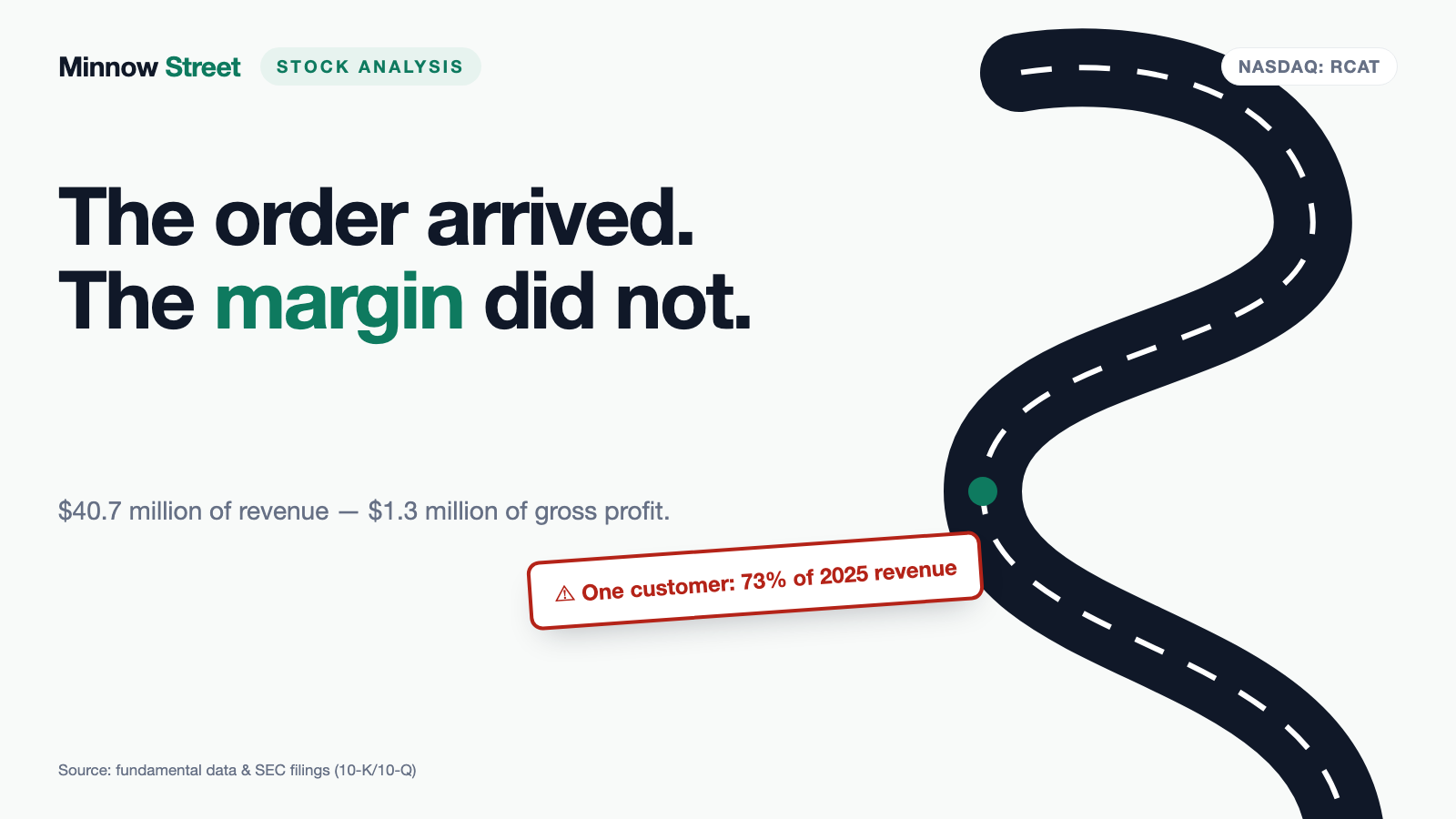
One warning before the chart, because without it the bars mislead: Red Cat changed its fiscal year. It used to end April 30; today it ends December 31. In between sits a transition period of only eight months (May 1 to December 31, 2024). The three pairs of bars therefore cover periods of different length — comparable in trend, not figure for figure.
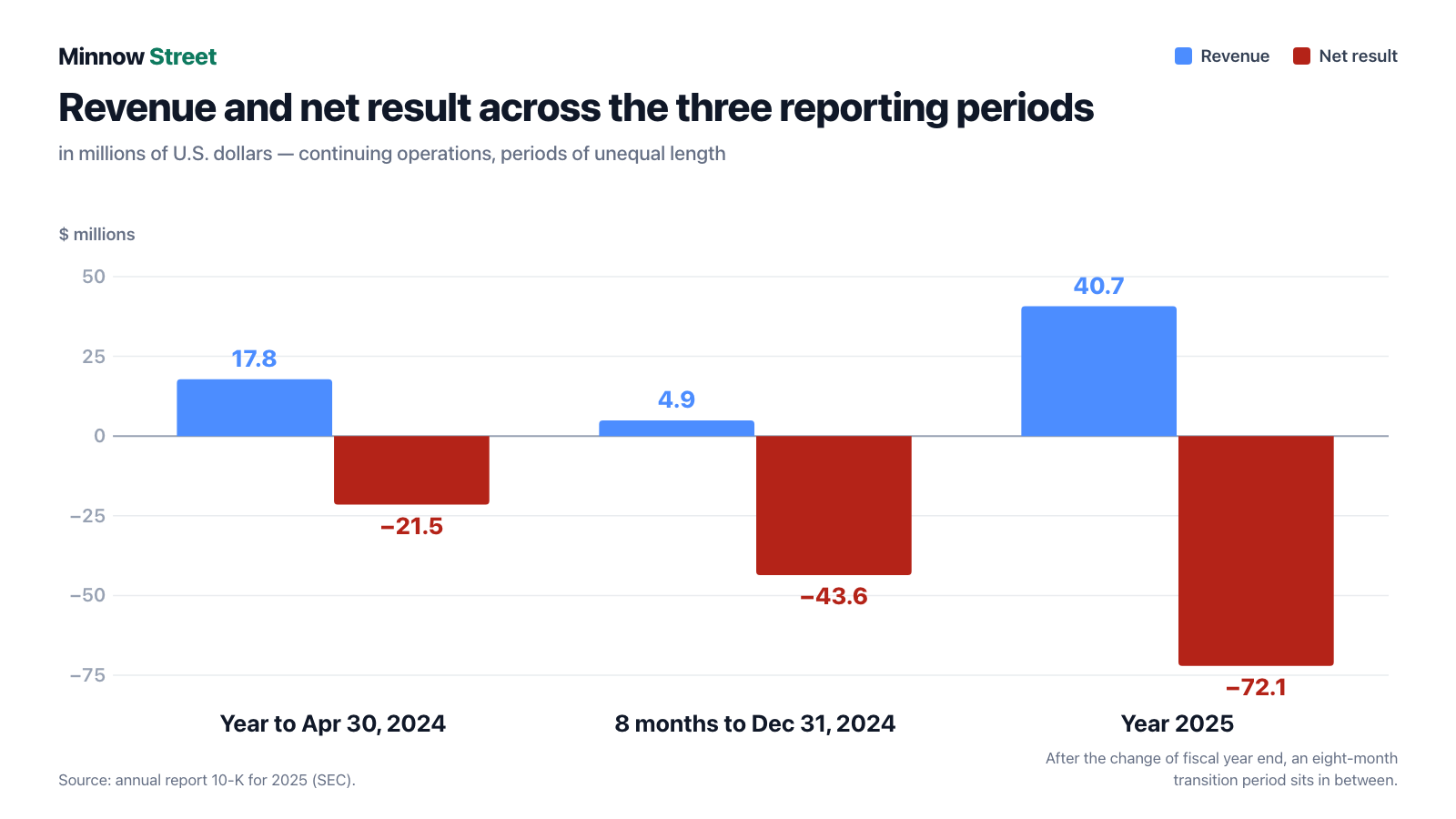
The chart puts this analysis into a single picture. The blue bar grows — from 17.8 through 4.9 (eight months) to $40.7 million. The red one grows faster: from 21.5 through 43.6 to a $72.1 million loss. One note on comparability that we owe you: all three red bars show the result from continuing operations. For 2025 and the transition period that is also the net loss; in the year to April 30, 2024 another $2.5 million came from the divested consumer segment, putting the net loss there at $24.1 million. We deliberately use one basis throughout rather than mixing two definitions. Remember the sentence: at Red Cat revenue grows — and the loss grows with it, not against it. Why that is so is written in the filings. Let us go through them.
What the filings say — the uncomfortable truths
Uncomfortable truth no. 1: a single customer carries three quarters of revenue
The notes to the annual report (10-K) for 2025 contain a paragraph worth reading twice. It sits in the section on credit-risk concentration and quantifies how much revenue comes from how few customers:
"For the year ended December 31, 2025, one customer accounted for equal to or greater than 10% of total revenue, totaling 73%."
— Red Cat Holdings, Inc., SEC annual report 10-K for 2025, note "Concentration of Credit Risk"
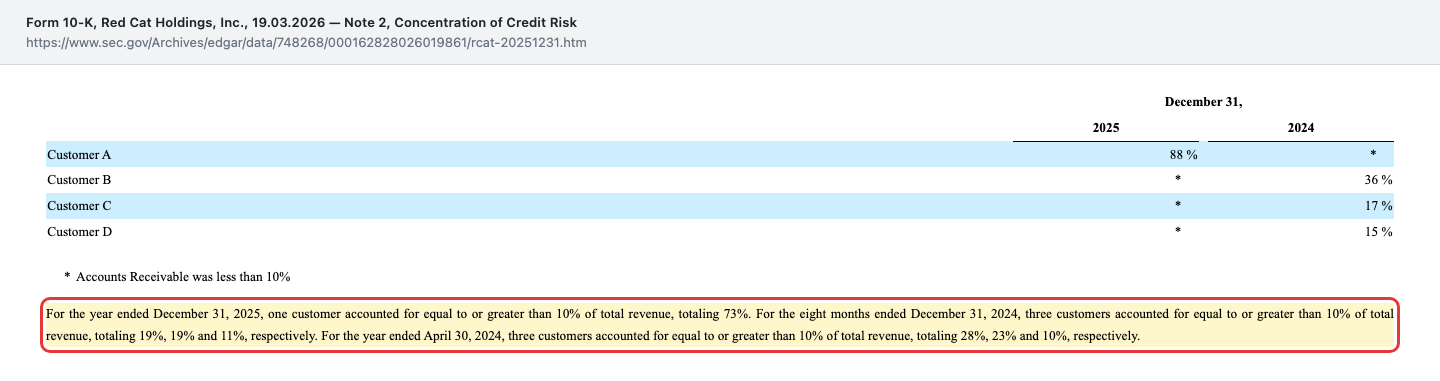
And now the figure that makes the sentence dangerous: this concentration is new. In the transition period to the end of 2024 the three largest customers came to 19, 19 and 11 percent — none of them dominant. In the year to April 30, 2024 it was 28, 23 and 10 percent. Only in 2025 did everything slide onto one address: 73 percent. The order that rescued the revenue curve is at the same time a concentration risk the company did not have before.
Translated into an everyday image: picture a workshop that writes three out of every four invoices to the same client. As long as that client keeps ordering, everything runs. If the client stops, the workshop stops. That is exactly Red Cat's position — with the difference that the client is the U.S. Government. The annual report says so itself: about 73 percent of 2025 revenue came from U.S. Government contracts, and the company expects to keep earning most of its revenue there. That is blessing and curse at once: a more solvent customer is hard to find — but a program can be cut, delayed or recompeted, and a government shutdown stops payments. The first quarter of 2026 eased things slightly: Customer A brought 56 percent of revenue, Customer B 19 percent; on the receivables side Customer A fell from 88 to 50 percent. That is not relaxed concentration — merely somewhat less extreme.
Uncomfortable truth no. 2: of every $100 of revenue, $3 remain
Here lies the actual finding of this analysis, and it can be checked with a calculator. Of the $40.7 million of 2025 revenue, $39.5 million went into making the product. What remained was $1.3 million of gross profit — a gross margin of 3.1 percent. For comparison: in the year to April 30, 2024, when Red Cat sold fewer but pricier units, the gross margin was 20.6 percent; in the transition period to the end of 2024 it was negative at minus 28 percent. The report explains it openly: the plant runs below its designed production capacity, and low unit volumes meet high fixed overhead. As volumes rise, the expectation goes, fixed costs spread and margins improve. In the first quarter of 2026 exactly that happened, up to a point: $2.0 million of gross profit on $15.5 million of revenue, or 12.7 percent.
Only it does not reach far enough. Below the gross profit line sit the operating expenses, and they are of an entirely different order: $67.9 million in 2025, split into $17.9 million of research and development, $13.1 million of sales and marketing — and $36.9 million of general and administrative cost. Read that last number next to the first: administration alone cost almost as much in 2025 as the company took in all year. The first quarter of 2026 continues the pattern: $16.7 million of administrative expense against $15.5 million of revenue. Part of it is payment in the company's own shares — $4.8 million in the first quarter of 2026 alone, up from $1.6 million a year earlier. And the bill is not finished: as of March 31, 2026, $21.5 million of share-based compensation had not yet been recognized as expense — $10.8 million from options (spread over 1.39 years) and $10.7 million from restricted stock (1.48 years). That is not a cash outflow, but it is not free either: it is paid in ownership, by all shareholders jointly.
Uncomfortable truth no. 3: cash leaves faster than it arrives
What the loss means in practice shows up in the cash line. In fiscal 2025 $89.1 million flowed out of operations. In the first quarter of 2026 it was $31.9 million — more than twice the prior-year quarter ($15.9 million). The company attributes the increase mainly to inventory purchases: stock rose from $23.5 million to $50.5 million because production runs ahead of deliveries. That is a good explanation — inventory becomes revenue later. But it is also money that is tied up now.
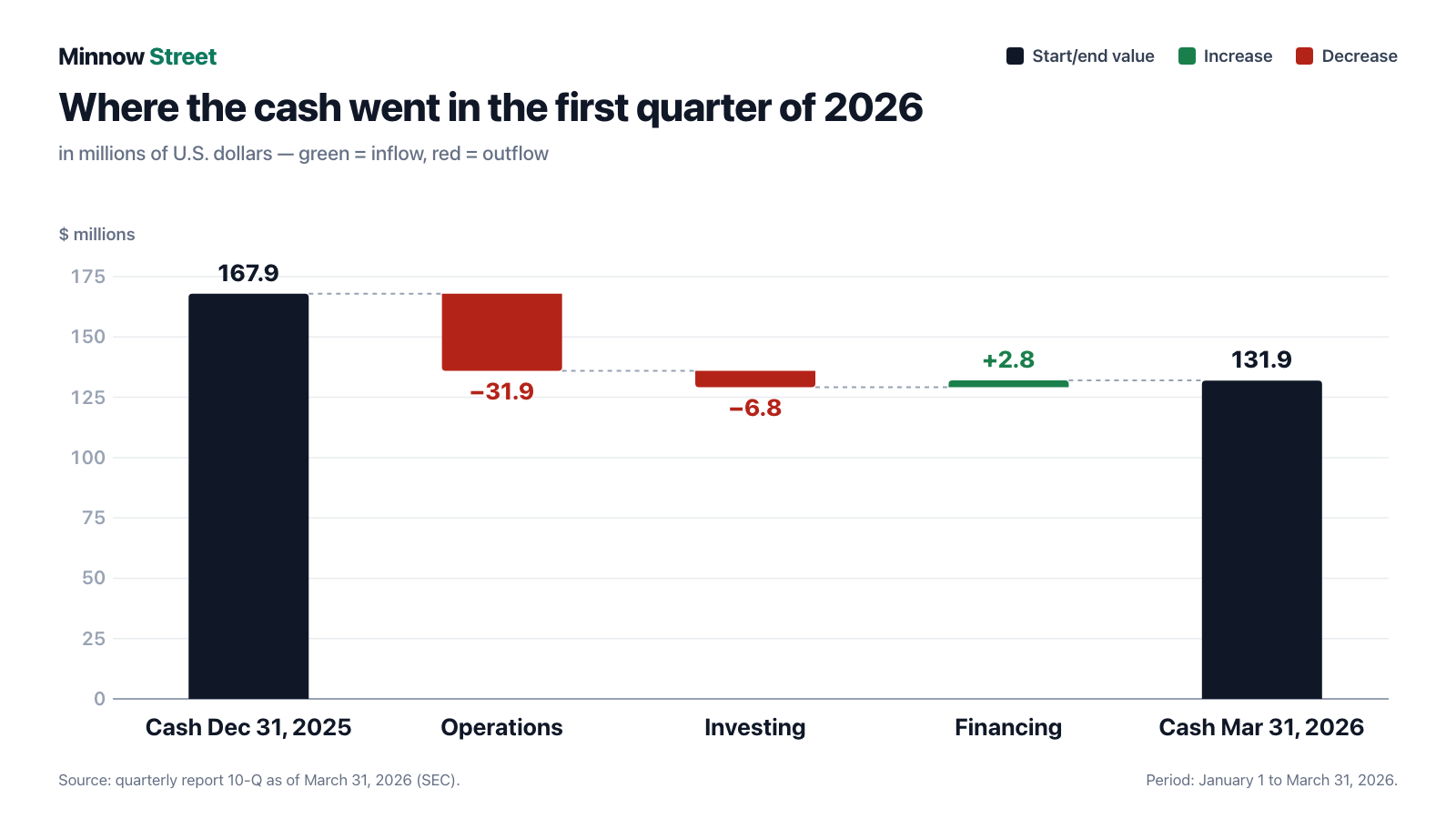
And here comes the good news, which changes the picture considerably: in May 2026 Red Cat raised fresh money — a lot of it. On May 12 the company signed an underwriting agreement with Evercore and BofA Securities for 23,936,171 new shares at $9.40; on May 14 the banks exercised their over-allotment option for a further 3,590,425 shares in full, delivered on May 18. Net proceeds to the company came to about $245.4 million. Applied to the March 31, 2026 cash balance, that leaves roughly $377 million available — at a quarterly outflow of about $32 million, arithmetically some twelve quarters, just under three years of runway. Anyone judging Red Cat should not overlook this: after May 2026 this company does not have a liquidity problem. It very much has a margin problem.
Uncomfortable truth no. 4: management calls its own controls "not effective"
Now the paragraph many investors skip because it sits at the back and sounds technical. At the end of every quarterly and annual report, the CEO and CFO must personally state whether the company's internal controls work. At Red Cat the answer has been no since the 2025 annual accounts — and no again in the quarterly report three months later:
"Based on that evaluation, the Company's Chief Executive Officer and the Company's Chief Financial Officer have concluded that, as a result of the material weakness discussed below, the Company's disclosure controls and procedures were not effective."
— Red Cat Holdings, Inc., SEC quarterly report 10-Q as of March 31, 2026, Item 4 "Controls and Procedures"

What is behind it? The report names the reason plainly: too few qualified accounting staff, and therefore too little supervision, too little four-eyes review and too little segregation of duties. A "material weakness" means, in auditor language, that there is a reasonable possibility a material misstatement would not be prevented or detected on a timely basis. Translated into an everyday image: too few people sit in the accounting department, and nobody reliably checks what the other one booked. Two things belong here in fairness. First: the company states expressly that no misstatements resulted from it. Second: it is working on remediation, has hired additional staff and formalized processes — but a weakness only counts as remediated once the new controls have operated long enough and have been tested. Until then: every number in this analysis comes from books whose control system the company itself calls ineffective.
Uncomfortable truth no. 5: four proceedings, a failed pay vote, a fired revenue chief
The annual report for 2025 names not a single proceeding in its legal chapter. The quarterly report seven weeks later names four. There is a contract dispute brought by Autonodyne against subsidiary Teal in 2025. And there is a package consisting of a shareholder class action filed in May 2025 (Olsen v. Red Cat Holdings, New Jersey) and two derivative suits filed in August 2025 and January 2026 (Fuchs and Henderson, Nevada). The allegation goes straight to the heart of the equity story:
"Each lawsuit alleges that, among other items, the defendants made false and/or misleading statements related to the production capacity of the Company's manufacturing facility in Salt Lake City and the potential value of the Company's contract for the U.S. Army's SRR Program of Record."
— Red Cat Holdings, Inc., SEC quarterly report 10-Q as of March 31, 2026, Item 1A "Risk Factors"

At the annual meeting on June 18, 2026 the shareholders then spoke their mind. Represented were 71,433,137 of the 122,051,175 shares entitled to vote as of the April 23, 2026 record date. The advisory vote on executive compensation — say-on-pay — failed:
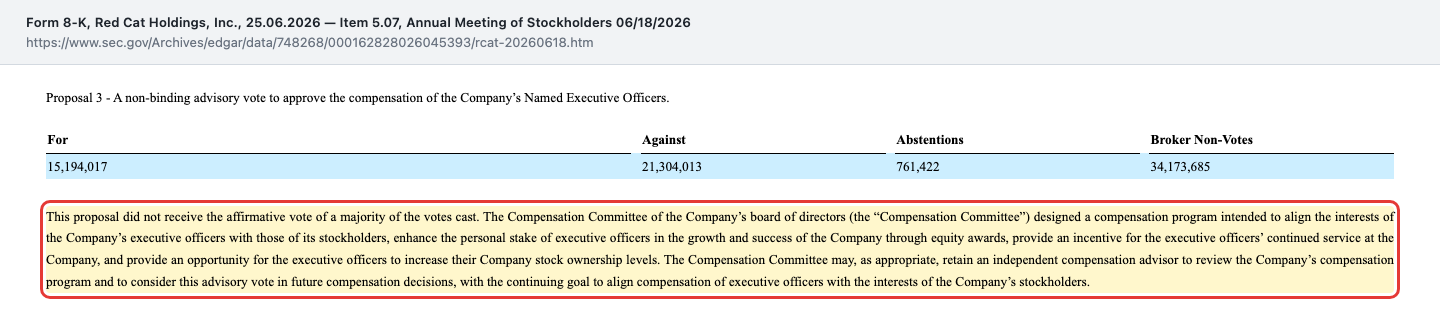
The board election repeated the pattern. Four of the five nominees drew more withheld than affirmative votes: Nicholas Liuzza Jr. (14,348,726 to 22,910,726), General (R) Paul E. Funk II (14,585,509 to 22,673,943), Christopher R. Moe (17,592,054 to 19,667,398) and Joseph Freedman (17,225,491 to 20,033,961). Only CEO Jeffrey M. Thompson came out ahead, 21,607,419 to 15,652,033. Because directors are elected by a plurality of the votes cast, all five remain in office — but the protest is on the record. For comparison: the ratification of auditor KPMG passed at the same meeting by 70,445,245 to 613,920. So it was not a turnout problem.
One week before that vote something else happened that you should know about: on June 11, 2026 director Paul E. Funk II — a retired U.S. Army general — sold 165,028 shares at an average of $11.50 and afterwards held, per his own insider filing (Form 4), not a single share of the company. Seven days later he stood for re-election and drew 14,585,509 affirmative against 22,673,943 withheld votes. The CEO is selling too: the notice of proposed sale (Form 144) dated July 15, 2026 covers 450,000 shares, of which only 150,000 had been reported as executed by the Form 4 of July 16.
Four weeks later came the next development. On July 17, 2026 the board resolved to terminate Chief Revenue Officer Geoffrey Hitchcock for cause, effective July 23 — determining that grounds for "Cause" existed, so that he is entitled to neither severance nor accelerated vesting of his equity awards. On July 21 Hitchcock filed suit: he alleges, among other things, retaliatory termination in violation of New York and Oregon law, plus breach of contract and breach of the implied covenant of good faith and fair dealing, and seeks damages in an unspecified amount. Red Cat considers the claims without merit, intends to defend itself vigorously and is weighing counterclaims. Nobody knows today how that ends. But pause and look at the pattern: a class action about how capacity and contract value were presented, a failed pay vote, four of five directors with more withheld than affirmative votes — and a revenue chief who moved from office to courtroom in four days. Those are four independent signals pointing the same way.
Uncomfortable truth no. 6: 85 million shares became 152 million
Dilution is the technical term for something very simple: your slice of the cake gets smaller because new slices are cut. At Red Cat the cake has been re-cut often in a short time. In the first quarter of 2025 an average of 85.5 million shares were outstanding; by December 31, 2025 it was 120.07 million, by March 31, 2026 121.84 million, and by May 5, 2026, per the cover page of the quarterly report, 122.74 million. Then came May: 27,526,596 new shares from the offering, plus 1,923,308 shares on May 19 as the purchase price for Canada's Quaze Technologies — a package worth about $21 million measured on the 20-day volume-weighted price as of May 18, 2026, with a possible earnout of up to $5 million, again in shares. After those steps 152,192,265 shares were outstanding.
And it can go further. The prospectus supplement of May 14, 2026 lists what additionally stood behind the count as of March 31, 2026: 1,853,808 shares from options under the 2019 plan (weighted-average exercise price $1.28), 2,451,355 from options under the 2024 plan ($6.72), 18,569,096 shares reserved for future issuance under the same plan, 206,100 from warrants ($7.56) and 3,896 from convertible preferred stock. Together roughly 23 million shares — a good 15 percent on top of today's base. Authorized in total are 500 million shares, so there is plenty of headroom. On top of that come the earnouts for Apium and Quaze, which will also be settled in stock. Remember the sentence: anyone modeling Red Cat over several years has to estimate not only revenue per share but the number of shares.
What the stock costs — and what sits behind the price
We quote no daily prices here; they would be wrong tomorrow. Instead we work with figures that appear in an SEC document and carry a date. The most recent price documented in a filing comes from an insider report (Form 4) dated July 16, 2026: CEO Jeffrey Thompson sold 150,000 shares on July 15 under a pre-arranged trading plan adopted on March 31, 2026. The reported price of $8.51 is the weighted average of those sales; individual trades ranged from $8.18 to $9.04. Afterwards Thompson still held 12,762,202 shares directly. Two months earlier, on May 12, 2026, the last reported sale price per the prospectus supplement was $11.03, and the offering was placed at $9.40.
With 152.2 million shares that puts the order of magnitude at about $1.3 billion of market value (on the $8.51 basis) or roughly $1.4 billion (on $9.40). Set against revenue, the expectation embedded in the price becomes visible: measured on 2025 revenue of $40.7 million, that is about 32 times sales; measured on the last four reported quarters ($54.6 million: fiscal 2025 plus the first quarter of 2026 minus the first quarter of 2025), roughly 24 times; and even annualizing the strong first quarter of 2026 ($61.9 million) leaves about 21 times. A price-earnings ratio cannot be formed — there are no earnings.
The most honest calculation, though, is one the company made itself. The prospectus supplement of May 14, 2026 states what the new shareholders got in hard substance for their $9.40: a net tangible book value of $2.80 per share. Red Cat quantifies the difference itself — "an immediate dilution to purchasers in this offering of $6.60 per share" — while existing holders saw their net tangible book value rise by $1.20 per share in the same step. Translated: whoever bought in May 2026 paid a good three dollars for one dollar of substance, and the rest for the expectation that the Army program will one day turn into a series order at a workable margin. That expectation may be met. It appears in none of the numbers published so far.
Opportunities and risks at a glance
Opportunities
- The program is real and running. The November 2024 selection for the U.S. Army's SRR program is a procurement line permanently anchored in the budget, not a one-off order. Revenue jumping from $4.9 million (eight months of 2024) to $40.7 million (2025) and on to $15.5 million in the first quarter of 2026 alone shows that units really are being delivered; a $9.5 million reorder arrived on May 8, 2026.
- Tailwind from the defense budget. The report points to the July 2025 legislative package that appropriated an additional $156 billion for defense and national security, and to a U.S. defense budget request of about $961.6 billion for fiscal 2026 — with an explicit focus on autonomous systems.
- The cash box is full. After the May 2026 offering (net proceeds of about $245.4 million), roughly $377 million is available measured against the March 31, 2026 cash balance. There is virtually no financial debt: $350 thousand short-term as of March 31, 2026.
- The margin is turning the right way. From 3.1 percent gross in 2025 to 12.7 percent in the first quarter of 2026 — exactly the scale effect management promised.
- American manufacturing as market access. The import restrictions on Chinese drones are a structural advantage the report itself names as a growth driver — and a competitive edge software cannot replace.
Risks
- One customer, 73 percent. If the program is cut or delayed, most of the business goes with it. The report explicitly names government shutdowns, budget cuts and bid protests as risks.
- The margin does not carry the cost base. $1.3 million of gross profit against $67.9 million of operating expenses (2025) — even doubling revenue at today's margin would not close the gap.
- Ineffective internal controls. The material weakness persisted unchanged as of December 31, 2025 and March 31, 2026. It counts as remediated only once the new controls have been tested and found effective.
- Litigation over the core claims of the story. The class action and two derivative suits concern production capacity and contract value; the company expects motion practice to run through the remainder of 2026. No loss contingency had been recorded as of March 31, 2026.
- Dilution. From 85.5 million weighted shares (first quarter of 2025) to 152,192,265 after May 19, 2026, plus roughly 23 million from options, warrants and plan reserves as well as the Apium and Quaze earnouts, which will be settled in stock.
- Leadership under pressure. A failed pay vote, four of five directors with more withheld than affirmative votes, the for-cause termination of the Chief Revenue Officer and his retaliation suit — all between June 18 and July 22, 2026.
A human conclusion
Remember the contract trap from the opening? The moment when the size of the customer's name replaces the calculation in your head? Red Cat is the most honest test of it you could ask for — because here both things are true at once. The order is real. The U.S. Army really is buying, the drones really are being built, in a genuinely certified plant in Utah, and revenue really has risen eightfold. None of that is fantasy. And yet in the same year the company lost $72.1 million, because only $3 of gross profit survived every $100 of revenue and administration alone cost almost as much as the entire year's sales.
What follows is not a recommendation but a question only you can answer: would you buy a company that can sell but cannot yet build at a profit — at 32 times its annual revenue? Whoever says yes is betting that volume and the learning curve will lift the margin before the roughly $377 million of cash is used up. Whoever says no points to the gross margin, the single customer, the ineffective controls, and to the fact that the company's own shareholders withheld their approval from management in June 2026. Both sides rest on the same stack of filings — they simply weight it differently.
If you want to watch only three numbers in the coming reports, watch these: the gross margin (last 12.7 percent in the first quarter of 2026 after 3.1 percent in 2025), the operating cash outflow (last $31.9 million in the quarter) and the sentence about internal controls at the very back of the report. If those three change, the whole story changes. What you make of it is your decision. And that is exactly as it should be.
Sources
- Red Cat Holdings, Inc. — annual report (10-K) for fiscal 2025, filed March 19, 2026
- Red Cat Holdings, Inc. — quarterly report (10-Q) as of March 31, 2026, filed May 7, 2026
- Prospectus supplement (424B5) of May 14, 2026 — offering, share count and dilution table
- Filing (8-K) of May 18, 2026 — full exercise of the over-allotment option for 3,590,425 shares
- Filing (8-K) of May 20, 2026 — closing of the Quaze Technologies acquisition
- Filing (8-K) of May 11, 2026 — $9.5 million reorder under the SRR program
- Filing (8-K) of June 25, 2026 — results of the annual meeting of June 18, 2026
- Filing (8-K) of July 22, 2026 — termination of the Chief Revenue Officer and his lawsuit
- Insider filings (Form 4) for Red Cat Holdings at SEC EDGAR — including the June 15, 2026 filing (Paul E. Funk II selling his entire holding) and the July 16, 2026 filing (CEO sale)
- Notice of proposed sale (Form 144) of July 15, 2026 for 450,000 shares for the account of Jeffrey M. Thompson
- Source: fundamental data & SEC filings (annual and quarterly reports, 10-K/10-Q); metrics as of July 27, 2026.
Note: this article is journalistic analysis of publicly available documents and is not investment advice, not an offer to buy or sell securities and not an individual recommendation. Shares of small defense and technology companies are especially volatile; a total loss of invested capital is possible. All figures come from the SEC filings named above and carry their reporting dates. The author holds no position in Red Cat Holdings, Inc. at the time of publication.
Our Bottom Line at a Glance
- Order book and growth positive
- The selection of Teal Drones for the U.S. Army's Short Range Reconnaissance program in November 2024 is a permanently anchored procurement line, not a one-off order. Revenue rose from $4.850 million in the eight-month transition period to December 31, 2024 to $40.729 million in fiscal 2025 and to $15.471 million in the first quarter of 2026 alone (prior-year quarter: $1.630 million). A $9.5 million reorder followed on May 8, 2026.
- Earnings power and margin negative
- Of $40.729 million of 2025 revenue, only $1.274 million remained as gross profit — 3.1 percent. Against that stood $67.871 million of operating expenses, including $36.875 million for administration alone. The net loss came to $72.075 million. In the first quarter of 2026 the gross margin rose to 12.7 percent, yet $16.718 million of administrative cost still exceeded $15.471 million of revenue.
- Customer concentration negative
- In fiscal 2025, 73 percent of total revenue came from a single customer, and as of December 31, 2025 that customer also held 88 percent of outstanding receivables. About 73 percent of revenue came from U.S. Government contracts. The first quarter of 2026 eased that slightly (Customer A 56 percent, Customer B 19 percent) but leaves a dependence on one procurement program.
- Balance sheet and liquidity positive
- As of March 31, 2026 the books showed $131.919 million of cash, $238.739 million of equity and virtually no financial debt ($0.350 million short-term). In May 2026 net proceeds of about $245.4 million from an offering were added. Measured against the first-quarter 2026 operating cash outflow of $31.945 million, that is arithmetically about twelve quarters, just under three years — provided the burn rate does not rise.
- Accounting and leadership negative
- Disclosure controls were rated not effective as of December 31, 2025 and again as of March 31, 2026; the material weakness in staffing, supervision and segregation of duties persists. Add a class action and two derivative suits over production capacity and contract value, a compensation proposal defeated on June 18, 2026 (15,194,017 to 21,304,013), four of five directors with more withheld than affirmative votes, and the for-cause termination of the Chief Revenue Officer on July 17, 2026 together with his July 21 lawsuit.
- Dilution and valuation negative
- 85.5 million weighted shares in the first quarter of 2025 became 152,192,265 after May 19, 2026; as of March 31, 2026 a further 23 million shares stood behind options, warrants and plan reserves. At $8.51 (weighted average of the CEO sales, Form 4 of July 16, 2026) that corresponds to about $1.3 billion of market value and roughly 32 times fiscal 2025 revenue. The company itself puts net tangible book value after the offering at $2.80 per share.
Red Cat has the contract small defense companies work toward for years: a U.S. Army Program of Record that lifted fiscal 2025 revenue to $40.729 million. So far, though, that success is paid for by the capital market rather than by the customer: $1.274 million of gross profit stood against $67.871 million of operating expenses, the net loss came to $72.075 million, and three quarters of revenue came from a single buyer. The gross margin firms up to 12.7 percent in the first quarter of 2026 and the cash box is well filled after the May 2026 offering — but the company's own controls are rated ineffective, four proceedings are running, and shareholders rejected the pay proposal in June 2026. Not investment advice.
What Our Rating Means
Open questions
The business works in principle, but one material question is open. As long as it stays open, our findings do not carry a quality verdict.
The business fundamentally works — the drones get built, accepted and paid for, revenue rose to $40.729 million in fiscal 2025, the balance sheet is robust after the May 2026 offering with about $377 million of liquidity and virtually no financial debt, and there is neither a going-concern flag nor negative equity. What is open is an operating core question, and it is a big one: at a 3.1 percent gross margin in 2025 and 12.7 percent in the first quarter of 2026, revenue comes nowhere near carrying a cost base of $67.871 million, and three quarters of it hang on a single procurement program. Add ineffective internal controls and a loss of confidence among the company's own shareholders. That is not a substance finding, but it is not proven quality either — hence yellow.
A journalistic assessment by our editorial team at the time of the deep dive, based on public sources — not investment advice and not a solicitation to buy or sell. Your personal circumstances (investment goals, risk capacity, taxes) cannot be taken into account. What our levels mean, how verdicts are formed, and what conflicts of interest exist →
Worth Noting
- Red Cat reached the research list through the Reddit hype scanner, which measures which names are written about unusually often in the stock forums; that data was pulled on July 25, 2026. The cross-check against our own screens on July 27, 2026 showed: across the lists of our in-house stock scanner, Red Cat appears that day on exactly one, "EPS acceleration" (29 names). These lists are recalculated daily.
- Recency status: the basis is the annual report (10-K) for 2025 filed March 19, 2026 and the quarterly report (10-Q) as of March 31, 2026 filed May 7, 2026. Every document filed afterwards was reviewed — the offering (424B5/8-K, May 2026), the closing of the Quaze acquisition (8-K, May 20, 2026), the annual meeting (8-K, June 25, 2026), the insider filings (Form 4) of June 15 and July 16, 2026, the notice of proposed sale (Form 144) of July 15, 2026 and the 8-K of July 22, 2026 on the termination of the Chief Revenue Officer.
- Careful with time series: Red Cat moved its fiscal year end from April 30 to December 31. Between the year to April 30, 2024 and calendar 2025 sits a transition period of eight months. Percentage changes across those periods compare spans of unequal length. Market value here is not a feed number but is calculated from 152.2 million shares and $8.51 per share — the weighted average price of the CEO's sales per the Form 4 of July 16, 2026. The share count on the cover of the notice of proposed sale (Form 144) of July 15, 2026 still reads 122,742,361; that is plainly the unchanged May 5, 2026 figure from before the offering, and is therefore not used here.
Frequently Asked Questions
Red Cat builds tactical drones and uncrewed surface vessels in the United States for the military, government agencies and first responders. Its most important subsidiary is Teal Drones with the Black Widow, the platform for the U.S. Army's Short Range Reconnaissance program. Add FlightWave (long-endurance aircraft), Blue Ops (uncrewed vessels), Apium (swarming software) and Quaze. As of December 31, 2025 the group had 244 full-time employees.
The annual report for 2025 gives the reason itself: the plant runs below its designed production capacity, so high fixed overhead is spread across too few units. As volumes rise, unit costs should fall. That happened partly in the first quarter of 2026: $2.0 million of gross profit on $15.5 million of revenue, or 12.7 percent.
The filings do not name a name. They do say that about 73 percent of fiscal 2025 revenue came from U.S. Government contracts and that the revenue jump traces to drone deliveries to the U.S. Army under the SRR program. As of December 31, 2025 a single customer also accounted for 88 percent of outstanding receivables.
The company moved its fiscal year end from April 30 to December 31. Between the year to April 30, 2024 and calendar 2025 therefore sits a transition period of eight months (May 1 to December 31, 2024). Growth rates across those periods are arithmetically correct but cover unequal spans, so they are only partly comparable.
The CEO and CFO rated disclosure controls as not effective as of December 31, 2025 and again as of March 31, 2026. The reason is too little accounting staff and therefore too little supervision and segregation of duties. That creates a reasonable possibility that a material misstatement would not be detected in time. According to the company, no misstatements actually resulted.
In the first quarter of 2025 an average of 85.5 million shares were outstanding; by March 31, 2026 it was 121.8 million and by May 5, 2026, per the quarterly report cover page, 122.7 million. After the offering and the Quaze acquisition in May 2026 the count stands at 152,192,265. As of March 31, 2026 a further 23 million shares sat in options, warrants and plan reserves. Authorized in total are 500 million shares.
As of March 31, 2026 there was $131.9 million of cash; in May 2026 the offering added net proceeds of about $245.4 million. Measured against the first-quarter 2026 operating cash outflow of $31.9 million, that is arithmetically about twelve quarters, just under three years — provided the burn rate does not rise further. There is virtually no financial debt: $350 thousand short-term as of March 31, 2026.
Found an error?
Did you spot a factual error, an outdated number, or a typo in this deep dive? Let us know briefly — your report goes straight to the editorial team.