SpaceX Stock: The $1.77 Trillion Debut — Starlink Pays the Bills, xAI Burns Them, and Elon Musk Keeps 82 Percent of the Votes
In June 2026, Space Exploration Technologies (Nasdaq: SPCX) pulled off the largest stock market debut in history: $75 billion raised at $135.00 per share, a valuation of roughly $1.77 trillion. But whoever buys SPCX is not just buying the rocket: the prospectus consolidates SpaceX, xAI and X (formerly Twitter) into one conglomerate — $18.7 billion in revenue (2025), a $4.9 billion net loss, and only the Starlink segment makes money. We read the 424B4 prospectus, the bond 8-Ks and the fine print on voting power, Mars clauses and capex. Not investment advice — just the ingredient list of a package with "rocket" printed on the box.
 Thomas Mücke
Founder & Publisher
Thomas Mücke
Founder & Publisher
Chart
Interactive price chart (TradingView).
Note: pure fact-based analysis, not investment advice and not a solicitation to buy or sell. All figures without guarantee.
There is one investor trap stronger than all the others, because it does not feel like greed — it feels like reason: the once-in-a-century trap. It whispers that there are moments when the market opens a door that is usually locked — Amazon in 1997, Google in 2004 — and that at this particular door you do not haggle over the price. In June 2026, that trap got a new name: SPCX. SpaceX, the company that lands rockets the way other people park bicycles, is publicly traded — after 24 years as a private company, in the largest IPO in history: 555,555,555 shares at $135.00, roughly $75 billion raised, a valuation of about $1.77 trillion. Who would haggle over the price of that? Which is exactly why we should make a deal: before you buy the ticket to the opportunity of the century, let\'s read together what Space Exploration Technologies Corp. reported, under penalty of law, to the U.S. securities regulator, the SEC — the 439-page IPO prospectus (Form 424B4, filed June 12, 2026) and the June bond filings (8-K). And this prospectus tells a story that barely made the headlines: you are not buying the rocket. You are buying a three-in-one bundle — and two of the three parts lose billions. In the end, you decide.
What is actually inside the SPCX package — a rocket, a satellite network and an AI conglomerate
The most important line of the entire prospectus is not on the cover page. It sits in Note 1 of the consolidated financial statements:
"On February 2, 2026, the Company completed its acquisition of X.AI Holdings Corp. ('xAI') … Prior to the xAI Merger, on March 28, 2025, xAI completed its acquisition of X Holdings Corp. … The Mergers have been accounted for as reorganizations of entities under common control as Mr. Elon Musk had a controlling financial interest in the Company, xAI and X."
— Space Exploration Technologies Corp., SEC IPO prospectus 424B4 of June 12, 2026, Note 1 to the consolidated financial statements
In plain English: before SpaceX went public, Elon Musk folded his companies into one another — xAI (the AI company behind the Grok language models) first bought X (formerly Twitter), then SpaceX bought xAI. Because the same owner controlled everything, the deals count as a mere reshuffling for accounting purposes ("common control") — and the prospectus presents the numbers as if all three companies had always belonged together: 2023, 2024 and 2025 are retrospectively combined. What trades under SPCX is therefore a conglomerate with three reporting segments: Space (launch services with Falcon 9, Falcon Heavy and the giant Starship program — 170 launches in 2025 alone), Connectivity (Starlink, the satellite internet service with roughly 9,600 satellites and 10.3 million subscribers as of March 31, 2026) and AI (Grok, the X platform and a rapidly growing fleet of GPU data centers). That names the central tension of this analysis, and it runs through every chapter: the rocket works and Starlink makes money — but the IPO sells you an AI conglomerate burning billions alongside it, wrapped in a share class whose vote effectively does not matter.
Where the stock shows up in our scanner — nowhere yet, and that is the honest answer
Normally this is where we show you which rankings of our in-house stock scanner a stock appears in. With SPCX we have to be straight with you: as of July 18, 2026, the stock sits in none of them — because it cannot yet. Our scanners measure things like the Weinstein stage, the relative-strength rating or the trend template — and all of that needs price history: months at minimum, ideally a year. A stock that has traded for five weeks has no 200-day line, no six-month momentum, no volume patterns. The fundamental side (Piotroski F-Score, Altman Z) lives on multi-year filing series that will only exist after the first 10-K, due in early 2027. That is not a weakness of the scanner — it is information for you: whoever buys SPCX today buys without the tools you would normally use to check quality and trend. There is only the prospectus. Fortunately, it is 439 pages thick. Every figure in this analysis is therefore computed straight from the SEC documents, not from the scanner.
The numbers over the years — honestly appraised
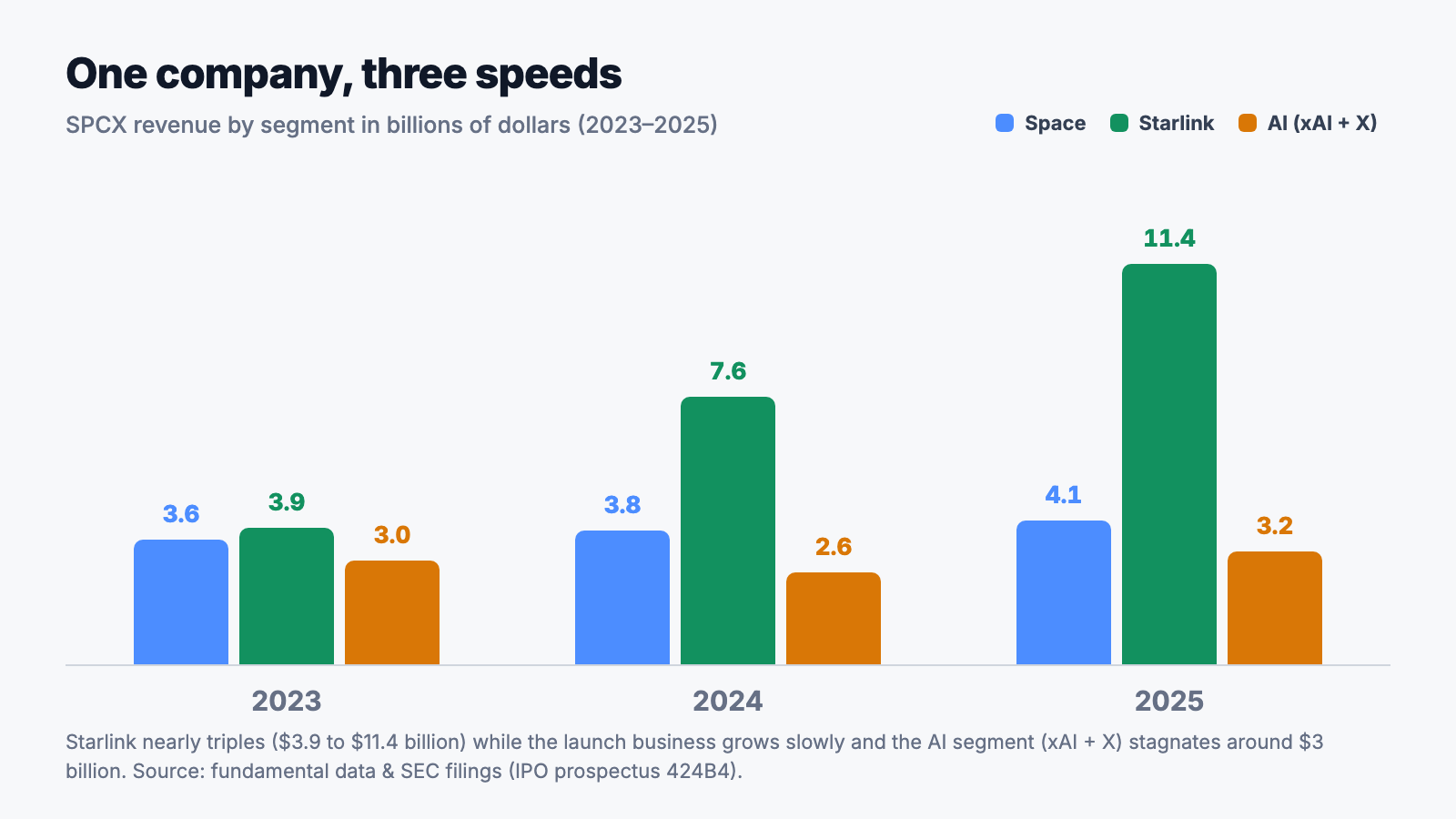
First, what genuinely impresses — and with this company, that is a lot. Revenue is growing steeply and accelerating: $10,387 million (2023), $14,015 million (2024), $18,674 million (2025) — up 33 percent in the latest year. Gross margin climbed from 41.2 to 49.4 percent along the way: for a company that builds rockets and launches satellites, that is a remarkably software-like margin. The driver has a name: Starlink. The Connectivity segment nearly tripled its revenue in two years — from $3,869 million to $11,387 million — and more than quadrupled subscribers from 2.3 million to 8.9 million (end of 2025), reaching 10.3 million by March 31, 2026. In orbital transport, the company is effectively without competition: 170 launches in 2025, 2,213 metric tons of mass to orbit — more than the rest of the world combined. Add a $28,377 million backlog (December 31, 2025) and a post-IPO, post-bond cash pile of about $100.8 billion (June 19, 2026), and you have a foundation other space companies can only dream of. Here is the growth in detail:
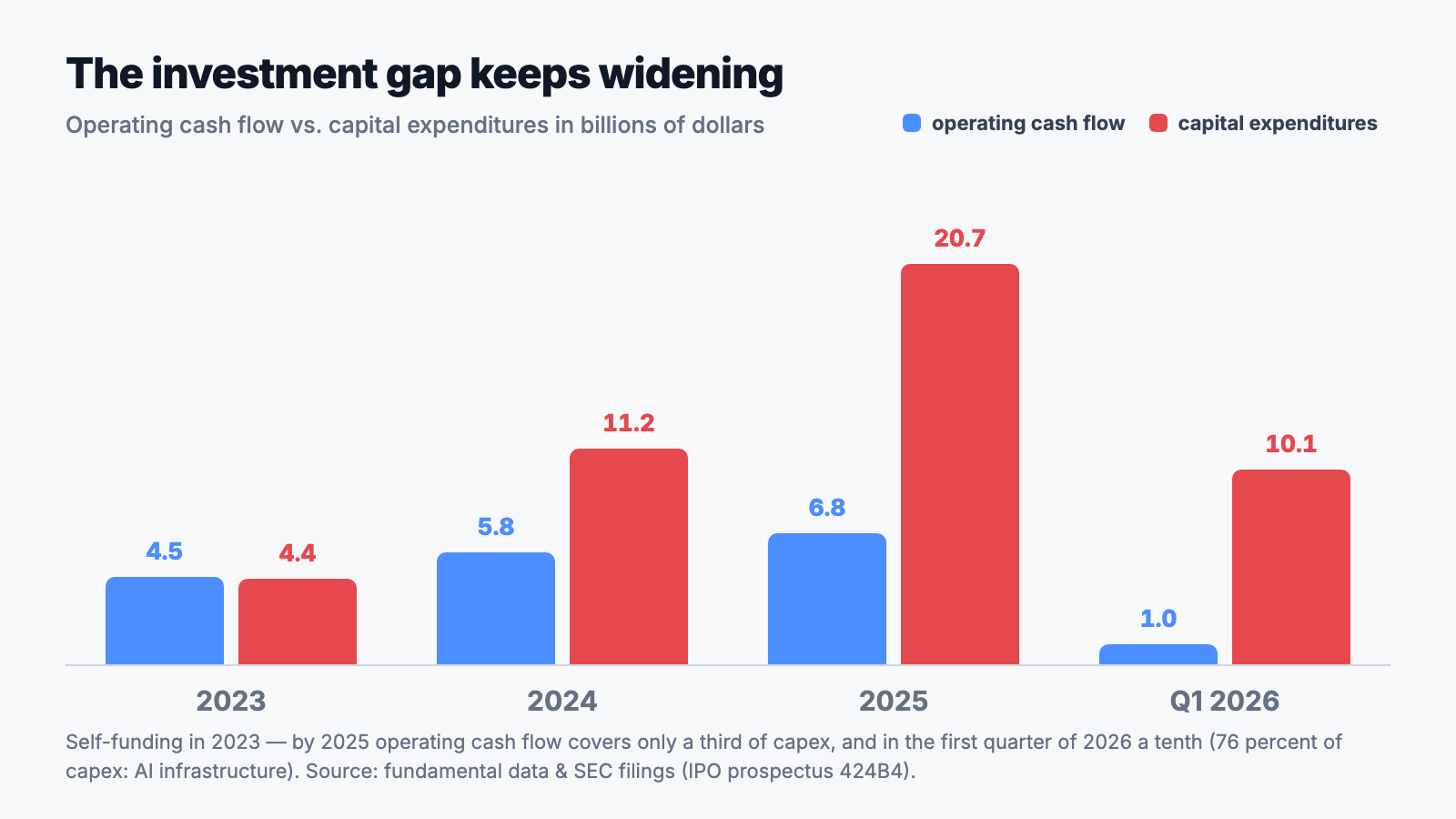
Now the other side of the curve. The bottom line for 2025 was a net loss of $4,937 million (2024: net income of $791 million; 2023: a $4,628 million loss), and the first quarter of 2026 set an even faster pace of losing money: $(4,276) million in just three months. The reason sits in the research line: R&D expenses exploded 149.5 percent in 2025 to $8,643 million — of which, per the prospectus, $3,888 million of the increase came from the AI segment (GPU depreciation, cloud costs) and $1,169 million from Starship. The accumulated deficit reached $41,311 million as of March 31, 2026. And a look at capital spending turns the growth story into a funding story: in 2025 the company invested $20,737 million — three times its operating cash flow of $6,785 million. In the first quarter of 2026 the ratio was nearly ten to one ($10,107 million vs. $1,047 million), and 76 percent of it went into AI infrastructure. Remember the rhythm: the operating business does not even fund half of the investments — capital providers pay the rest. First private ones. Now you.
What the filings say — the uncomfortable truths
Uncomfortable truth no. 1: Only one of the three businesses earns money — and the most expensive one has an officially unproven business model
The segment disclosure is the most honest document of the whole listing story. 2025 results by segment: Connectivity (Starlink) +$4,423 million, Space $(657) million, AI $(6,355) million. The Starlink segment earns handsomely — and the AI segment burns everything Starlink earns, plus two billion on top. The first quarter of 2026 shows the same picture: +$1,188 million Connectivity, $(662) million Space, $(2,469) million AI. And about the AI business, the prospectus writes a sentence you should read twice at a $1.77 trillion valuation:
"While industry interest in AI has grown substantially, the commercial value proposition of frontier AI models remains largely unproven, and long-term market acceptance of our AI products and services is uncertain. … Our AI segment has incurred significant operating losses since inception, and we may not achieve profitability in this segment, or, if achieved, sustain it."
— Space Exploration Technologies Corp., SEC IPO prospectus 424B4 of June 12, 2026, "Risk Factors"

Add a quiet erosion in the showcase business: monthly revenue per Starlink subscriber fell from $99 (2023) through $91 and $81 to $66 in the first quarter of 2026 — a third less in just over two years, per the prospectus due to international expansion and cheaper plans. That is deliberate strategy (volume over margin), but it means Starlink has to add customers ever faster just to keep revenue growth flat. And the launch business — the actual world-champion franchise — shrank 28.4 percent in the first quarter of 2026 as customer launches declined. Remember the pattern: the market story says "rocket and AI" — the income statement says "satellite internet pays for both."
Uncomfortable truth no. 2: Your share has one vote — Elon Musk has 82 percent of them
The cover page of the prospectus says it without ceremony:
"Elon Musk, our founder, Chief Executive Officer, Chief Technical Officer and Chairman of our board, will hold approximately 82.4% of the voting power of our common stock … immediately after the completion of this offering … As a result, Mr. Musk will be able to control the outcome of matters requiring shareholder approval."
— Space Exploration Technologies Corp., SEC IPO prospectus 424B4 of June 12, 2026, cover page
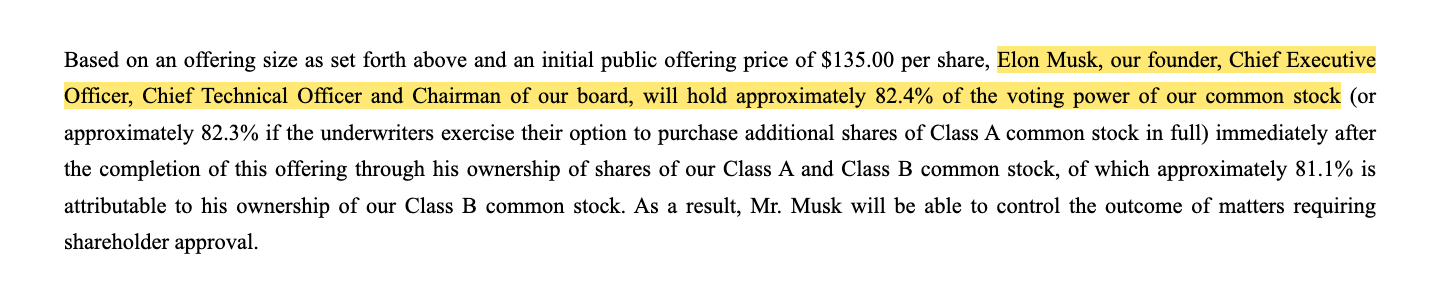
The construction behind it: your Class A share carries one vote, Musk\'s Class B shares carry ten — and Class B holders, voting separately as a class, elect an additional 51 percent of the board for as long as a single Class B share exists. Under the charter, Musk can only be removed from the board and his offices by the Class B holders — in essence, by himself. SPCX explicitly uses the Nasdaq "controlled company" exemptions from standard governance rules. And the prospectus stacks three more layers on top: there is no key-person life insurance on Musk; he explicitly does not devote his full time to the business ("he does not devote his full time and attention to our businesses" — he is simultaneously Tesla\'s CEO and involved in Neuralink and The Boring Company); and the charter renounces corporate opportunities that come the way of Musk and certain directors ("we renounce certain corporate opportunities"). Put into an everyday image: you are boarding a plane whose captain is undisputedly the best in the business — but he is flying three other aircraft at the same time, nobody is allowed to replace him, and the airline\'s own rules let him move attractive cargo onto his other flights. Billion-dollar projects with Tesla are already ramping (the "Macrohard" AI platform, the "Terafab" chip fab) — without definitive agreements, as the prospectus concedes. Remember the sentence: with SPCX you buy economic exposure, not a say.
Uncomfortable truth no. 3: The very first risk factor is Starship — and the entire growth story hangs on it
Prospectus authors do not sort risk factors alphabetically: what comes first is what the company itself considers most important. At SPCX that is not competition, not regulation, not even the AI bet — it is their own giant rocket:
"If we are unable to successfully complete the development, testing, and deployment of Starship at scale in accordance with our anticipated schedule, or at all, or if we are unable to achieve sufficient launch cadence, reusability, and capability, our ability to execute our growth strategy (such as the deployment of our next-generation V3 satellites, V2 satellite-to-mobile connectivity, and providing orbital AI compute infrastructure) would be materially and adversely affected."
— Space Exploration Technologies Corp., SEC IPO prospectus 424B4 of June 12, 2026, "Risk Factors" (first risk factor)

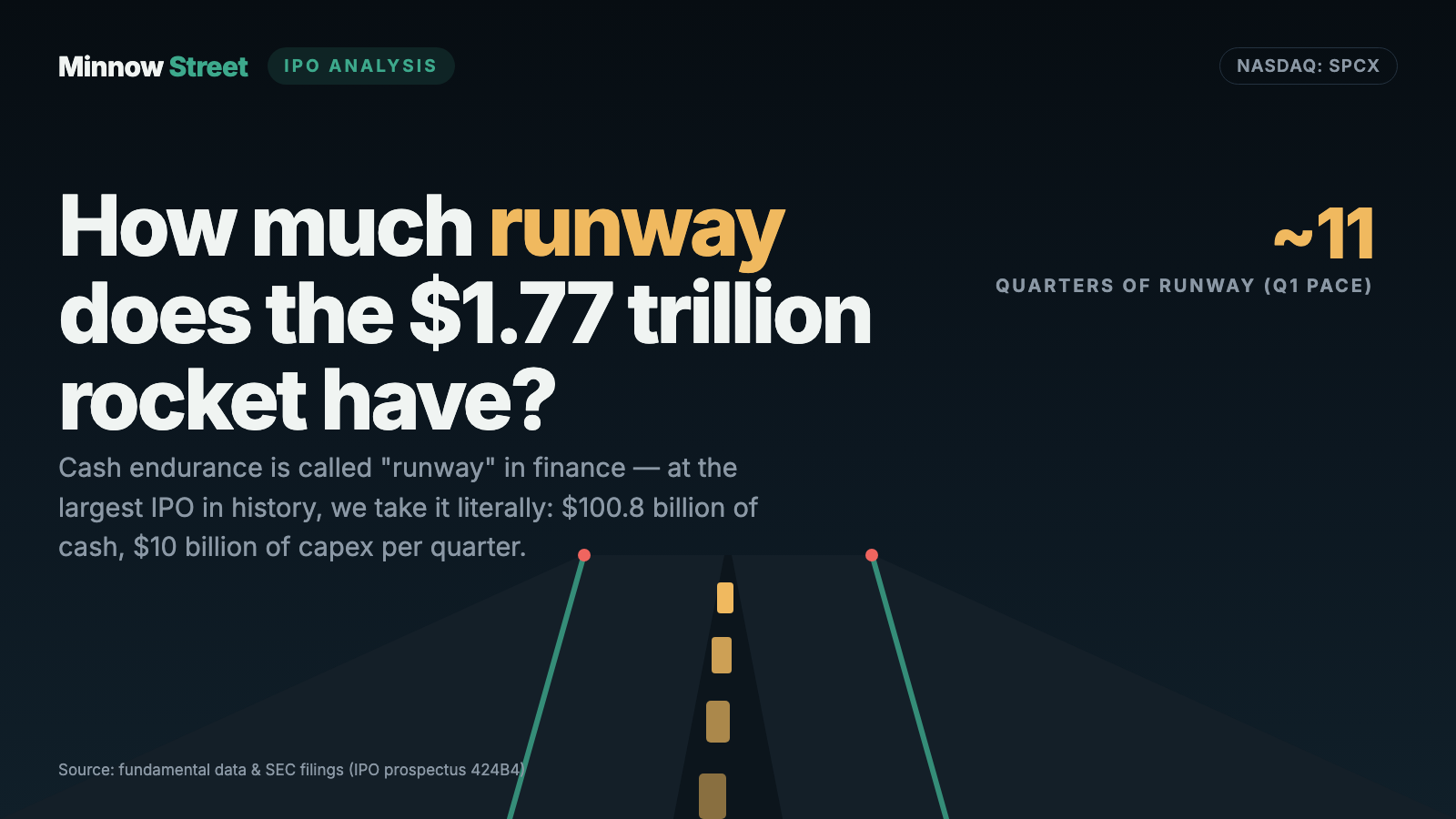
Why the bottleneck is so narrow is stated one paragraph further on: "Our current operational rockets, including Falcon 9 and Falcon Heavy, are not capable of deploying V3 satellites and V2 Mobile satellites" — today\'s rockets simply cannot carry the next Starlink generation. No Starship means no V3 satellites, no full-scale satellite-to-phone business, no "orbital AI data centers" — essentially nothing of what the $1.77 trillion valuation narrates. At the same time, the prospectus is remarkably candid about priorities: to reach its own orbital-compute goals, SPCX may put its own payloads ahead of government and customer launches ("we may prioritize our own launch payloads over additional U.S. government contracts or third-party customers") — a bold statement toward a customer that provides roughly one-fifth of revenue (the U.S. government: NASA, the Department of War, intelligence agencies). All of this is now funded with debt as well: in June 2026 the company placed its first bonds ever — $25.0 billion in five tranches with coupons of 5.35 to 6.65 percent — to repay a $20 billion bridge loan that had itself refinanced legacy X and xAI debt (including secured xAI notes carrying 12.5 percent interest). On top sit $9,105 million of obligations from AI data centers recorded as "failed sale-leaseback transactions." The $100.8 billion cash pile is an enormous cushion — but at a recent investment pace of $10 billion per quarter it is not a permanent state. It is a runway: long, but finite.
Uncomfortable truth no. 4: Two billion additional shares hang over your stake — one batch vests on a Mars colony
At the $135.00 IPO price and 13,091 million shares outstanding, SPCX weighs in at roughly $1.767 trillion. But today\'s share count is not tomorrow\'s. The prospectus lists a whole swarm of future shares: 1,302 million unvested shares from two CEO awards for Elon Musk (January 2026), roughly 262 million shares for the EchoStar spectrum purchase ($19.6 billion in equity and cash), a call option on the AI coding company Cursor for $60.0 billion in stock (about 444 million additional shares at the IPO price) and roughly 645 million options and RSUs. The vesting condition of the largest award has to be read in the original to be believed:
"… the Company\'s establishment of a permanent human colony on Mars with at least one million inhabitants, in each case, subject to Mr. Musk\'s continued employment ('SpaceX CEO Award')."
— Space Exploration Technologies Corp., SEC IPO prospectus 424B4 of June 12, 2026, note "Share-Based Compensation"

The SpaceX CEO Award (1.0 billion Class B shares) vests on market-cap milestones between $500 billion and $7.5 trillion plus the Mars colony; the AI CEO Award (302.1 million shares) is tied, among other things, to data centers off Earth with 100 terawatts of annual compute. For accounting purposes both milestones are classified as "improbable" — not a cent of compensation expense has been booked. Dilution here is not a side effect; it is the built-in plan: taken together, a good 2.6 billion potential additional shares (about 20 percent of today\'s base) are waiting to be triggered — the better the story goes, the smaller your slice of the pie. In short: growth paid for with fresh shares is never quite free — here, it is the compensation plan. To be fair: the underwriting fee of $500 million (0.67 percent) was historically cheap, no insider sold a single share (all 555.6 million shares were newly issued primary stock), and the lock-up runs 180 days — on these points the prospectus treats retail buyers more fairly than many a smaller IPO. But shortly before the IPO, the company still repurchased $3,838 million of its own stock — at $105.32 per Class A share, 22 percent below the IPO price you would have paid six weeks later.
Valuation: 90 times revenue — the most expensive order of magnitude in stock market history
Let\'s check the price tag, as of the IPO (June 11, 2026): 13,091 million shares × $135.00 = roughly $1.767 trillion of market capitalization — more than the GDP of Spain, for a company with $18,674 million in revenue. That puts the price-to-sales ratio between 85 and 95 depending on the share base; annualizing the first quarter of 2026 changes nothing (~94). A P/E ratio does not exist — there is no E, only a $4.9 billion loss. Even if you credit the entire valuation to the profitable Starlink segment alone, the IPO price paid about 155 times that segment\'s revenue and 400 times its segment result. For comparison: Nvidia — the most profitable beneficiary of the AI boom — traded around mid-2026 at roughly 23 times revenue, with a 56 percent net margin instead of a 26 percent net-loss margin. What do you get for the premium? A genuine monopoly in orbital transport (2,213 metric tons to orbit in 2025), the fastest-growing telecom business in the world, a $28.4 billion backlog, $100.8 billion in cash — and the options: Starship, satellite-to-phone (the spectrum comes from the $19.6 billion EchoStar deal, FCC-approved May 12, 2026), orbital compute, Grok. The prospectus itself sizes the addressable market at $28.5 trillion — asteroid mining included. This is exactly where analysis parts ways with worship: a price of 90 times revenue does not capitalize today\'s business (even generous multiples would get you a fraction of it) — it capitalizes tomorrow\'s narrative. A classic analyst consensus does not exist yet five weeks after listing — the underwriters\' research quiet period was still running as of our data cut-off. Remember the proportion: of the $135.00 purchase price, perhaps $20 to $30 — generously computed — pays for today\'s business. The rest is future, bought on faith.
Opportunities and risks at a glance
What speaks for SPCX:
- A de-facto monopoly in orbital transport: 170 launches and 2,213 metric tons to orbit in 2025 — more than the rest of the world; reusable Falcon rockets with more than a decade\'s head start.
- Starlink is an exceptional business: revenue up from $3,869 million to $11,387 million in two years, 10.3 million subscribers (March 31, 2026), a +$4,423 million segment result (2025) — with satellite-to-phone as the next stage (EchoStar spectrum, FCC approval May 12, 2026).
- War chest and order book: roughly $100.8 billion in cash (June 19, 2026), a $28,377 million backlog, and long-term debt for the first time at near-investment-grade coupons (5.35–6.65 percent).
- A 49.4 percent gross margin (2025, up from 41.2 percent in 2023) and accelerating revenue growth (+33 percent) — the company scales while it invests.
- The IPO itself was built investor-friendly: primary shares only (no insider exit), a 0.67 percent underwriting fee, a 180-day lock-up.
What speaks against it:
- Only one segment earns: Connectivity +$4,423 million, Space $(657) million, AI $(6,355) million segment result (2025); a $4,937 million net loss (2025) and another $4,276 million in the first quarter of 2026 alone; $41,311 million of accumulated deficit.
- Record-pace capital burn: $20,737 million of capex (2025) against $6,785 million of operating cash flow; nearly 10:1 in Q1 2026 — 76 percent of it flowing into a segment whose business model the prospectus itself calls "largely unproven."
- Governance without a counterweight: 82.4 percent of votes with Musk, Class B elects 51 percent of the board, no key-person insurance, no full-time CEO, corporate opportunities renounced by charter, billion-dollar dealings with Tesla and the board\'s own orbit ($20.2 billion of Valor GPU leases).
- Everything hangs on the Starship schedule (the first risk factor; Falcon cannot carry V3 satellites) and on one major customer, the U.S. government (~20 percent of revenue), whose launches SPCX openly says it may deprioritize; plus geopolitics up to anti-satellite weapons and the Brazil asset-seizure precedent.
- Valuation and dilution: P/S of 85–95 at the IPO price, no earnings, Starlink ARPU erosion ($99 → $66); a good 2.6 billion potential additional shares (CEO awards, EchoStar, the Cursor option, options/RSUs) as overhang.
A human conclusion
Back to the once-in-a-century trap from the opening. Its trick is wiring a correct observation to a wrong conclusion. The observation is true: SpaceX is a once-in-a-century company — no other private company has ever monopolized access to orbit, built a global telecom network in three years and, on the side, cut the cost of spaceflight by orders of magnitude. But the conclusion — "therefore the stock is a buy at any price" — is refuted by the prospectus itself, across 439 pages of plain language: you are buying a bundle in which the century business (Starlink) subsidizes the losses of an AI conglomerate whose business model is "largely unproven." You are paying 90 times revenue for a company that lost $4.3 billion last quarter. And you check your vote at the door — handed to a brilliant captain who flies three other aircraft and whose biggest share award only vests at one million Mars inhabitants. Maybe the bet pays off; the bets of 2002 (rockets don\'t land) and 2015 (satellite internet never pays) sounded crazy too, and this company won both. But the honest question is not "Is SpaceX a once-in-a-century company?" It is: would you buy these financial statements if there were no rocket painted on them? If yes, you have a thesis. If no, you had wanderlust. What you make of it is your decision. And that is exactly as it should be.
Sources
All original documents used in this analysis — read them yourself:
- Space Exploration Technologies Corp. — SEC IPO prospectus 424B4 (prospectus date June 11, 2026, filed June 12, 2026)
- Space Exploration Technologies Corp. — SEC Form 8-K of June 22, 2026 (launch of the notes offering; cash of $100.8 billion as of June 19, 2026)
- Space Exploration Technologies Corp. — SEC Form 8-K of June 23, 2026 (pricing of the $25 billion notes, five tranches)
- Space Exploration Technologies Corp. — SEC Form 8-K of June 26, 2026 (closing of the bond issuance, indenture)
- Space Exploration Technologies Corp. — SEC registration S-1/A of June 3, 2026 (fixed price of $135.00)
- Complete SEC filing history of Space Exploration Technologies Corp.: EDGAR overview (sec.gov)
- Fundamental data: every financial figure in this analysis comes directly from the IPO prospectus (Summary Financial Data, MD&A, segment reporting, notes); XBRL series do not yet exist for SPCX (no 10-K/10-Q before the IPO).
- In-house stock scanner: as of July 18, 2026, SPCX has no price history and therefore appears in no ranking (explained in the text).
Transparency & disclaimer: This analysis is a journalistic contextualization of publicly available information and is not investment advice, not a financial analysis in the regulatory sense and not a solicitation to buy or sell securities. Stock investments carry substantial risks up to and including total loss. All information without guarantee; the data cut-off is noted in the text. The author holds no position in SPCX shares at the time of publication.
Our Bottom Line at a Glance
- Market position & technology positive
- A de-facto monopoly in orbital transport (170 launches, 2,213 metric tons to orbit in 2025 — more than the rest of the world), more than a decade's lead in reusability, plus Starlink with ~9,600 satellites across 164 countries — technologically, SPCX has no serious rival (IPO prospectus 424B4, June 2026).
- Starlink growth & order book positive
- Connectivity revenue nearly tripled in two years ($3,869 → $11,387 million), 10.3 million subscribers (03/31/2026), a +$4,423 million segment result (2025); a $28,377 million backlog and ~$100.8 billion in cash after the IPO and bond offering (06/19/2026) — the profitable core business is real and growing.
- Earnings quality & capital burn negative
- A net loss of $4,937 million (2025) and $4,276 million in Q1 2026 alone; only one of three segments earns (AI: $(6,355) million); capex of $20,737 million = 3x operating cash flow (2025), nearly 10:1 in Q1 2026 — 76 percent of it for an AI business model the prospectus itself calls "largely unproven"; Starlink ARPU erosion ($99 → $66).
- Governance & key person negative
- 82.4 percent of votes with Elon Musk, Class B separately elects 51 percent of the board, removal only by Class B holders; a "controlled company" using Nasdaq exemptions, no key-person insurance, no full-time CEO; corporate opportunities renounced by charter; a related-party web (Tesla projects without definitive agreements, $20.2 billion of GPU leases with board member Antonio Gracias's Valor).
- Valuation & dilution overhang negative
- P/S of 85–95 at the IPO price ($1.767 trillion for $18,674 million of revenue), no P/E for lack of earnings; even Starlink-only math works out to ~155x segment revenue; plus a good 2.6 billion potential additional shares (1,302 million CEO awards incl. the Mars clause, 262 million EchoStar, ~444 million Cursor option, ~645 million options/RSUs) and pre-IPO buybacks at $105.32 — 22 percent below the IPO price.
SPCX is the largest IPO in history and the once-in-a-century trap in its purest form: a genuine once-in-a-century company (an orbital monopoly, Starlink with a +$4.4 billion segment result, $100.8 billion in cash) — wrapped in a conglomerate where an AI segment with a "largely unproven" business model burns $6.4 billion, valued at 85 to 95 times revenue, steered by a part-time CEO holding 82.4 percent of the votes and a pay package that only fully vests on a Mars colony. Whoever buys is buying tomorrow's narrative, not today's business. Not investment advice.
What Our Rating Means
- If you don't own the stock
- In our view, the documented risks clearly outweigh — we see no basis for an entry.
- If you hold it in your portfolio
- In our view, the findings carry enough weight to warrant a critical look at your own position.
A journalistic assessment by our editorial team at the time of the deep dive, based on public sources — not investment advice and not a solicitation to buy or sell. Your personal circumstances (investment goals, risk capacity, taxes) cannot be taken into account. What our categories mean, how verdicts are formed, and what conflicts of interest exist →
Worth Noting
- SPCX has only traded since mid-June 2026: no price history, no scanner findings, no analyst consensus yet (the underwriters' research quiet period was still running as of July 18, 2026) — this analysis rests solely on the 424B4 IPO prospectus and the June 8-Ks.
- All figures are retrospectively consolidated (SpaceX + xAI + X, "common control") — comparisons with previously circulated SpaceX-only numbers are misleading; fiscal 2023 also contains a $3,775 million Twitter brand impairment.
- Valuation figures are dated: the $1.767 trillion market cap and the P/S of 85–95 refer to the IPO price of June 11, 2026; analyses are evergreen, daily prices are not a buy argument. Exercise of the greenshoe (83.3 million shares) had not been reported via 8-K as of July 18, 2026.
Frequently Asked Questions
No. Space Exploration Technologies Corp. (Nasdaq: SPCX) has comprised three businesses since the 2025/2026 mergers: the SpaceX rocket business (Falcon, Starship), the Starlink satellite internet service, and an AI segment made up of xAI (the Grok language models) and the X platform (formerly Twitter). xAI acquired X on March 28, 2025; SpaceX acquired xAI on February 2, 2026. The IPO prospectus consolidates all three retrospectively because Elon Musk controlled each of them ("common control").
It was the largest IPO in history: 555,555,555 new Class A shares at a fixed price of $135.00, roughly $75.0 billion in gross proceeds (about $74.4 billion net), and a valuation of approximately $1.77 trillion at the IPO price. SPCX is listed on Nasdaq and Nasdaq Texas (first trading around June 12, 2026). In the same month the company also placed $25.0 billion of debut senior notes in five tranches (coupons of 5.35 to 6.65 percent).
As a group, no: 2025 produced a net loss of $4,937 million on $18,674 million in revenue, and the first quarter of 2026 added another $4,276 million loss; the accumulated deficit stood at $41,311 million (March 31, 2026). Only the Starlink segment is profitable (+$4,423 million segment result in 2025); the Space segment lost $657 million and the AI segment $6,355 million. In 2024 the group was briefly net positive at +$791 million.
Per the prospectus cover page, Musk holds approximately 82.4 percent of the voting power after the IPO: his Class B shares carry ten votes each (Class A: one), and Class B holders, voting separately, elect an additional 51 percent of the board for as long as a single Class B share exists. Musk can only be removed from the board and the CEO role by the Class B holders. SPCX uses the Nasdaq "controlled company" governance exemptions; there is no key-person insurance on Musk, and he runs Tesla in parallel.
At the $135.00 IPO price the company was valued at roughly $1.767 trillion — 85 to 95 times its 2025 revenue of $18,674 million. A P/E ratio does not exist for lack of earnings. Even crediting the entire valuation to the profitable Starlink segment alone works out to about 155 times that segment's revenue. The price therefore essentially capitalizes the future narrative: Starship, satellite-to-phone, orbital AI data centers (data basis: prospectus dated June 11, 2026).
In January 2026 Elon Musk received two share awards totaling 1,302 million Class B shares. The larger one (1.0 billion shares) vests only on market-cap milestones between $500 billion and $7.5 trillion and — verbatim — on "the establishment of a permanent human colony on Mars with at least one million inhabitants." The second award is tied, among other things, to non-Earth-based data centers delivering 100 terawatts of compute per year. Both milestones are classified as "improbable" for accounting purposes — no compensation expense has been booked yet.
Average monthly revenue per Starlink subscriber (ARPU) fell, per the prospectus, from $99 (2023) through $91 (2024) and $81 (2025) to $66 in the first quarter of 2026 — roughly a third in just over two years. The company cites international expansion and lower-priced service plans. Subscribers grew from 2.3 million to 10.3 million over the same period; Starlink is deliberately trading margin for volume — which means revenue growth must increasingly come from new customers.
Because the stock has only traded since mid-June 2026. Trend and momentum metrics (Weinstein stage, relative-strength rating, the 200-day line) need months to years of price history, and fundamental scores such as Piotroski or Altman Z need multi-year filing series — the first 10-K is not due until early 2027. Until then the only data basis is the IPO prospectus and the 8-Ks; every figure in this analysis is computed from exactly those documents (data as of July 18, 2026).
Found an error?
Did you spot a factual error, an outdated number, or a typo in this deep dive? Let us know briefly — your report goes straight to the editorial team.