SOPHiA GENETICS: The Platform Is Growing Fast — The Cash Only Keeps Up With Other People's Money
SOPHiA GENETICS, based in Rolle, Switzerland, runs SOPHiA DDM, a cloud platform that analyzes genomic data for hospitals and biopharma companies. Revenue rose 19 percent to $77.3 million in 2025 and 22 percent in the first quarter of 2026. Yet the net loss stayed at $79.0 million, exactly where it stood two years earlier, equity fell from $96.5 million to $47.1 million within twelve months, and in June 2026 the company sold 12,104,900 new shares at $4.75. On top of that sit $50 million of secured debt at no less than 10.25 percent and a patent suit from U.S. rival Guardant Health that targets the very region supplying 72 percent of revenue. Not investment advice — just the question of how much runway is left.
 Thomas Mücke
Founder & Publisher
Thomas Mücke
Founder & Publisher
Chart
Interactive price chart (TradingView).
Note: pure fact-based analysis, not investment advice and not a solicitation to buy or sell. All figures without guarantee.
There is an investor trap that catches the careful readers in particular — because it feels like diligence: the speed trap. It works like this. You read a growth number and your head immediately extrapolates. Up 22 percent in the quarter, up 19 percent for the year, net dollar retention of 117 percent — that can be projected forward, and projecting forward feels like control. What your head does not calculate is the second question every pilot asks before takeoff: how long is the runway? Speed is only good news if you know how much tarmac is left. SOPHiA GENETICS SA (Nasdaq: SOPH), based in the small Swiss town of Rolle, is exactly that kind of case: a company whose product runs in nearly a thousand hospitals and laboratories, whose revenue has grown at double-digit rates for years — and whose cash had to be topped up with fresh shareholder money twice in six months. So let us make a deal. We read together what the company itself told the U.S. securities regulator, the SEC: the annual report on Form 20-F for 2025, the interim report on Form 6-K as of March 31, 2026, and the prospectus supplement for the June 17, 2026 share sale. Those documents are honest under penalty of law. At the end you decide whether the runway looks long enough to you.
What SOPHiA GENETICS actually does — the baker who never buys the oven
Imagine every hospital had to build its own industrial bakery just to produce one loaf of bread. Genomic analysis was organized roughly like that for a long time: a hospital that wanted a tumor sequenced shipped the sample to a central specialist lab — and handed over the sample, the data and the interpretation with it. SOPHiA GENETICS inverts that. Hospitals and labs sequence in house, on the machines they already own, and then upload only the data to the cloud platform SOPHiA DDM. The analysis happens there: which genetic variant is present, what it means, what other institutions have seen in similar cases. Billing is usually per analysis — clinical customers get access to the platform itself free of charge. The annual report puts the ambition plainly:
"We envision a future in which all clinical diagnostic test data is channeled through a decentralized analytics platform that will provide insights powered by large real-world data sets and AI."
— SOPHiA GENETICS SA, SEC annual report 20-F for 2025, Item 4.B “Business Overview”
The scale as of December 31, 2025: more than 993 customers across hospitals, laboratories and biopharma in 75 countries, roughly 2.3 million genomic profiles analyzed since launch, and 2,712 peer-reviewed publications built on the platform. 528 of those customers count as the hard core — customers who actually paid for analyses during the year; in the first quarter of 2026 it was 537. Sales run through more than 105 field representatives with a direct presence in 60 countries plus distributors in 50 more. And because the analysis itself is software, a lot of each dollar sticks: gross margin was 67.4 percent in 2025, or 74.2 percent adjusted for the amortization of internally developed software. A conventional lab with its own instruments and reagents rarely clears 40 percent. That sets up the central tension of this analysis, and it runs through every chapter: the growth story is told in the United States — but 72 percent of the money comes from Europe, the Middle East and Africa. And that is exactly where a U.S. competitor is suing.
How the stock reached our desk — through a prospectus, not a screen
Honesty first: SOPHiA GENETICS is not a screen hit. On July 29, 2026 we queried our own lists — the stock appeared in none of them. No momentum filter, no quality filter, no valuation filter surfaced it, which is hardly surprising for a company that has posted a loss every year since its 2021 listing. Our lists are recalculated daily, so the statement holds for that date. The stock reached the desk another way, one we read alongside every analysis: the filing stream of the U.S. securities regulator, the SEC. On June 17, 2026 a prospectus supplement appeared there (Form 424B5) — the paperwork a company files when it sells new stock. Thirteen days earlier, on June 4, 2026, SOPHiA had announced a memorandum of understanding for a joint venture with Memorial Sloan Kettering Cancer Center in New York, one of the best-known cancer centers in the world. Good news, then a capital raise: that sequence is as old as the stock market itself, and it always deserves a second look. Remember the reflex: when a prospectus follows a headline, read the prospectus first. That is what we do next.
The numbers over the years — given their due
First what genuinely impresses, and there is a fair amount. Revenue climbed from $62.4 million in 2023 through $65.2 million in 2024 to $77.3 million in 2025 — up 19 percent in the latest year after only 4 percent the year before. Growth is accelerating rather than fading. The first quarter of 2026 brought $21.7 million, 22 percent above the prior-year quarter and 14 percent in constant currency. Real volume sits behind that: more than 391,000 analyses ran through the platform in 2025 and a record 108,000 in the first quarter of 2026 alone. Existing customers are getting bigger, too. Net dollar retention — how much the same customers pay a year later — rose from 104 percent (2024) to 115 percent (2025) and 117 percent (first quarter of 2026). Anything above 100 means revenue would grow without a single new customer. In 2025 a record 124 new core customers signed anyway. Now the chart that explains everything else:
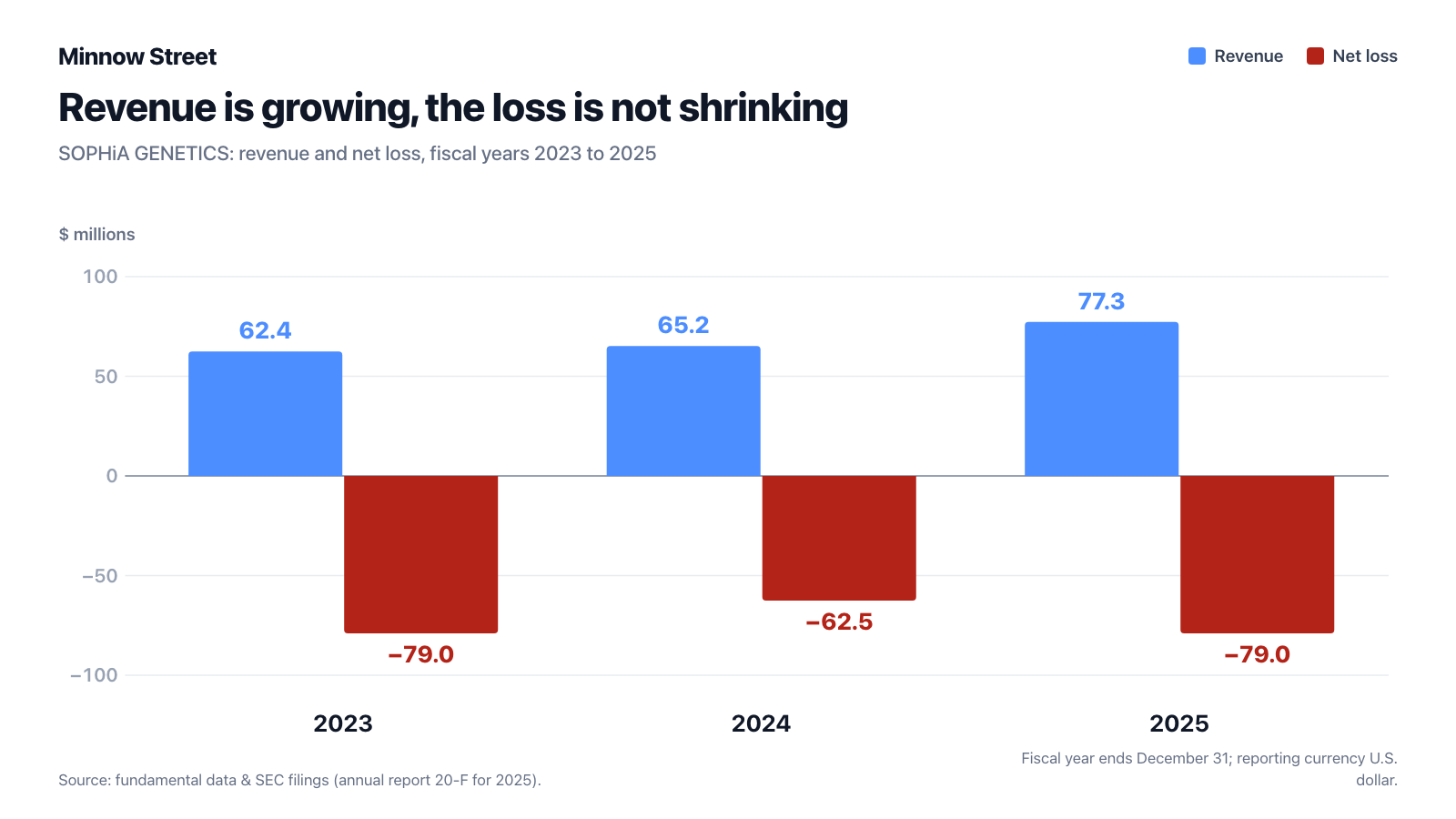
Two pairs of bars, one uncomfortable message. The blue bar grows every year; the red one does not shrink. 2024 briefly looked like progress at $62.5 million, and then 2025 put the loss back at $79.0 million — within $18,000 of where it stood two years earlier ($78.999 million against $78.981 million). The second chart shows where this business actually earns its money:
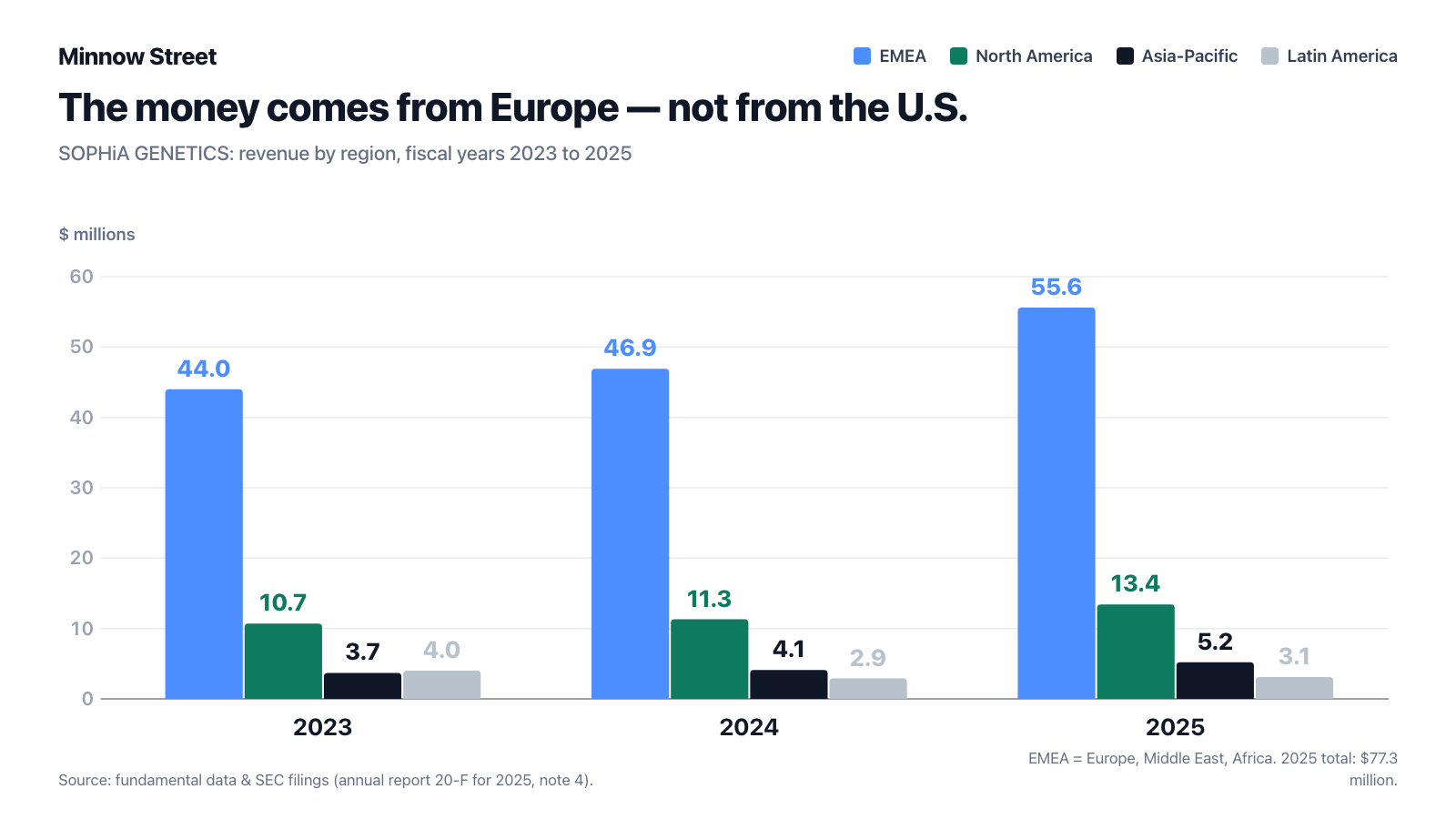
The shift over three years is modest: EMEA grew from $44.0 million (2023) through $46.9 million (2024) to $55.6 million, North America from $10.7 million through $11.3 million to $13.4 million, Asia-Pacific from $3.7 million through $4.1 million to $5.2 million — only Latin America shrank from $4.0 million to $2.9 million before recovering to $3.1 million in 2025. France ($11.3 million), Italy ($10.8 million) and Spain ($6.0 million) together produced more 2025 revenue than the entire United States ($10.9 million). That is not a criticism — European hospitals are good, loyal customers. But it shifts the risk: anyone who thinks they are buying a U.S. growth stock is in fact buying a European diagnostics business with an American narrative. Keep the image: the story drives in America, the cash register stands in Europe. How familiar that pattern is across AI-driven biotech shows up in our analysis of Recursion Pharmaceuticals — there, too, capital markets fund a platform that does not yet carry itself.
What the filings say — the uncomfortable truths
Uncomfortable truth no. 1: a fifth of revenue goes out as stock to the staff — and vanishes in the “adjusted” number
When a company loses money, management tends to reach for a friendlier metric. At SOPHiA it is adjusted EBITDA, which came in at $-41.5 million in 2025 rather than the $79.0 million net loss. That is permitted and cleanly disclosed. What repays attention is what gets stripped out. The largest single item is share-based compensation: $16.2 million in 2025 (2024: $16.5 million). That equals 21 percent of annual revenue. Put in everyday terms: a workshop pays every fifth dollar of its revenue not in money but in slices of the business — and then removes that cost from its performance measure because “no cash moved.” For the workshop, fair enough. For you as a co-owner, not so: your slice of the pie gets smaller, year after year. That is dilution, and it is a wealth question rather than an accounting one.
That pay is an issue here shows up not only in the notes but in the voting record of the annual general meeting of June 18, 2026. Shareholders approved a maximum of $17,500,000 in variable compensation for the executive committee for the current year 2026 — against group revenue of $77.3 million the year before. The striking part is the tally: while the routine items — annual accounts, discharge, auditor, independent proxy — all drew more than 99 percent approval, this one reached only 66.02 percent, with 11.07 percent against and 22.91 percent abstaining. Nearly a quarter of the shares represented declined to endorse it. Nor was it the only sore point: board compensation (84.49 percent), fixed executive compensation (89.12 percent) and the increase in conditional share capital (85.91 percent) drew the weakest results of the day. A maximum is not a payout — but lately it has been very nearly used up: the meeting invitation puts actual variable compensation granted for 2025 at $15.16 million against an approved ceiling of $15.95 million, or 95 percent; in 2024 it was only 48 percent ($6.92 million of $14.50 million). The same meeting also sealed the leadership handover: co-founder Jurgi Camblong was elected chair of the board, and since July 1, 2026 Ross Muken — previously president and, until 2024, chief financial officer — has run the company as chief executive.
Uncomfortable truth no. 2: the cash holds because shareholders paid in twice in six months
Now the core. Cash stood at $70.3 million on December 31, 2025, after $80.2 million a year earlier and $123.3 million at the end of 2023. The first quarter of 2026 consumed $15.1 million in operations plus $2.6 million of investment — $17.7 million in three months. Without fresh money the account would have run dry around the winter of 2026/27. So the company raised money, twice. First through an at-the-market program: 2,795,485 treasury shares for $14.3 million gross, sold through February 20, 2026 at a weighted average of $5.12. Second, and far larger, through a conventional offering in June 2026:
"The Shares were offered to investors at $4.75 per Share. The gross proceeds from the offering, before deducting the underwriting discounts and commissions and offering expenses, were approximately $57.5 million. The offering closed on June 18, 2026."
— SOPHiA GENETICS SA, SEC interim report 6-K of June 22, 2026
That is 12,104,900 shares in total, including the fully exercised option for an additional 1,578,900. What it means for you as an existing holder is spelled out in the prospectus supplement of June 17, 2026 — and it is one of the most honest numbers the stock market produces:

Read the middle line again. Net tangible book value — everything the company owns, minus intangibles, minus all liabilities — was $9.9 million, or 14 cents per share, on March 31, 2026. After the offering it is $55.7 million, or 68 cents (75 cents with the option fully exercised). Anyone subscribing at $4.75 therefore paid $4.07 above the substance behind the share ($4.00 with the full option). For a software company that is not inherently wrong — the value sits in the customer base, not in fixed assets. But it answers the question of why the share count is climbing so fast: from 66.7 million (December 31, 2024) through 68.5 million (December 31, 2025) and 71.8 million (March 31, 2026) to 83.9 million after the June offering. That is roughly 26 percent more shares in eighteen months. And the overhang is not worked off: as of March 31, 2026 there were another 13.8 million shares under options, 2.3 million under restricted share units, 5.3 million in plan reserves and 0.5 million under warrants — roughly 21.9 million shares in all, a good quarter of today's base. And the pot those employee awards are served from has grown since: the annual general meeting of June 18, 2026 amended article 4b of the articles of association, and the conditional share capital for participation plans now runs to 24,807,564 shares.
Uncomfortable truth no. 3: the debt costs at least 10.25 percent — and is secured by the whole company
Beyond equity there is a second source of money, and it is expensive. In May 2024 SOPHiA signed a credit agreement with specialty lender Perceptive Credit Holdings IV for up to $50.0 million; $15.0 million funded immediately and the remaining $35.0 million on June 25, 2025. The rate: Term SOFR with a 4 percent floor, plus 6.25 percentage points — at least 10.25 percent a year, maturing in 2029. On default the spread rises to 9.25 points. Interest expense rose accordingly from $1.9 million (2024) to $4.6 million (2025) and ran at $1.7 million in the first quarter of 2026. More interesting than the rate are the conditions:

Two things matter here, and both are reassuring at first. The revenue covenant of $67.4 million was cleared comfortably in 2025 with $77.3 million, and the company reported full compliance with all covenants at December 31, 2025 and 2024 — the interim report confirms it again for March 31, 2026. Minimum liquidity of $3.0 million is a non-issue against $65.4 million of cash (March 31, 2026). The uncomfortable part is the structure behind it: a lender holding essentially the whole company as collateral has a seat at every future decision — the agreement explicitly limits new debt, asset sales and distributions. In January 2026 an amendment was added, and it contains a number worth remembering:

This is a rare gift for attentive readers: a threshold you can calculate. Trailing twelve-month revenue at March 31, 2026 was $81.2 million (fiscal 2025 at $77.3 million, less the first quarter of 2025 at $17.8 million, plus the first quarter of 2026 at $21.7 million). That leaves $3.8 million to the $85 million mark. The second quarter of 2025 delivered $18.3 million — so if the second quarter of 2026 comes in above roughly $22.1 million, the threshold is cleared and another $12.5 million of credit stands ready. Reaffirmed guidance of $92 million to $94 million implies an average of $23.4 million to $24.1 million across the remaining three quarters. The price of that option: each drawn tranche makes a warrant for another 100,000 shares exercisable for the lender. Even the debt here is ultimately paid in equity.
Uncomfortable truth no. 4: the U.S. competitor is suing — in Europe, where the money is made
The product SOPHiA has grown fastest with over the past two years is MSK-ACCESS, a liquid biopsy that reads traces of cancer from a blood sample rather than from the tumor. A total of 100 customers across more than 30 countries had signed up for MSK-ACCESS or the related solid tumor application MSK-IMPACT by the end of March 2026, and nearly 3,000 liquid biopsy analyses ran in the first quarter of 2026, more than twice the prior-year figure. That is precisely the product U.S. competitor Guardant Health is attacking in court:

The interim score favors SOPHiA. On January 23, 2026 the Unified Patent Court in Paris finally rejected the application for provisional measures and ordered Guardant to pay 400,000 euros in costs; Guardant appealed on February 9, 2026, and on February 18, 2026 the Court of Appeal refused to suspend that cost award or to reduce it. Even so, two sentences from the filing belong here. First the company's own sober warning: "Patent litigation is inherently uncertain, and even favorable preliminary rulings do not guarantee ultimate success.". Second, the geography: before the Unified Patent Court, Guardant named four group companies as defendants — SOPHiA GENETICS SA, SAS, SRL and GmbH — and alleged infringement in Belgium, Germany, France, Italy, the Netherlands, Sweden, Switzerland and Spain; the U.K. action runs alongside. That is exactly the region delivering 72 percent of revenue. An injunction there would weigh far more heavily than one in the United States. And the bill is already running: $2.4 million of legal expense in the second half of 2025 alone and another $0.7 million in the first quarter of 2026 — amounts that also get stripped out of “adjusted” EBITDA. SOPHiA has recorded no provision: as of December 31, 2025 losses from this matter are not considered probable.
Valuation: about five times revenue — for a business without profit
There is no price-earnings ratio because there are no earnings. That leaves revenue as the yardstick, plus a clean dated anchor from the prospectus itself: on June 16, 2026 the stock closed on Nasdaq at $4.93. With the 83,895,266 shares outstanding after the offering, that is a market value of roughly $414 million. Measured against trailing twelve-month revenue of $81.2 million (as of March 31, 2026) that is 5.1 times; against the midpoint of 2026 guidance ($93 million) it is 4.5 times. Deducting the pro forma $118 million of cash (the March 31, 2026 balance plus the net proceeds of the offering) and adding the $50 million of debt puts enterprise value near $346 million, or 4.3 times trailing revenue. Fundamental data show a market value of $467 million as of July 28, 2026; the roughly 13 percent difference is price movement over those six weeks, not a data error. We name both anchors with their dates rather than crowning one of them.
Is that a lot? For a software business with a 74 percent adjusted gross margin and accelerating growth, a revenue multiple of four to five is no outlier — profitable platforms of this size often trade higher. For a company that has lost money every year since listing and whose net tangible book value stood at 14 cents per share before the raise, it is equally no bargain with a margin of safety. The professionals are far friendlier: six analysts carry a consensus price target of $9.00, nearly double the June price. Consensus targets are notoriously optimistic and usually extrapolate company guidance; they are a mood reading, not evidence. Anyone who wants to see the gap between platform promise and cash position in its purest form will find it in our analysis of Alpha Tau Medical — a different business, the same underlying question.
Opportunities and risks at a glance
What speaks for SOPHiA GENETICS:
- Accelerating growth built on real volume: revenue up 19 percent to $77.3 million in 2025 and up 22 percent in the first quarter of 2026; more than 391,000 analyses in 2025 and 108,000 in the first quarter of 2026 alone.
- Existing customers are getting bigger: net dollar retention from 104 percent (2024) to 115 percent (2025) and 117 percent (first quarter of 2026); 124 new core customers in 2025, with the average contract value of new signings up roughly 120 percent year over year.
- Software economics rather than lab operations: adjusted gross margin of 74.2 percent in 2025, up 1.4 percentage points, even as processed data volume grew 40 percent — the platform demonstrably scales.
- A door into the U.S.: a memorandum of understanding for a joint venture with Memorial Sloan Kettering Cancer Center (June 4, 2026), plus Mount Sinai, NYU Langone and two large integrated health systems together committed to roughly 60,000 analyses a year from the second half of 2026.
- Funding secured for now: roughly $118 million of cash on a pro forma basis — $65.4 million at March 31, 2026 plus $52.9 million of net proceeds from the offering that closed on June 18, 2026, with the burn of April through June not yet deducted — plus $25 million of committed but undrawn credit; the board states that resources suffice for at least twelve months.
What speaks against it:
- The loss grows along with revenue: a $79.0 million net loss in 2025, exactly the 2023 level; adjusted EBITDA worse at $-41.5 million against $-40.2 million; selling, marketing, general and administrative costs up $12.4 million to $88.7 million — more than revenue itself gained in the same year ($12.1 million).
- Equity halved within twelve months from $96.5 million to $47.1 million; net tangible book value was just $9.9 million, or 14 cents per share, on March 31, 2026.
- Continuous dilution: shares outstanding from 66.7 million (December 31, 2024) to 83.9 million after June 2026, plus an overhang of roughly 21.9 million shares from options, restricted share units, reserves and warrants; share-based compensation of $16.2 million in 2025 equals 21 percent of revenue.
- Expensive secured debt: $50.0 million at Term SOFR (4 percent floor) plus 6.25 percentage points through 2029, secured by substantially all assets, with covenants on minimum liquidity and trailing twelve-month revenue.
- The Guardant Health patent dispute in the United Kingdom and at the Unified Patent Court — in the market supplying 72 percent of revenue; the first instance was won, the appeal is pending, no provision has been recorded, and legal costs ran to $2.4 million in the second half of 2025 alone.
- Concentration in Europe: $55.6 million of $77.3 million of 2025 revenue came from EMEA against $10.9 million from the United States — buying the U.S. growth story today means buying a European business.
A human conclusion
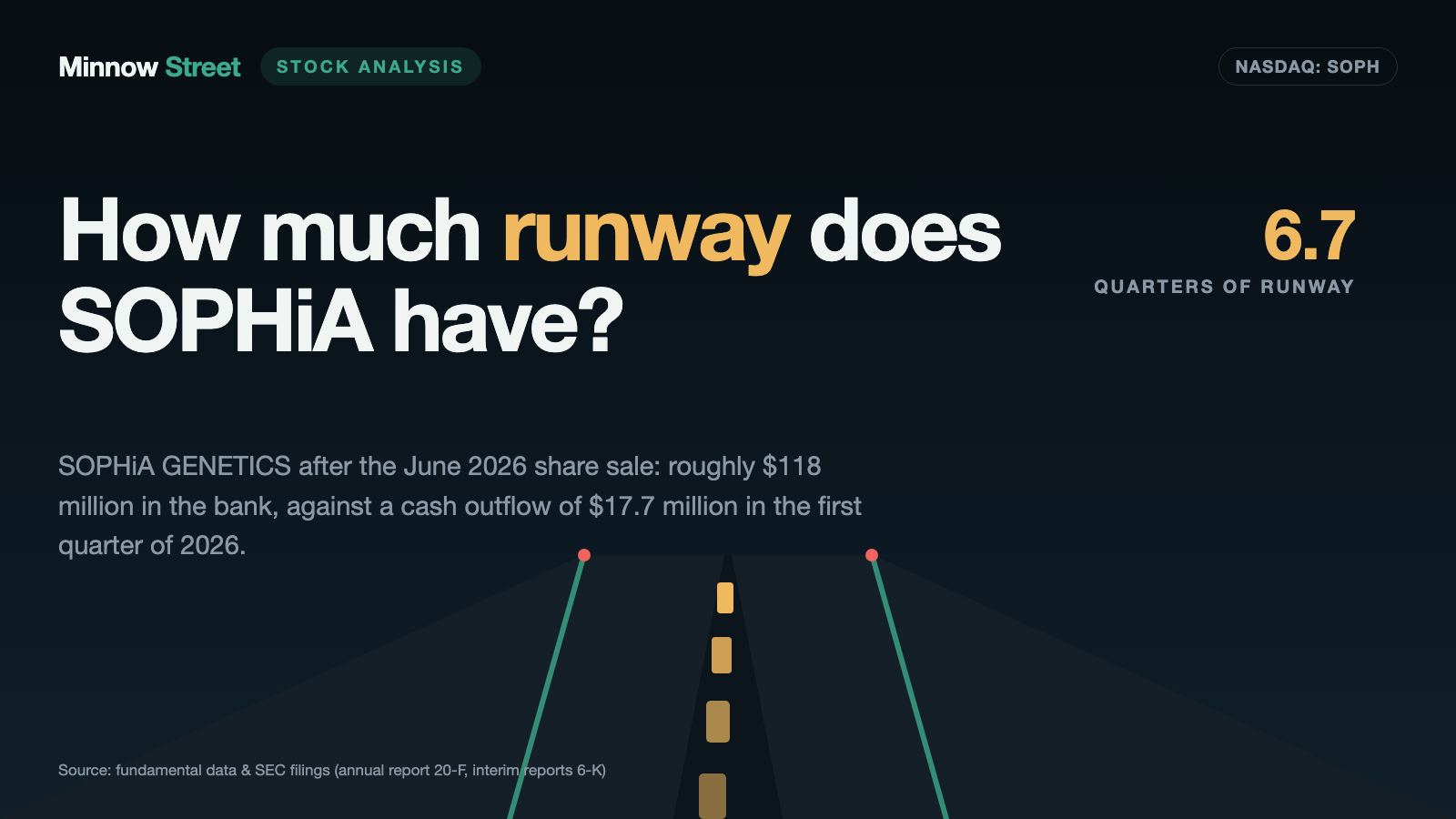
Back to the speed trap. Its core is not that growth is bad — SOPHiA GENETICS does have a product running in nearly a thousand institutions, a margin many laboratories would envy, and customers who order more every year. Its core is that a handsome growth number crowds out the second question: how much tarmac is left in front of the aircraft? The answer sits in the filings and is neither panic nor an all-clear. On a pro forma basis — $65.4 million of cash at March 31, 2026 plus $52.9 million of net proceeds from the offering that closed on June 18, 2026 — there is roughly $118 million in the bank; at the most recent burn of $17.7 million per quarter that lasts at most a good six quarters, because the burn of April through June is not yet deducted from that figure — and the company intends to be at the edge of adjusted EBITDA breakeven by the end of 2026. So it can make it before the runway ends. But that is an intention, not a result, and so far shareholders have paid for the journey: 26 percent more shares in eighteen months, 21 percent of revenue in employee equity, at least 10.25 percent interest on $50 million of debt. So the honest question is not “is the company growing fast enough?” but: are you willing to pay for the next stretch of runway — and what happens to your slice if another stretch is still missing after that? If you have a calm answer, you have a thesis. If not, you had a growth number. What you make of it is your decision. And that is exactly as it should be.
Sources
Every original document used in this analysis — read it yourself:
- SOPHiA GENETICS SA — SEC annual report 20-F for fiscal year 2025 (filed March 3, 2026)
- SOPHiA GENETICS SA — SEC interim report 6-K as of March 31, 2026, interim financial statements (filed May 5, 2026) and first quarter 2026 earnings release
- SOPHiA GENETICS SA — SEC interim report 6-K, fourth quarter and full year 2025 earnings release (filed March 3, 2026)
- SOPHiA GENETICS SA — SEC prospectus supplement 424B5 for the share offering (filed June 17, 2026)
- SOPHiA GENETICS SA — SEC interim report 6-K on the closing of the offering (filed June 22, 2026)
- SOPHiA GENETICS SA — SEC interim report 6-K with the results of the annual general meeting of June 18, 2026 (filed June 22, 2026)
- SOPHiA GENETICS SA — SEC interim report 6-K on the memorandum of understanding with Memorial Sloan Kettering Cancer Center (filed June 4, 2026)
- SOPHiA GENETICS SA — SEC interim report 6-K, second quarter 2025 earnings release (filed August 5, 2025)
- Complete SEC filing history of SOPHiA GENETICS SA: EDGAR overview (sec.gov)
- Fundamental data (metrics, share count, analyst consensus; data as of July 28/29, 2026), reconciled against the SEC filings.
Transparency & disclaimer: this analysis is journalistic commentary on publicly available information. It is not investment advice, not a regulated financial analysis and not a solicitation to buy or sell securities. Equity investments carry substantial risk up to and including total loss. All information without warranty; the data cutoff is noted in the text. The author holds no position in SOPHiA GENETICS shares at the time of publication.
Our Bottom Line at a Glance
- Growth and customer retention positive
- Revenue rose 19 percent to $77.3 million in 2025 and 22 percent to $21.7 million in the first quarter of 2026. Net dollar retention — how much existing customers pay a year later — climbed from 104 percent (2024) to 115 percent (2025) and 117 percent (first quarter of 2026). A record 124 new core genomics customers signed in 2025.
- Business model and margin positive
- The platform earns on every analysis without running samples or labs: gross margin of 67.4 percent in 2025, or 74.2 percent adjusted — 1.4 percentage points better than 2024, even as the data volume processed grew 40 percent. The decentralized approach is a genuine differentiator against centralized lab service providers.
- Earnings and cash burn negative
- The net loss of $79.0 million in 2025 matched 2023 exactly (2024: $62.5 million), and adjusted EBITDA deteriorated from $-40.2 million to $-41.5 million. Operations and investing consumed $17.7 million in the first quarter of 2026. The path to adjusted EBITDA breakeven — which management targets for the end of 2026 — remains unproven.
- Balance sheet and funding negative
- Equity fell from $96.5 million to $47.1 million within twelve months (December 31, 2025) and further to $45.7 million (March 31, 2026), with net tangible book value of just $9.9 million on that date. Against that sit $50.0 million of secured debt at Term SOFR plus 6.25 percent. The cash only holds because shares were sold twice in 2026 — most recently 12.1 million of them at $4.75.
- Litigation and regional mix negative
- Guardant Health has been suing since July and August 2025 in the United Kingdom and at the Unified Patent Court in Paris over the MSK-ACCESS liquid biopsy test — in the very market that delivered $55.6 million of $77.3 million, or 72 percent, of 2025 revenue. The first instance in Paris went SOPHiA's way on January 23, 2026, but the appeal is live, the U.K. case is pending and no provision has been recorded.
- Governance and dilution neutral
- Disclosure is detailed and candid, PricewaterhouseCoopers has audited since 2020, and there is no going concern qualification. But shares outstanding are up roughly 26 percent since the end of 2024, share-based compensation cost $16.2 million in 2025, and the annual general meeting of June 18, 2026 approved up to $17.5 million of variable pay for 2026 — with only 66.02 percent of the shares represented in favor. Ross Muken took over as chief executive on July 1, 2026 from co-founder Jurgi Camblong, who became chairman of the board.
SOPHiA GENETICS is not selling a story but a running platform: 391,000 analyses in 2025, 528 core genomics customers, 19 percent revenue growth and an adjusted gross margin of 74.2 percent. What it cannot yet do is pay for itself. The 2025 net loss of $79.0 million matched 2023, equity halved within a year to $47.1 million, and the cash holds mainly because 12.1 million new shares went out at $4.75 in June 2026. Add $50.0 million of secured debt at no less than 10.25 percent and a Guardant Health patent suit in exactly the region that supplies 72 percent of revenue. Buying here means buying a good product with an open bill. Not investment advice.
What Our Rating Means
Open questions
The business works in principle, but one material question is open. As long as it stays open, our findings do not carry a quality verdict.
Yellow because one material operating question is open — not because the stock is expensive. The evidence for red is missing: the 2025 accounts carry no going concern qualification, equity is positive at $45.7 million (March 31, 2026), the credit covenants were most recently met in full at March 31, 2026 (and before that at December 31, 2025 and 2024), and on a pro forma basis — cash at March 31, 2026 plus the net proceeds of the June 18, 2026 offering — roughly $118 million sits in the bank, at most a good six quarters of runway at the most recent burn of $17.7 million per quarter, since the second-quarter burn is not yet deducted. The evidence for green is missing too: the loss has not shrunk since 2023, equity halved in twelve months, share count is up roughly 26 percent since the end of 2024, and the promised turn to adjusted EBITDA breakeven by the end of 2026 is an intention, not a result. Three numbers in the next interim report will settle it: revenue growth, adjusted EBITDA loss and the cash balance. The decision is yours.
A journalistic assessment by our editorial team at the time of the deep dive, based on public sources — not investment advice and not a solicitation to buy or sell. Your personal circumstances (investment goals, risk capacity, taxes) cannot be taken into account. What our levels mean, how verdicts are formed, and what conflicts of interest exist →
Worth Noting
- SOPHiA GENETICS did not come to us through one of our screens — on July 29, 2026 the stock appeared in none of them. It came through the filing stream of the U.S. securities regulator, the SEC: the 424B5 prospectus supplement of June 17, 2026 for the share offering. Screen lists are recalculated daily.
- On valuation: we use the last sale price documented in a filing, $4.93 (closing price of June 16, 2026, cited in the prospectus supplement of June 17, 2026), and 83,895,266 shares — roughly $414 million. Fundamental data show a market value of $467 million as of July 28, 2026; the gap of roughly 13 percent reflects the price move over those six weeks and stays within our tolerance. Both anchors are stated with their dates in the text.
- On data sources: SOPHiA GENETICS is registered with the SEC as a foreign private issuer and therefore files an annual report on Form 20-F and interim reports on Form 6-K — a Form 10-Q does not exist. All quarterly figures in this analysis come from the 6-K as of March 31, 2026 and its exhibits; accounting is IFRS in U.S. dollars even though the company is based in Switzerland.
- Do not confuse the two loss figures: adjusted EBITDA is no side show here. For 2025 the reconciliation strips out $16.2 million of share-based compensation, $9.5 million of depreciation and amortization ($4.0 million on property and equipment, $5.6 million on intangibles) and $2.4 million of litigation expense, among other items. That turns an IFRS loss of $79.0 million into $41.5 million. Both numbers are correct, but only the first one contains the dilution existing shareholders actually bear.
Frequently Asked Questions
SOPHiA GENETICS SA (Nasdaq: SOPH), based in Rolle, Switzerland, runs SOPHiA DDM, a cloud platform for analyzing genomic and other medical data. Hospitals and labs sequence in house and upload only the data; the analysis runs in the cloud and is usually billed per analysis. More than 391,000 analyses ran through the platform in 2025 for 528 core genomics customers, and 108,000 analyses for 537 customers in the first quarter of 2026.
Because the U.S. securities regulator, the SEC, treats the company as a foreign private issuer. Those companies file an annual report on Form 20-F instead of the U.S. annual report 10-K, and interim reports on Form 6-K instead of quarterly reports 10-Q. The latest 20-F covers fiscal 2025 and was filed on March 3, 2026; the latest 6-K covers the first quarter of 2026 and was filed on May 5, 2026.
Cash stood at $65.4 million on March 31, 2026. The June 2026 share sale added roughly $52.9 million net according to the prospectus (with the option fully exercised), for a pro forma total of about $118 million; the prospectus itself shows $111.3 million as adjusted at March 31, 2026 — before the option was exercised in full. In the first quarter of 2026 operations and investing together consumed $17.7 million. At that pace the money lasts roughly 6.7 quarters; measured against the average of the past twelve months it is a little over nine quarters. Both are upper bounds: the burn from April through June 2026 is not yet deducted from the cash figure. The board stated in the annual report that resources suffice for at least the next twelve months.
Because costs grow along with it. Revenue rose 19 percent to $77.3 million in 2025, while selling, marketing, general and administrative costs climbed from $76.3 million to $88.7 million. The net loss therefore came back to $79.0 million — exactly the 2023 level. Adjusted EBITDA deteriorated slightly from $-40.2 million to $-41.5 million. For 2026 the company guides to an adjusted EBITDA loss of $29 million to $32 million.
Guardant Health sued SOPHiA GENETICS in the United Kingdom in July 2025 and at the Unified Patent Court in Paris in August 2025 over the MSK-ACCESS liquid biopsy test. On January 23, 2026 the court rejected the application for provisional measures and awarded SOPHiA an interim cost award of 400,000 euros; Guardant appealed. The U.K. proceedings remain pending. The defense cost roughly $2.4 million in the second half of 2025 alone, and no provision has been recorded.
Shares outstanding rose from 66.7 million (December 31, 2024) through 68.5 million (December 31, 2025) and 71.8 million (March 31, 2026) to 83.9 million after the June 2026 offering — roughly 26 percent more in eighteen months. The prospectus supplement of June 17, 2026 puts immediate dilution for new subscribers at $4.07 per share. On top of that sit roughly 21.9 million shares from options, restricted share units, plan reserves and warrants (March 31, 2026).
There is no price-earnings ratio because there are no earnings. The dated anchor is the last sale price documented in the prospectus supplement of June 17, 2026: $4.93 on June 16, 2026. With 83.9 million shares that is a market value of roughly $414 million, a little over five times trailing twelve-month revenue of $81.2 million and about 4.5 times the 2026 revenue guidance. Fundamental data show a market value of $467 million as of July 28, 2026. Six analysts carry an average price target of $9.00.
Found an error?
Did you spot a factual error, an outdated number, or a typo in this deep dive? Let us know briefly — your report goes straight to the editorial team.