Richardson Electronics: The Best Result in Three Years — and $4.1 Million Less in the Bank
In fiscal 2026 Richardson Electronics finished with a sprint it had not managed since 2023: quarterly revenue up 27.6 percent, quarterly net income up 244.4 percent, backlog at $164.4 million. Jumps like that are exactly what puts a stock into our Big Earnings Surprise ranking, where RELL sits at rank 14 of the U.S. selection (as of July 25, 2026). One problem: cash from operations for the whole year came to $0.8 million, and the company ended the year with $4.1 million less in the bank than it started. Inventories of $103.0 million tie up nearly half a year of sales, and an 83-year-old founder holds 61 percent of the votes with 14 percent of the shares. Not investment advice — just the question of where the money went.
 Thomas Mücke
Founder & Publisher
Thomas Mücke
Founder & Publisher
Chart
Interactive price chart (TradingView).
Note: pure fact-based analysis, not investment advice and not a solicitation to buy or sell. All figures without guarantee.
There is an investor trap that catches you precisely when you are doing the right thing — reading numbers instead of stories: the percentage trap. It works like this. You see a headline saying "net income up 244.4 percent," and your brain hears "this company exploded." What it actually heard was how small the prior-year number was. A gain of 244.4 percent on $1.1 million is $3.7 million. That is a very respectable quarter — but it is a return, not an explosion. And the percentage tells you nothing about whether the money actually landed in the bank. Richardson Electronics (NASDAQ: RELL) of LaFox, Illinois, is a perfect specimen for this trap: on July 22, 2026 the company reported a strong closing quarter, the highest backlog in three years and the best annual result since 2023. That is why it landed on our desk. So let us make a deal: before you let the percent signs carry you away, we read together what the company itself filed with the U.S. securities regulator, the SEC — the annual report (10-K) for fiscal 2025, the quarterly reports (10-Q) of fiscal 2026, the earnings release of July 22, 2026 (Form 8-K) and the proxy statement. An SEC filing is honest under penalty of law. And this one describes a genuine recovery, a cash balance that shrank anyway, an inventory worth half a year of sales — and an 83-year-old founder who owns 14 percent of the shares and 61 percent of the votes. In the end you decide.
What Richardson Electronics actually does — the spare parts dealer of industry
At its core Richardson Electronics is a specialty distributor with its own manufacturing — in everyday terms: the spare parts store for machines nobody else services any more, and at the same time the workshop that builds the part itself when it can no longer be bought. What it sells goes into industrial plants, transmitters, radar systems, semiconductor fabs and hospitals. The business splits into three units.
PMT (Power and Microwave Technologies) is by far the largest unit with $160.5 million of revenue in fiscal 2026 — a good 70 percent of the group. It covers electron tubes, RF and microwave components and engineered solutions for semiconductor manufacturing; anyone wanting to see how cyclical that end market is will find the same swings in our analysis of semiconductor equipment maker Kulicke & Soffa. GES (Green Energy Solutions) came in at $30.8 million and develops energy storage and power management products for wind, solar, hydrogen and electric vehicles — an explicitly project-driven business that moves in bursts. Canvys contributed $37.3 million and builds customized displays, mostly for medical technology. A fourth unit no longer exists: the healthcare business was largely sold to DirectMed on January 24, 2025 — at a loss of $5.074 million in fiscal 2025, followed by a $0.847 million gain on the remaining assets in fiscal 2026.
More than 55 percent of the products are made in the company’s own plants in LaFox (Illinois), Marlborough (Massachusetts) or Donaueschingen (Germany). And one more detail you need before reading any figure: the fiscal year does not end in December but on the Saturday nearest May 31. Fiscal 2026 ran from June 1, 2025 through May 30, 2026. That also names the central tension of this analysis, and it runs through every chapter: the income statement shows a company on the way up — the cash flow statement shows a company whose money is sitting in the warehouse and with its customers.
How the stock landed on our desk
Richardson Electronics sits at rank 14 in our in-house Big Earnings Surprise ranking (U.S. selection with 81 hits, as of July 25, 2026). The full list is in our Big Earnings Surprise stock scanner — the filter looks for companies whose reported earnings came in well above expectations. Worth knowing: these lists are recalculated daily, so rank and composition can shift with the next run.
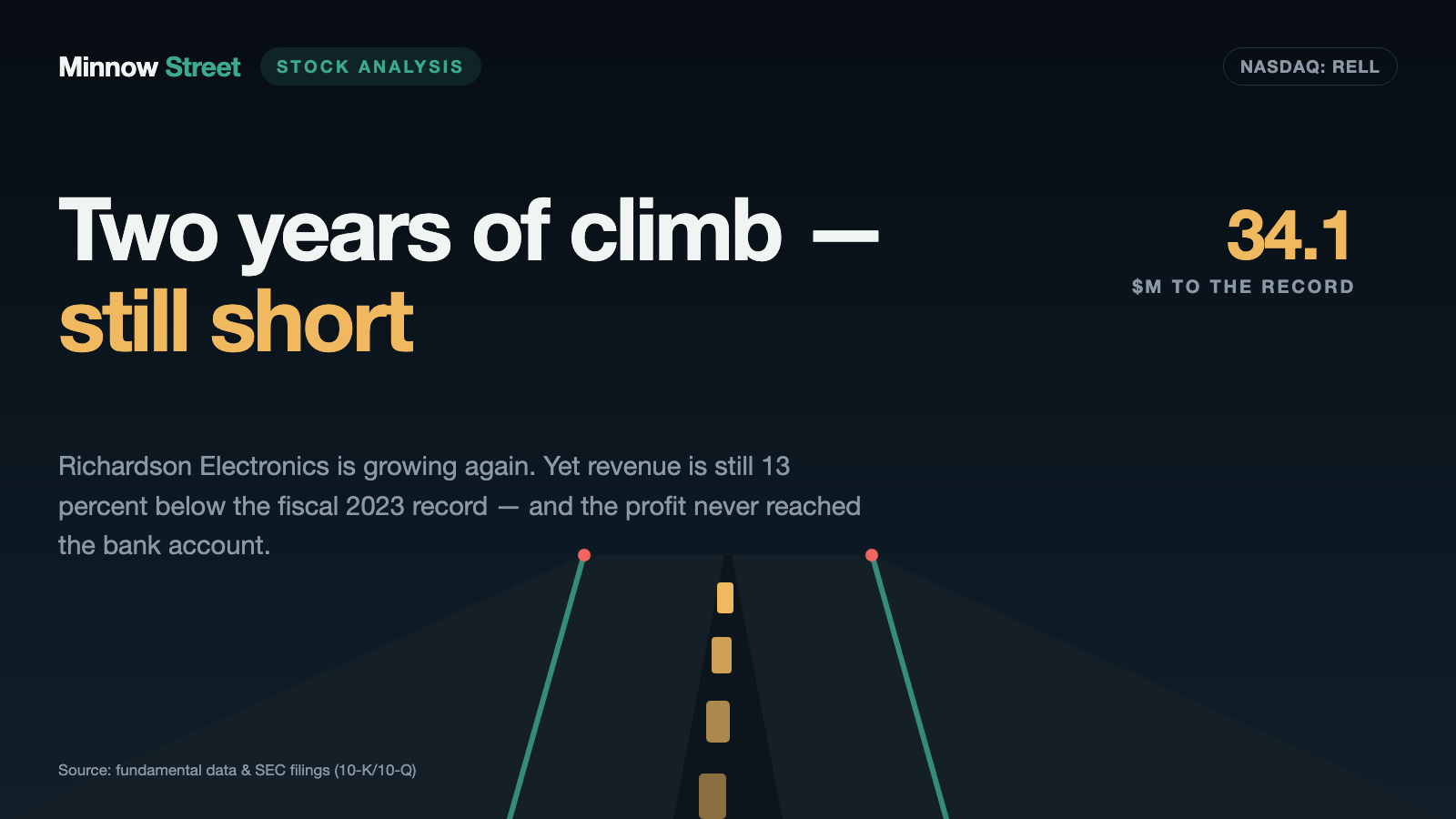
What triggered the filter is in the July 22, 2026 release: in the fourth quarter of fiscal 2026 revenue rose 27.6 percent to $66.2 million and net income 244.4 percent to $3.7 million, or $0.25 per diluted share. On top of that comes a relative strength rating of 90 — the stock outperformed 90 percent of the comparison field (as of July 25, 2026). Translated, relative strength simply means the market has already noticed the turn. Which is exactly why the second look matters. An earnings jump of 244 percent sounds like a company being repriced; mostly it measures how weak the comparison quarter was. Remember the finding right at the start: a percentage describes the slope, not the altitude. So let us measure the altitude.
The numbers over the years — given their due
First what genuinely speaks for Richardson, and that is quite a lot. Revenue is growing again, for the second year running:
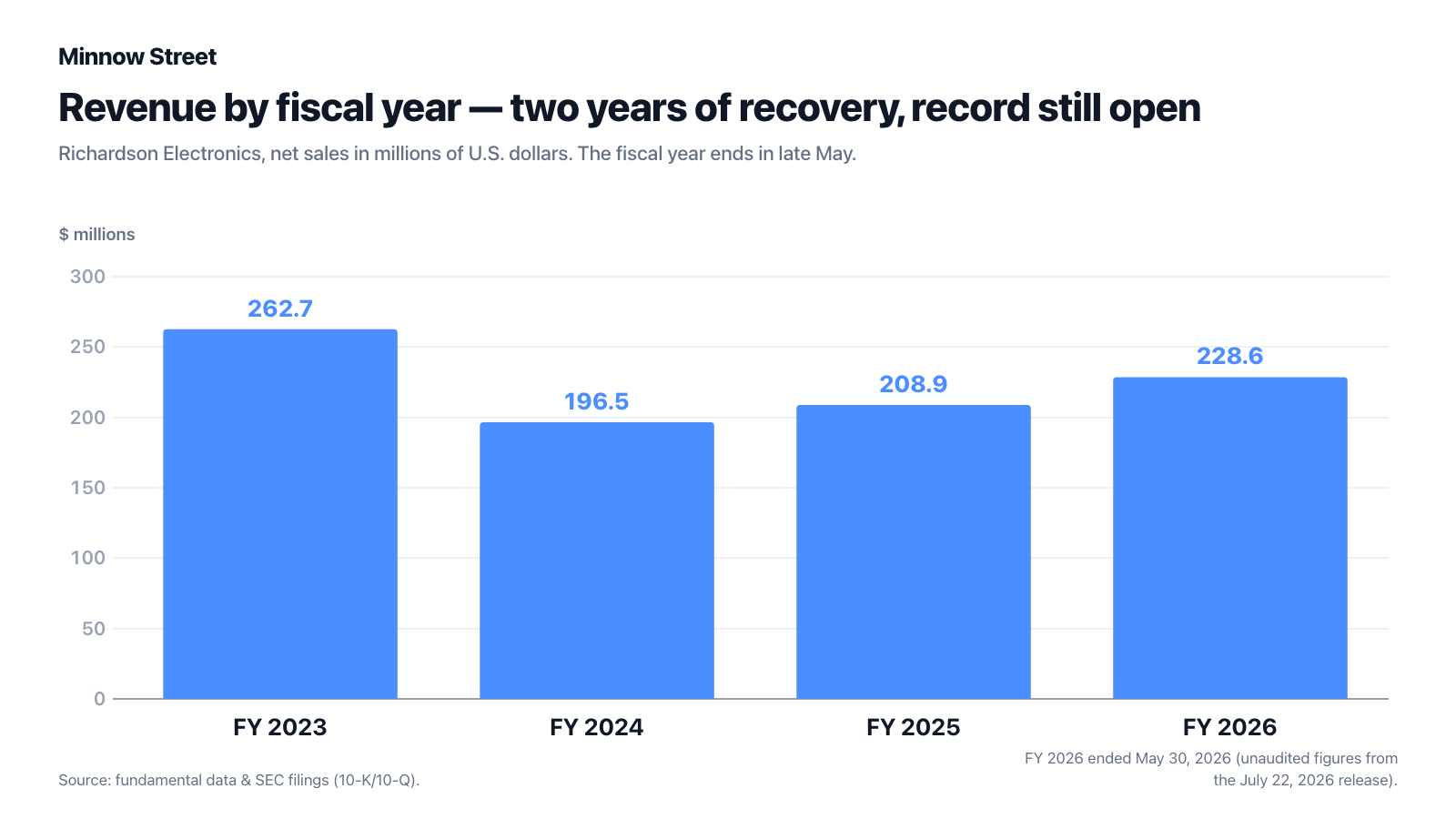
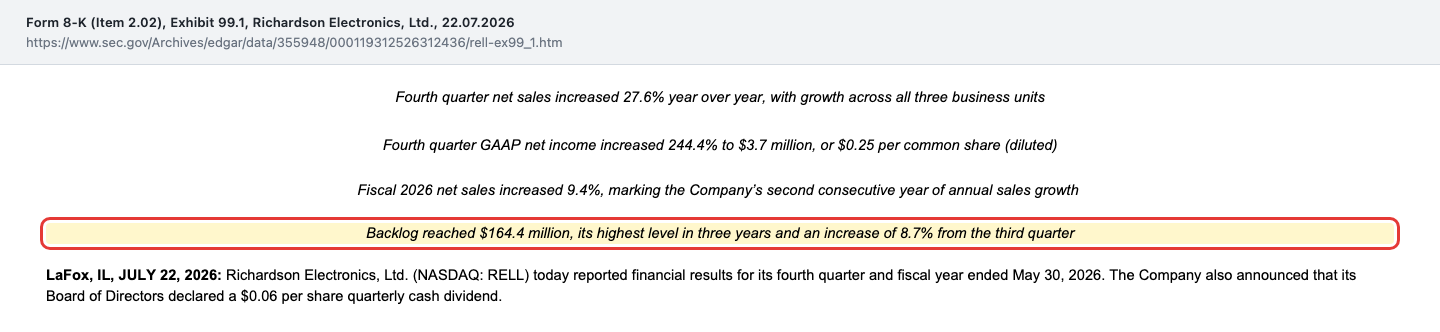
All three units grew in fiscal 2026: PMT by 9.1 percent to $160.5 million, GES by 7.3 percent to $30.8 million, Canvys by 12.4 percent to $37.3 million. Gross margin improved slightly from 31.0 to 31.2 percent, and operating expenses fell from 29.8 to 28.8 percent of revenue. An operating loss of $2.463 million turned into operating income of $6.464 million. Net income swung from −$1.143 million to $6.383 million, and diluted earnings per common share from −$0.08 to $0.44. Backlog reached $164.4 million as of May 30, 2026, the highest level in three years and 8.7 percent above the end of the third quarter ($151.2 million). The chief executive puts it this way:
"I am pleased to report that Richardson Electronics delivered its eighth consecutive quarter of year-over-year sales growth, and the highest quarterly net sales since the third quarter of fiscal 2023."
— Edward J. Richardson, Chairman, CEO and President, Form 8-K of July 22, 2026, Exhibit 99.1 (SEC EDGAR)
The balance sheet deserves respect too. As of May 30, 2026, total assets of $202.0 million carried only $38.3 million of liabilities — equity of $163.7 million is 81 percent of total assets. Nothing was drawn on the PNC Bank revolving line; the facility was extended on October 7, 2025 through October 7, 2028, with the limit cut from $30 million to $20 million. The Altman Z-score, a common bankruptcy early-warning gauge, stands at 6.71 (as of July 25, 2026) — anything above 3 counts as the safe zone, and the margin here is comfortable. The same audit firm, BDO USA, P.C., has been signing the books since 2015. Remember the image: this company is not going bankrupt. The question is whether it earns. Which brings us to the uncomfortable truths.
What the filings say — the uncomfortable truths
Uncomfortable truth no. 1: the profit arrived, the cash did not
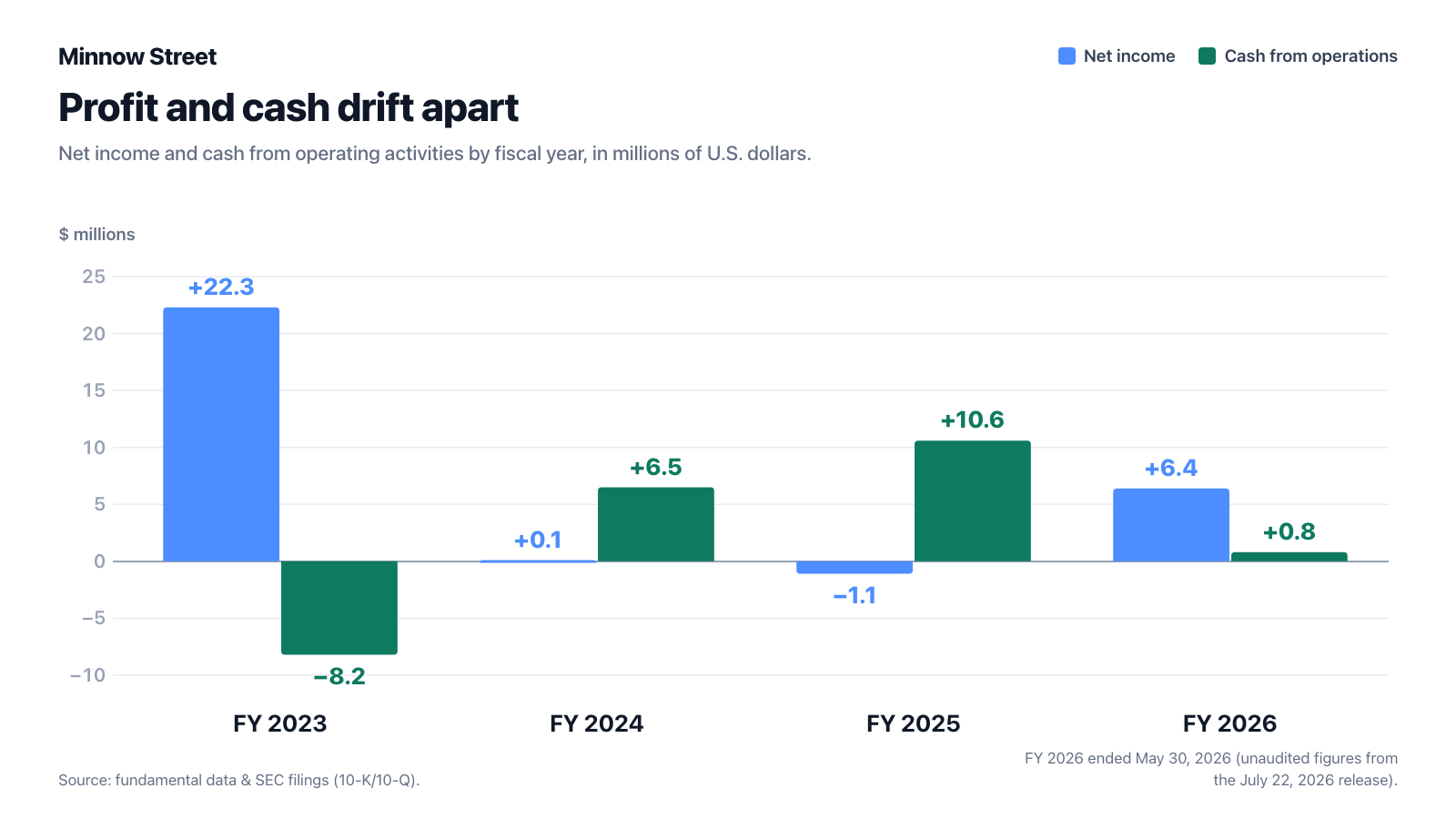
This is the heart of the analysis, and it is not at the top of the press release but at the back of the cash flow statement. In fiscal 2026 Richardson earned $6.383 million. But only $0.762 million of cash came in from operations — against $10.552 million the year before, when the company still reported a loss. After $4.383 million of capital expenditures, that leaves a free cash outflow of about $3.6 million, after an inflow of about $7.7 million the prior year. The sign has flipped.
Where the money got stuck shows up in a single line: accounts receivable rose by $8.909 million, from $24.117 million to $33.162 million. In everyday terms: the store sold more, but a larger share of the invoices is still unpaid. On the arithmetic, days sales outstanding stretched from roughly 42 to roughly 53. Part of that is the logical consequence of a strong final quarter — ship in May, get paid in July. Part of it is an early warning: receivables rising alongside revenue is normal, receivables rising faster than revenue is not.
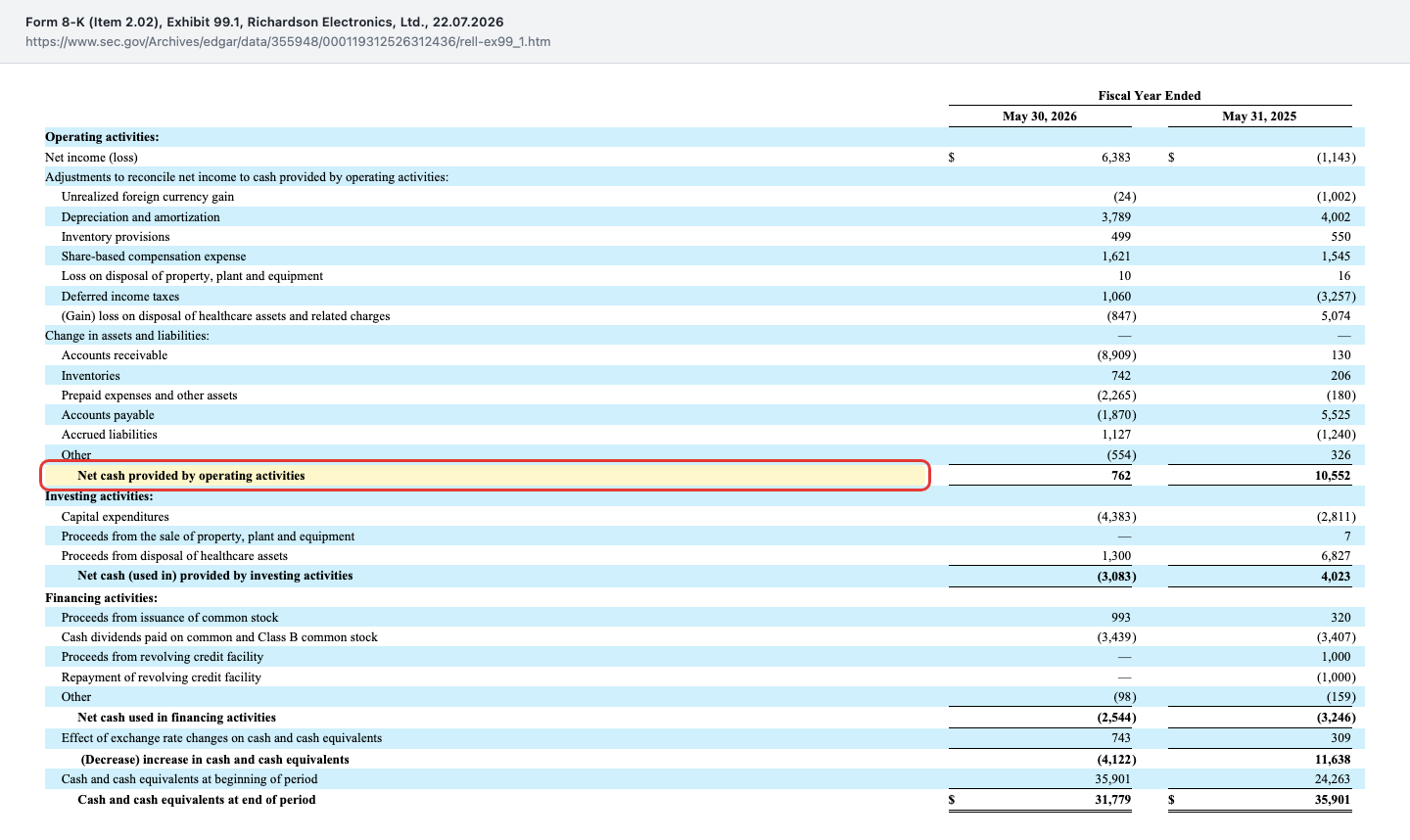
The consequence sits at the bottom of the same table: cash fell by $4.122 million to $31.779 million. A record year that leaves the bank account lighter — that one needs a moment. And it is not purely a fourth-quarter phenomenon: through the first nine months of fiscal 2026 cash from operations was negative at −$1.382 million, against +$10.478 million in the prior-year period. Remember the sentence: profit is an opinion, cash flow is a fact.
Uncomfortable truth no. 2: half the company sits in the warehouse
As of May 30, 2026 the balance sheet carried inventories of $103.020 million. For comparison: total annual revenue was $228.564 million and total assets $202.017 million. The warehouse therefore equals 45 percent of a year of sales and more than half of all assets; on the arithmetic it covers roughly 239 days of cost of sales. For a spare parts distributor a large inventory is the business model rather than a mistake — customers buy from Richardson precisely because the rare part is on the shelf. But inventory is also money tied up that earns no interest and can age.
How serious that risk is comes not from management but from the auditor. BDO USA, P.C. designated inventory valuation a critical audit matter — the place in the audit report where an auditor discloses which estimate gave them the most trouble:
"A number of products in the PMT reportable segment represent trailing edge technology the Company often buys products ahead of supplier price increases and extended lead times which can create higher levels of inventory. As technologies evolve and customers replace their equipment, PMT inventory on hand may become obsolete."
— Richardson Electronics, Ltd., annual report 10-K for fiscal 2025, audit report by BDO USA, P.C., critical audit matter (SEC EDGAR)

As of May 31, 2025 the $102.8 million of inventories already included $7.6 million of reserves. Fiscal 2026 added $0.499 million of inventory provisions. As long as demand is picking up, that is a manageable number. If the semiconductor cycle turns, it is the first line item that hurts — with components for industrial equipment, the border between "rare spare part" and "unsellable legacy stock" is thin. How hard component cycles can bite is something we worked through in detail in our analysis of component maker Vishay.
Uncomfortable truth no. 3: one man holds 14 percent of the shares and 61 percent of the votes
Richardson Electronics has two classes of stock. The listed common share (ticker RELL) carries one vote; the unlisted Class B share carries ten votes — at 90 percent of the cash dividend. As of May 30, 2026 there were 12.588 million common and 2.036 million Class B shares outstanding, so Class B is just under 14 percent of the capital. Who owns it is stated by the annual report itself, under the heading "A single stockholder controls a majority of the Company’s voting stock":
"As of July 28, 2025, Edward J. Richardson, our Chairman, Chief Executive Officer and President, beneficially owned approximately 98% of the outstanding shares of our Class B common stock, representing approximately 61% of the voting power of the outstanding common stock."
— Richardson Electronics, Ltd., annual report 10-K for fiscal 2025, Item 1A Risk Factors (SEC EDGAR)

On that basis the company uses the Nasdaq controlled company exemption (rule 5615(c)) and is therefore not required to meet certain nominating committee standards. In everyday terms: you are a co-owner, but at the club vote one member holds 61 of 100 votes. A second point belongs on the table too: per the proxy statement of August 25, 2025, Edward J. Richardson is 83 years old, has served on the board since 1965 and has worked at the company since 1961. The annual report itself lists him as a key person risk, saying success depends "to a large extent" on his continued service. That is not an insinuation but a self-disclosure — and a reason why every Form 8-K carrying Item 5.02 (management changes) deserves attention with this stock.
Uncomfortable truth no. 4: the year hung on a single quarter
Annual revenue rose by $19.7 million. Of that, $14.3 million — nearly three quarters — came from the fourth quarter alone. Through the first nine months revenue grew a modest 3.4 percent ($162.4 million after $157.0 million), and in the third quarter only 3.1 percent, with GES shrinking 5.4 percent and Canvys 13.5 percent. Only in the closing quarter did all three units pull together: PMT up 28.1 percent, GES up 20.4 percent, Canvys up 29.5 percent.
That is good news — and an open question. The good part is that backlog is following: $164.4 million at year end, 8.7 percent above the prior quarter. The open part is whether this is a trend or a catch-up effect, for instance pulled-forward orders from semiconductor manufacturing. For a company whose largest unit is tied to one of the most cyclical end markets in the world, the difference decides everything. A second point belongs to honesty: fourth-quarter earnings include a $0.847 million gain on the disposal of the remaining healthcare equipment, offset by a $0.436 million charge from the settlement of a state unclaimed property audit. Excluding both items, non-GAAP net income for fiscal 2026 was $5.693 million instead of $6.383 million, and non-GAAP diluted earnings per share $0.40 instead of $0.44.
Valuation: the market is paying for the recovery, not the substance
How expensive is the stock? For a defensible, dated anchor we do not use the daily price but a price documented in an SEC filing: the Forms 4 filed on July 23, 2026 record a price of $18.01 per share for July 22, 2026. Applied to 14.624 million shares (common plus Class B), that is roughly $263 million of market value — fundamental data show roughly $261 million as of July 25, 2026, so the order of magnitude holds.
From that follow these ratios: a price-to-earnings ratio of about 41 (on fiscal 2026 earnings of $0.44 per share), a price-to-sales ratio of about 1.1, a price-to-book ratio of about 1.6 (equity of $163.7 million) and an enterprise value of roughly 22 times adjusted EBITDA ($10.4 million). Translated: for a company with a 2.8 percent net margin and a 4.0 percent return on equity, 41 times earnings is not a bargain price. The market is not paying for substance here but for the expectation that the recovery continues — the stock has traded in a 52-week range of $9.26 to $23.15 (as of July 25, 2026), which shows how fast that expectation turns.
Two counterweights belong in the picture. First the substance: current assets less all liabilities came to roughly $134 million as of May 30, 2026, so a good half of the market value sits in inventory, receivables and cash rather than in hope. Second the professional view, which is very thin here: only one analyst publicly covers the stock, with a price target of $15.50, below the last documented price (as of July 25, 2026). At this size that mostly means there is no consensus to push against — you are on your own numbers. The Piotroski quality score fits: 6 out of 9 points. That is decent, not good; a genuinely healthy company sits at 8 or 9. The missing points lie exactly where this analysis is looking — at the conversion of profit into cash.
Opportunities and risks at a glance
What speaks for Richardson Electronics:
- A real operating turn: an operating loss of $2.463 million (fiscal 2025) became operating income of $6.464 million (fiscal 2026), on revenue up 9.4 percent to $228.6 million and a slightly better gross margin of 31.2 percent.
- Backlog of $164.4 million as of May 30, 2026 — the highest level in three years, 8.7 percent above the prior quarter, driven mainly by PMT.
- Fortress balance sheet: $163.7 million of equity against $202.0 million of total assets (81 percent equity ratio), no drawn bank debt, $31.8 million of cash, a $20 million credit line through October 2028, Altman Z-score of 6.71.
- Broad customer base: no single customer accounted for more than 10 percent of revenue in fiscal 2025 or 2024; the units serve semiconductor manufacturing, defense, wind power, medical technology and industry in parallel.
- A dividend stable for years at $0.06 per common share per quarter ($0.054 on Class B), most recently declared July 22, 2026 and payable August 26, 2026 — at a payout ratio of roughly 54 percent of annual earnings.
What speaks against:
- Profit is not turning into cash: $0.762 million of operating cash flow against $6.383 million of net income; free cash flow swung from +$7.7 million to −$3.6 million; cash fell by $4.122 million despite the record year. The $3.439 million dividend therefore did not come out of current operations.
- Inventories of $103.0 million tie up 45 percent of a year of sales and more than half the balance sheet; the auditor treats their valuation as a critical audit matter and warns about trailing edge technology.
- Concentrated control: roughly 61 percent of the voting power with one person holding roughly 14 percent of the capital, use of the Nasdaq controlled company exemption, plus an 83-year-old founder with no publicly known succession plan.
- Growth hung on the closing quarter: nearly three quarters of the annual increase came in three months, while the nine-month period grew just 3.4 percent and two of three units shrank in the third quarter.
- A demanding valuation on thin earning power: roughly 41 times earnings, a 2.8 percent net margin, a 4.0 percent return on equity, and a single analyst whose price target sits below the last documented price (as of July 25, 2026).
A human conclusion
Back to the percentage trap from the beginning. Its core is not that "up 244.4 percent" is a lie — the number is right, and it stands exactly like that in the filing with the SEC. Its core is that a big percentage blocks the view of the basic question: how much money does this business actually earn, and where does it end up? At Richardson Electronics the honest answer for fiscal 2026 reads: $6.4 million on paper, $0.8 million in cash, $4.1 million less in the bank than a year earlier — with a warehouse that ties up almost half a year of sales. That is not a catastrophe. A company with an 81 percent equity ratio, no bank debt and the highest backlog in three years has time to fix it. But it is also not the story the headline tells. So the honest question for you is not "how strong was the quarter?" but: are you paying 41 times a profit that still has to prove, in the next filing, that it reaches the bank account? If you can answer yes and bring the patience for a cyclical niche supplier, you have a thesis. If not, you had a percentage. What you make of it is your decision. And that is exactly how it should be.
Sources
Every primary document used in this analysis — for you to read yourself:
- Richardson Electronics, Ltd. — Form 8-K of July 22, 2026, Exhibit 99.1: fourth quarter and fiscal 2026 results (unaudited)
- Richardson Electronics, Ltd. — quarterly report 10-Q as of February 28, 2026 (filed April 9, 2026)
- Richardson Electronics, Ltd. — quarterly report 10-Q as of November 29, 2025 (filed January 8, 2026)
- Richardson Electronics, Ltd. — quarterly report 10-Q as of August 30, 2025 (filed October 9, 2025)
- Richardson Electronics, Ltd. — annual report 10-K for fiscal 2025 (filed August 4, 2025)
- Richardson Electronics, Ltd. — annual report 10-K for fiscal 2024 (filed August 5, 2024)
- Richardson Electronics, Ltd. — proxy statement DEF 14A for the 2025 annual meeting (filed August 25, 2025)
- Complete SEC filing history of Richardson Electronics, Ltd. (CIK 0000355948): EDGAR overview (sec.gov)
- Fundamental data (metrics, valuation, 52-week range, quality scores; as of July 25, 2026), reconciled with the SEC filings.
- Rank and relative strength rating: our in-house Big Earnings Surprise stock scanner, U.S. selection with 81 hits, as of July 25, 2026; the lists are recalculated daily.
Transparency & disclaimer: This analysis is a journalistic contextualization of publicly available information and is not investment advice, not a financial analysis in the regulatory sense, and not a solicitation to buy or sell securities. Stock investments carry substantial risks up to total loss. The fiscal 2026 annual figures come from the unaudited release of July 22, 2026; the audited annual report 10-K had not been filed as of July 25, 2026. All information without warranty; the data cut-off is noted in the text. The author holds no position in Richardson Electronics shares at the time of publication.
Our Bottom Line at a Glance
- Operating turn positive
- Revenue rose 9.4 percent to $228.6 million in fiscal 2026, the second consecutive year of growth; an operating loss of $2.463 million became income of $6.464 million. Backlog hit $164.4 million as of May 30, 2026, the highest level in three years, and all three units grew.
- Conversion into cash negative
- Against net income of $6.383 million stood only $0.762 million of cash from operations (prior year $10.552 million); receivables rose by $8.909 million. After $4.383 million of capital expenditures, free cash flow swung from +$7.7 million to −$3.6 million, and cash fell by $4.122 million to $31.779 million (May 30, 2026).
- Balance sheet strength positive
- Equity of $163.701 million against total assets of $202.017 million (81 percent ratio), no drawn bank debt, a $20 million credit line through October 7, 2028, Altman Z-score of 6.71 (as of July 25, 2026). Bankruptcy risk is not an issue with this structure.
- Inventory & auditor view negative
- Inventories of $103.020 million tie up 45 percent of a year of sales and more than half the balance sheet (May 30, 2026). BDO USA, P.C. treats their valuation as a critical audit matter for fiscal 2025 and points to trailing edge technology in the PMT segment; $7.6 million of reserves were included as of May 31, 2025.
- Governance & succession negative
- Roughly 61 percent of the voting power sits with Edward J. Richardson through the ten-vote Class B share, on roughly 14 percent of the capital (as of July 28, 2025); the company uses the Nasdaq controlled company exemption. The chairman is 83 per the proxy of August 25, 2025, and the annual report itself names him as a key person risk.
- Valuation neutral
- Roughly $263 million of market value (14.624 million shares × $18.01, price documented in Forms 4 for July 22, 2026) means about 41 times earnings at a 2.8 percent net margin — expensive for the earning power, though roughly half the market value sits in net current assets of about $134 million. The 52-week range runs from $9.26 to $23.15.
Richardson Electronics is the percentage trap in pure form: "net income up 244.4 percent" is accurate, but it mostly measures how weak the prior-year quarter was. Fiscal 2026 brought a genuine operating turn — $228.6 million of revenue (up 9.4 percent), $6.383 million of net income after a loss, $164.4 million of backlog. The cash simply never arrived: $0.762 million from operations, a free cash outflow of $3.6 million and $4.122 million less in the bank. On top sit inventories of $103.0 million that the auditor flags as the critical judgment, and an 83-year-old founder with 61 percent of the votes on 14 percent of the capital. The balance sheet is a fortress; the valuation at about 41 times earnings is not. Not investment advice.
Worth Noting
- Richardson Electronics landed on the research list at rank 14 in our in-house Big Earnings Surprise ranking (U.S. selection with 81 hits), as of July 25, 2026, with a relative strength rating of 90. These lists are recalculated daily, so rank and composition can shift with the next run.
- Data cut-off and audit status: the annual report 10-K for fiscal 2026 had not been filed as of July 25, 2026. All fiscal 2026 annual and balance sheet figures come from the unaudited release of July 22, 2026 (Form 8-K, Exhibit 99.1). Structural, voting and auditor data come from the fiscal 2025 10-K and the proxy statement of August 25, 2025.
- Two states from the fiscal 2025 10-K are superseded and were carried over corrected: the PNC credit facility was extended on October 7, 2025 through October 7, 2028 and the limit cut from $30 million to $20 million; authorized capital was raised at the annual meeting of October 7, 2025 to 22 million common and 3 million Class B shares.
- Do not confuse: the non-calendar fiscal year ends in late May, so the "fourth quarter of fiscal 2026" covers the calendar months March through May 2026. The share count in market data feeds (12.52 million) covers only the listed common stock; market value and earnings per share rest on the 14.624 million common plus Class B shares.
Frequently Asked Questions
Richardson Electronics, Ltd. (NASDAQ: RELL) of LaFox, Illinois, is a manufacturer and specialty distributor of electron tubes, RF and microwave components and power management products. Three units: PMT (Power and Microwave Technologies, $160.5 million of revenue in fiscal 2026), GES (Green Energy Solutions, $30.8 million, energy storage and power products for wind, solar, hydrogen and electric vehicles) and Canvys ($37.3 million, customized displays, mostly medical). Customers come from semiconductor manufacturing, defense, broadcast, industry and medicine.
Not in December. The fiscal year ends on the Saturday nearest May 31. Fiscal 2026 ran from June 1, 2025 through May 30, 2026; fiscal 2025 ended May 31, 2025 and fiscal 2024 ended June 1, 2024. Anyone comparing quarters needs to keep that in mind: the fourth quarter of fiscal 2026 covers the calendar months of March through May 2026. The annual report on Form 10-K is usually filed in early August.
Revenue rose 9.4 percent to $228.6 million, the second consecutive year of growth. Net income swung from −$1.143 million to +$6.383 million, and diluted earnings per share from −$0.08 to +$0.44. In the fourth quarter revenue climbed 27.6 percent to $66.2 million and net income 244.4 percent to $3.7 million. Backlog reached $164.4 million, the highest level in three years. All figures from the unaudited release of July 22, 2026.
Because the profit did not turn into cash. Cash from operating activities in fiscal 2026 came to just $0.762 million after $10.552 million the prior year — receivables rose by $8.909 million to $33.162 million. After $4.383 million of capital expenditures, free cash flow was an outflow of about $3.6 million. Together with $3.439 million of dividends, cash fell by $4.122 million to $31.779 million as of May 30, 2026.
As of May 30, 2026 the balance sheet carried inventories of $103.020 million — 45 percent of annual revenue and more than half of total assets of $202.017 million. Auditor BDO USA, P.C. designated the valuation of this inventory a critical audit matter in the fiscal 2025 audit report and pointed to trailing edge technology in the PMT unit. As of May 31, 2025 the balance included $7.6 million of reserves.
There are two classes: the listed common share with one vote and the unlisted Class B share with ten votes. As of May 30, 2026 there were 12.588 million common and 2.036 million Class B shares outstanding. Chairman, CEO and President Edward J. Richardson held roughly 98 percent of the Class B shares as of July 28, 2025, representing roughly 61 percent of the voting power. The company uses the Nasdaq controlled company exemption. Richardson is 83 per the proxy and has been a director since 1965.
Yes. On July 22, 2026 the board again declared a quarterly cash dividend of $0.06 per common share and $0.054 per Class B share, payable August 26, 2026 to holders of record on August 7, 2026. In fiscal 2026 dividends cost $3.439 million in total. That is roughly 54 percent of annual earnings — but more than the business had left in cash after capital expenditures.
Measured against a price of $18.01 documented in Forms 4 for July 22, 2026 and 14.624 million shares (common plus Class B), market value is roughly $263 million. That gives a price-to-earnings ratio of about 41 (on earnings of $0.44 per share), a price-to-sales ratio of about 1.1 and a price-to-book ratio of about 1.6. At a 2.8 percent net margin that is not a bargain price. The 52-week range runs from $9.26 to $23.15 (as of July 25, 2026).
Found an error?
Did you spot a factual error, an outdated number, or a typo in this deep dive? Let us know briefly — your report goes straight to the editorial team.