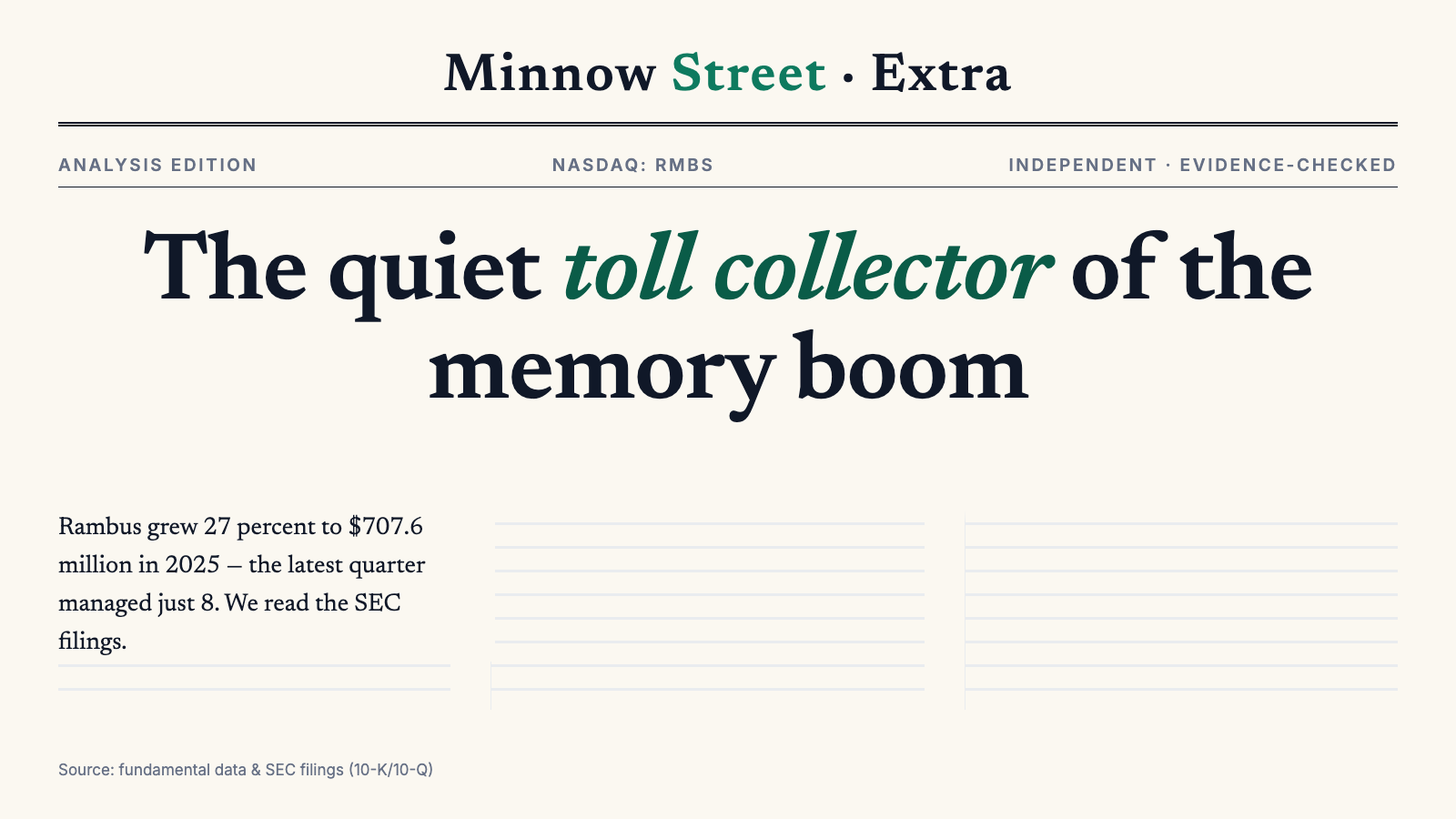
Rambus Stock: The Quiet Toll Collector of the Memory Boom — a Record Year at 27 Percent Growth, the Latest Quarter at 8
Rambus (Nasdaq: RMBS), the memory-chip and patent company from Silicon Valley, ranks fourth in our in-house Terry Smith quality scanner (U.S. selection, as of July 18, 2026): a 37 percent operating margin, essentially no debt, and a record 2025 with $707.6 million in revenue. We read the annual report (10-K) for 2025 and the quarterly report (10-Q) as of March 31, 2026 — and they also tell the other story: 66 percent of revenue hangs on five customers, nearly half on contracting parties in South Korea, the patents expire between 2026 and 2044, and growth has cooled from 41 to 8 percent within four quarters. Not investment advice — just the question of which drawer fits this time.
 Thomas Mücke
Founder & Publisher
Thomas Mücke
Founder & Publisher
Chart
Interactive price chart (TradingView).
Note: pure fact-based analysis, not investment advice and not a solicitation to buy or sell. All figures without guarantee.
There is a thinking trap that grows stronger the longer you have been around the market: the drawer trap. Your brain loves ready-made labels, because they spare it the tedious work of checking. With Rambus Inc. (Nasdaq: RMBS), two labels sit ready to hand. Anyone who lived through the 2000s pulls open the old drawer: "Rambus? That is the company whose name used to come up in courtrooms more often than in data centers." Anyone who arrived with the AI boom opens the new one: "Memory plus AI — buy it before everyone notices." Both drawers share the same flaw: they replace reading. So let's make a deal: we leave both labels where they are and read together what Rambus itself reported, under penalty of law, to the U.S. securities regulator, the SEC — the annual report (10-K) for fiscal year 2025 and the quarterly report (10-Q) as of March 31, 2026. The occasion is a good one: in our in-house Terry Smith quality scanner, Rambus ranks fourth in the U.S. selection (as of July 18, 2026), and fiscal 2025 was the best year in the company's history. But the same filings also contain five customers, one country, an expiration date — and a set of skid marks. In the end, you decide.
What Rambus actually does — and where the money comes from
Picture the data traffic in an AI data center as an eight-lane highway. The processors are the vehicles, the working memory is the destination — and right at the on-ramp stands Rambus. The company from San Jose (founded in California in 1990, a Delaware corporation since 1997) earns its money at three points along this highway. First, and by now the largest: memory interface chips (49 percent of 2025 revenue). These are specialized traffic cops — above all so-called DDR5 RCD chips — that sit on every server memory module and clock, sort and stabilize the data stream between processor and memory chips. The buyers are, of all companies, the world's three big DRAM makers: Micron, Samsung and SK hynix, plus system manufacturers and cloud providers. Second: patent royalties (40 percent). Rambus owns 2,029 patents on memory and security technology and rents them out — a toll booth where, per the annual report, AMD, Broadcom, NVIDIA, Qualcomm, MediaTek, Micron, Samsung, SK hynix and even China's DRAM challenger CXMT pay. The contracts typically run up to ten years. Third: silicon IP (11 percent) — finished circuit blueprints for high-speed interfaces such as HBM4, GDDR7 and PCIe 7.0, as well as security chips, which other companies build into their own silicon for a license fee.
The market story comes bundled with the filing: AI workloads make systems "memory bound" — the memory, not the processor, becomes the bottleneck, and that is exactly where Rambus sits. Sounds like marketing? In part, it is. But the core holds: 791 employees, 71 percent of them engineers, and a product line that jumped 41 percent to a record in 2025 — this is a real technology business, not a paper tiger. Which brings us to the central tension of this analysis, running through every chapter: the financials are a fortress — but its three foundations are named five customers, renewable licenses and patents with expiration dates, and the growth rate has cooled from 41 to 8 percent within four quarters. How cyclical the memory business itself is, we dissected in our deep dive on the Rambus customer Micron — the two business models are a case study in the difference between a factory and a toll booth.
Where the stock shows up in our scanner
Every day we run roughly 3,500 stocks through our scanners. Rambus reached the research list via the Terry Smith quality scanner — rank 4 of the U.S. selection, as of July 18, 2026. This filter looks for what British fund manager Terry Smith calls "good companies": high returns on capital, high margins, reliable cash generation, little debt. And there Rambus delivers impressively: the operating margin reached 36.8 percent in fiscal year 2025 (of $100 in revenue, almost $37 stick before interest and taxes), the net margin stood at 33.2 percent in the first quarter of 2026. An equity ratio around 90 percent and debt near zero make the balance sheet a fortress; the Altman-Z score — a bankruptcy-risk gauge where anything above 3 counts as very solid — sits around 18. On top of that, the scanner reports confluence with momentum filters such as Stage 2 and institutional accumulation: big money has been adding, and the stock roughly doubled within twelve months (data as of July 18, 2026).
But the same scanner also shows the first dent: the Piotroski F-Score — a nine-point health check of the books — stood at just 4 of 9 as of the first quarter of 2026, after a straight 9 a year earlier. That is no alarm, but it is a pointer: the momentum in the metrics is fading, while the quality-filter rank lives off the strong 2025 numbers. Remember this sentence, it applies to every filter in the world: a scanner answers the question "How good were the numbers?" — never the question "How long will they stay that good?" Only the filings answer the second question. So let's go.
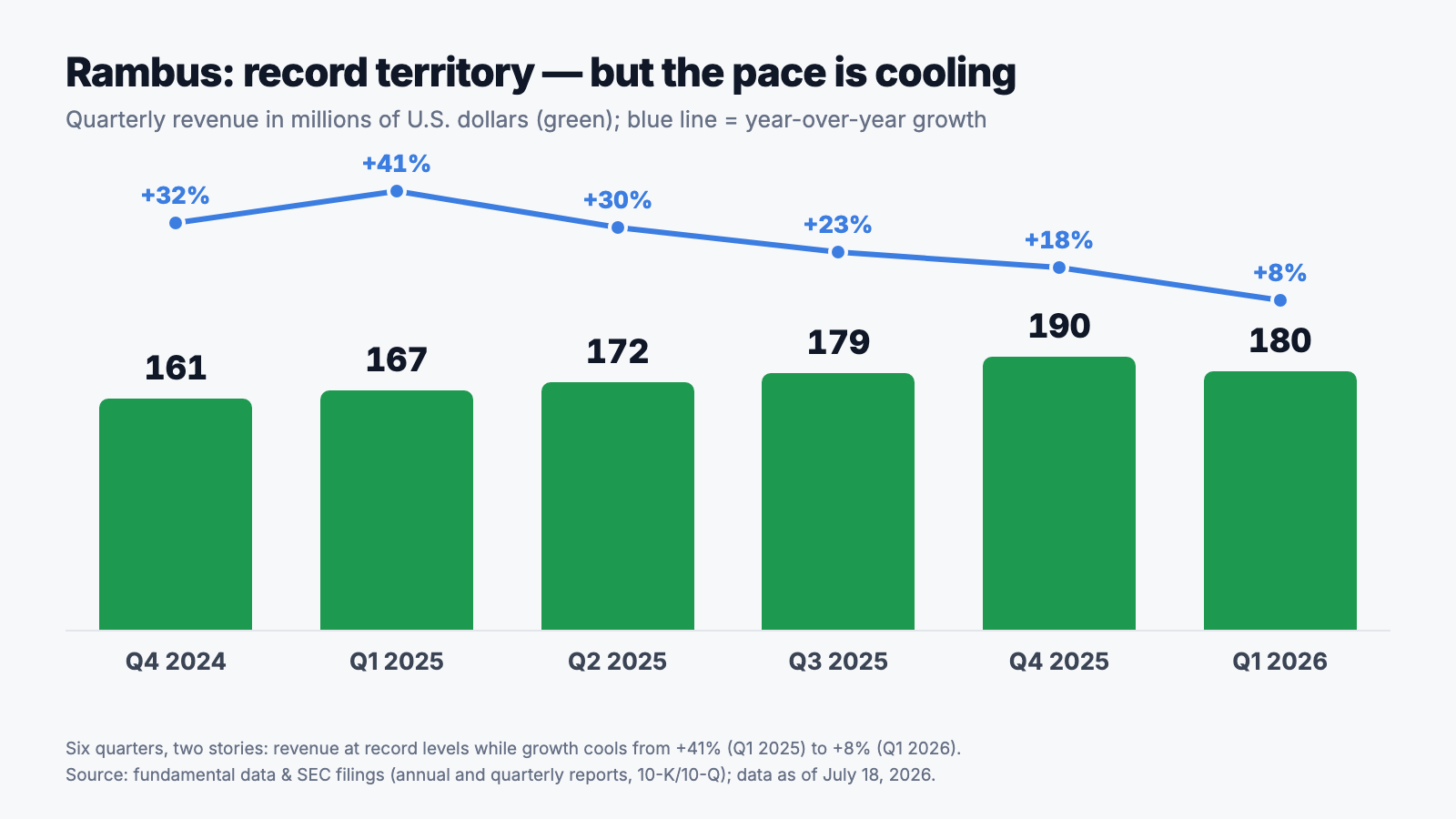
The numbers over the years — honestly appraised
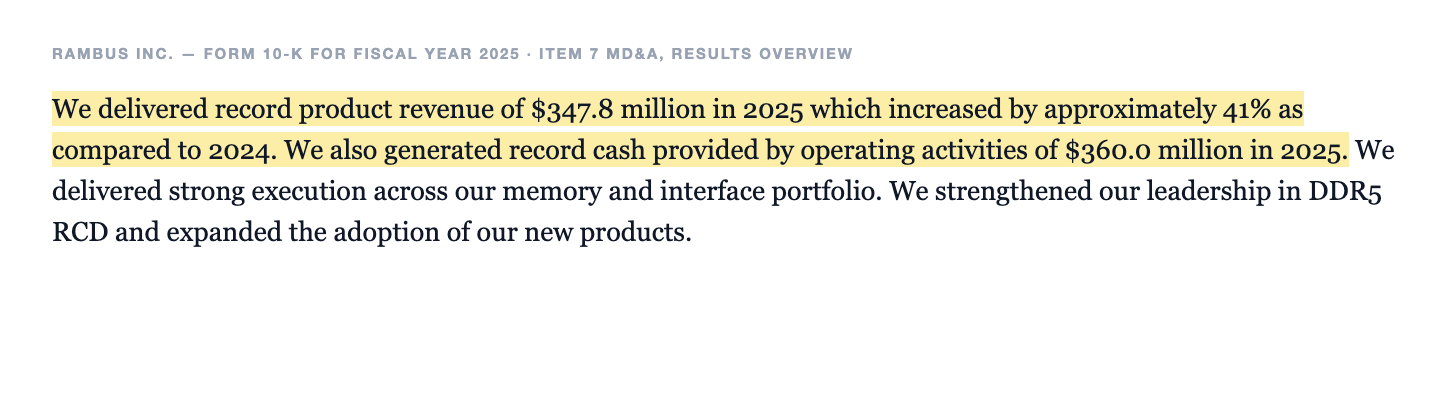
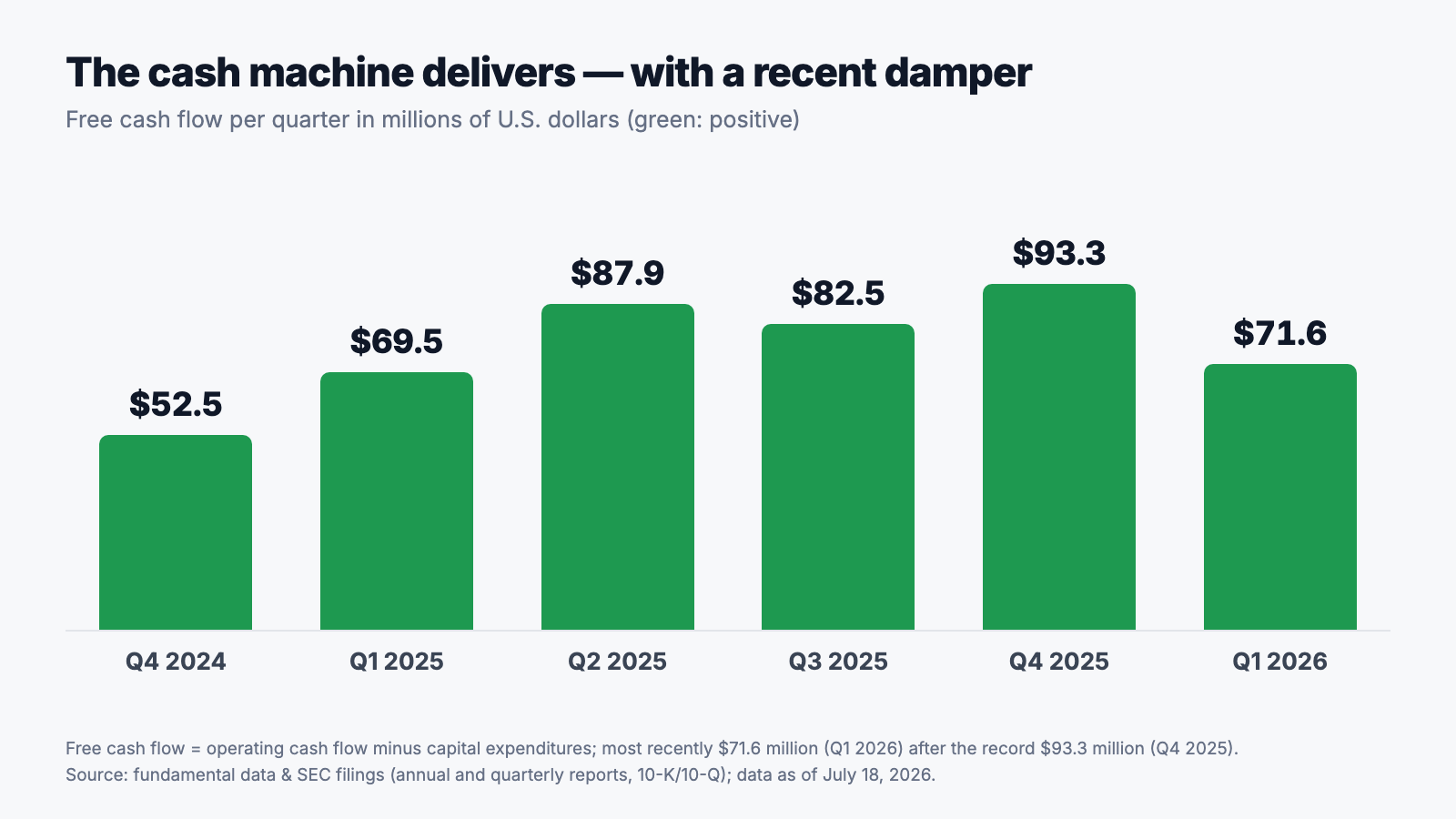
First, what genuinely impresses — and at Rambus that is a lot. Revenue climbed from $461.1 million (2023) through $556.6 million (2024) to $707.6 million in fiscal year 2025, up 27 percent. More important still: the driver is the product business. Chip revenue jumped 41 percent to a record $347.8 million in 2025 — Rambus no longer just sells rights, it sells ever more actual building blocks for server memory and, lately, complete chipsets for AI PCs. Operating income climbed from $153.6 million through $183.0 million to $260.2 million — up 70 percent in two years. Net income for 2025: $230.5 million ($2.11 per diluted share). Honesty requires a footnote here: 2023 showed more at the bottom line ($333.9 million), but only because of one-off effects — a tax benefit of $146.7 million and a $90.8 million gain from selling the PHY IP business. Operationally, 2025 was by far the best year in company history. The cash column confirms it: $360.0 million of operating cash flow (a record), and as of March 31, 2026 there were $786 million in cash and securities — against essentially zero financial debt.
"We delivered record product revenue of $347.8 million in 2025 which increased by approximately 41% as compared to 2024. We also generated record cash provided by operating activities of $360.0 million in 2025."
— Rambus Inc., SEC annual report 10-K for fiscal year 2025, Item 7 "Management's Discussion and Analysis"
And then came the first quarter of 2026 — and with it the skid marks. Revenue still grew 8.1 percent to $180.2 million (after +41.4 percent in the prior-year quarter), patent royalties fell 5.9 percent to $69.6 million, and net income marked time at $59.9 million (prior year: $60.3 million) — partly because Rambus raised research spending 18 percent to $50.2 million. None of this is a collapse; beating a record year is hard, and license revenue breathes with contract dates. But hold on to this number: 41 percent of growth became 8 within four quarters. We will meet it again at the valuation.
What the filings say — the uncomfortable truths
Uncomfortable truth no. 1: five customers, 66 percent — and half the revenue hangs on South Korea
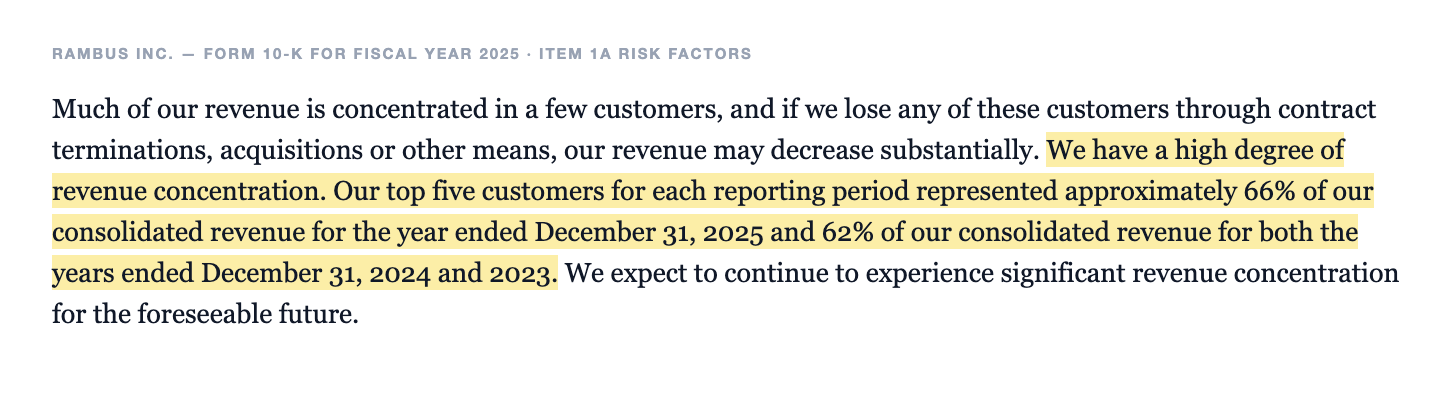
Rambus's customer list reads like a who's who of the chip industry — but it is short. The structure of the industry makes that unavoidable: there are only three big DRAM makers in the world, and it is exactly to them that Rambus sells its interface chips. The result sits soberly in the risk chapter:
"We have a high degree of revenue concentration. Our top five customers for each reporting period represented approximately 66% of our consolidated revenue for the year ended December 31, 2025 and 62% of our consolidated revenue for both the years ended December 31, 2024 and 2023."
— Rambus Inc., SEC annual report 10-K for fiscal year 2025, Item 1A "Risk Factors"
The quarterly report makes it more concrete: in the first quarter of 2026, the anonymized "Customer A" alone stood for 29 percent of revenue (prior year: 23), "Customer B" for 15, "Customer C" for 10 percent; among receivables, a single customer accounted for 35 percent. And the map sharpens the picture: by location of contracting parties, $329.3 million — roughly 47 percent — of 2025 revenue came from South Korea and another $163.8 million (23 percent) from Singapore; the U.S. share shrank to 18 percent. Picture a maker of specialized tooling that builds world-class machines, but only three factories on Earth can install them — and two of those stand in the same country. That is this business. In fairness: the end demand behind it (servers, data centers, AI) is broad, and the concentration is industry physics, not a management failure. But it has real consequences all the way into the tax line: a long-carried refund claim on South Korean withholding taxes of $114.9 million was written off entirely in the third quarter of 2025 — Rambus itself no longer considers the refund more likely than not. Remember: concentration risks never show up in the metrics, always in the fine print.
Uncomfortable truth no. 2: 40 percent of revenue is rent — and every renewal is a negotiation
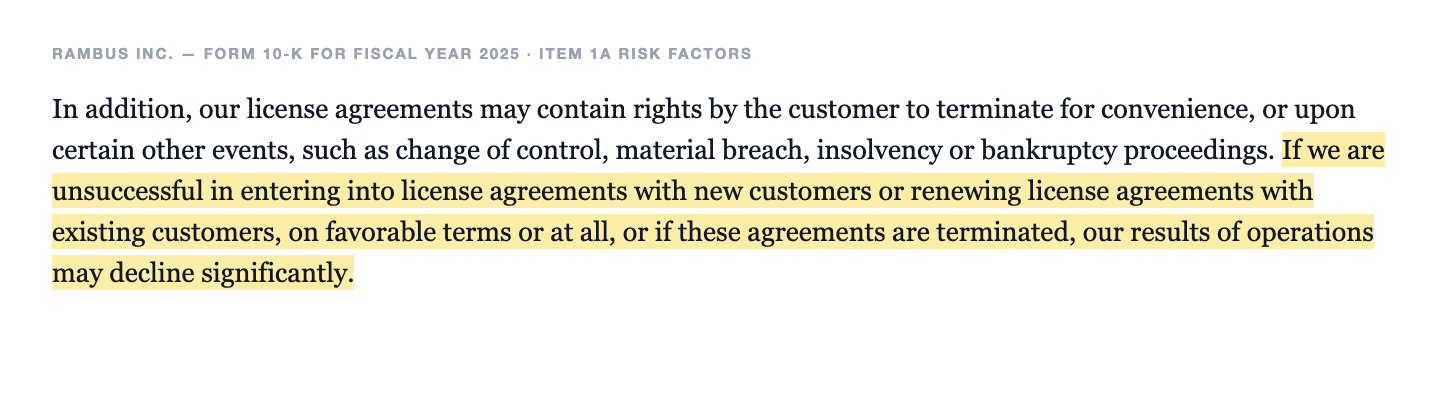
The second pillar of the business, patent royalties, looks at first glance like perfect passive income: $279.4 million flowed in 2025 for other companies using Rambus inventions. But rent only flows while the lease runs — and the contracts typically run up to ten years, often with fixed payments. What happens at expiry is open. The filing itself puts it like this:
"If we are unsuccessful in entering into license agreements with new customers or renewing license agreements with existing customers, on favorable terms or at all, or if these agreements are terminated, our results of operations may decline significantly."
— Rambus Inc., SEC annual report 10-K for fiscal year 2025, Item 1A "Risk Factors"
That this is no theoretical worry was shown by the very first quarter of 2026: royalties fell 5.9 percent, per the quarterly report "primarily due to the timing and structure of license agreements and renewals" (10-Q as of March 31, 2026). Translated: this revenue pillar breathes with the contract calendar, not with the economy. In its favor: many payments are contractually fixed, and the licensee list runs from AMD to NVIDIA. Against it: every negotiation is an event with an open outcome — and the counterparty across the table is usually a company with a hundred times Rambus's market power.
Uncomfortable truth no. 3: the toll booth has an expiration date — the patents run out between 2026 and 2044
The third truth is the most fundamental one, and it sits almost casually in the risk section:
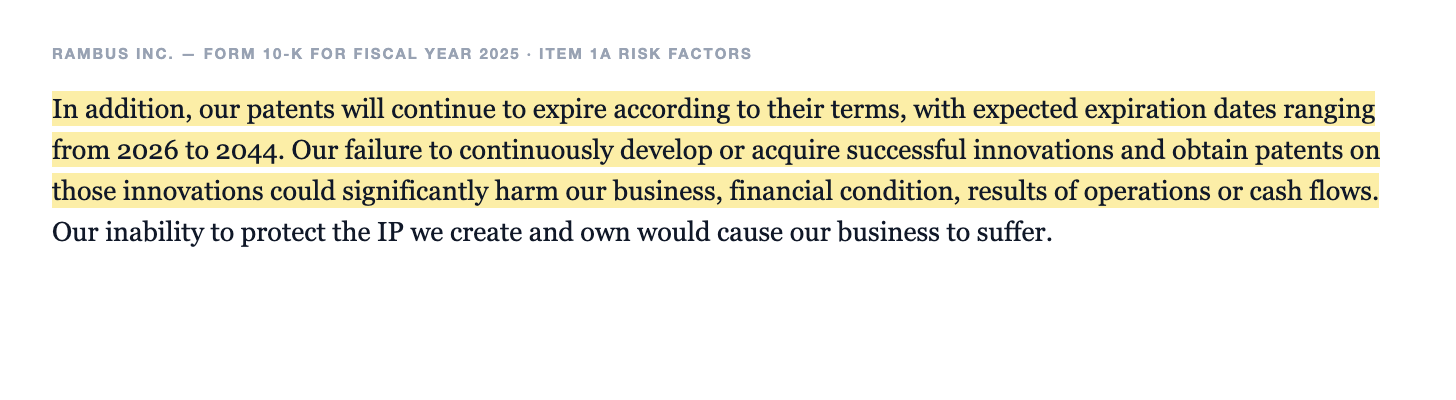
"In addition, our patents will continue to expire according to their terms, with expected expiration dates ranging from 2026 to 2044. Our failure to continuously develop or acquire successful innovations and obtain patents on those innovations could significantly harm our business, financial condition, results of operations or cash flows."
— Rambus Inc., SEC annual report 10-K for fiscal year 2025, Item 1A "Risk Factors"
A patent is not a moat — it is a lease with an end date. After at most about 20 years, a protected invention becomes public property, and the toll lapses. That the range of expiration dates already starts at "2026" means: part of the portfolio is losing its protection right now. Rambus's antidote is visible and expensive at once — $187.7 million of research and development spending in 2025 (up 15 percent), 481 patent applications in the pipeline, plus the strategic pivot from a pure licensing house to a chip maker, which is no coincidence: chips have to be sold anew every quarter, but they do not expire. The filing additionally warns that courts and agencies have lately leaned patent-skeptical in their rulings. For you as a reader this means: the 40 percent pillar is not a perpetuity but a renewal machine, and you can check it at two gauges — R&D spending and patent applications. Both numbers appear in every annual report.
Valuation: about $9 billion of market value at Q1 — and a stock that ran faster than the business
What does all this cost? As of March 31, 2026, Rambus weighed in at roughly $9.4 billion of market value — after a peak of $11.4 billion in the third quarter of 2025, a quarter in which the stock alone rose 63 percent. Rambus itself serves as a price anchor: in November 2025 the company bought back its own shares at an average of $88.41, in the first quarter of 2026 at around $86. Measured against the earnings of the trailing four quarters ($2.10 per share), that already amounted to a price-to-earnings ratio around 41. At the data cut of July 18, 2026 — after the stock's twelve-month doubling — the price-to-earnings ratio sits around 55, the price-to-sales ratio around 18.5, price-to-book just under 10. For comparison: the customer Micron, which builds the memory chips through which Rambus's data flows, traditionally trades at a fraction of these multiples — the market is not paying for memory here, it is paying for the toll-booth margin. The analyst consensus of 8 estimates stands at an average grade around 1.1 (on a scale where 1 means "strong buy", data as of July 18, 2026) — unanimous optimism, which can itself be a warning sign: if everyone is already optimistic, who is left to upgrade?
What Rambus does not do with the money is telling. The company has never paid a dividend. And the share buybacks tell a little parable about prices: of the 14.45 million shares repurchased since 2020, the great mass went on the books at an average of $32.49 — in November 2025, at prices around $88, the company bought a merely symbolic 14,752 shares, and in the first quarter of 2026 about 30,000. In other words, the company itself barely reaches for its own stock at the doubled price; meanwhile the share count crept up from 107.2 to 108.1 million within a year through employee stock plans. The view into the executive floor fits the same picture: per fundamental data, insiders reported 13 sales and not a single purchase in recent months, among them the chief executive (as of July 18, 2026). None of this is illegal or even unusual — executives diversify, plans run on autopilot. But the observation stands: the people who know the company best are not buying at these prices. One curiosity on the side that shows how late this business model matured: only in 2025 did the balance-sheet line "retained earnings" turn positive for the first time ($76.8 million, after minus $153.7 million at the end of 2024) — 35 years after its founding, Rambus has arithmetically worked off the losses of its early history.
Opportunities and risks at a glance
What speaks for Rambus:
- A record year with substance: $707.6 million in revenue (+27 percent), operating income up 42 percent to $260.2 million, a net margin above 30 percent, $360.0 million of operating cash flow in fiscal year 2025.
- A fortress balance sheet: $786 million in cash and securities against essentially zero financial debt, an equity ratio around 90 percent, Altman-Z around 18 (March 31, 2026).
- Structural tailwind: AI systems are, per the 10-K, increasingly "memory bound" — memory interface technology becomes the bottleneck-solver; product revenue +41 percent in 2025, plus new fields (AI PC chipsets, HBM4, GDDR7 and PCIe 7.0 IP).
- A double business model: the cyclical chip business and contractually fixed patent royalties (licensees from AMD to NVIDIA) stabilize each other; 2,029 patents, 481 applications pending.
- No material litigation: the company whose name once stood for patent lawsuits reports no material pending legal proceeding in its current 10-K.
What speaks against it:
- Extreme customer concentration: top five customers = 66 percent of 2025 revenue, "Customer A" alone 29 percent in Q1 2026, one customer with 35 percent of receivables; roughly 47 percent of revenue via contracting parties in South Korea.
- A royalty pillar with negotiation risk: 40 percent of revenue hangs on license renewals with open outcomes — in Q1 2026 royalties already fell 5.9 percent.
- Patents with expiration dates: per the 10-K, between 2026 and 2044; the shield must be continuously and expensively renewed through R&D.
- Cooling momentum: revenue growth down from +41 to +8 percent within four quarters, net income flat in Q1 2026, the Piotroski F-Score down from 9 to 4.
- A valuation without a margin of safety: a price-to-earnings ratio around 55 and price-to-sales around 18.5 (data as of July 18, 2026) price in sustained high growth — while insiders sold 13 times and never bought, and the company itself barely repurchases its own shares anymore.
A human conclusion
Back to the two drawers from the opening. The old one — "yesterday's litigation shop" — is demonstrably wrong: Rambus today earns half its money with real chips, reports no material litigation anymore, and delivered the best operating year of its history in 2025. But the new drawer — "AI memory winner, buy blind" — is just as comfortable and just as incomplete. Because what the filings actually describe is more precise than any label: an excellent, highly profitable, essentially debt-free niche business that hangs on five customers, one country and an expiring patent portfolio — and whose growth is normalizing just as the price assumes perfection. So the honest question for you is not "Is Rambus a good company?" — after everything in the filings: yes. It is: do you want to pay roughly 55 times earnings for a company whose latest quarter shows 8 percent growth and whose most important revenue pillars must be renegotiated on schedule? Whoever answers yes is betting that the AI memory cycle brings the pace back — which is possible. Whoever hesitates can read along in the quarterly reports (10-Q): product revenue growth, the royalty trend and the revenue share of "Customer A" are the three gauges on which this story must prove itself. What you make of it is your decision. And that is exactly as it should be.
Sources
All original documents used in this analysis — for your own reading:
- Rambus Inc. — SEC annual report 10-K for fiscal year 2025 (ended December 31, 2025; filed February 18, 2026)
- Rambus Inc. — SEC quarterly report 10-Q as of March 31, 2026 (filed April 28, 2026)
- Rambus Inc. — SEC annual report 10-K for fiscal year 2024 (ended December 31, 2024; filed February 24, 2025)
- Complete SEC filing history of Rambus Inc.: EDGAR overview (sec.gov)
- Fundamental data (metrics, quarterly series, valuation, insider transactions; data as of July 18, 2026 and Q1 2026 respectively), cross-checked against the SEC filings.
- Screener and rating data: in-house stock scanner, Terry Smith quality scanner (U.S. selection) plus Stage 2 and institutional accumulation filters (data as of July 18, 2026).
Transparency & disclaimer: This analysis is a journalistic contextualization of publicly available information and is not investment advice, not a financial analysis in the regulatory sense, and not a solicitation to buy or sell securities. Stock investments carry substantial risks up to and including total loss. All information without guarantee; the data cut-off is noted in the text. The author holds no position in Rambus shares at the time of publication.
Our Bottom Line at a Glance
- Profitability & balance sheet positive
- Fortress quality: a 36.8 percent operating margin and $230.5 million of net income in fiscal year 2025, $360.0 million of operating cash flow (a record), $786 million in cash and securities against essentially zero financial debt and an equity ratio around 90 percent (10-K FY 2025, 10-Q as of March 31, 2026).
- Product business & AI tailwind positive
- The strategic pivot is working: product revenue up 41 percent to a record $347.8 million in 2025, new fields from AI PC chipsets to HBM4/GDDR7/PCIe 7.0 IP; AI systems are, per the 10-K, increasingly "memory bound" — exactly Rambus's specialty (10-K FY 2025, Item 1 and Item 7).
- Customer concentration & geography negative
- Top five customers = 66 percent of 2025 revenue, "Customer A" alone 29 percent in Q1 2026, one customer with 35 percent of receivables; roughly 47 percent of revenue runs through contracting parties in South Korea — the narrowest point of the business model appears in no quality metric (10-K Item 1A, 10-Q note "Segments and Major Customers").
- Royalty base & patent expiry negative
- 40 percent of revenue is patent royalties whose renewal, per the 10-K, is never guaranteed and whose base — patents with expiration dates from 2026 to 2044 — must be continuously and expensively renewed; in Q1 2026 royalties already fell 5.9 percent (10-K Item 1A, 10-Q MD&A).
- Pace & valuation neutral
- Growth cooled from +41 to +8 percent within four quarters, net income flat in Q1 2026, Piotroski down from 9 to 4 — at a price-to-earnings ratio around 55 and price-to-sales around 18.5 after the stock doubled; insiders sold 13 times and never bought (fundamental data, as of July 18, 2026).
Per the SEC filings, Rambus is an excellent niche business: record revenue, record cash flow, a balance sheet essentially free of debt, and a double business model of a growing chip business plus contractually fixed patent royalties, right in the middle of the AI memory boom. But the three load-bearing pillars sit in the fine print: 66 percent of revenue hangs on five customers and nearly half on South Korea, the royalty pillar must be renegotiated on schedule, and the patents expire between 2026 and 2044 — while growth has cooled from 41 to 8 percent and the market keeps paying 55 times earnings for perfection. Not investment advice.
What Our Rating Means
- If you don't own the stock
- As long as the question raised in the bottom line stays open, we see no basis for an entry.
- If you hold it in your portfolio
- Our findings offer no acute reason to sell — the checkpoints named remain decisive.
A journalistic assessment by our editorial team at the time of the deep dive, based on public sources — not investment advice and not a solicitation to buy or sell. Your personal circumstances (investment goals, risk capacity, taxes) cannot be taken into account. What our categories mean, how verdicts are formed, and what conflicts of interest exist →
Worth Noting
- RMBS reached the research list via rank 4 in the in-house Terry Smith quality scanner (U.S. selection, as of July 18, 2026); additional hits in momentum filters (Stage 2, institutional accumulation). A quality scanner measures financials, not customer structure, license terms or patent expiries — it never replaces the cross-check in the SEC filings.
- Valuation figures deliberately anchored evergreen: the price anchors are the average buyback prices Rambus itself reported ($88.41 in November 2025 per 10-K Item 5; ~$86 in Q1 2026 per the 10-Q statement of stockholders' equity); P/E and P/S from the scanner data cut of July 18, 2026. Analyses are evergreen, daily prices are not a buy argument.
- Identity verified via EDGAR submissions (CIK 0000917273, Delaware, Nasdaq: RMBS, domestic filer 10-K/10-Q, no Form 15, no former names). Fiscal year ends December 31.
Frequently Asked Questions
Rambus Inc. (Nasdaq: RMBS) of San Jose, California earns its money three ways: memory interface chips for server memory modules (49 percent of 2025 revenue; customers are the DRAM makers Micron, Samsung and SK hynix), royalties from 2,029 patents (40 percent; licensees include AMD, Broadcom, NVIDIA and Qualcomm), and silicon IP blueprints for interfaces such as HBM4, GDDR7 and PCIe 7.0 (11 percent). In fiscal year 2025 (ended December 31, 2025) the company generated $707.6 million in revenue (+27 percent) and earned $230.5 million in net income.
The filter looks for companies with high margins, high returns on capital and little debt — and there Rambus delivers: a 36.8 percent operating margin in fiscal year 2025, a 33.2 percent net margin in the first quarter of 2026, an equity ratio around 90 percent with essentially zero financial debt, and $786 million in cash and securities (March 31, 2026). As of July 18, 2026 that yields rank 4 of the U.S. selection. The scanner, however, only measures the financials — not customer concentration, license terms or the cooling growth rate.
Very: per the annual report (10-K), the top five customers accounted for roughly 66 percent of 2025 revenue (2024 and 2023: 62 percent each). In the first quarter of 2026, "Customer A" alone stood for 29 percent of revenue and a single customer for 35 percent of receivables. By location of contracting parties, about 47 percent of 2025 revenue came from South Korea and 23 percent from Singapore. The concentration is industry physics — there are only three big DRAM makers — but it remains the business model's largest single risk.
The patent royalties (40 percent of 2025 revenue) rest on a portfolio whose protection, per the 10-K, ends between 2026 and 2044 — a patent lasts at most about 20 years, after which the invention becomes public property. Rambus renews the shield continuously: $187.7 million of R&D spending in 2025 (+15 percent) and 481 patent applications pending (March 31, 2026). In addition, the company is shifting its weight toward the chip business, which does not expire — product revenue grew 41 percent in 2025 and now makes up 49 percent of the company.
In the first quarter of 2026, revenue grew 8.1 percent — after 41.4 percent in the prior-year quarter. Two reasons: first, the chip business now compares against its own record quarters of the DDR5 ramp; second, patent royalties fell 5.9 percent, per the quarterly report (10-Q) "primarily due to the timing and structure of license agreements and renewals". Net income marked time at $59.9 million, partly because R&D spending rose 18 percent. That is not a collapse — but it is a normalization that sits in tension with the rich valuation.
No — it is priced for continued success: at the data cut of July 18, 2026, the price-to-earnings ratio sits around 55 and price-to-sales around 18.5, after the stock roughly doubled within twelve months. Even at the company's own buyback prices of $86 to $88 (November 2025 through Q1 2026), the price already amounted to roughly 41 times trailing earnings. The analyst consensus of 8 estimates is unanimously optimistic at a grade around 1.1; insiders reported 13 sales and no purchase over the same stretch (as of July 18, 2026).
Found an error?
Did you spot a factual error, an outdated number, or a typo in this deep dive? Let us know briefly — your report goes straight to the editorial team.