Quantum Stock: Only Two Companies Trip All Three of Our Bankruptcy Alarms — and This One Doubled
Quantum has been in the storage business for decades — and it is one of exactly two companies in our in-house scanner that set off all three signals of our bankruptcy study at once (as of July 26, 2026), while the stock is up around 114 percent for the year. We read the annual report filed June 25, 2026: a net loss of $101.0 million, loans at 14 percent, an auditor going-concern paragraph that a June 2026 emergency financing has since erased — paid for with eight times the share count. Not investment advice: we put a number on what the rescue cost, and on who paid the bill.
 Thomas Mücke
Founder & Publisher
Thomas Mücke
Founder & Publisher
Chart
Interactive price chart (TradingView).
Note: pure fact-based analysis, not investment advice and not a solicitation to buy or sell. All figures without guarantee.
There is a storyteller living inside every investor, and his favorite genre is the comeback. He loves a chart like this one: a stock that trades far below where it stood three years ago suddenly doubles within a few months. The storyteller leans in and whispers: "This is the turn. The debt is gone, the price is running, and anyone who waits will miss the turnaround of the year." What he never mentions is how often the same story has already been told about the same company — and who paid for the earlier chapters. So let us make a deal. Before you touch a single share of Quantum Corporation (NASDAQ: QMCO), we read the annual report the company filed with the U.S. securities regulator, the SEC, on June 25, 2026. A document like that is honest under threat of penalty. And this one holds a sentence you would not expect behind a doubling share price: that there had been "substantial doubt" about the company's ability to stay in business. You decide what to do with it at the end.
What Quantum actually does — the basement archive of the digital world
Quantum is a veteran of the storage industry: decades in the business, headquartered in Centennial, Colorado, with about 490 employees across 18 countries (as of March 31, 2026). The core business is as unglamorous as it is indispensable — Quantum builds the basement archives of the digital world. Its Scalar tape libraries are wardrobe-sized robots full of magnetic tape cartridges in which corporations, government agencies and film studios lock away mountains of data for decades: cheap, power-frugal, and the last line of defense against ransomware, because a cartridge sitting on a shelf cannot be encrypted by an intruder. Around that sit DXi backup appliances, ActiveScale object storage for very large data sets and specialist systems for video — plus a steady royalty stream, because Quantum earns a licence fee on the LTO tape format standard. In the annual report, all of this sounds considerably more glamorous:
"Quantum delivers end-to-end data management solutions designed for unstructured data in the artificial intelligence ('AI') era. From high-performance ingest that powers AI applications and demanding data-intensive workloads to massive, durable data lakes to fuel AI models, Quantum delivers one of the most comprehensive and cost-efficient solutions for the entire data lifecycle."
— Quantum Corporation, SEC annual report 10-K, fiscal 2026, Item 1 "Business"
Marketing? Partly, yes — hold on to that AI framing, because we will test it against the revenue lines further down. First, the more urgent question: why does a stock that has just gained triple digits show up in the harshest warning list we run?
Where this stock landed on our desk: three alarms at the same time
We run about 3,500 stocks through our scanners every day. As of July 26, 2026, Quantum appears in eleven of them, and the list contradicts itself on purpose. On one side the momentum screens: Stan Weinstein Stage 2 (an established uptrend), RS-Leader with a relative-strength rating of 94, Qullamaggie Top Gainers 1M, Richard Moglen Top Performers 3/6 Month, above the 50- and 200-day averages, 21-day EMA trend, high average daily range. The stock is up roughly 114 percent for the year (price data as of July 24, 2026). On the other side four warning lists — and one of them is the sharpest instrument we have:
The scanner "Bankruptcy Study: The Sharpest Three-Signal Combination" holds, as of July 26, 2026, exactly two companies out of the entire universe. One is the biotech NeOnc Technologies. The other is Quantum. To reproduce it: open the scanner list, look under "confluence" — the two tickers are QMCO and NTHI. The combination requires all three of the following to have occurred within twelve months, straight from the original filings:
- Previously published numbers declared unreliable. On August 8, 2025, Quantum filed a current report (8-K) under Item 4.02 — the SEC item that exists for exactly one purpose: to tell investors that financial statements already published can no longer be relied upon. It concerned the third quarter of fiscal 2025, with an expected revenue reduction of roughly $3.9 million.
- An auditor going-concern paragraph. The annual report for fiscal 2025, filed late on August 26, 2025, carries one — we quote it in full below.
- Current liabilities above current assets. As of March 31, 2026, current assets stood at $112.486 million against $205.797 million of current liabilities: a coverage ratio of 0.55, a gap of $93.3 million. Every single quarter since 2025 has looked like this, in a range of 0.37 to 0.55.
What that combination is worth is something we measured rather than assumed, in our study of bankruptcy warning signals in U.S. stocks: since 2005 the trio has fired 98 times, just under nine times a year. In 53 percent of those cases the stock lost at least 30 percent within three months — against 11 percent in a control group matched for the same price level, the same dollar volume and the same distance from the 52-week high. And now the sentence that belongs in the same breath, because a signal without its error rate is a horoscope: about 96 out of 100 of these companies survive the year. This is a smoke detector, not a verdict. For Quantum the trio window runs out on August 8, 2026, the first anniversary of the Item 4.02 filing — unless a fresh signal renews it.
The other three warning lists round out the picture: "Insolvency Radar: Cash Running Low" (cash at the last balance sheet date divided by the operating cash burn of the last four quarters — for Quantum, $15.6 million against roughly $9.5 million a quarter, about 1.7 quarters of runway), "Going Concern (Distress Proxy)" and "Bankruptcy Study: Stacked Warning Signals". The rest of the metrics agree: fundamental grade D, a Piotroski F-score of 4 out of 9 (a nine-point test of balance-sheet direction, where a genuinely healthy company sits at 8 or 9), an Altman Z-score deep in the distress zone at minus 26. Only the Beneish M-score, our early-warning model for earnings cosmetics, is unremarkable at minus 4.1 — Quantum's problem is not a polished profit, it is an honestly reported loss. Ten more names from the same family are lined up in our overview "Ten stocks whose cash is running out". Note that all scanner lists are recalculated daily, so treat these hits as a snapshot of July 26, 2026.
The numbers over the years — first the honest praise
Quantum's fiscal years end on March 31, so "fiscal 2026" means April 2025 through March 2026. And fair is fair: operationally, the company has steadied itself. After a 12 percent revenue decline in fiscal 2025 (from $311.6 million to $274.1 million), fiscal 2026 revenue rose again to $279.6 million, up 2 percent. Product revenue grew 12 percent to $172.4 million, carried by a remarkable renaissance in the "boring" division: secondary storage — tape libraries, backup appliances, object storage — added $27.1 million, or 36.7 percent. Devices and media added $6.1 million, or 17.7 percent. The cost program bit as well: research and development aside, administrative expenses fell by around $20 million and the operating loss almost halved, from $41.7 million to $24.5 million. The final quarter points the same way: revenue of $78.0 million, up 27 percent year over year and above the company's own guidance of $68 million plus or minus $2 million, with adjusted EBITDA of $1.0 million — the first positive quarter on that measure in a while.
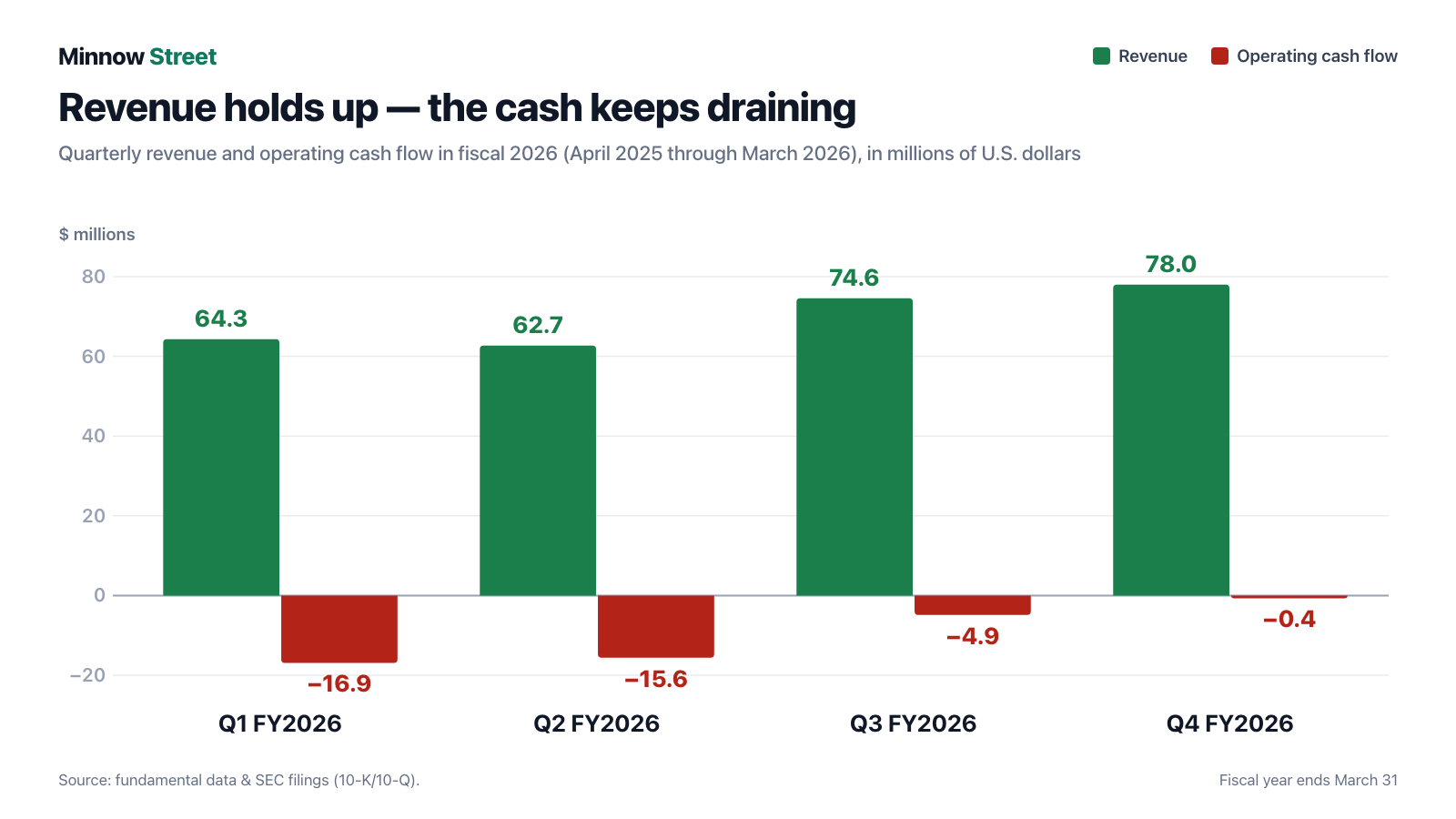
That is where the praise ends. Gross margin fell from 40.1 percent to 36.9 percent — Quantum sells more and earns less on it; in the fourth quarter the margin was down to 35.7 percent, against 39.6 percent a year earlier. Research and development was cut by a quarter, from $31.1 million to $23.5 million: short-term cosmetics for the cost line, a long-term mortgage for a technology company. Service and subscription revenue, the recurring part of the business, fell 10 percent to $99.2 million. And the bottom line still shows a net loss of $101.0 million (fiscal 2025: $115.1 million), or $7.97 per share. The balance sheet records how long this has been going on: an accumulated deficit of $1.043 billion and shareholders' equity of minus $198.9 million — liabilities exceed everything the company owns. A business that has existed for decades and burned more than a billion dollars along the way: that is the raw material the earlier chapters of the comeback story were made of. Which brings us to the central tension of this analysis: the rescue is real, and it was paid for by the shareholders — while the company that was rescued is still the one our sharpest alarm points at.
What the filings say — the uncomfortable truths
Uncomfortable truth no. 1: the doubt was real — and it is now formally gone
When auditors and management doubt that a company can survive the next twelve months under its own power, U.S. accounting rules force them to say so: "substantial doubt about the ability to continue as a going concern". It is the sharpest warning formula the rulebook contains. In Quantum's fiscal 2025 annual report — filed late, on August 26, 2025 — the auditor put it in its own section of the report:
"The Company's ability to achieve the foregoing elements of its business, which may be necessary to permit the realization of assets and satisfaction of liabilities in the ordinary course of business, is uncertain and raises substantial doubt about its ability to continue as a going concern."
— Grant Thornton LLP, Report of Independent Registered Public Accounting Firm, section "Going concern", in: Quantum Corporation, SEC annual report 10-K, fiscal 2025 (filed August 26, 2025)
That is the signal our study counts — and it was accurate at the time: the term loans came due on August 5, 2026, and Quantum expected to breach the net leverage covenant as early as the quarter ended September 30, 2025. Ten months later the picture had changed, and the current annual report says so in the same technical language:
"As previously disclosed, the Company identified that there was substantial doubt about the Company's ability to continue as a going concern. This was due to the requirement to repay the Term Loans (as defined herein) on August 5, 2026. Subsequent to March 31, 2026, the Company completed several transactions which resulted in the repayment of the Term Loans and removed the substantial doubt noted above."
— Quantum Corporation, SEC annual report 10-K, fiscal 2026, Note 1 "Liquidity"

Read that passage closely, because it explains the entire rally. On June 1, 2026, Quantum sold 10,615,712 new shares at $9.42 apiece in a private placement and took in $94.7 million net. On June 4, 2026, it paid $57.8 million and retired the term loans in full. The August 5, 2026 deadline was off the table, the standing share-sale agreement with a financial investor was terminated on June 11, 2026, and the market celebrated the rescue. So the storyteller is right about one thing: the acute danger is gone. It was simply paid for out of your pocket, if you are a shareholder — more on that in a moment. And there is a second sentence in the same report that did not go away: the auditor's opinion on the financial statements is unqualified, but the opinion on internal control over financial reporting, dated June 25, 2026, is an adverse opinion. That combination — clean numbers, broken controls — is rare, and it is not a formality.
Uncomfortable truth no. 2: 14 percent money — the debt cost more than the business lost
Why was the situation that serious in the first place? Because Quantum could only finance itself on terms usually reserved for distressed borrowers. The annual report spells out the rate on the loan increased in August 2024:
"[F]rom April 1, 2025, (i) for any August 2024 Term Loan designated as a 'SOFR Loan', 14.00% per annum and (ii) for any August 2024 Term Loan designated an 'ABR Loan', 13.00% per annum, in each case, with 8.00% of such interest rate margin paid-in-kind. The August 2024 Term Loan also includes a multiple on invested capital payable to the August 2024 Term Loan lenders."
— Quantum Corporation, SEC annual report 10-K, fiscal 2026, Note 4 "Debt"

Two translations into everyday life. First: a 14 percent margin on top of the U.S. reference rate is the loan you get when nobody else will lend to you. Second: paid in kind means the interest is not wired anywhere — it is stacked on top of the debt. It is the overdraft you never clear: in fiscal 2026 alone, paid-in-kind interest added $6.6 million to Quantum's debt without a dollar of new borrowing. What the whole construction cost becomes visible when you take the annual loss apart:
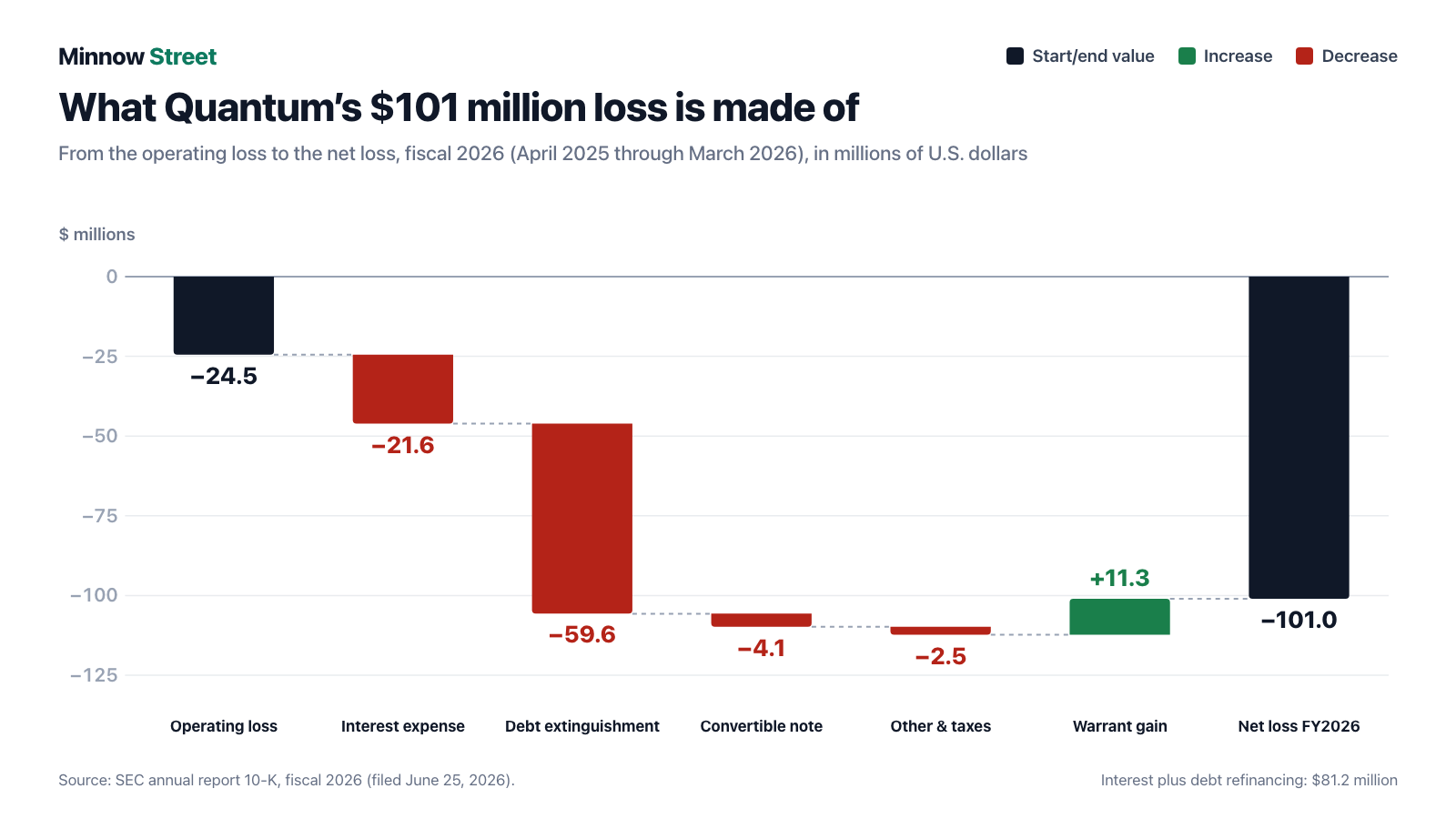
In numbers: $21.6 million of interest expense, close to 8 percent of total revenue handed to lenders. On top of that $59.6 million of losses on debt extinguishment, incurred in the restructuring transactions of September and December 2025, when Quantum handed lenders warrants and then placed a convertible note (fair value as of March 31, 2026: $90.0 million). The rest of the bridge is smaller and mostly non-cash: $4.1 million from revaluing that convertible note, $2.5 million of other items and taxes, and an $11.3 million gain from revaluing warrant liabilities that made the loss look better. Together, interest and debt restructuring alone are $81.2 million of financing damage — more than three times the $24.5 million operating loss. Remember this sentence: it was not the tape robots that wrote Quantum into a going-concern paragraph, it was the price of borrowed money. The term loans have been gone since June 4, 2026, and the convertible note was converted into shares — which leads straight to the bill.
Uncomfortable truth no. 3: the rescue was paid by shareholders — eight times the shares in 27 months
Where does the money come from when a company with negative equity can no longer borrow at a sane price? Out of your pocket, through new shares. Dilution means your slice of the cake gets thinner because new slices keep being cut. At Quantum, the current chapter opened in August 2024 with a 1-for-20 reverse split — twenty old shares became one, the only way back above the Nasdaq minimum price of one dollar:
"At the Effective Time, every twenty issued shares of common stock were automatically reclassified into one issued share of common stock […] The number of outstanding shares of common stock was reduced from approximately 95.9 million shares to approximately 4.8 million shares."
— Quantum Corporation, SEC annual report 10-K, fiscal 2026, Note 1 "Reverse Stock Split"

And then the refilling began. Through a standby equity purchase agreement, Quantum was allowed to sell up to $200 million of new stock into the market; by March 31, 2026 it had placed roughly 8.7 million shares for about $91 million net that way. Add the June 2026 rescue: 10,615,712 shares in the private placement, and the conversion of the convertible note at $5.194 into 14,104,620 shares — including 3,083,975 shares handed over purely as compensation for the PIK interest the lender would no longer collect. The chain of share counts, all of it adjusted for the reverse split: 4,792,000 (March 31, 2024) to 6,962,000 (March 31, 2025) to 14,638,029 (March 31, 2026) to 39,374,500 (June 24, 2026, per the cover page of the annual report). That is a factor of 8.2, or plus 722 percent, in 27 months — growth in the share count rather than in the business. Every rescue, every rate deal, every warrant was paid for with slices belonging to the existing owners. It also explains how "down about 95 percent over three years" and "up 114 percent this year" can both be true: whoever admires the chart is looking at an instrument that has been rebuilt several times over by a reverse split and by dilution.
And the next tranche is already registered. On July 14, 2026, Quantum filed a registration statement (Form S-1) covering the resale of up to 13,809,707 shares — the private placement shares, the shares handed to the converting lender and the shares underlying a warrant. Measured against 39,374,500 shares outstanding, that is roughly 35 percent of the company becoming freely sellable. A resale registration is not a sale, and rescuers do not have to leave through the nearest exit. But it is the mechanism that turns yesterday's rescue into tomorrow's supply, and it is worth knowing about before you read the chart as a promise.
Uncomfortable truth no. 4: the rescuer sits on the board
Who owns the rescue? The same S-1 answers that in a table. The largest selling stockholder is Dialectic Technology SPV LLC, the lender that held the convertible note, with 16,867,948 shares, or 40.03 percent; even after selling the registered portion it would still hold 32.45 percent. And Dialectic is not an anonymous fund at arm's length, as the annual report itself discloses:
"The Forbearance Warrant and Convertible Note issued to Dialectic constitute related party transactions, as John Fichthorn, a member of the Company's Board, is also Managing Partner of Dialectic Capital Management, the investment adviser to Dialectic. On issuance of the Convertible Note, Quantum paid $1.1 million to Dialectic for consulting services."
— Quantum Corporation, SEC annual report 10-K, fiscal 2026, Note 4 "Debt" (related party transactions)

None of this is illegal, and a lender willing to convert instead of collecting is genuinely useful in a squeeze — Quantum would look very different today without it. But the constellation deserves to be named: the counterparty that set the terms of the emergency financing is represented on the board that approved it, was paid a consulting fee on the deal, and now owns a plurality of the company. On top of that, the investors in the private placement, Dialectic among them, secured a right of first refusal to buy 25 percent of any equity Quantum issues for six months from June 1, 2026. Whoever buys the stock today is buying into a structure in which the next round of financing already has a first customer.
Uncomfortable truth no. 5: the books have broken twice in eight years — and the controls are still not fixed
Item 4.02 filings are rare in a company's life. Quantum has now made several. In 2018 it restated three fiscal years; that episode ended with an SEC order on December 20, 2019 and a $1,000,000 civil penalty against the company for recognizing revenue without meeting the accounting requirements. In May 2024, fiscal 2023 and 2022 were declared unreliable, and in August 2025 the third quarter of fiscal 2025 followed. The current annual report does not pretend the repair is done:
"However, because the detailed review and documentation process did not operate for the full fiscal year, management has concluded that the material weakness remains as of March 31, 2026."
— Quantum Corporation, SEC annual report 10-K, fiscal 2026, Item 9A "Controls and Procedures"
Alongside that sit the smaller items that only look small in isolation: the auditor was replaced on September 30, 2025 after a "competitive process"; the annual report was late again in June 2026 (a Form NT 10-K on June 15, 2026, with the 10-K following on June 25); Nasdaq sent notices in 2024 and 2025 for a low share price and late reports, all of them cured; a securities class action is pending in the U.S. District Court for the District of Colorado (Lee v. Quantum Corporation, 1:25-cv-02770, filed September 4, 2025, covering purchases between November 15, 2024 and August 18, 2025), and two derivative suits against the board were consolidated in January 2026. Restructuring costs of $8.1 million in fiscal 2026, after $4.1 million a year earlier, complete the picture of a company rebuilding its product, its balance sheet and itself all at once.
And the AI story? The window display outshines the warehouse
Back to the framing from the top. Quantum presents itself as the storage supplier of the "AI era", and the fourth-quarter release doubles down on it: management attributes the 27 percent growth to "robust demand for our tiered storage solutions as the proliferation of AI-driven data rapidly reshapes the industry". The revenue lines tell a more sober story. What grew in fiscal 2026 was the classic business of tape and backup systems, up 36.7 percent, while primary storage — the division that contains the AI-grade all-flash system Myriad — kept declining and service and subscription revenue fell 10 percent. Quantum reports no AI revenue segment at all.
Two absences are worth more than any press release. Myriad, the company's flash flagship, has had no product announcement since January 30, 2025; it does not appear in the product list of the fiscal 2026 annual report, although it was still listed there a year earlier, and management did not mention it once on any earnings call of fiscal 2026. And the widely shared NVIDIA connection rests on a single one-sided announcement from December 18, 2024 about support for GPUDirect Storage — explicitly described then as a client under development, with general availability announced for the second half of 2025. There has been no confirmation of that availability, no certification, and no mention of NVIDIA anywhere in the fiscal 2026 annual report. The stock rose 153 percent on that December 2024 announcement.
The honest version of the growth story is almost the opposite of the flash narrative: what is selling is cold storage, because flash and disk have become expensive and hard to secure, and because AI projects make companies keep more data rather than less. Tape order backlog reached a record roughly five times its normal level in the third quarter of fiscal 2026 — and the limiting factor was supply, because the tape drives inside Quantum's libraries come from IBM, which is simultaneously a competitor. Independent observers put the same picture on the record: in the Coldago Map 2025 for File Storage, published January 8, 2026, Quantum was downgraded from Leader to Challenger in high-performance file storage, while remaining one of ten leaders in object storage. To keep the size relations straight: VAST Data was valued at $30 billion in April 2026, DDN at $5 billion in January 2025 — the market value of Quantum's non-affiliate float, per its own annual report cover page, was $116.8 million. So the sentence that fits the filings is this one: the AI story is in the window display; the money is earned, and lost, in the warehouse with the tape robots. How we tell an AI label apart from AI substance is documented in our AI classification methodology.
Valuation: cheap looks different
Priced against 39,374,500 shares (June 24, 2026) and a share price of $11.10 in our data as of July 24, 2026, Quantum carries a market value in the region of $0.4 billion. There is no price-to-earnings ratio, for lack of earnings. The price-to-sales ratio of about 1.6 against fiscal 2026 revenue is the more meaningful anchor — and for a company with a falling gross margin, negative equity and an operating cash outflow, it is not a bargain multiple. A clean enterprise value cannot honestly be calculated yet: the term loans were repaid and the convertible note converted after the balance sheet date, so the first post-rescue balance sheet in the next quarterly report (10-Q) is the earliest place where debt, cash and equity can be read as they now stand. That is a gap in the data, and we would rather name it than paper over it with a stale number.
The stock also remains a trading vehicle rather than an investment case. Short interest stood at 2,288,430 shares, about 5.9 percent of the float, with days-to-cover of 2.9 (July 15, 2026), and borrowing the stock cost roughly 2.9 percent a year — there is no squeeze set-up here. The options market is tiny at about 5,300 open contracts, while 30-day implied volatility of 127 percent against 81 percent realized (July 24, 2026) prices in exactly the kind of jumps this stock delivered in June 2026, up 27 percent one day and down 20 percent three days later. Analyst coverage of micro caps like this one is thin; treat it as sentiment, not as a promise. The most honest valuation statement is still the one on the balance sheet: only when operating cash flow turns does the enterprise value belong to shareholders again — before that, creditors and new investors negotiate over your slice of the cake.
Opportunities and risks at a glance
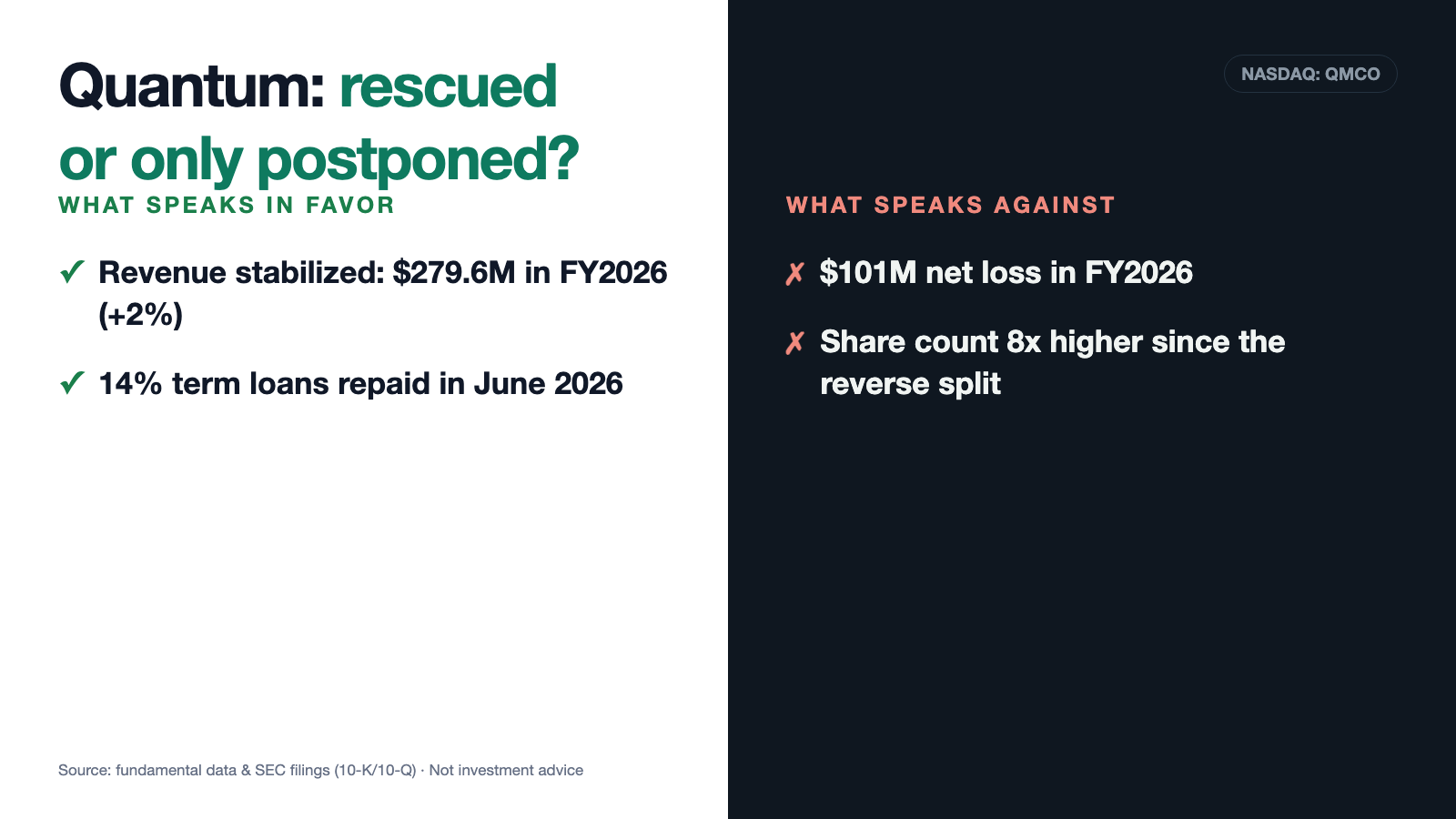
What speaks for Quantum:
- The acute existential threat is gone: a private placement of $94.7 million net (June 1, 2026), the term loans repaid in full for $57.8 million (June 4, 2026), the standing dilution facility terminated (June 11, 2026) — and the annual report records the going-concern doubt as removed.
- Operational stabilization: revenue up 2 percent to $279.6 million in fiscal 2026, secondary storage up 36.7 percent, the operating loss almost halved to $24.5 million, fourth-quarter revenue up 27 percent to $78.0 million above the company's own guidance, adjusted EBITDA back in positive territory at $1.0 million.
- Substance in the core business: a decades-old customer base in archive and backup storage, recurring LTO royalties, and tape as the cheap, ransomware-resistant tier with genuine tailwind as data volumes grow and flash gets more expensive.
- Strong price momentum: up about 114 percent for the year, relative strength of 94, Weinstein Stage 2 (data as of July 24 and 26, 2026) — the market has visibly rewarded the rescue.
- With the 14 percent loans retired, a large part of the $21.6 million annual interest bill disappears from the income statement going forward.
What speaks against it:
- The business itself still burns cash: an operating outflow of $37.9 million in fiscal 2026 against $23.6 million a year earlier — the number got worse, not better — with only $15.6 million of cash on the balance sheet at March 31, 2026.
- A balance sheet shaped by decades of losses: an accumulated deficit of $1.043 billion, equity of minus $198.9 million, and current liabilities of $205.8 million against $112.5 million of current assets (coverage 0.55).
- Dilution history and dilution ahead: the share count is 8.2 times higher than in March 2024, and a further 13,809,707 shares — roughly 35 percent of the company — were registered for resale on July 14, 2026.
- Governance and control: an adverse auditor opinion on internal control as of March 31, 2026, a material weakness that management says "remains", the third non-reliance filing in eight years, a pending securities class action and consolidated derivative suits, plus a rescuer holding 40.03 percent who is represented on the board.
- Substance eroded in the turnaround: gross margin down from 40.1 to 36.9 percent, research and development cut by a quarter, service and subscription revenue down 10 percent, the AI-adjacent primary storage line still shrinking, and Myriad missing from the current annual report's product list.
A human bottom line
Back to the comeback storyteller on your shoulder. He is not entirely wrong this time: the June 2026 rescue is real, the loan-shark terms are gone, the core business has steadied, and the operating loss is shrinking. But tell him the whole story. This comeback was not earned by the business, it was paid for by the shareholders — with a share count eight times what it was two years earlier, a further 35 percent registered for resale, and an annual report that still carries an adverse opinion on the company's own bookkeeping controls. Quantum has bought itself time. Whether that time becomes a turnaround will be decided by one line in the coming quarterly reports: operating cash flow. If it turns positive and stays there without fresh shares, June 2026 really was the pivot. If it stays red, the newly filled treasury is just the next chapter of a very long story — and experience tells you whose slice of the cake gets cut thinner then. A hit in our sharpest bankruptcy screen is not a verdict; about 96 out of 100 of these companies are still there a year later. But a doubling share price is not an all-clear either. What you make of that is your decision. And that is a good thing.
Sources
All original documents used in this analysis — for your own reading:
- Quantum Corporation — SEC annual report 10-K, fiscal 2026 (filed June 25, 2026)
- Quantum Corporation — SEC annual report 10-K, fiscal 2025 (filed August 26, 2025)
- Quantum Corporation — SEC quarterly report 10-Q as of December 31, 2025 (filed February 17, 2026)
- Quantum Corporation — SEC current report 8-K filed August 8, 2025, Item 4.02 (non-reliance on previously issued financial statements)
- Quantum Corporation — SEC current report 8-K on the private placement of June 1, 2026 (filed June 2, 2026)
- Quantum Corporation — SEC current report 8-K on the term loan repayment of June 4, 2026 (filed June 5, 2026)
- Quantum Corporation — SEC current report 8-K, Exhibit 99.1: fourth quarter and full year fiscal 2026 results (filed June 25, 2026)
- Quantum Corporation — SEC registration statement S-1: resale of up to 13,809,707 shares (filed July 14, 2026)
- U.S. Securities and Exchange Commission — Order in the matter of Quantum Corporation, Release 34-87812 (December 20, 2019): $1,000,000 civil penalty
- Quantum's complete SEC filing history: EDGAR overview (sec.gov)
- Fundamental data (metrics, valuation, share statistics; price data as of July 24, 2026) and our in-house stock scanner (as of July 26, 2026), including the Bankruptcy Study: The Sharpest Three-Signal Combination and the Insolvency Radar: Cash Running Low.
Transparency & disclaimer: This analysis is a journalistic assessment of publicly available information and is not investment advice, not a financial analysis in the regulatory sense, and not a solicitation to buy or sell securities. The hit in our bankruptcy study screen is a quantitative signal based on filed documents and the last balance sheet date, not a prediction of an actual bankruptcy. Stock investments carry substantial risks up to and including total loss. All information without guarantee; the data cut-off is noted in the text. The author holds no position in Quantum shares at the time of publication.
Our Bottom Line at a Glance
- Rescue of June 2026 positive
- A private placement of $94.7 million net (June 1, 2026) and the full repayment of the term loans due August 5, 2026 for $57.8 million (June 4, 2026): the fiscal 2026 annual report records the going-concern doubt as removed, and the standing equity line was terminated on June 11, 2026.
- Operational stabilization positive
- Revenue up 2 percent to $279.6 million in fiscal 2026, secondary storage up 36.7 percent, fourth-quarter revenue up 27 percent to $78.0 million above the company's own guidance, the operating loss almost halved from $41.7 million to $24.5 million, adjusted EBITDA back positive at $1.0 million in Q4.
- Price momentum positive
- Up about 114 percent for the year, relative strength of 94, Weinstein Stage 2 (price data July 24, 2026; scanner data July 26, 2026) — but mind the anchor: over three years the stock is still down roughly 95 percent, and the reverse split makes long charts misleading.
- Cash burn negative
- An operating cash outflow of $37.9 million in fiscal 2026 against $23.6 million the year before — the wrong direction — with cash of only $15.6 million at March 31, 2026, which is why the insolvency radar counted about 1.7 quarters of runway before the June placement.
- Balance sheet & dilution negative
- Equity of minus $198.9 million, an accumulated deficit of $1.043 billion, current liabilities of $205.8 million against $112.5 million of current assets (coverage 0.55); the share count is 8.2 times higher than in March 2024, and 13,809,707 further shares were registered for resale on July 14, 2026.
- Governance & controls negative
- An adverse auditor opinion on internal control as of March 31, 2026, a material weakness management says "remains", the third non-reliance filing in eight years (2018, 2024, 2025) after a $1,000,000 SEC penalty in 2019, a pending securities class action — and a 40.03 percent holder represented on the board.
Quantum bought itself time in June 2026: the loan-shark debt is repaid, the acute threat to its existence is gone — paid for with massive dilution. What remains is a company with negative equity, an adverse opinion on its own bookkeeping controls and a business that still consumed $37.9 million of cash in fiscal 2026. Whether the rescue becomes a turnaround will be decided by operating cash flow alone. Not investment advice.
What Our Rating Means
Substance risk
We found at least one documented issue that threatens the company itself — regardless of how the stock is currently valued.
The substance findings are documented and there is more than one of them. Shareholders' equity stood at minus $198.9 million on March 31, 2026, the accumulated deficit at $1.043 billion, and current liabilities exceeded current assets by $93.3 million. The auditor issued an adverse opinion on internal control, and management states the material weakness remains — after the third non-reliance filing in eight years. Operating cash outflow widened to $37.9 million while cash stood at $15.6 million. The June 2026 rescue removed the going-concern doubt, and we say so plainly; it did not remove the negative equity, the broken controls or the fact that the share count is 8.2 times what it was in March 2024. Red here judges the company, not the share price: the substance question is open regardless of how strongly the stock has run in 2026. The decision is yours.
A journalistic assessment by our editorial team at the time of the deep dive, based on public sources — not investment advice and not a solicitation to buy or sell. Your personal circumstances (investment goals, risk capacity, taxes) cannot be taken into account. What our levels mean, how verdicts are formed, and what conflicts of interest exist →
Worth Noting
- QMCO came onto our desk as one of exactly two hits in our in-house scanner "Bankruptcy Study: The Sharpest Three-Signal Combination" (as of July 26, 2026, verified on both brands); the trio window runs out on August 8, 2026 unless a fresh signal renews it.
- The fiscal year ends March 31 — "fiscal 2026" is April 2025 through March 2026, reported on June 25, 2026. Radar figures (cash $15.6 million, about 1.7 quarters of runway) refer to the March 31, 2026 balance sheet date; the private placement ($94.7 million net) and the loan repayment ($57.8 million) came after it.
- Do not confuse this company with quantum computing: Quantum Corporation sells storage hardware and has nothing to do with quantum computers, although retail platforms regularly file quantum-computing headlines under the QMCO ticker.
- Price, market value and short-interest figures use data as of July 15 and 24, 2026, checked against 39,374,500 shares from the cover page of the fiscal 2026 annual report; analyses are evergreen, and a daily price is never a buy argument.
Frequently Asked Questions
Quantum builds storage systems for very large data sets: Scalar tape libraries for long-term archives, DXi backup appliances, ActiveScale object storage and all-flash systems for video and AI data, plus royalties from the LTO tape format. Headquarters are in Centennial, Colorado, with about 490 employees across 18 countries (March 31, 2026). Fiscal 2026 revenue was $279.6 million; the fiscal year ends March 31.
Because all three signals of the combination fired within twelve months: an Item 4.02 filing declaring published numbers unreliable (8-K, August 8, 2025), an auditor going-concern paragraph (10-K, August 26, 2025) and current liabilities above current assets ($205.8 million against $112.5 million as of March 31, 2026). As of July 26, 2026, Quantum is one of exactly two companies in that list.
It has fired 98 times since 2005, just under nine times a year. In 53 percent of those cases the stock lost at least 30 percent within three months, against 11 percent in a control group matched for price, dollar volume and distance from the 52-week high. It is still only a probability: about 96 out of 100 of these companies survive the year.
No. The doubt existed and was documented by the auditor in the fiscal 2025 annual report (filed August 26, 2025) because the term loans came due on August 5, 2026. After the private placement of June 1, 2026 ($94.7 million net) and the repayment of the loans on June 4, 2026 ($57.8 million), the fiscal 2026 annual report states the substantial doubt was removed.
Adjusted for the 1-for-20 reverse split of August 2024, the share count went from 4,792,000 (March 31, 2024) to 39,374,500 (June 24, 2026) — a factor of 8.2 in 27 months. On July 14, 2026, Quantum registered a further 13,809,707 shares for resale, about 35 percent of all shares outstanding.
PIK means paid in kind: the interest is not wired to the lender but added to the loan balance, so the debt grows by itself. Quantum's term loans carried a margin of up to 14 percent a year, 8 percentage points of it PIK; in fiscal 2026 alone that added $6.6 million of debt without any new money coming in.
The annual report uses the AI framing, but the numbers do not support an AI business yet. Growth came from tape and backup (secondary storage up 36.7 percent in fiscal 2026), while primary storage — the line containing the flash system Myriad — kept declining. Myriad is absent from the fiscal 2026 product list, and NVIDIA is not mentioned in that report at all.
Quantum closes its books on March 31, so "fiscal 2026" covers April 2025 through March 2026 and was reported on June 25, 2026. Quarterly comparisons therefore shift: the fourth quarter of fiscal 2026 is the calendar first quarter of 2026, which is why the $78.0 million quarter reads as a January-to-March figure.
Found an error?
Did you spot a factual error, an outdated number, or a typo in this deep dive? Let us know briefly — your report goes straight to the editorial team.