PLAYSTUDIOS: Cheaper Than Its Own Cash
On paper PLAYSTUDIOS is a bargain: the entire market value stood at roughly $79 million on July 24, 2026 — while cash alone was $104 million and there is no bank debt at all. Our scanner duly lists the stock among the cheapest names on free cash flow. The trouble is that this very metric does not survive scrutiny: it overlooks $15.5 million of capitalized game development and counts one of two share classes. We read the 2025 annual report, the quarterly report for the period ended March 31, 2026 and the Nasdaq filings, and we recalculate both. There is no recommendation at the end, only a number you can check yourself.
 Thomas Mücke
Founder & Publisher
Thomas Mücke
Founder & Publisher
Chart
Interactive price chart (TradingView).
Note: pure fact-based analysis, not investment advice and not a solicitation to buy or sell. All figures without guarantee.
The bargain trap
There is a moment in stock screening that feels wonderful and is dangerous all the same: a number lights up, it says "cheap", and from then on you stop reading and start looking for confirmation.
At PLAYSTUDIOS that number shines especially brightly. On July 24, 2026 the company was worth roughly $79 million on the market. Its cash at the end of 2025 was $104.9 million — and it carries no bank debt. Buy the whole business, in other words, and arithmetically you get money back.
That is exactly why the stock sits in our ranking of the cheapest names on free cash flow. And it is exactly why we do the opposite of seeking confirmation here: we take apart the metric that creates the appeal.
The deal for this article: we recalculate two things almost nobody recalculates — what is left of the cash flow once game development is counted, and how many shares there actually are. By the end you will know whether the bargain is one.
What PLAYSTUDIOS actually does
PLAYSTUDIOS builds mobile games that cost nothing. The money comes afterwards: players who want to keep going buy virtual currency — chips, coins, spins. That is the business model in one sentence, and in 2025 it delivered $189.4 million, about four-fifths of revenue. The remaining $45.7 million came from advertising served between rounds of play.
The company is best known for casino-style titles such as myVEGAS. What sets it apart is not a game but an attachment: the playAWARDS loyalty programme with its myVIP membership. Play, collect points, and exchange them for real things — hotel nights, meals, tickets from partner businesses. The idea is that a free game paying out real rewards binds players more tightly than one that does not. The company accordingly reports two segments, playGAMES and playAWARDS.
One detail shapes the rest of this analysis: a player does not buy chips from PLAYSTUDIOS but from Apple's App Store, from Google, from Amazon or through Facebook. Of every dollar a player spends, only about 70 cents reaches the company — and it does not get a vote on that fee:
“The platform providers charge us a transaction fee to process payments from our players for their purchase of in-game virtual currency. These platform fees are generally set at 30% of the in-game purchase. Each platform provider has broad discretion to set its platform fees and to change and interpret its terms of service and other policies with respect to us and other developers in its sole discretion, and those changes may be unfavorable to us.”
— PLAYSTUDIOS, Inc., Form 10-K for 2025, MD&A — Key Factors Affecting Our Performance
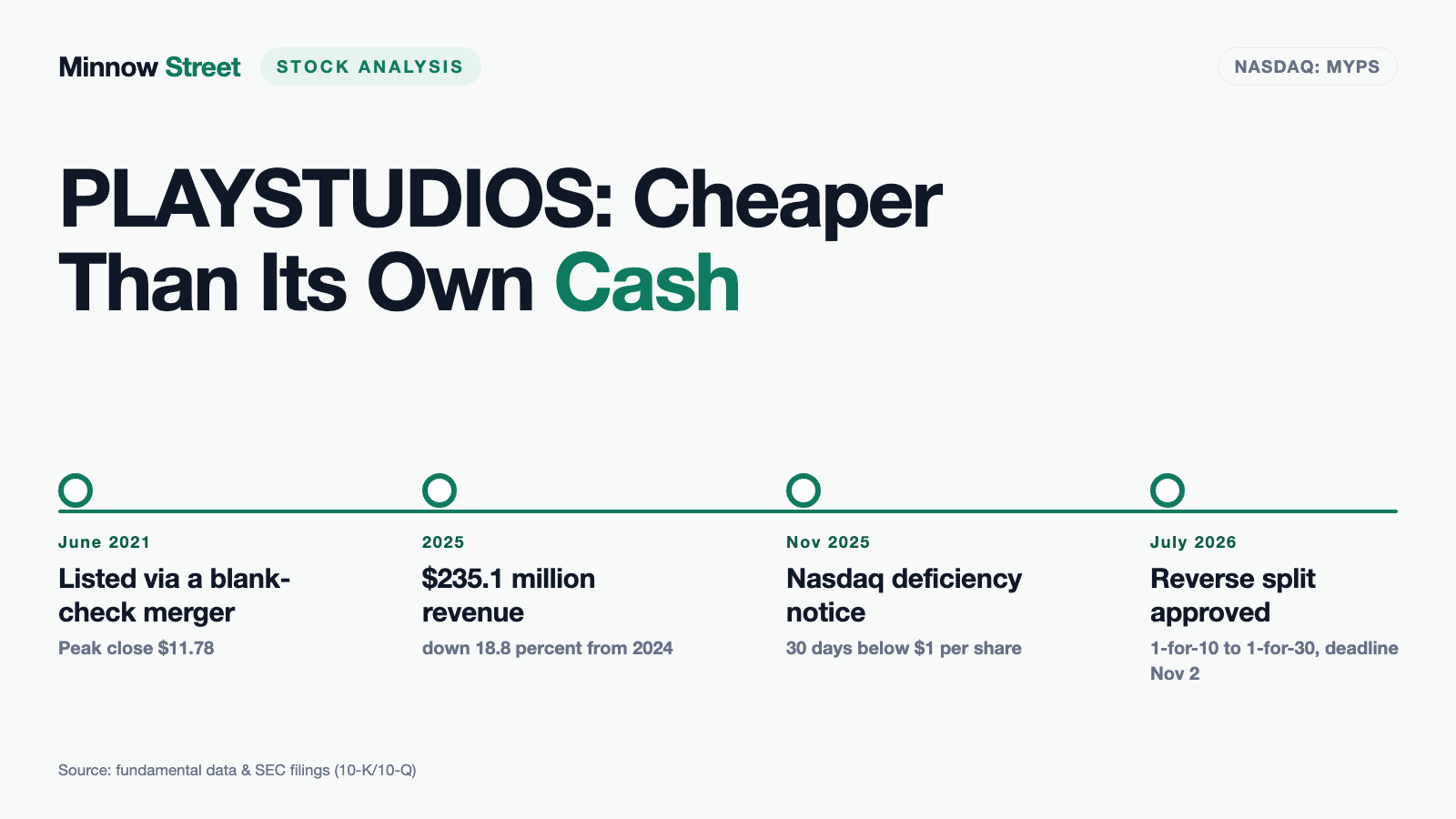
On its origins: PLAYSTUDIOS did not go public through a conventional listing in June 2021 but by merging with a blank-check vehicle called Acies Acquisition Corp. Such shells raise money first and then hunt for a company to fold in. Anyone looking at prices before June 2021 is looking at the shell, not the games business. The highest closing price on record dates from February 2, 2021 at $11.78 — still the shell phase.
How the stock landed on our desk
The stock reached us through our in-house stock scanner, specifically the K-FCF ranking. That list sorts stocks by how many years of free cash flow you pay at the current market value. The smaller the number, the cheaper — in theory.
To repeat the search: go to Stocks → Scanner, open the K-FCF ranking and pick "USA" as the market in the top right.
On July 27, 2026 the list counted 545 U.S. hits. PLAYSTUDIOS ranked 38th at 2.01. Unlike many point-based lists there is no tie here — the value occurs exactly once, so the rank is meaningful. What you still need to know: the page shows only the 25 strongest hits, and the cutoff that day was 1.39. PLAYSTUDIOS therefore does not appear on the visible list at all. All rankings are recomputed daily, so the figures in this section carry July 27, 2026 as their date.
The same day the stock also featured in our price-to-sales and price-to-cash-flow rankings, both valuation lists. The other side is telling: MYPS simultaneously sat in three warning lists — stage-4 downtrend, near 52-week low and weakness cluster. Remember the sentence: when a stock appears in cheap lists and warning lists at the same time, it is usually cheap for a reason.
And now comes the part a ranking cannot do. That 2.01 rests on two assumptions, and neither holds. One concerns the numerator, the other the denominator. Each gets its own chapter.
What genuinely impresses: the balance sheet
Start with what is honestly good — and at this company that is not the income statement but the balance sheet.
As of December 31, 2025 the books held $104.9 million in cash. Against it sits no financial debt whatsoever. No bonds, no bank loan, no convertible. Total liabilities of $62.8 million consist of running payables, lease obligations and provisions. Equity of $227.9 million equals 78.4 percent of total assets.
Translated: nobody can force this company into a capital raise, no lender can turn off the tap, and several consecutive loss-making years would still be affordable. The distress metric our scanner carries stands at 7.34 — on a scale where anything below 1.1 counts as the danger zone and anything above 2.6 as safe. That is not a borderline case.
Operationally there is a working part too: the playGAMES segment produced adjusted operating income of $58.6 million on revenue of $234.1 million in 2025. The core business earns money. How much of it reaches the group is a different question, and we get to it shortly.
Management is also not diluting shareholders but buying back: $31.2 million went into own shares in 2024 and another $3.5 million in 2025. At the end of 2025 the company held 21.7 million shares in treasury.
Uncomfortable truth No. 1: free cash flow is a quarter of the size
Free cash flow answers one question: what is left of the money after the company has paid for everything it needs to keep going? The usual calculation subtracts purchases of property and equipment from operating cash flow — buildings, computers, furniture.
For a games developer that is the wrong calculation. This company does not need a factory, it needs games. And the cost of those sits not in property and equipment but one line below.
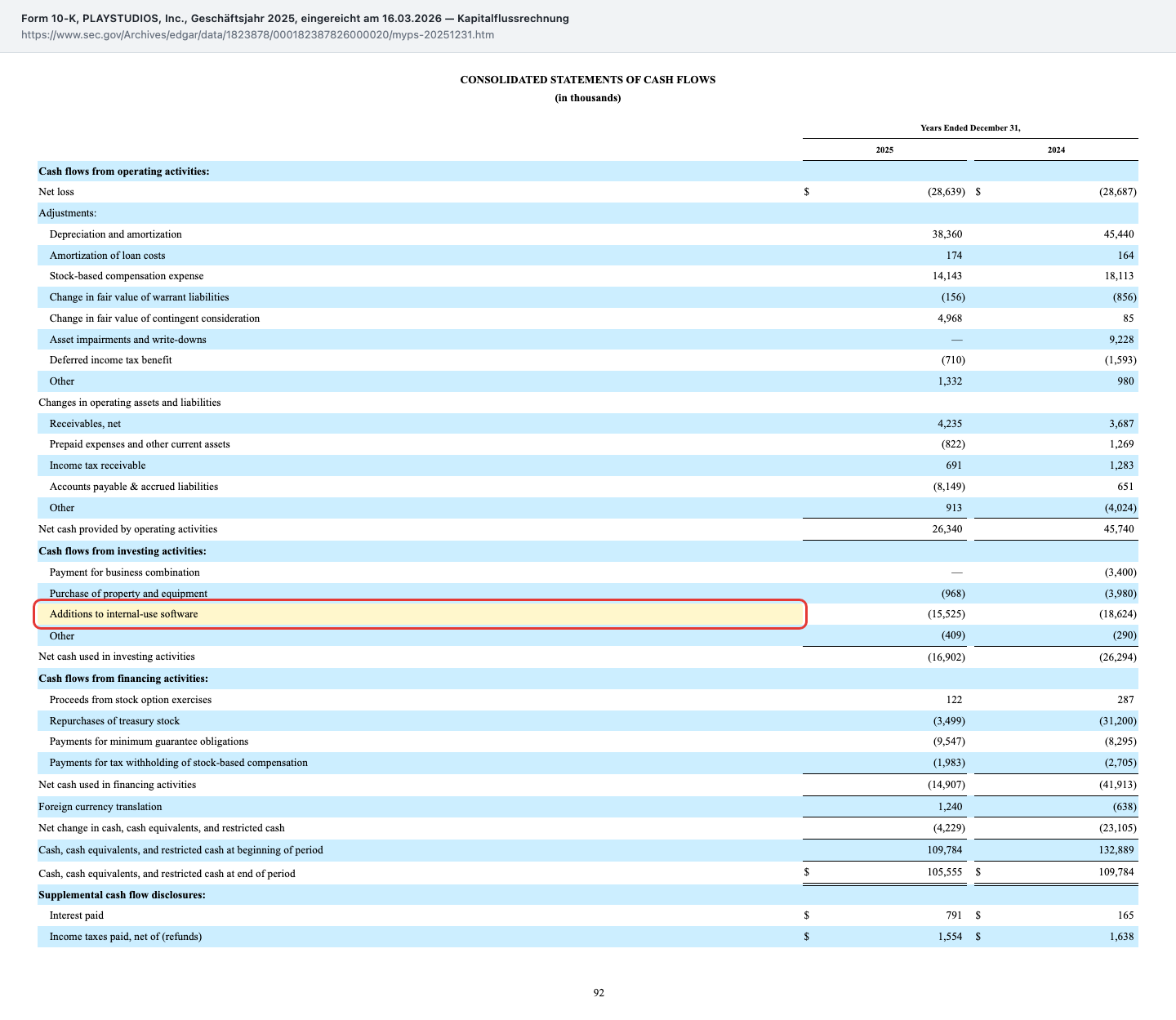
"Additions to internal-use software" means software built in-house that is not expensed immediately but capitalized and written down over several years. At PLAYSTUDIOS that is game development. It came to $15.5 million in 2025 and $18.6 million in 2024. This is real money genuinely leaving the business — it simply does not show up in this year's profit.
Do the arithmetic:
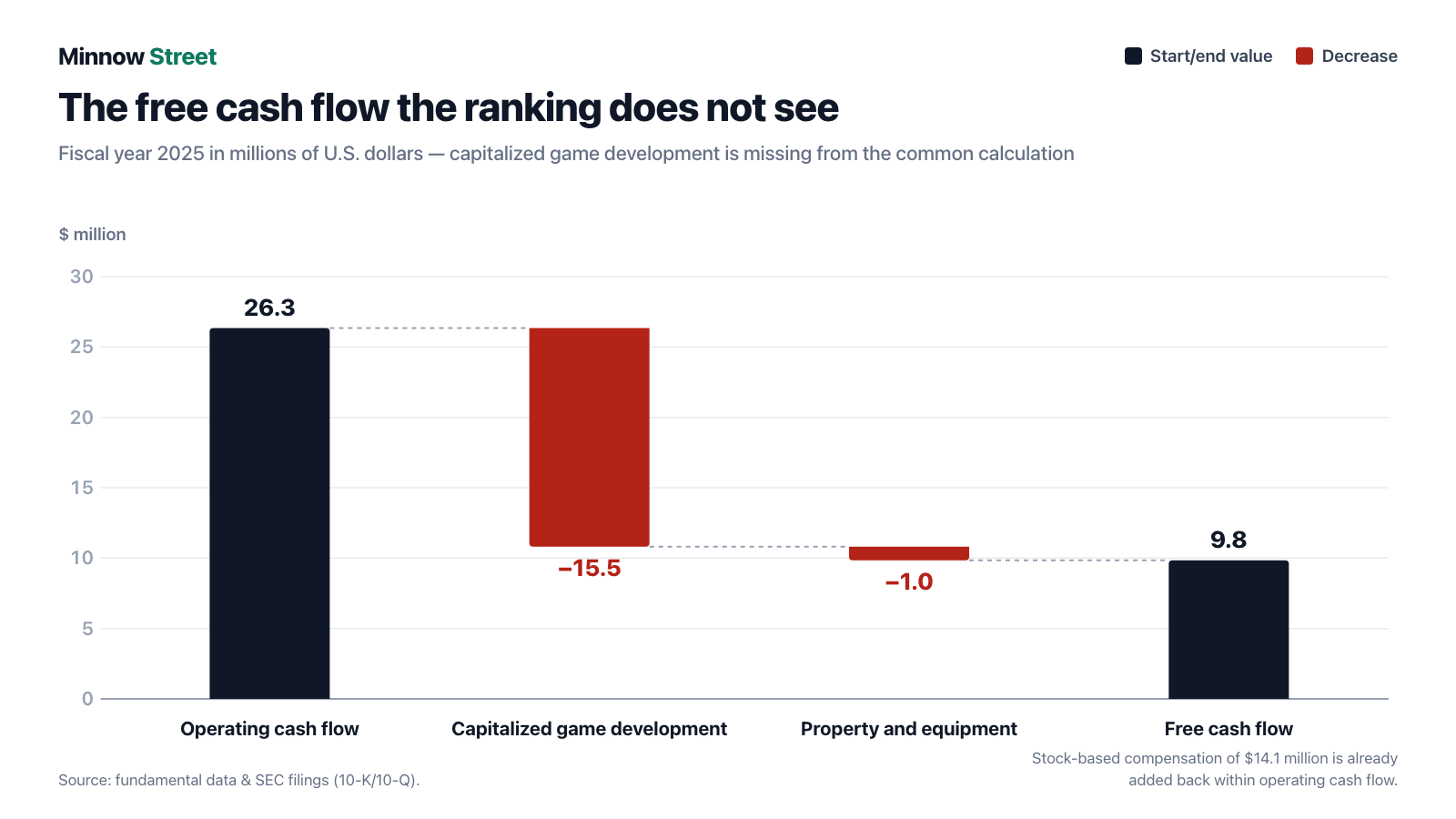
Instead of the $25.4 million the common calculation uses, $9.8 million remains. Measured against a correctly calculated market value of $79.0 million, a multiple of 2.0 becomes 8.1. Still not expensive — but no longer an exclamation mark, just an ordinary number.
In the first quarter of 2026 the picture tips over entirely: $3.7 million of operating cash flow met $4.0 million of capitalized game development and $0.07 million of property and equipment. The result is minus $0.4 million. Before you read that as a collapse: the prior-year quarter was minus $0.3 million. So this is not fresh damage but a seasonal pattern — the first quarter does not carry itself at this company.
A second comparison belongs here. Stock-based compensation — what employees receive in shares rather than cash — was $14.1 million in 2025, plus $0.6 million capitalized. That is roughly half again as much as the entire $9.8 million of free cash flow. The company pays a substantial part of its workforce in pieces of itself, and because that costs no cash it is added back within operating cash flow. It costs something else instead: your slice of the cake gets smaller.
Uncomfortable truth No. 2: the market value counts one share class
Now the denominator. PLAYSTUDIOS has two kinds of shares: Class A, which trades on the exchange, and Class B, which does not trade but owns just as much of the company. Dual-class structures like this are common at firms that reached the market through a blank-check vehicle.
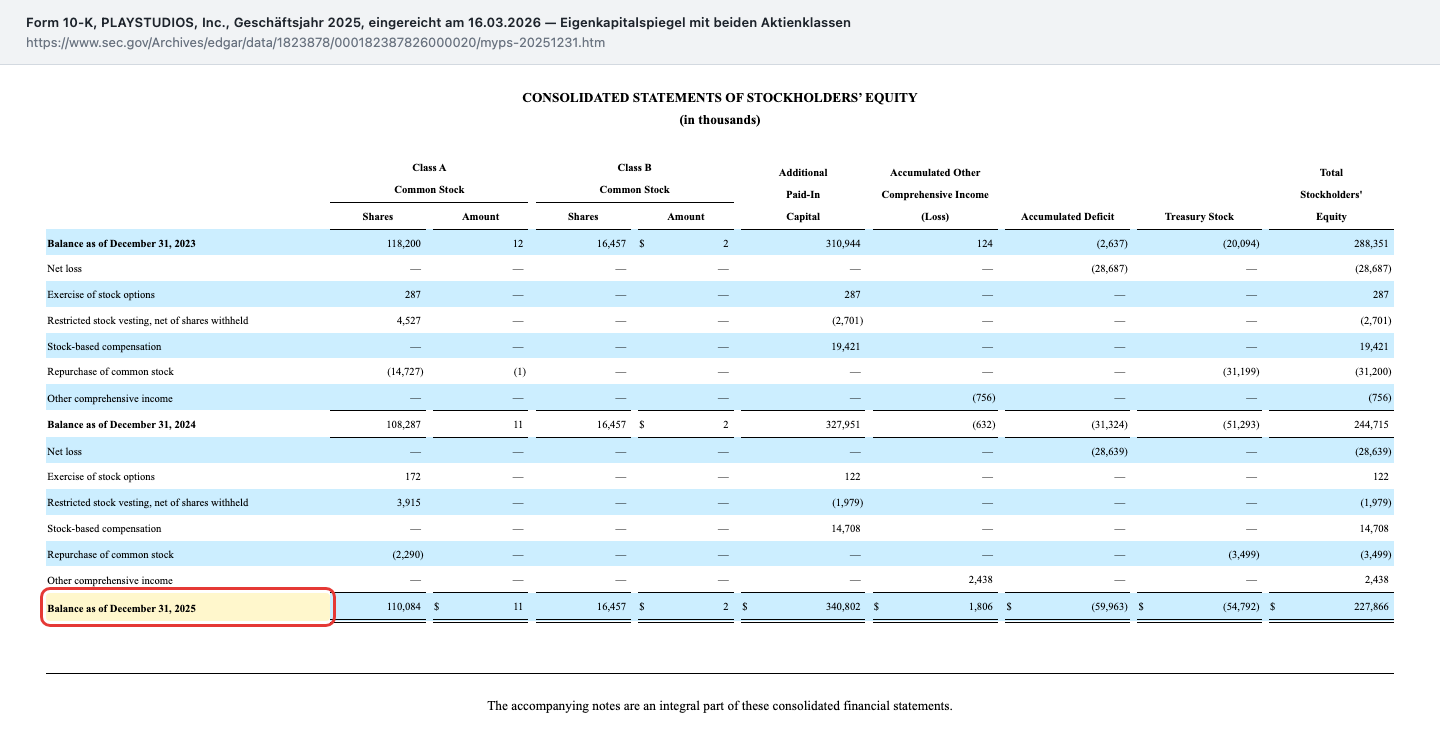
The 10-Q cover page carries the most recent figures: as of April 30, 2026 there were 111,897,452 Class A shares and 16,457,769 Class B shares, or 128,355,221 in total. Counting Class A alone leaves out 12.8 percent of the company.
That is precisely what happens in many data sets, including ours. The stored share-count field carries 112.3 million and means Class A only. We therefore calculated the market value in this analysis ourselves: 128,355,221 shares at the July 24, 2026 close of $0.6158 gives $79.0 million. As a control, the separate market-value field of the fundamental data reports $79.3 million — the two routes agree, and both include both classes.
Why this matters: every metric with market value in the numerator is flattered by that error — price-to-sales, price-to-book, and the multiple of free cash flow. Set market value an eighth too low and you believe a stock is an eighth cheaper than it is. We described the same effect in our analysis of Bumble, where two share classes also sit side by side.
Uncomfortable truth No. 3: the loyalty programme loses money
playAWARDS is meant to be what separates PLAYSTUDIOS from a hundred other games publishers: real rewards for time spent playing. In the company's telling it is the moat. In the segment accounts it looks different.
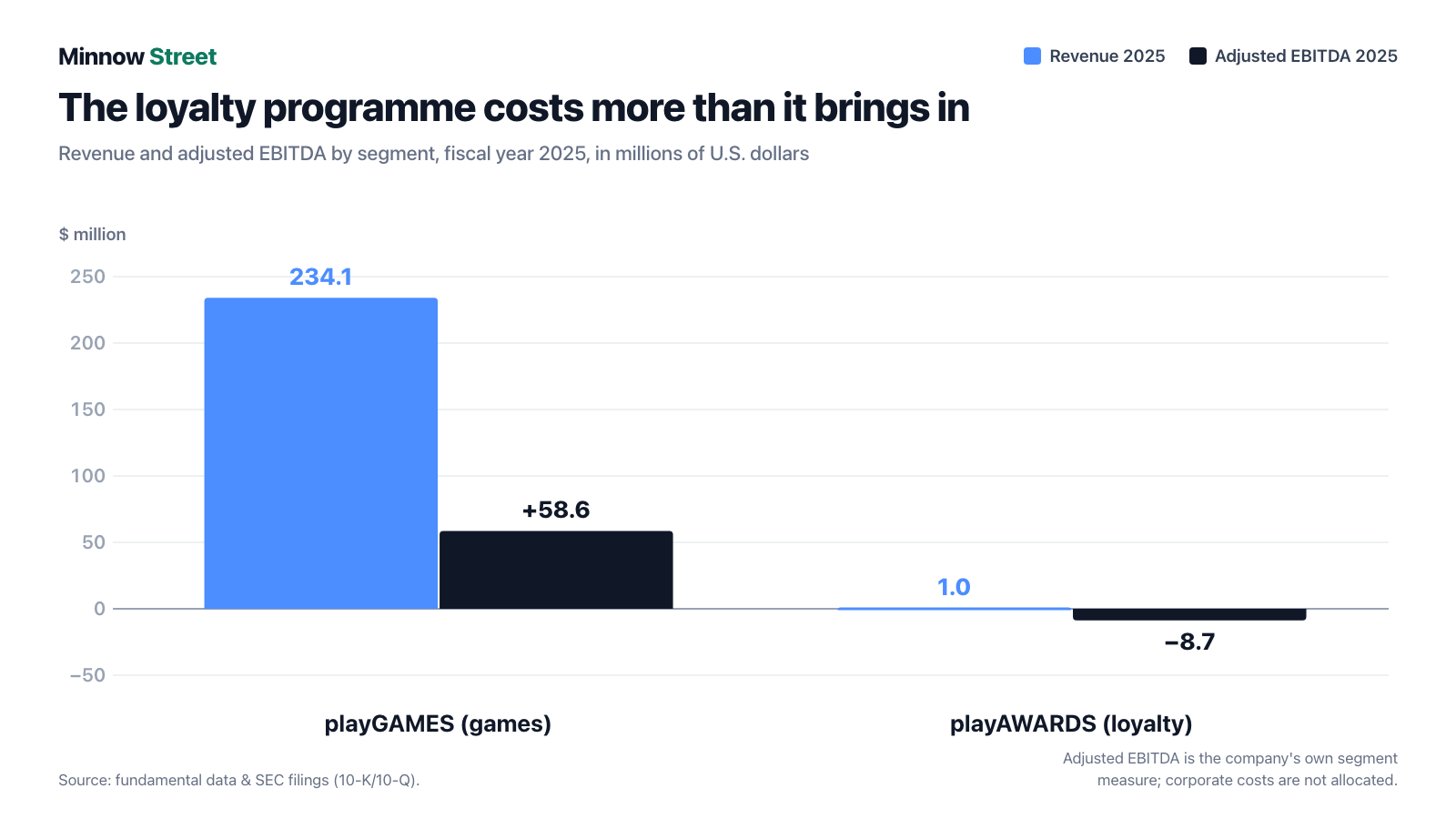
In 2025 playAWARDS generated $1.0 million of revenue and cost $9.7 million — adjusted operating income of minus $8.7 million. In the first quarter of 2026 it was $0.5 million of revenue against minus $1.5 million. This is not the start-up loss of a new venture: the programme has existed since the company's early days.
You can defend it — perhaps the programme pays off indirectly because players stay longer and buy more chips. But that cannot be verified from the filings, and the number that can be verified points the other way: revenue in the games segment fell 18.7 percent to $234.1 million in 2025. If the loyalty programme is supposed to keep players, it has lately not managed to.
The first quarter of 2026 makes it starker still. Revenue fell 6.9 percent to $58.4 million while user acquisition spending in the same period rose 64.4 percent, from $10.2 million to $16.7 million. The company bought players considerably more expensively and still took in less. The operating loss grew from $2.7 million to $13.3 million.
Uncomfortable truth No. 4: the Nasdaq clock is running
A stock that trades persistently below one dollar cannot stay on Nasdaq. In the twelve months to July 24, 2026, MYPS closed below that mark on 230 of 252 trading days.
The sequence is on the record. On November 5, 2025 Nasdaq gave notice that the closing bid price had been below $1.00 for 30 consecutive business days. The first cure period ran to May 4, 2026 and lapsed without the stock closing above a dollar for ten consecutive days. On April 7, 2026 the company applied to transfer to the Nasdaq Capital Market, effective May 6, 2026 — and with it came a second compliance period.
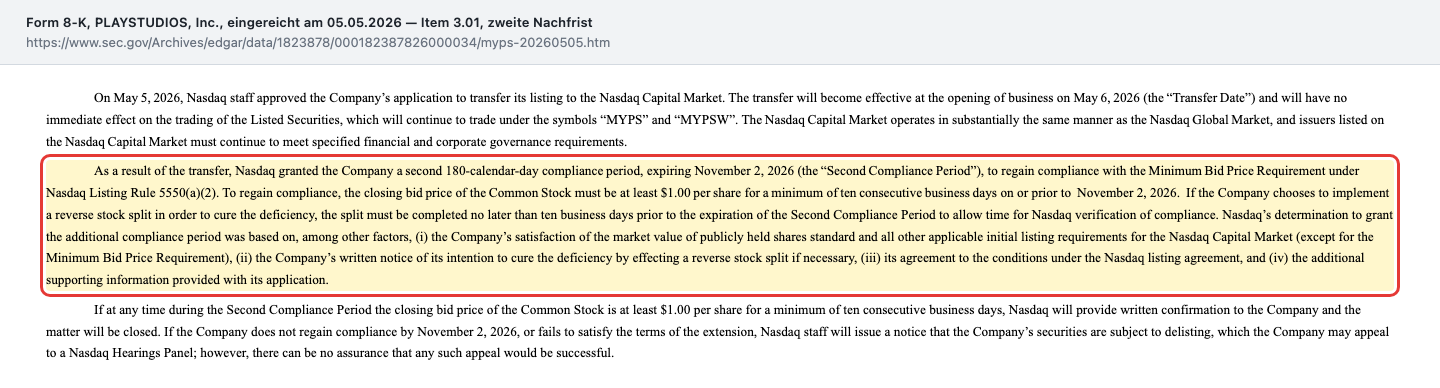
The document is unusually clear about what now applies:
“As a result of the transfer, Nasdaq granted the Company a second 180-calendar-day compliance period, expiring November 2, 2026 (the “Second Compliance Period”), to regain compliance with the Minimum Bid Price Requirement under Nasdaq Listing Rule 5550(a)(2). … If the Company chooses to implement a reverse stock split in order to cure the deficiency, the split must be completed no later than ten business days prior to the expiration of the Second Compliance Period.”
— PLAYSTUDIOS, Inc., Form 8-K filed May 5, 2026, Item 3.01
The route the company has chosen is settled too. On July 10, 2026 shareholders approved a reverse stock split of 1-for-10 to 1-for-30 — by 391,823,940 votes to 610,096, effectively unanimous. The board may carry it out at its discretion within twelve months.

What a reverse split is, in one picture: ten shares at $0.60 become one share at $6.00. Your stake in the company does not change — only the price is back above a dollar. It is a repair to the quote line, not to the business.
So that you read the Form 25 correctly, which has been in the file since June 17, 2026: it concerns the warrants alone, not the common stock. The shares remain listed on Nasdaq.
What the stock costs
All figures below rest on 128,355,221 shares across both classes (10-Q cover page as of April 30, 2026) and a closing price of $0.6158 on July 24, 2026. That gives a market value of roughly $79.0 million — a dated valuation anchor, not a price forecast.
The cash. As of March 31, 2026 the books held $104.3 million of cash and no financial debt. Enterprise value — market value less net cash — is therefore negative, around minus $25 million. The market values the entire operating business at less than nothing.
The book value. Equity of $227.9 million as of December 31, 2025 equals $1.78 per share. At $0.6158 you are paying 0.35 times book.
The revenue. $79.0 million of market value against $235.1 million of annual revenue is 0.34 times sales.
The free cash flow. Honestly calculated, $9.8 million for 2025, a multiple of 8.1 — instead of the 2.0 from the ranking.
The earnings. There is no price-to-earnings ratio, because the company posted losses in 2024, in 2025 and in the first quarter of 2026.
One balance sheet item deserves particular attention. The books carry goodwill of $52.2 million from earlier acquisitions — two-thirds of the entire market value. It has never once been written down, as the table in the annual report shows: the "Accumulated Impairment" column holds a dash in both years. With revenue down almost a fifth and a market value below the cash, that is an open question rather than a reassuring answer.

Opportunities and risks at a glance
What speaks for PLAYSTUDIOS
- More cash than market value. $104.3 million as of March 31, 2026 against roughly $79.0 million of market value on July 24, 2026 — with no financial debt at all.
- The balance sheet can absorb a lot. An equity ratio of 78.4 percent as of December 31, 2025; the distress metric at 7.34 sits far above the safety threshold of 2.6.
- The core business earns. The playGAMES segment produced adjusted operating income of $58.6 million in 2025.
- No dilution pressure. Rather than issuing shares, the company bought back $34.7 million of its own stock across 2024 and 2025.
- The listing question has an approved remedy. Shareholders approved a reverse split on July 10, 2026 effectively unanimously.
What speaks against PLAYSTUDIOS
- Revenue is falling sharply. Down 18.8 percent to $235.1 million in 2025 and a further 6.9 percent in the first quarter of 2026.
- Losses are widening, not narrowing. The operating loss grew from $2.7 million to $13.3 million in the first quarter of 2026 while user acquisition spending rose 64.4 percent.
- Free cash flow is small. $9.8 million in 2025 after capitalized game development; minus $0.4 million in the first quarter of 2026.
- Share-based pay exceeds cash flow. $14.1 million in 2025 against $9.8 million of free cash flow.
- The listing period is the second and final one. It ends on November 2, 2026, and a reverse split must be completed ten business days earlier.
- Goodwill has never been tested with consequences. $52.2 million without a single write-down, at two-thirds of market value.
- Other people's checkouts decide. Platform operators generally keep 30 percent of every purchase according to the annual report and can change their terms unilaterally.
A human conclusion
Back to the start, to the number that says "cheap".
It did not lie, it was merely incomplete. Calculated properly — with both share classes in the denominator and game development in the numerator — PLAYSTUDIOS costs not twice its free cash flow but eight times. That is still not an expensive stock. It is simply not one where you are allowed to stop reading.
And then there is the second finding, which cannot be calculated away: a company whose cash exceeds its entire market value, whose core business produced $58.6 million of adjusted operating income last year — and which is nonetheless valued as though the operating business were worth less than nothing. Either the market is wrong. Or it expects the cash to be consumed over the coming years while revenue keeps falling.
Which reading is right turns on a single question: does the revenue decline stop? As long as the company buys players more expensively and still takes in less, the cash is not a treasure but a reserve being spent. And the calendar is running: by November 2, 2026 the price has to be back above a dollar, or the listing gets tight.
What you make of that is your decision. And that is exactly as it should be.
Sources
- PLAYSTUDIOS, Inc. — Annual report on Form 10-K for fiscal year 2025, filed March 16, 2026 (SEC EDGAR, CIK 0001823878)
- PLAYSTUDIOS, Inc. — Quarterly report on Form 10-Q for the period ended March 31, 2026, filed May 11, 2026
- PLAYSTUDIOS, Inc. — Form 8-K, Item 3.01 (transfer to the Nasdaq Capital Market, second compliance period), filed May 5, 2026
- PLAYSTUDIOS, Inc. — Form 8-K, Item 5.07 (annual meeting, reverse stock split approval), filed July 10, 2026
- Nasdaq Stock Market LLC — Form 25-NSE for PLAYSTUDIOS, Inc. (class of securities: warrants), filed June 17, 2026
- Source: fundamental data & SEC filings (annual and quarterly reports, 10-K/10-Q); price, valuation and ratio data as of July 24, 2026
- In-house stock scanner K-FCF ranking, price-to-sales ranking and price-to-cash-flow ranking, measured July 27, 2026 on both brands
Journalistic analysis, not investment advice. This article is not a solicitation to buy or sell securities and does not replace individual advice. Stocks can fluctuate substantially; a total loss of invested capital is possible. All figures come from the original documents linked above and carry the date stated with them. The author holds no position in PLAYSTUDIOS, Inc. at the time of publication.
Our Bottom Line at a Glance
- Balance sheet and financial staying power positive
- As of December 31, 2025 the books held $104.9 million of cash with no financial debt whatsoever; equity of $227.9 million equalled 78.4 percent of total assets. Cash still stood at $104.3 million on March 31, 2026. The distress metric of 7.34 is far above the safety threshold of 2.6.
- Revenue trend negative
- Revenue fell 18.8 percent to $235.1 million in 2025 and a further 6.9 percent to $58.4 million in the first quarter of 2026. At the same time user acquisition spending in that quarter rose 64.4 percent from $10.2 million to $16.7 million — more expensive players against falling receipts.
- Free cash flow and share-based pay negative
- After $15.5 million of capitalized game development and $1.0 million of property and equipment, $9.8 million remained in 2025 from $26.3 million of operating cash flow. Stock-based compensation of $14.1 million exceeded that by roughly half. In the first quarter of 2026 free cash flow on the same basis was negative at minus $0.4 million.
- The playAWARDS loyalty programme negative
- The segment meant to distinguish the business model from other games publishers generated just $1.0 million of revenue in 2025 and reported adjusted operating income of minus $8.7 million. In the first quarter of 2026 it was $0.5 million against minus $1.5 million. No indirect benefit is quantified in the filings.
- Nasdaq listing negative
- Following the notice of November 5, 2025 the first compliance period lapsed unused on May 4, 2026. Since the transfer to the Nasdaq Capital Market on May 6, 2026 the second and final period runs to November 2, 2026, and a curing reverse split must be completed ten business days earlier. Shareholders approved one on July 10, 2026 by 391.8 million votes to 0.6 million.
- Valuation against substance positive
- At 128,355,221 shares across both classes and $0.6158 on July 24, 2026, market value is roughly $79.0 million — below the $104.3 million of cash and at 0.35 times book. Enterprise value is negative at around minus $25 million, so the operating business is valued at less than nothing.
PLAYSTUDIOS is worth less on the market than the money in its own account: roughly $79.0 million of market value against $104.3 million of cash with no financial debt, at 0.35 times book. The metric that puts the stock into our free cash flow ranking does not survive scrutiny, however — it overlooks $15.5 million of capitalized game development and counts only one of two share classes; calculated properly, a multiple of 2.0 becomes 8.1. Against that stand revenue down 18.8 percent, widening operating losses and a listing deadline of November 2, 2026. Not investment advice.
What Our Rating Means
Open questions
The business works in principle, but one material question is open. As long as it stays open, our findings do not carry a quality verdict.
The traffic light judges the company, not the share price. There is no documented substance problem: equity of $227.9 million as of December 31, 2025 is clearly positive and equals 78.4 percent of total assets, cash of $104.3 million as of March 31, 2026 exceeds the entire market value, there is no financial debt, the distress metric of 7.34 sits far above the safety threshold of 2.6, and there is no indication of a going-concern issue. What is open are three questions at once: revenue fell 18.8 percent in 2025 and a further 6.9 percent in the first quarter of 2026 while the operating loss in that quarter grew from $2.7 million to $13.3 million; fully calculated free cash flow was only $9.8 million in 2025 and minus $0.4 million in the first quarter of 2026, below stock-based compensation of $14.1 million; and the Nasdaq minimum bid price period expires on November 2, 2026 as the second and final one. Goodwill of $52.2 million — two-thirds of market value — has never been written down. Hence yellow: hard substance, unresolved trading performance.
A journalistic assessment by our editorial team at the time of the deep dive, based on public sources — not investment advice and not a solicitation to buy or sell. Your personal circumstances (investment goals, risk capacity, taxes) cannot be taken into account. What our levels mean, how verdicts are formed, and what conflicts of interest exist →
Worth Noting
- Hook: in-house stock scanner K-FCF ranking (U.S. selection), measured July 27, 2026 on both brands — 545 U.S. hits, PLAYSTUDIOS in place 38 at 2.0137. The value occurs only once, so there is no tie here. Only the 25 strongest hits are listed (cutoff 1.393), so PLAYSTUDIOS does not appear on the list. All lists are recomputed daily.
- Data as of: price, valuation and ratio data from July 24, 2026; balance sheet and income figures from the Form 10-K for 2025 (March 16, 2026) and the Form 10-Q for March 31, 2026 (May 11, 2026).
- Market value cross-check: calculated over 128,355,221 shares across both classes per the 10-Q cover page as of April 30, 2026. The metrics.sharesOutM field of the data set holds Class A only for MYPS (112.3 million) and understates by 12.8 percent; the stored market_cap_b of $59 million is 34 percent below the correct figure. Neither was used.
- The distress metric is the Z double-prime variant for non-manufacturers with thresholds of 1.1 (distress) and 2.6 (safe), not the original formula.
- Risk of confusion: prices before June 2021 belong to the blank-check vehicle Acies Acquisition Corp., not to the games business. The Form 25 of June 17, 2026 concerns the warrants (MYPSW) only, not the common stock.
Frequently Asked Questions
Operating activities provided $26.3 million in 2025. Of that, $15.5 million went into capitalized game development and $1.0 million into property and equipment, leaving $9.8 million. The common calculation subtracts only property and equipment and therefore arrives at $25.4 million. In the first quarter of 2026 fully calculated free cash flow was negative at minus $0.4 million.
Because the company has two share classes. As of April 30, 2026 there were 111,897,452 Class A shares and 16,457,769 Class B shares, or 128,355,221 in total. Counting only the exchange-traded Class A understates the figure by 12.8 percent. At the July 24, 2026 close of $0.6158 the market value is roughly $79.0 million.
The company is in its second and final compliance period. Following the notice of November 5, 2025, the first period lapsed unused on May 4, 2026; since the transfer to the Nasdaq Capital Market on May 6, 2026 a second period runs to November 2, 2026. A reverse stock split used as a cure must be completed ten business days before that deadline.
On July 10, 2026 shareholders approved a ratio of 1-for-10 to 1-for-30 by 391,823,940 votes to 610,096; the board decides on timing and size. At 1-for-10, ten shares at $0.60 each would become one share at $6.00. Your stake in the company is unchanged — it adjusts the quote line, it does not improve the business.
No. The Form 25-NSE filed by Nasdaq on June 17, 2026 names "warrants" as the class of securities concerned, meaning the MYPSW warrants. The Class A common stock remains listed on Nasdaq under the symbol MYPS; ticker and exchange are unchanged in the SEC submissions record.
The games are free; revenue comes from in-game sales of virtual currency and from advertising. In 2025, $189.4 million came from virtual currency and $45.7 million from advertising. Purchases run through the App Store, Google, Amazon and Facebook, which according to the annual report generally keep 30 percent of each purchase as a fee.
On the reported numbers, not so far. The playAWARDS segment generated only $1.0 million of revenue in 2025 and reported adjusted operating income of minus $8.7 million; in the first quarter of 2026 it was $0.5 million against minus $1.5 million. Any indirect benefit from longer play sessions is not quantified in the filings, and games segment revenue fell 18.7 percent in 2025.
Because the K-FCF ranking shows only the 25 strongest hits. On July 27, 2026 the U.S. selection counted 545 hits; PLAYSTUDIOS ranked 38th at 2.01 while the visible cutoff stood at 1.39. The value occurs only once, so there is no tie. All lists are recomputed daily.
Found an error?
Did you spot a factual error, an outdated number, or a typo in this deep dive? Let us know briefly — your report goes straight to the editorial team.