Newell Stock: $39 Million of Operating Income, $321 Million of Interest — and Everyone Knows the Brands
Rubbermaid, Sharpie, Paper Mate, Coleman, Graco, Yankee Candle: if you own a kitchen and a nursery, you own Newell products. That is exactly what makes the stock tempting — and the filings uncomfortable. In 2025 operating income of $39 million stood against $321 million of interest expense, revenue fell for the fifth straight year to $7.204 billion, and the company wrote down its own brands by $1.041 billion over three years. We read the reports line by line — and separate how famous a brand is from how much a company earns.
 Thomas Mücke
Founder & Publisher
Thomas Mücke
Founder & Publisher
Chart
Interactive price chart (TradingView).
Note: pure fact-based analysis, not investment advice and not a solicitation to buy or sell. All figures without guarantee.
There is an investor trap that smells like home: the kitchen cabinet trap. It springs shut the moment you read a company name and your mind supplies a picture — the marker on the desk, the storage box in the cupboard, the cooler in the trunk, the scented candle in the bathroom. Newell Brands Inc. (NASDAQ: NWL) of Atlanta owns Sharpie, Paper Mate, Parker, Rubbermaid, Coleman, Contigo, Graco, NUK, Crockpot, Mr. Coffee and Yankee Candle. You know these brands. And because you know them, your brain whispers: "What I recognize must be solid."
That is the short circuit. Recognition is a marketing achievement, not a balance sheet item. So let us make a deal: before you trust the feeling, we read together what Newell told the U.S. securities regulator, the SEC — the annual report on Form 10-K for 2025 filed February 13, 2026, the quarterly report on Form 10-Q as of March 31, 2026 filed May 1, 2026, and the current report on Form 8-K dated December 1, 2025. An SEC filing is honest under penalty of law. And this one describes a company whose brands sit in millions of households — and whose operating business did not earn its own interest bill in 2025.
What Newell actually does — everyday things in three drawers
Newell designs, manufactures and sells things people use without thinking about them. The company sorts them into three segments whose names are clumsier than the products.
Home and Commercial Solutions is the largest, with $3,772 million of net sales in 2025: food and home storage from Rubbermaid, commercial cleaning and material handling from Rubbermaid Commercial Products, kitchen appliances from Crockpot, Mr. Coffee, Oster and Sunbeam, fresh preserving products sold under the licensed Ball name, and home fragrance from Yankee Candle and WoodWick. Learning and Development accounts for $2,691 million: writing instruments from Sharpie, Paper Mate, EXPO and Parker, art products from Elmer's, labeling from Dymo — and baby gear from Graco and NUK. Outdoor and Recreation is the smallest at $741 million: coolers and camping gear from Coleman and Campingaz, drinkware from Contigo and Bubba, technical apparel from Marmot.
As of December 31, 2025 the company employed roughly 21,900 people worldwide, about 13,250 of them in manufacturing and supply chain roles. Newell is therefore not a pure brand holder that outsources everything — a substantial share of production runs in its own plants. That matters later, when tariffs come up.
Which names the central tension of this analysis, and it runs through every chapter: Newell sells products almost everyone recognizes — and earns less from them than its own debt pile costs in interest.
How the stock landed on our desk — rank 28 of 28
Newell did not come to us through a press release but through a ranking produced by our in-house stock scanner. In the list Richard Moglen: 1 Week Top Performers (U.S. selection) the stock stood at rank 28 of 28 — the very last place — on July 25, 2026, with a relative strength rating of 70. The list is recalculated daily; the placement is a snapshot of that day, not a permanent trait.
The three conditions behind the list, translated and assessed: a gain of at least 15 percent over four trading days is pure momentum — it says nothing about the company, only about demand for its shares that week. An average dollar volume of at least $10 million a day keeps out names you cannot get out of again; over the fifty trading days to July 24, 2026 Newell shares changed hands at an average of roughly $55 million a day, so liquidity is not an issue here. And a relative strength rating of at least 70 measures on a scale to 100 how a share price has performed against the broad market.
This is where the second look pays. Newell's reading is 70 — exactly the minimum threshold. The stock sits in last place among the 28 names. Translated: Newell barely walked into this list, it did not lead it. A momentum filter scraped at the threshold is a reason to look, not an argument. Remember the sentence right at the start: a scanner finds movement, not quality. How differently two consumer products stories can end is worth comparing with our analysis of Nature's Sunshine Products — a small, debt-free supplier against the leveraged giant here. So let us open the books.
The numbers over the years — credit where it is due
First what genuinely speaks for Newell, and it is more than the headline suggests. Gross margin is rising. It came to 33.8 percent in 2025 after 33.6 percent the year before — and that despite roughly $114 million of additional tariff costs landing in cost of products sold. Improving margin in a year of falling sales and new tariffs takes real operational work.
One segment earns serious money. Learning and Development — Sharpie, Paper Mate, Elmer's, Dymo, Graco, NUK — produced segment operating income of $464 million on $2,691 million of sales in 2025. That is a 17.2 percent margin. This business is healthy; it carries essentially the entire company result.
Cash still comes in. Cash provided by operating activities was $264 million in 2025. That is far below 2023 ($930 million), but it is positive — the operating business does not burn cash.
And management is acting. On November 26, 2025 the board approved a global productivity plan: roughly 10 percent of professional and clerical positions worldwide are being eliminated (more than 900 people), along with about 20 Yankee Candle stores. Expected annualized savings: $110 million to $130 million, against one-time charges of $75 million to $90 million. Through March 31, 2026 the company had incurred $41 million of restructuring and $5 million of restructuring-related costs under the plan.
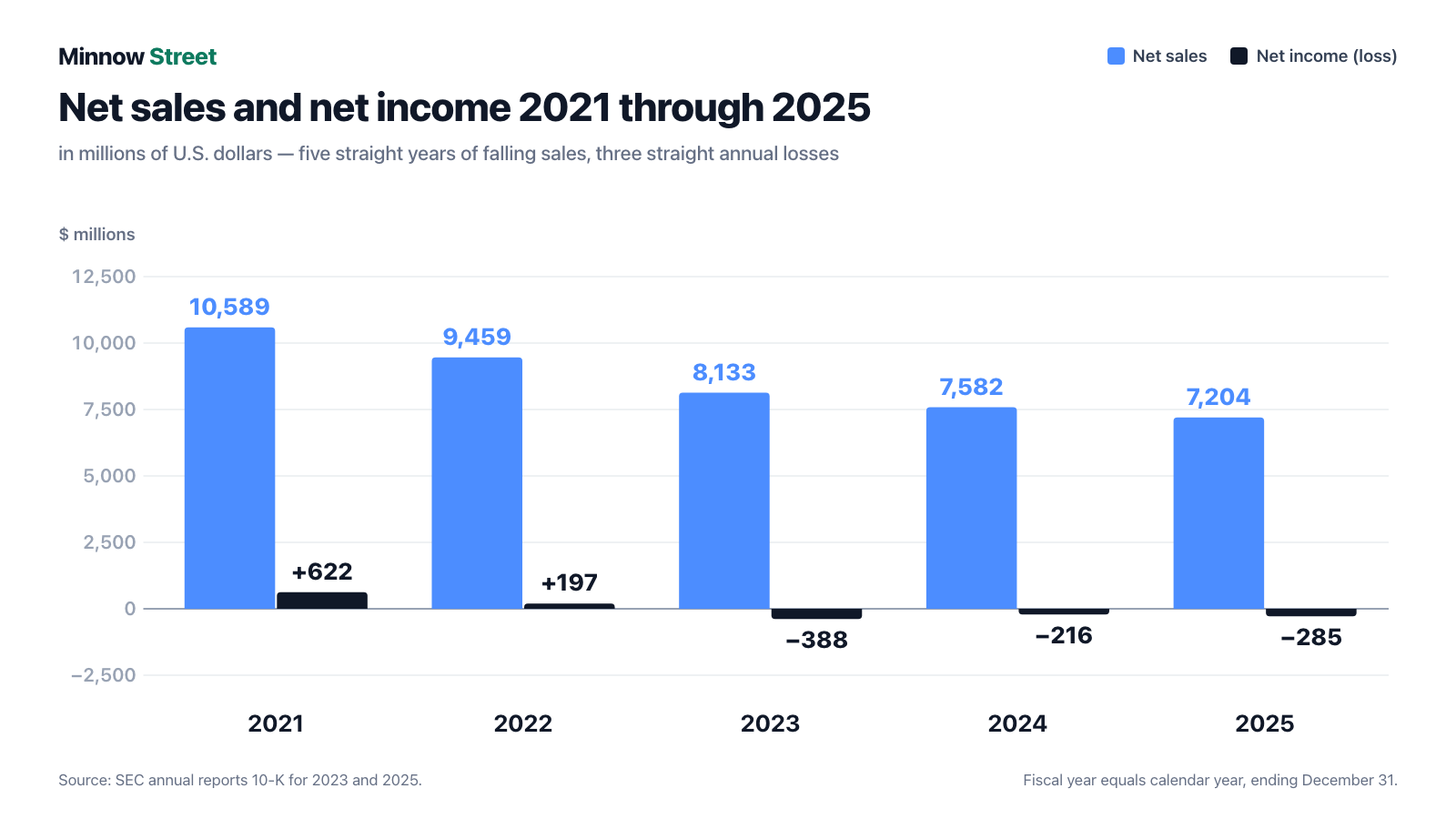
That, however, exhausts the credit column — and the chart already shows why.
What the filings say — the uncomfortable truths
Uncomfortable truth no. 1: the business does not earn its own interest
This is the number everything turns on. Under U.S. GAAP, Newell posted operating income of $39 million in 2025. In the same year it incurred interest expense of $321 million. On that arithmetic the operating business covers about 12 percent of its own interest bill. The rest comes out of the balance sheet.
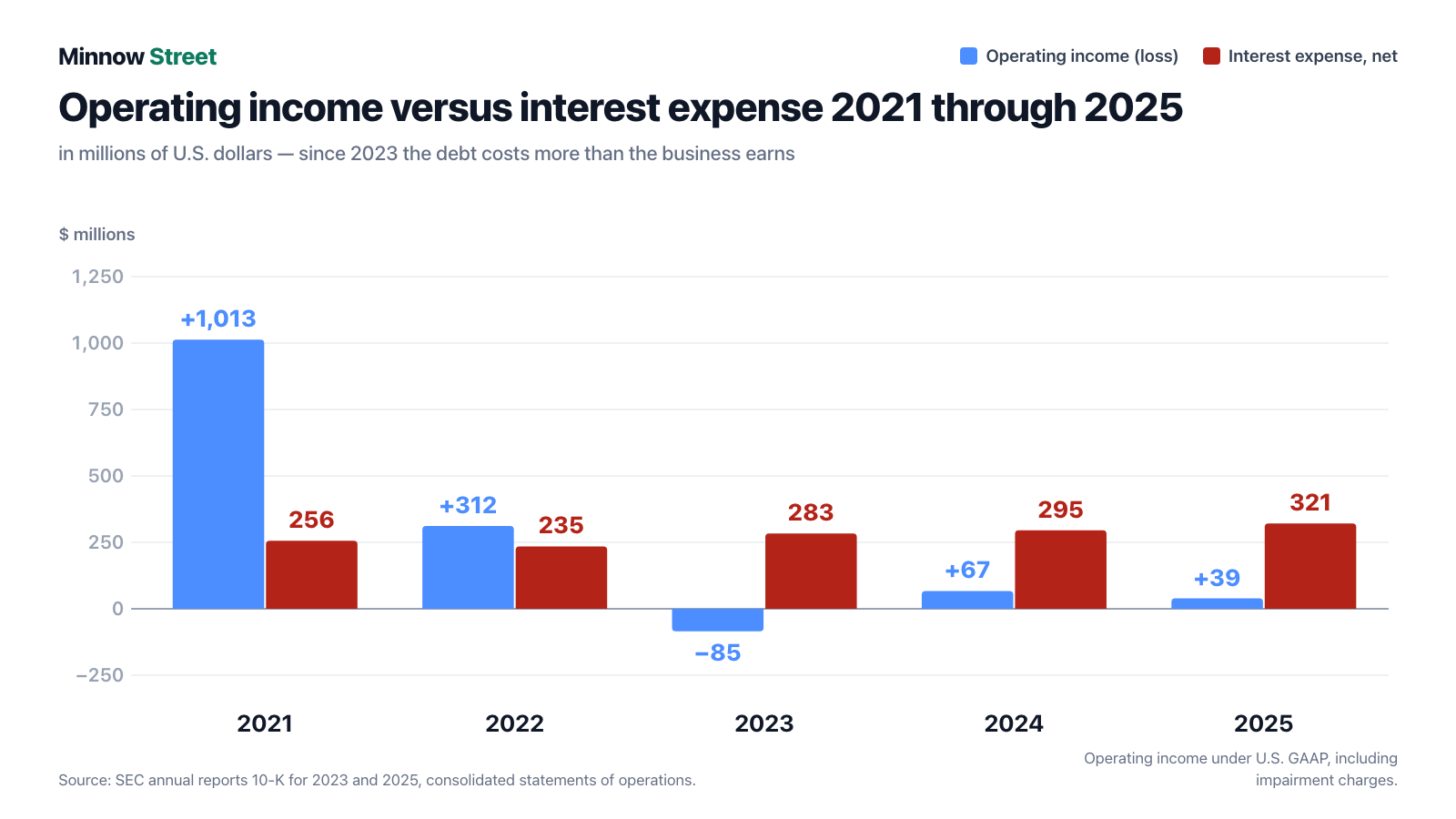
Now the fair counter-calculation, because operating income includes $346 million of impairment charges on goodwill, intangibles and other assets — entries that cost no cash. Strip them out and you get $385 million against $321 million of interest: coverage of 1.2 times. Better than 0.12, and still thin. For comparison, the same measure stood at 4.2 in 2021. Worth remembering: a company whose interest bill nearly matches its adjusted operating profit has stopped working for its owners and started working for its lenders.
The income statement lays the reason bare: 2025 revenue of $7,204 million produced $2,432 million of gross profit, against $1,985 million of selling, general and administrative expense, $62 million of restructuring costs and $346 million of impairment charges. That leaves $39 million. After interest, a $13 million loss on early debt redemption and $6 million of other expense, the company reported a $301 million pre-tax loss and, after a $16 million tax benefit, a net loss of $285 million, or $0.68 per share. It is the third consecutive loss year: $388 million in 2023 and $216 million in 2024.
The first quarter of 2026 changed little: $34 million of operating income against $84 million of interest expense, and a $33 million net loss. The weighted average interest rate on the company's debt rose from 6.0 to 6.9 percent.
Uncomfortable truth no. 2: Newell writes down its own brands — every year
Goodwill arises when a company pays more for an acquisition than the acquired assets are worth. The premium sits on the balance sheet as an asset — and has to be retested every year. When earnings expectations fall, it gets written down. That is exactly what has happened at Newell for three years running:
- 2023: $342 million of impairment of goodwill, intangibles and other assets
- 2024: $353 million
- 2025: $346 million
That is $1,041 million in three years — close to half of today's market capitalization, erased from the books. In 2025 the charges hit two tradenames in the Home and Commercial Solutions segment ($163 million and $127 million) and one in Learning and Development ($50 million). The stated reasons: downward revisions to forecast cash flows and higher discount rates, the latter explicitly linked to the decline in the company's own share price.
What remains on the balance sheet is still enormous. As of March 31, 2026 goodwill of $3,092 million and other intangible assets of $1,607 million — $4,699 million together — stood against total stockholders' equity of $2,342 million. Subtract both and tangible equity works out to minus $2,357 million. Put plainly: without the carrying value of its own brand names the balance sheet would be underwater. And the filing warns this may continue — one reporting unit in the Home and Commercial Solutions segment had a fair value within 10 percent of its carrying value at the end of 2025.
Uncomfortable truth no. 3: five years of falling sales — $3.4 billion gone
In 2021 Newell recorded $10,589 million of net sales. In 2025 it was $7,204 million. That is a decline of $3,385 million, or 32.0 percent, in four years, without a single year of recovery in between. In the first quarter of 2026 revenue fell a further 1.1 percent to $1,549 million.
The company names the reasons itself: soft demand, retailers keeping inventories tight, changing shopping behavior, an intensely competitive environment. What stands out is the framing in the annual report — Newell does not expect this to resolve on its own. The current market contraction, it writes, is "reflective of a reset of demand levels," a lasting recalibration rather than a dip. That is an unusually sober statement for an annual report, and one worth taking seriously.
By segment the picture is uneven: Home and Commercial Solutions posted a segment operating loss of $138 million on $3,772 million of sales in 2025, and Outdoor and Recreation a $25 million loss on $741 million. Only Learning and Development earned money, at $464 million. After $262 million of corporate expenses, the $39 million mentioned above is what is left.
Uncomfortable truth no. 4: the rating agencies cut twice — and that costs money
During the second quarter of 2025 Moody's and S&P downgraded the company's senior unsecured debt. The consequence was not just a worse label but an automatic coupon increase on roughly $1.08 billion of notes:
"During the second quarter of 2025, Moody's Corporation ("Moody's") and S&P Global Inc. ("S&P") downgraded the Company's senior unsecured debt rating to "B1" and "B+", respectively. As a result, certain of the Company's outstanding senior notes aggregating to approximately $1.08 billion (the "Coupon-Step Notes") were subject to an interest rate adjustment of 25 basis points for each downgrade, or 50 basis points in the aggregate."
— Newell Brands Inc., SEC annual report 10-K for 2025, Note 8 Debt

In the fourth quarter of 2025 Moody's cut once more, to "B2", with no further coupon effect because the contractual maximum had been reached. What such a rating means in hard currency is visible in the May 2025 issue: $1.25 billion at 8.500 percent, due 2028. For comparison, the older notes on the books carry coupons between 5.375 and 6.625 percent. The company's weighted average interest rate rose from 5.2 percent in 2023 through 5.8 percent in 2024 to 6.4 percent in 2025, and to 6.9 percent in the first quarter of 2026.
There is also a date in the calendar. The secured $1.00 billion revolving credit facility, maturing in August 2027, carries a net leverage ceiling that tightens automatically at the quarter ending September 30, 2026:
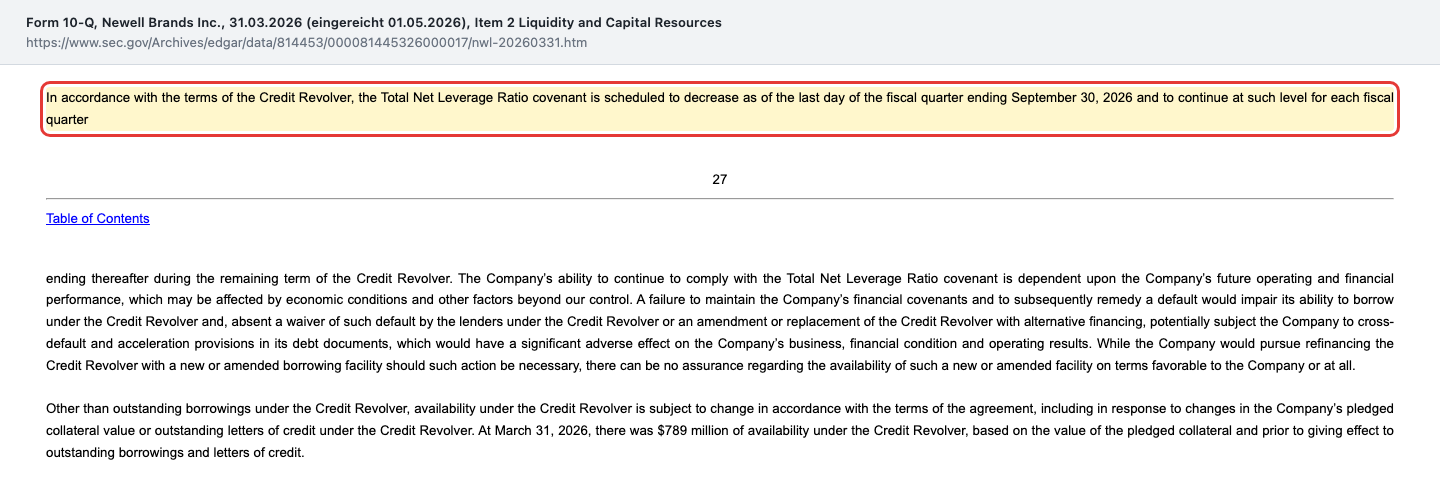
As of March 31, 2026 $425 million was drawn under that facility — up from $130 million at the end of 2025 — leaving net availability of roughly $327 million. Newell explicitly reports being in compliance with all of its debt covenants at that date. The question is not the past but the date in September.
Uncomfortable truth no. 5: one customer is 17 percent — with no purchase commitment
Newell does not sell to consumers but to retailers. And the retailers are growing while Newell shrinks:
"The Company's largest customer in 2025, Amazon, accounted for approximately 17%, 15% and 13% of net sales in 2025, 2024 and 2023 respectively. Walmart Inc. and subsidiaries ("Walmart"), the Company's second largest customer in 2025, accounted for approximately 13%, 14% and 15% of net sales in 2025, 2024 and 2023, respectively."
— Newell Brands Inc., SEC annual report 10-K for 2025, Item 1 Business

Together Amazon and Walmart account for 30 percent of company sales. What matters more, though, is a sentence a few lines earlier: Newell has no long-term supply contracts and no guaranteed minimum purchases with its largest customers. Orders come as individual purchase orders that can be changed or cancelled. The first-quarter 2026 report shows that mechanism at work: certain customers pulled orders forward, which weighed on the following quarter. In other words, drawing 30 percent of revenue from two addresses that can reschedule at will is not a contractual relationship — it is a dependency.
Uncomfortable truth no. 6: the dividend did not come out of the business
Newell has paid a dividend for many years, currently $0.07 per share per quarter, or $0.28 a year. That cost $120 million in 2025. In the same year free cash flow — $264 million from operations less $247 million of capital expenditures — came to $17 million.
The math does not work: the payout was roughly seven times what the business left over after investment. The difference came from the balance sheet, not from earnings. For comparison, 2024 put $237 million of free cash flow against $118 million of dividends, and 2023 put $646 million against $184 million — both comfortable. Only in 2025 does the ratio flip. A dividend yield of roughly 5.5 percent (data as of July 25, 2026) looks attractive at first glance. In that year it was not a distribution out of surplus.
What could still land on top — the tariff question
There is one item that is not on the balance sheet and is large all the same. In 2025 Newell reported roughly $174 million of incremental cash tariff cost, of which about $114 million flowed through cost of products sold. The company pushed back with 15 U.S. production facilities and two in Mexico that make products representing more than half of U.S. revenue and are not subject to the new U.S. tariffs — a genuine advantage over competitors that import everything.
Then came February 20, 2026. The U.S. Supreme Court ruled that the IEEPA emergency statute does not authorize tariffs; in April 2026 the U.S. Court of International Trade ordered the customs agency to recalculate the affected entries and refund importers with interest. Newell writes:
"During the year 2025, the Company paid approximately $120 million of IEEPA Tariffs. […] As of March 31, 2026, the Company has not recorded a receivable related to potential refunds for IEEPA Tariffs paid by the Company."
— Newell Brands Inc., SEC quarterly report 10-Q as of March 31, 2026, Note 14
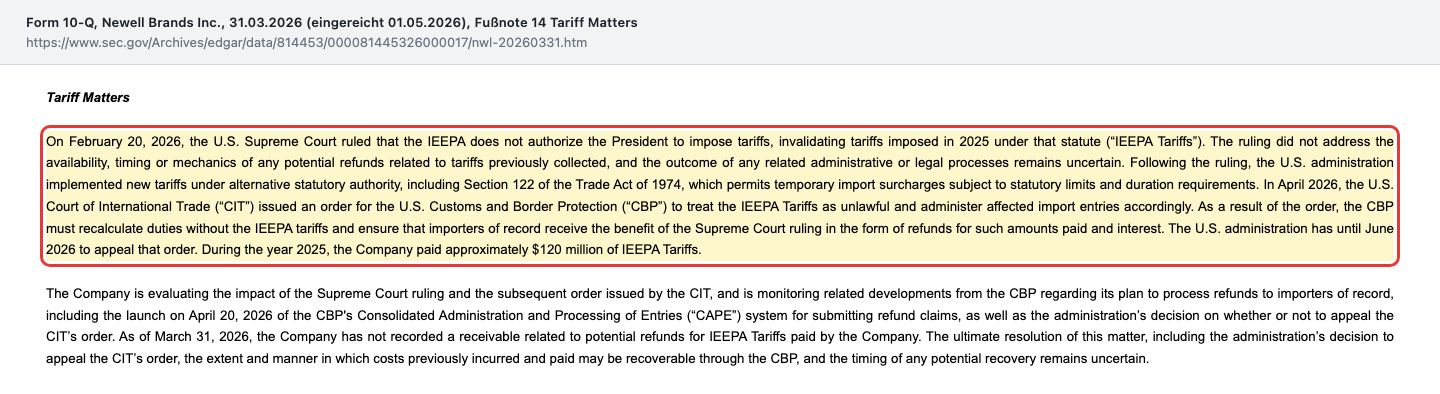
For scale: $120 million is roughly 5.6 percent of the market capitalization and more than fourteen times 2025 free cash flow. But go easy on the anticipation — the filing lists three open points. The administration had until June 2026 to appeal the order (as stated in the report dated May 1, 2026), the customs agency's electronic refund system only opened on April 20, 2026, and the timing of any recovery is unresolved. On top of that, the administration imposed new tariffs under a different statutory authority after the ruling. Anyone writing this number into a valuation model today is modeling a hope.
Valuation — what the price already pays for
Scale first, not the daily quote: with roughly 424.9 million shares outstanding (cover page of the quarterly report, as of April 27, 2026) and a closing price of $5.08 on July 24, 2026, market capitalization was about $2.2 billion. Cross-check against the annual report cover page, where Newell puts the market value of shares held by non-affiliates as of June 30, 2025 at roughly $2.2 billion as well. The order of magnitude holds.
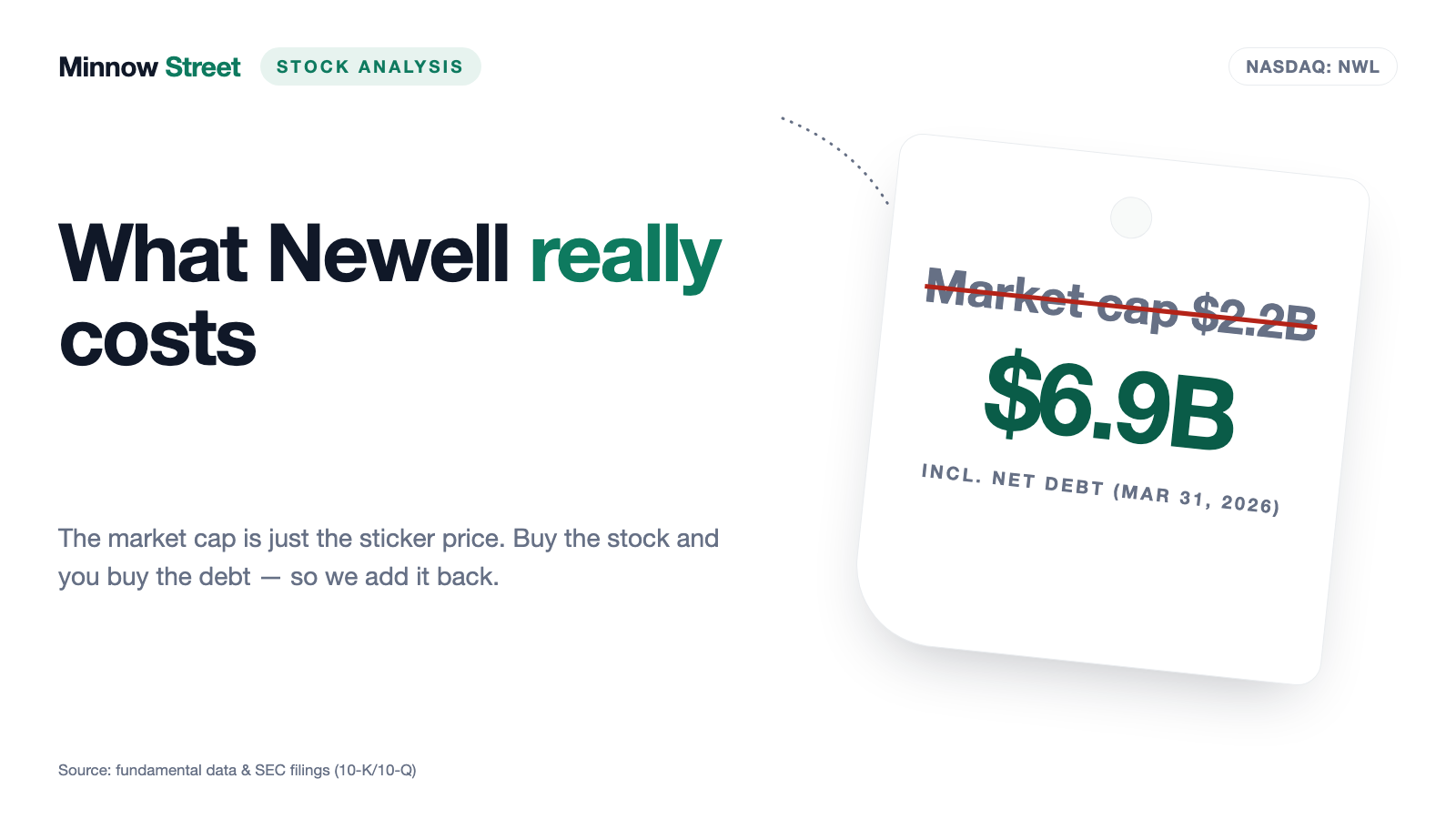
Three anchors follow. First, price to sales: roughly 0.3 against 2025 revenue of $7,204 million. That is optically cheap — strikingly so for a consumer products group with global brands. Second, enterprise value: buy the stock and you buy the debt. On top of the $2.2 billion of equity value sit $4,965 million of debt less $201 million of cash (both as of March 31, 2026), or roughly $4.8 billion net. Enterprise value therefore comes to about $6.9 billion — roughly 0.96 times sales instead of 0.3. That gap is the whole point: the stock is cheap, the company is not. Third, book value: roughly $5.51 per share, putting price to book at about 0.9. A price-to-earnings ratio cannot be formed — there were no earnings in 2025.
That the market values the company below its book equity is something Newell states in the annual report itself — and draws an uncomfortable conclusion from:
"In addition, the Company has experienced a significant sustained decline in its market capitalization as a result of a decrease in its stock price, resulting in the Company's market capitalization being less than its consolidated stockholders' equity."
— Newell Brands Inc., SEC annual report 10-K for 2025, Item 7 Critical Accounting Estimates
The filing names that condition explicitly as a possible trigger for further impairment charges. A price below book value here is therefore not only a bargain signal but also a balance sheet risk.
The professional view, as context rather than verdict: nine research houses cover the stock, the consensus target sits at $5.59 (data as of July 25, 2026), barely above the July 24, 2026 close. The recommendations split into one strong buy, two buys, five holds and one strong sell. Anyone looking for a recovery bet will not find an enthusiastic chorus. Two further anchors say more than any target: the stock traded between $3.07 and $6.64 in the twelve months to July 24, 2026 — a factor of more than two. And our in-house Altman distance-to-distress reading stands at 0.56; anything below 1.81 counts as the critical zone on that measure. It is not an oracle, but it does not describe the situation wrongly either.
Opportunities and risks at a glance
What speaks for Newell:
- Genuine global brands: Sharpie, Paper Mate, Parker, Rubbermaid, Coleman, Contigo, Graco, NUK, Crockpot and Yankee Candle, distributed through virtually every retail channel — $7,204 million of net sales in 2025.
- One segment really earns: Learning and Development produced $464 million of segment operating income on $2,691 million of sales in 2025, a 17.2 percent margin.
- Margin up against the wind: gross margin of 33.8 percent after 33.6 percent, despite roughly $114 million of additional tariff cost in cost of products sold.
- Cash stays positive: $264 million provided by operating activities in 2025 — the business does not burn cash.
- Tariff advantage from owned plants: 15 U.S. sites and two in Mexico make products representing more than half of U.S. revenue that the new U.S. tariffs do not touch.
- A possible refund: roughly $120 million of IEEPA tariffs paid may be recoverable after the Supreme Court ruling of February 20, 2026; none of it is recorded as of March 31, 2026.
- The savings plan is running: $110 million to $130 million of expected annualized savings from the productivity plan approved November 26, 2025.
What speaks against it:
- The business does not carry its interest: $39 million of operating income against $321 million of interest expense in 2025; even excluding the $346 million of impairment charges, coverage is only 1.2 times.
- Three consecutive loss years: minus $388 million (2023), minus $216 million (2024) and minus $285 million (2025); the accumulated deficit stood at $3,260 million as of March 31, 2026.
- Five years of falling sales: from $10,589 million to $7,204 million, down 32.0 percent — and a further 1.1 percent in the first quarter of 2026.
- The brands keep getting written down: $1,041 million in three years; one reporting unit sat within 10 percent of its carrying value at the end of 2025.
- No tangible equity cushion: $3,092 million of goodwill plus $1,607 million of intangibles against $2,342 million of equity — tangible equity of minus $2,357 million as of March 31, 2026.
- Expensive refinancing: ratings of "B2" (Moody's) and "B+" (S&P), an 8.500 percent coupon on the $1.25 billion 2028 notes, a 6.9 percent average rate in the first quarter of 2026, and maturities of $500 million in 2027 and $1,252 million in 2028.
- A date in the credit agreement: the leverage ceiling on the $1.00 billion revolver steps down at the quarter ending September 30, 2026; $425 million was already drawn as of March 31, 2026.
- Customer concentration: Amazon at 17 percent and Walmart at 13 percent of 2025 sales — with no long-term supply contracts or minimum purchase commitments.
- The 2025 dividend was not earned: $120 million paid out against $17 million of free cash flow.
A human conclusion
Back to the kitchen cabinet trap. It works because something in it is true: Newell's brands are real, they sit in millions of households, and Sharpie or Rubbermaid do not vanish because a holding company carries debt. Buy Newell and you buy actual products with actual customers — not a castle in the air.
What makes the trap treacherous is the leap our minds take unasked: from "I know the brand" to "the company is solid." Between those two sit $4.8 billion of net debt, five years of falling sales, three loss years and an operating result that does not earn its own interest. The brands are the collateral, not the outcome.
The decisive question sits in the coming quarterly reports and is refreshingly simple: does operating income grow faster than the interest bill — clearly enough that the tighter leverage ceiling on September 30, 2026 never becomes an issue? If it does, a price below book value will look like a gift in hindsight. If it does not, it was a price tag with a good reason behind it. What you make of that is your decision. And that is exactly as it should be.
Sources
- Newell Brands Inc., SEC annual report 10-K for 2025 (period ended December 31, 2025, filed February 13, 2026), CIK 0000814453 — Item 1 Business, Item 1A Risk Factors, Item 7 MD&A including "Update on Tariffs", consolidated statements of operations and Notes 3, 6, 8 and 16.
- Newell Brands Inc., SEC quarterly report 10-Q as of March 31, 2026 (filed May 1, 2026) — interim balance sheet, Item 2 Liquidity and Capital Resources and Notes 3, 8 and 14 ("Tariff Matters").
- Newell Brands Inc., SEC annual report 10-K for 2023 (filed February 21, 2024) — comparative figures for 2021 through 2023.
- Newell Brands Inc., SEC current report 8-K dated December 1, 2025 — Item 2.05, approval of the global productivity plan on November 26, 2025 with headcount reductions, store closures, expected savings and restructuring charges.
- Ranking from our in-house stock scanner: Richard Moglen: 1 Week Top Performers (U.S. selection, rank 28 of 28, relative strength rating 70), as of July 25, 2026; the list is recalculated daily.
- Fundamental data (market capitalization, valuation metrics, analyst consensus, share count, twelve-month range, trading volume, Altman reading), data as of July 25, 2026, closing price of July 24, 2026.
Disclaimer: This article is journalistic analysis of publicly available company data. It is not investment advice, not a recommendation to buy or sell, and not a solicitation to buy or sell securities. Share prices can fall sharply at any time and a total loss is possible. All figures come from the primary sources linked above and carry the reporting date stated there. The author holds no position in the stock discussed at the time of publication.
Our Bottom Line at a Glance
- Brands and market access positive
- Newell sells everyday products under brands almost everyone recognizes — Sharpie, Paper Mate, Parker, Rubbermaid, Coleman, Contigo, Graco, NUK, Crockpot, Yankee Candle — through virtually every retail channel. That produced $7,204 million of net sales in 2025, with roughly 21,900 employees as of December 31, 2025, about 13,250 of them in manufacturing and supply chain roles.
- Earning power negative
- Operating income was $39 million in 2025 against $321 million of interest expense — coverage of about 12 percent, or 1.2 times excluding the $346 million of non-cash impairment charges. It was the third consecutive loss year: minus $388 million (2023), minus $216 million (2024), minus $285 million (2025). The first quarter of 2026 put $34 million of operating income against $84 million of interest.
- Revenue trend negative
- Net sales fell for five straight years from $10,589 million (2021) to $7,204 million (2025), down 32.0 percent, and a further 1.1 percent in the first quarter of 2026. The 2025 annual report explicitly reads the market contraction as a reset of demand levels rather than a temporary dip.
- Balance sheet and financing negative
- As of March 31, 2026, $4,965 million of debt stood against $201 million of cash and $2,342 million of equity, of which $4,699 million is goodwill and other intangibles. Ratings are "B2" (Moody's, fourth quarter 2025) and "B+" (S&P); the leverage ceiling on the $1.00 billion revolver steps down at the quarter ending September 30, 2026, with $425 million already drawn.
- Customer concentration negative
- Amazon accounted for roughly 17 percent of 2025 net sales (2023: 13 percent) and Walmart for roughly 13 percent — 30 percent together. The annual report states explicitly that there are no long-term supply contracts and no guaranteed minimum purchases with the largest customers; orders can be changed or cancelled.
- Valuation neutral
- At the July 24, 2026 close of $5.08 the market capitalization was about $2.2 billion — roughly 0.3 times sales and 0.9 times book value. Add net debt of about $4.8 billion and enterprise value rises to roughly $6.9 billion, or about 0.96 times sales. Newell itself notes in the annual report that its market capitalization is below its consolidated stockholders' equity.
Newell Brands is the kitchen cabinet trap in its purest form: the brands are real, the products sit in millions of households, one segment earns a genuine $464 million, and gross margin still rose to 33.8 percent in 2025 despite roughly $114 million of extra tariff cost. None of it carries the company: $39 million of operating income stands against $321 million of interest expense, sales have fallen 32.0 percent over five years, the company wrote down its own brands by $1,041 million in three years, and the $120 million dividend exceeded 2025 free cash flow of $17 million sevenfold. Not investment advice.
What Our Rating Means
Substance risk
We found at least one documented issue that threatens the company itself — regardless of how the stock is currently valued.
This light rates the company, not the share price — and the finding is documented. Operating income of $39 million covered the $321 million interest bill only to about 12 percent in 2025; even adjusted for the $346 million of non-cash impairment charges, interest coverage is 1.2 times. That marks the third straight year below the level at which a business carries its own financing: 2023 operating income was negative, 2024 put $67 million against $295 million of interest, and the first quarter of 2026 put $34 million against $84 million. On top of that sits equity of $2,342 million that consists entirely of goodwill and brand carrying values ($4,699 million, tangible equity of minus $2,357 million as of March 31, 2026), B-category credit ratings, and a leverage ceiling in the credit agreement that tightens by itself on September 30, 2026. The counterweight is not trivial: cash from operations was positive at $264 million in 2025, the company was in compliance with all debt covenants as of March 31, 2026, and the auditor issued no going-concern paragraph. So this is not an emergency — but it is a substance finding under our criteria, and where the evidence sits between two levels we take the more cautious one. That the stock trades below book value changes nothing: the low price is a consequence of this finding, not a rebuttal of it. The decision is yours.
A journalistic assessment by our editorial team at the time of the deep dive, based on public sources — not investment advice and not a solicitation to buy or sell. Your personal circumstances (investment goals, risk capacity, taxes) cannot be taken into account. What our levels mean, how verdicts are formed, and what conflicts of interest exist →
Worth Noting
- Newell reached our research list through our in-house stock scanner: rank 28 of 28 in the list "Richard Moglen: 1 Week Top Performers" (U.S. selection) with a relative strength rating of 70, as of July 25, 2026 — last place, and the RS reading sits exactly at that list's minimum threshold. The list is recalculated daily and measures price momentum, liquidity and relative strength, that is, demand for the shares rather than the quality of the company.
- Every figure carries its own reporting date: annual figures from the 10-K for 2025 (filed 02/13/2026), comparative years 2021 and 2022 from the 10-K for 2023 (filed 02/21/2024), quarterly and balance sheet figures from the 10-Q as of 03/31/2026 (filed 05/01/2026), share count from that report's cover page (04/27/2026). Valuation metrics carry a data-as-of date of July 25, 2026 based on the July 24, 2026 close — meant as evergreen scale, not a daily price as an argument.
- Possible confusion: the ticker NWL here stands for Newell Brands Inc. of Atlanta (CIK 0000814453). The same three letters also name a transformer brand inside the grid business of American Superconductor — a company Newell Brands has nothing to do with. The former corporate name was Newell Rubbermaid Inc. until 2016; older figures appear under that name.
- On the tariff refund: the quarterly report dated May 1, 2026 states that the administration had until June 2026 to appeal the Court of International Trade order. Whether an appeal was filed does not appear in any later SEC filing by the company; the last reported status is "no receivable recorded" as of March 31, 2026.
Frequently Asked Questions
Newell Brands owns Sharpie, Paper Mate, EXPO, Parker, Elmer's and Dymo (writing and art), Graco and NUK (baby gear), Rubbermaid and Rubbermaid Commercial Products (storage and cleaning), Crockpot, Mr. Coffee, Oster and Sunbeam (kitchen appliances), Yankee Candle and WoodWick (home fragrance) and Coleman, Campingaz, Contigo, Bubba and Marmot (outdoor). The company was named Newell Rubbermaid until 2016.
Operating income came to $39 million in 2025 because $346 million of impairment charges on goodwill and brands plus $62 million of restructuring costs weighed on the result. Below that line sat $321 million of interest expense, a $13 million loss on early debt redemption and $6 million of other expense. The bottom line was a net loss of $285 million, or $0.68 per share.
As of March 31, 2026 Newell reported $4,965 million of debt — $425 million short-term and $4,540 million long-term — against $201 million of cash, leaving roughly $4.8 billion net. Per the annual report, maturities fall due as $130 million in 2026, $500 million in 2027, $1,252 million in 2028, $500 million in 2029, $750 million in 2030 and $1,586 million thereafter.
Newell pays $0.07 per share per quarter, or $0.28 a year. That cost $120 million in 2025, while free cash flow came to just $17 million — the payout was roughly seven times what the business left over after investment. In 2023 and 2024 the dividend was covered by free cash flow. The filings contain no commitment for the future.
No. The company's SEC filings contain no Form 425, no merger agreement, no merger proxy and no Schedule 13D. The most recent ownership filings are plain Schedule 13G notices from asset managers. The only Form 25 in the filing history dates from 2018 and did not concern the common stock.
Newell put incremental cash tariff cost for 2025 at roughly $174 million, of which about $114 million ran through cost of products sold. It offset that with 15 plants in the United States and two in Mexico making products that represent more than half of U.S. revenue. Roughly $120 million of the tariffs paid related to the IEEPA levies struck down in court in February 2026.
Amazon was the largest customer in 2025 at roughly 17 percent of net sales, Walmart the second largest at roughly 13 percent. The annual report also lists Costco, Grainger, Office Depot, Staples, Target, The Home Depot, The Kroger Co. and Uline among the ten largest. By the company's own account there are no long-term supply contracts or minimum purchase commitments with these customers.
A rating in the B category sits well below investment grade and is commonly described as high yield. For Newell the 2025 downgrade had an immediate cost: the coupon on roughly $1.08 billion of notes automatically rose by 50 basis points. The notes issued in May 2025, worth $1.25 billion, carry an 8.500 percent coupon and mature in 2028.
Found an error?
Did you spot a factual error, an outdated number, or a typo in this deep dive? Let us know briefly — your report goes straight to the editorial team.