Nature's Sunshine: Five Quarters Above the Estimate — and the Estimate Comes From Two Analysts
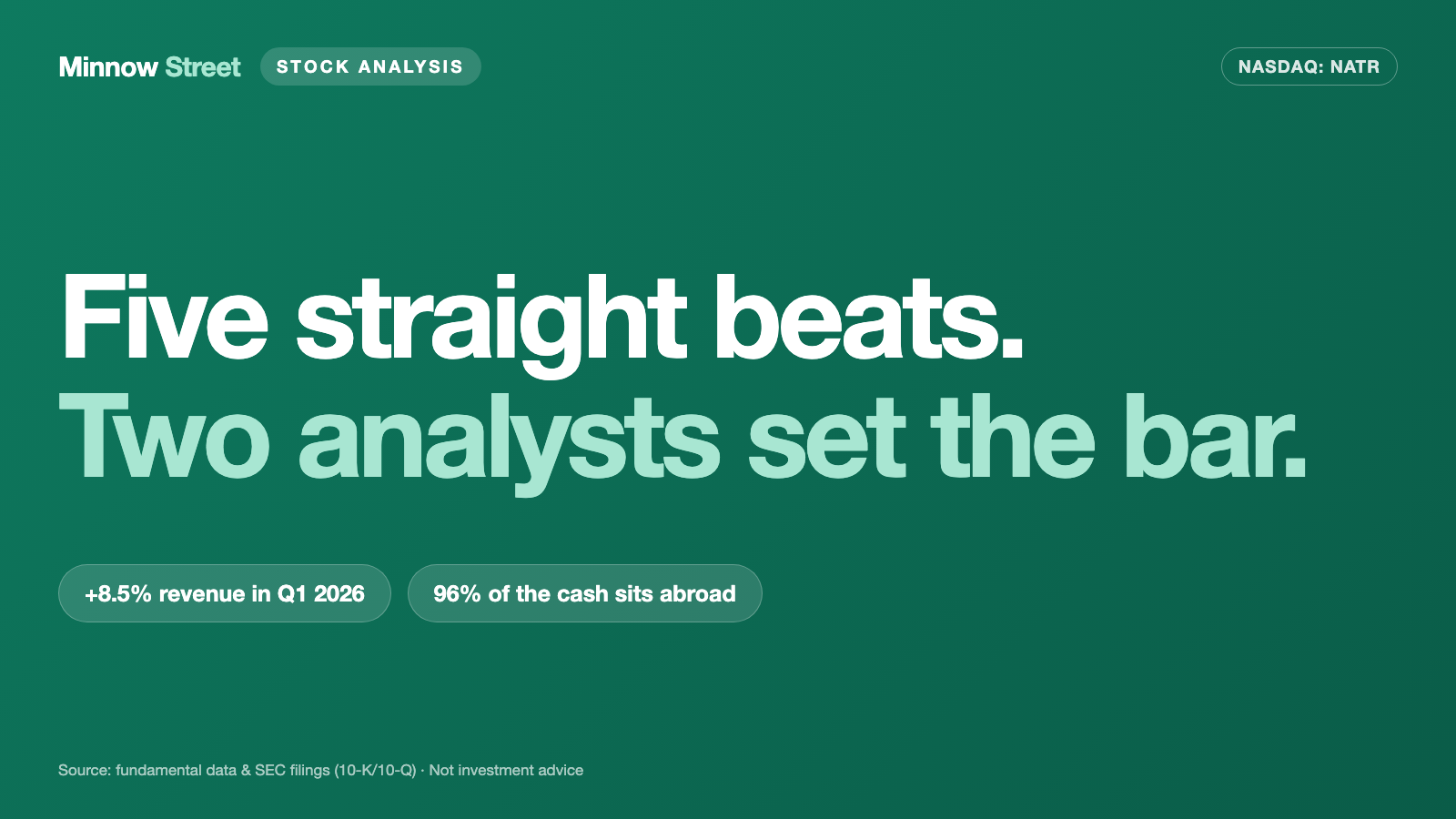
Nature's Sunshine Products sells herbal capsules through independent consultants — and has earned more than the market expected five quarters in a row. That is why the stock sits at rank 50 in our Big Earnings Surprise ranking. The filings with the U.S. securities regulator, the SEC, show two things at once: the business really is growing (net sales of $480.1 million in 2025, up 8.5 percent in the first quarter of 2026, all four regions higher) — but little of that reaches the bottom line, because taxes, currencies and a shrinking share count write the second half of the story. Add $84.0 million of cash held abroad, a twelfth of revenue in Russia and Ukraine, and a finance chief who has only been an interim since June 2026. Not investment advice — just a look at who set that bar in the first place.
 Thomas Mücke
Founder & Publisher
Thomas Mücke
Founder & Publisher
Chart
Interactive price chart (TradingView).
Note: pure fact-based analysis, not investment advice and not a solicitation to buy or sell. All figures without guarantee.
There is an investor trap that feels like a compliment to your own judgment: the beat trap. It works like this. You read that a company "beat expectations" — and your brain hears: the company was better than it needed to be. But what got beaten was not reality. It was an estimate. And estimates are made by people. At Nature's Sunshine Products (NASDAQ: NATR) of Lehi, Utah, they are made by exactly two analysts (data as of July 25, 2026). Five quarters in a row the company cleared that bar — which is the only reason the stock landed on our desk at all. So let us make a deal. Before you take the streak as proof of a great company, we read together what the company itself filed with the U.S. securities regulator, the SEC: the annual report (Form 10-K) for 2025, filed March 10, 2026, and the quarterly report (Form 10-Q) for the quarter ended March 31, 2026, filed May 7, 2026. Those documents are honest under penalty of law. And they describe a business that really is growing, a profit that gets nibbled at several times on its way down, a cash pile that sits almost entirely outside the United States — and a finance chief who is currently only an interim. In the end, you decide.
What Nature's Sunshine actually does — herbal capsules, sold by people to people
Nature's Sunshine is a Utah corporation formed in 1976, and it makes what Americans call dietary supplements: capsules, tablets and concentrates from herbs and other raw materials, plus personal care items — more than 800 products across six categories (general health, immune, cardiovascular, digestive, personal care and weight management). Most of it is produced at the company's own plant in Spanish Fork, Utah. As of December 31, 2025, 806 people worked for the company.
What is unusual is not the product but the route to market. Nature's Sunshine does not sell through drugstores; it sells through independent consultants — people who use the products themselves, resell them to friends and neighbors, and earn commissions, including on the sales of the consultants they recruited. The filings call these commissions "volume incentives," and in 2025 they came to 30.1 percent of net sales. In China the company pays no volume incentives at all; instead it pays independent service fees ($16.8 million in 2025), because local rules cap direct selling compensation.
Reporting runs in four regions. Asia is the largest at $221.8 million of 2025 net sales, carried by Taiwan ($67.3M), Japan ($56.1M), South Korea ($50.8M) and a fast-growing China business. North America came to $143.6 million, Europe to $93.1 million, Latin America and Other to $21.6 million. Roughly 72.2 percent of net sales in 2025 were realized outside the United States. That frames the central tension of this analysis, and it runs through every chapter: the business is growing again — but between the top line and the shareholder stand commissions, exchange rates, a heavy foreign tax burden and a cash pile that is 96 percent offshore.
How the stock landed on our desk
Nature's Sunshine came onto the research list through our in-house stock scanner, specifically through the Big Earnings Surprise list: rank 50 of 81 U.S. hits, as of July 25, 2026. You can rebuild what that list does in one sentence: it collects stocks whose most recently reported earnings per share came in well above the consensus estimate, then sorts them by relative strength — how the share price has held up against the broad market. Nature's Sunshine sits there with a reading of 45: solidly mid-pack, no standout. The lists are recomputed daily, so the ranking is a dated snapshot, not a permanent state.
The streak itself is unusually long. Here is what it looked like:
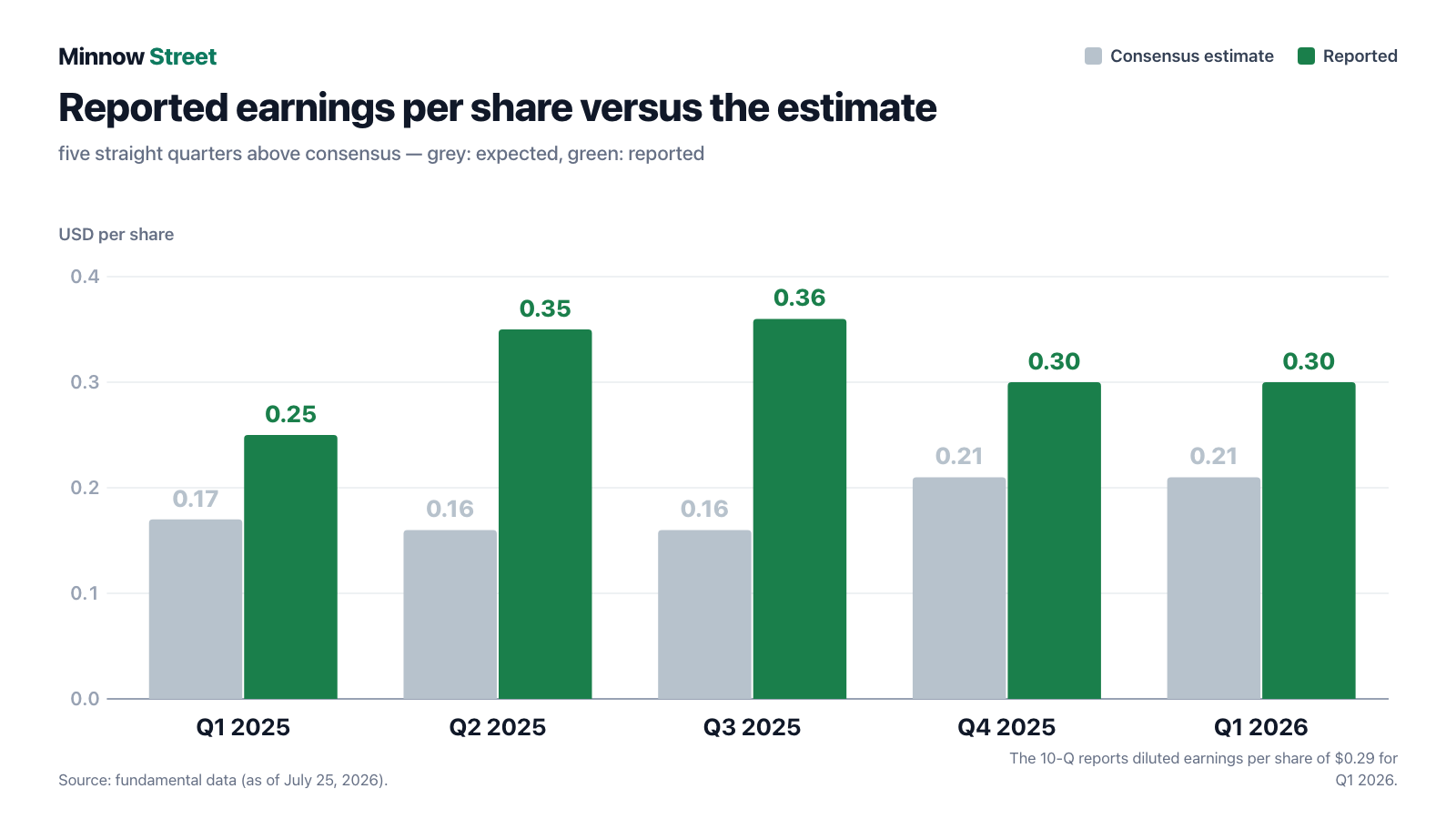
Two things belong in that picture. First: the green bars are real — the company earned more in each of those quarters than in the year-earlier period. Second: the grey bars are low, and they are set by two analysts (both with a price target of $35, data as of July 25, 2026). For a company with a market value of roughly $359 million that is entirely normal — small caps get covered by few firms. But it changes what the word "surprise" means. The fewer people estimating, the higher the odds that the estimate itself is off. File this one away: a big surprise says as much about the estimators as it does about the company.
The numbers over the years — honestly credited
Start with what genuinely impresses. Revenue has climbed out of a multi-year hole: $444.1 million (2021), $421.9M (2022), $445.3M (2023), $454.4M (2024) and $480.1 million (2025) — the best year of the run, up 5.7 percent from 2024 (up 5.3 percent excluding currency effects). Operating income rose from $16.3 million (2022) through $18.7M and $20.1M to $24.7 million in 2025, and net income from a loss of $0.4 million (2022) to $19.5 million. Cash from operations was $35.3 million in 2025 after $25.3 million a year earlier; after $6.5 million of capital expenditures, $28.8 million of free cash flow remained — all years measured on the same consolidated basis, without adjustments.
The first quarter of 2026 continued the trend: $122.9 million in net sales, up 8.5 percent (up 6.9 percent excluding currency), and in all four regions at once — Asia up 7.3 percent, Europe up 9.5 percent, North America up 9.4 percent, Latin America up 9.7 percent. China grew 45.7 percent, Japan 12.9 percent, South Korea 13.4 percent. The one exception was Taiwan, at $67.3 million the group's second-largest single market, down 16.1 percent — the filing blames "slower consumer acquisition and a reduction in total orders."
The comparison with the industry also lands in the company's favor, and by a wide margin. The annual report includes a five-year performance table that tracks $100 invested on December 31, 2020. By the end of 2025 that $100 was worth $152.42 at Nature's Sunshine — and only $25.66 in the peer group of Herbalife, LifeVantage, Nu Skin and USANA. Direct selling as a sector lost three quarters of its value in five years; this company gained. That is not a small thing, and it belongs on the credit side before we get uncomfortable.
Which leaves the question of where the revenue actually goes. The first quarter of 2026 shows it step by step:
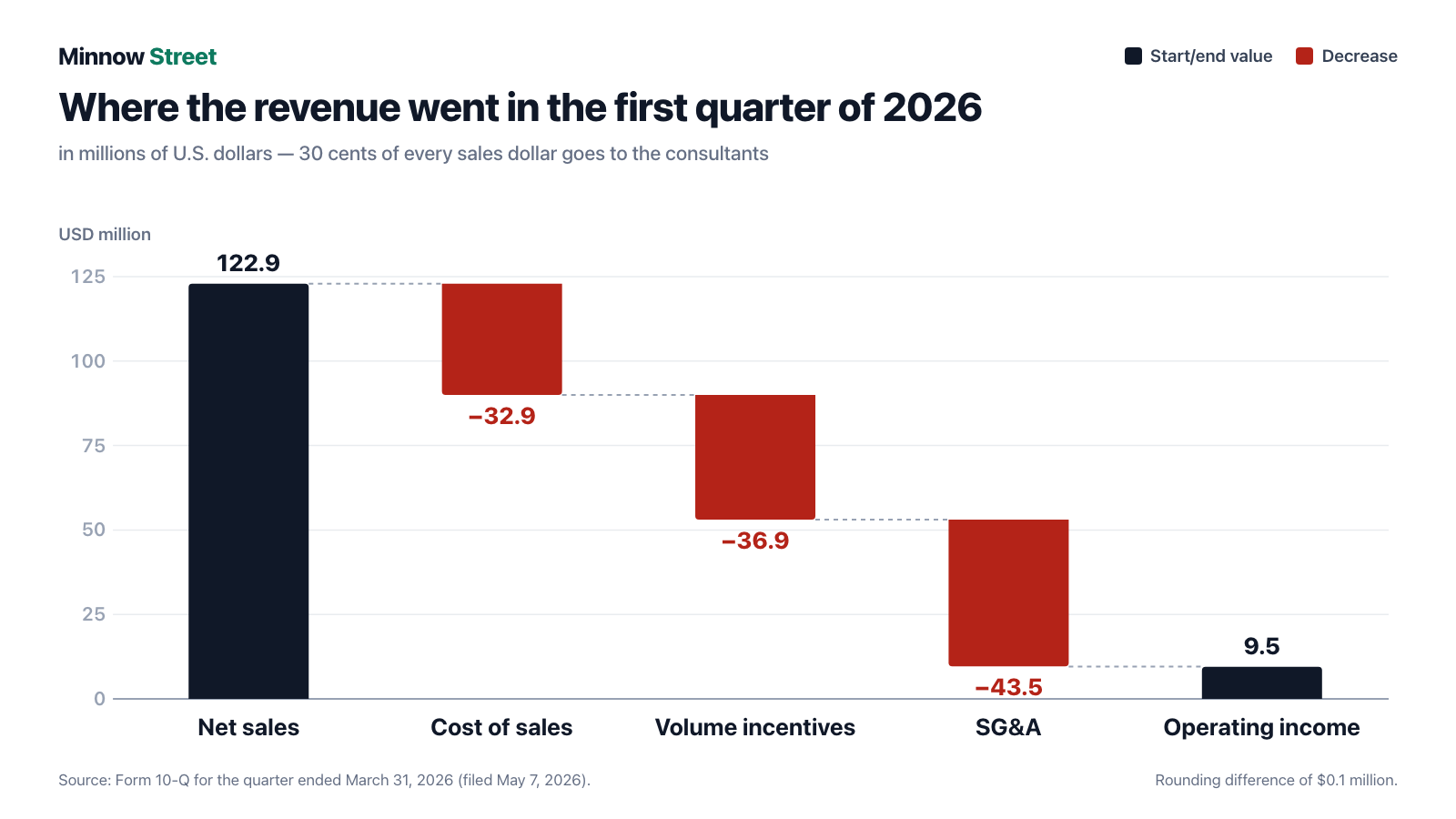
That is the economics of direct selling in one image. The goods themselves are cheap (26.8 percent of net sales, giving a gross margin of a hefty 73.2 percent) — but 30 cents of every sales dollar goes to the consultants as commission, and another 35 cents to selling, general and administrative expenses. What is left is not quite 8 cents. A retailer with that gross margin would be extremely profitable; here it is the price of having a network of human beings bring in the customers.
What the filings say — the uncomfortable truths
Uncomfortable truth No. 1: half the surprise is created below the operating line
In the first quarter of 2026 operating income rose 54.7 percent to $9.5 million. A brilliant number. Almost none of it reached net income: $5.1 million against $4.7 million in the year-earlier quarter, up 7.8 percent. Two items ate the improvement. First, currency: a gain of $0.9 million in the first quarter of 2025 turned into a loss of $1.4 million in the first quarter of 2026 — a $2.3 million swing that has nothing to do with selling capsules. Second, tax: the effective rate rose from 31.3 to 37.2 percent, against a U.S. federal statutory rate of 21.0 percent. The filing explains why: a valuation allowance is recorded against foreign tax credits that are not expected to be used before they expire — at the end of 2025 that meant $14.7 million of credits effectively written off.
So why does a higher figure show up per share? Because the denominator shrank. The diluted share count fell from 18.846 million (Q1 2025) to 17.929 million (Q1 2026), down roughly 4.9 percent. In 2025 the company had repurchased 1,260,000 shares for $16.3 million. That is entirely legitimate and value-creating — but it is capital allocation, not operating performance. Remember it for every earnings-per-share streak you meet: part of the surprise was not earned, it was bought back.
Uncomfortable truth No. 2: 96 percent of the cash sits abroad
At first glance the balance sheet is spotless: $261.5 million of total assets, $166.9 million of equity (a 63.8 percent equity ratio), $87.6 million of cash and essentially no debt — the $25.0 million revolving credit facility with Bank of America was completely undrawn at March 31, 2026 and runs to July 1, 2027. The cash simply does not sit where the shareholders do:
"At March 31, 2026, we had $87.6 million in cash and cash equivalents, of which $3.6 million was held in the U.S. and $84.0 million was held in foreign markets and may be subject to various withholding taxes and other restrictions related to repatriation before becoming available to be used along with the normal cash flows from operations to fund any unanticipated shortfalls in future cash flows."
— Nature's Sunshine Products, Inc., Form 10-Q for the quarter ended March 31, 2026, "Liquidity and Capital Resources"

Put plainly: the money sits in 40 bank accounts in 40 countries, and part of it costs a toll to bring home. For day-to-day operations that is no problem — the subsidiaries need their working capital locally anyway. For buybacks, dividends or acquisitions in the United States, it is. Fitting into the same picture: cash from operations in the first quarter of 2026 was negative, at minus $1.8 million after plus $2.6 million a year earlier, which the filing attributes to the timing of payments for accrued liabilities, receivables and deferred revenue. A single quarter is not a trend, but it explains why only 20,000 shares for $0.5 million were repurchased in the first quarter of 2026, against well over a million shares in 2025.
Uncomfortable truth No. 3: a twelfth of revenue comes from Russia and Ukraine — with an open sanctions matter
Nature's Sunshine does not report Eastern Europe as a segment, but it states the figure explicitly: $60.0 million in net sales and $4.7 million in operating income for 2025 from the "Russia and Other" market, which covers Russia, Ukraine, Belarus and other states in the region. That is 12.5 percent of group revenue — nearly three times the entire Latin America segment. In the first quarter of 2026 the region grew further, to $17.6 million (prior year $15.8 million) with $2.0 million of operating income (prior year $1.4 million). Assets tied up there stood at $6.3 million as of March 31, 2026, so the exposure is not stranded property but a running contribution to earnings.
Alongside runs a matter worth knowing about. In November 2024 the company began an internal investigation into its past compliance with U.S. trade controls and disclosed itself voluntarily — first to the Bureau of Industry and Security at the Commerce Department (BIS), then in April 2025 also to the sanctions agency OFAC. The final disclosures went out on September 5, 2025. The current status appears only in the quarterly report, not in the annual report:
"We received a response from BIS on November 3, 2025 closing the matter without further action. The VSD with OFAC remains pending."
— Nature's Sunshine Products, Inc., Form 10-Q for the quarter ended March 31, 2026, risk factors (trade and economic sanctions)

The company estimates the affected transactions at less than one percent of net revenue in each of the last three fiscal years and believes any penalties would not be material, but says it can predict neither the outcome nor the timing. Translated: this is not an existential risk — but it is a line to look up in every future filing until it disappears.
Uncomfortable truth No. 4: the business rests on a few consultants — and the tariffs are still to come
A sales network of self-employed people is cheap as long as it works, and unprotected when it stops working. The annual report says so itself, under the heading "Dependence upon Independent Consultants":
"A significant amount of our revenue in some of our markets is dependent on only a few independent consultants and their extensive sales networks. The loss of one or more of these independent consultants who, together with their extensive sales network generate a significant amount of our revenue, could have a material adverse effect on the results of operations and financial condition on one or more of our business segments."
— Nature's Sunshine Products, Inc., Form 10-K for fiscal year 2025, Item 1 "Business"

On top of that sits a cost risk that is not yet in the numbers. Raw materials are bought largely in U.S. dollars from U.S. vendors, and most production runs through the company's own plant in Utah — both of which meet tariffs that eat into cost of sales. The wording has softened slightly between the annual and the quarterly report: the 10-K for 2025 still said tariffs "will continue to adversely affect our costs in 2026," while the 10-Q for the quarter ended March 31, 2026 is more cautious:
"While we did not experience material impacts as a result of tariffs for the three months ended March 31, 2026 and 2025, we continue to monitor the additional pressure that tariff-related price increases may have on our business, including the price, availability and quality of raw materials and other ingredients. We expect that tariffs may adversely affect our costs in the remainder of 2026."
— Nature's Sunshine Products, Inc., Form 10-Q for the quarter ended March 31, 2026, "Tariffs"

We worked through how that kind of input cost pressure runs through a packaged food balance sheet in our analysis of Lamb Weston, where raw material and energy costs form the same pincer. At Nature's Sunshine there is an added wrinkle: price increases are hard to pass on in direct selling, because the consultants buy the goods themselves and live off the spread.
Uncomfortable truth No. 5: the Chinese partner is gone — at $12.00 per share
Since 2014 China's Fosun Pharma had been a major shareholder and, through two joint ventures, a partner in the China business. In 2025 it ended both. On June 25, 2025, its U.S. subsidiary Fosun Pharma USA sold 2,854,607 shares at a public offering price of $12.00; Nature's Sunshine itself was permitted to take up to $15.0 million of those shares at the same price under its buyback program. After the offering closed on June 27, 2025, Fosun held just 64,167 shares, or 0.35 percent. Six months later, on December 17, 2025, Nature's Sunshine also bought out Fosun's interests in the joint ventures in Hong Kong and Shanghai — for $3.1 million in cash plus $2.9 million at closing and an additional $1.0 million payable on December 17, 2027. Both entities are now wholly owned.
You can read that two ways, and honestly, both are true. On the positive side: the China business — up 16.9 percent in 2025 and 45.7 percent in the first quarter of 2026 — now belongs entirely to the shareholders, and a large holder whose interests were not fully aligned has left. On the negative side: an investor who bought in 2014 and exited at $12.00 in 2025 did not do well on that position, and the company now carries the China risk alone, including the rules that apply to wholly foreign-owned enterprises in the People's Republic and the final $1.0 million installment.
Leadership changed at the same time. Terrence O. Moorehead announced his departure in May 2025; since October 29, 2025, Kenneth Romanzi has been chief executive — previously CEO of B&G Foods, a consumer packaged goods veteran with more than 40 years of experience. Then on May 8, 2026, CFO L. Shane Jones resigned, effective June 5, 2026; chief accounting officer Jonathan D. Lanoy has served as interim principal financial officer since. The company states expressly that the resignation was not the result of any disagreement over financial reporting or accounting. Still, the fact stands: a company that just delivered five good quarters in a row has replaced both its chief executive and its finance chief within seven months. That is not a scandal — but it is not stability either.
Valuation — what you pay for the business
Let us talk orders of magnitude, not daily prices. Market value stood at roughly $359 million (data as of July 25, 2026), spread across 17,584,871 shares (as of April 24, 2026, per the cover page of the quarterly report). That gives a price-to-earnings ratio of about 18 on 2025 net income of $19.5 million, a price-to-sales ratio of about 0.7 and a price-to-book ratio of about 2.2. The 52-week range ran from $12.97 to $28.14 — more than a doubling from low to high within a single year, which tells you how thin this market is: recent trading averaged roughly $2.6 million of stock changing hands per day.
The more interesting calculation strips out the cash. Of the $359 million market value, $87.6 million is cash (March 31, 2026) against essentially no debt. So you are paying a little over $270 million for the operating business — roughly eleven times the 2025 operating income of $24.7 million. For a company that grew 5.7 percent in 2025 and 8.5 percent in the first quarter of 2026, carries no debt and posts a 73 percent gross margin, that is not expensive. The caveats: the cash is 96 percent offshore, and the operating margin is razor thin at 5.1 percent for 2025 — with that cost structure, one weak quarter in Taiwan or a tariff step-up is enough to cut it in half.
The professional view, such as it is: two analysts cover the stock, both with a buy rating and a price target of $35 (data as of July 25, 2026). With two estimates that is not a consensus, it is an opinion — and it is the same thinness that makes the surprise streak possible in the first place. A second, harder anchor sits in the filings: the last documented price at which an informed large holder sold a block was the offering price of $12.00 on June 25, 2025. Both are dated data points, not forecasts.
Opportunities and risks at a glance
What speaks for the company:
- Growth in all four regions simultaneously in the first quarter of 2026 (up 7.3 to 9.7 percent), with 2025 net sales of $480.1 million the highest of the five-year run.
- A balance sheet without debt: a 63.8 percent equity ratio, $87.6 million of cash and an undrawn $25.0 million credit facility running to July 2027 (as of March 31, 2026).
- A gross margin of 73.2 percent in the first quarter of 2026 and a cost base in which a third of the expense is performance-based commission — the sales force only costs money when it sells.
- Far ahead of the industry: $100 invested at the end of 2020 was worth $152.42 at the end of 2025, against $25.66 for the peer group of Herbalife, LifeVantage, Nu Skin and USANA.
- China and Hong Kong have been wholly owned since December 17, 2025; China grew 16.9 percent in 2025 and 45.7 percent in the first quarter of 2026.
What speaks against it:
- A thin operating margin (5.1 percent in 2025) in a sales model whose industry lost three quarters of its market value in five years.
- A bottom line heavily driven by currency and tax: a $1.4 million foreign exchange loss and a 37.2 percent effective tax rate in the first quarter of 2026.
- $84.0 million of the $87.6 million cash balance sits abroad and may be subject to withholding taxes and repatriation restrictions.
- 12.5 percent of 2025 revenue came from Russia, Ukraine and Belarus, and the voluntary self-disclosure with OFAC remains pending.
- Dependence on a few consultants in individual markets (the company's own words in the annual report), and a 16.1 percent decline in Taiwan in the first quarter of 2026.
- An interim finance chief since June 5, 2026, and a chief executive in office only since October 2025.
- A new equity plan covering 1,500,000 shares (8.5 percent of the count), approved at the May 6, 2026 annual meeting with only about 46 percent of the votes cast.
A human bottom line
Back to the beat trap from the opening. Five quarters above expectations sounds like a company routinely catching its rivals off guard. After reading the filings it looks different, and more honest in both directions. Yes, the business really has improved: revenue is growing in all four regions, the cost ratio is falling, the balance sheet carries no debt, and while the entire direct selling industry has lost three quarters of its value since 2020, this company is up. No, the surprise itself is not proof of quality: it is measured against the estimate of two firms, a noticeable slice of the earnings per share comes from repurchased stock, and in the first quarter of 2026 half of the operating gain went to exchange rates and the tax authorities.
What you should take away is less a verdict on this one stock than a reading habit. Whenever you see "beat expectations," ask first whose expectations those were and how many. Then check how much of the good news was created above the operating line and how much below it. At Nature's Sunshine you get both in the same file: a soundly financed, growing small company with a very thin margin, an aging sales model, a twelfth of its revenue in a war zone and a temporary finance chief. Our analysis of Mama's Creations ran along similar lines one size down — there, too, the growth rate did not decide the outcome; what reached the bottom line did. What you make of that is your decision. And that is exactly as it should be.
Sources
- Nature's Sunshine Products, Inc. — Annual report (Form 10-K) for fiscal year 2025, filed March 10, 2026
- Quarterly report (Form 10-Q) for the quarter ended March 31, 2026, filed May 7, 2026
- Form 8-K dated May 7, 2026 — first quarter results, annual meeting of May 6, 2026 and the 2026 Stock Incentive Plan
- Form 8-K dated May 11, 2026 — resignation of the chief financial officer and interim succession
- Form 8-K dated October 15, 2025 — appointment of Kenneth Romanzi as chief executive officer
- Schedule 13D/A No. 3 dated June 27, 2025 — sale of 2,854,607 shares by Fosun Pharma USA at $12.00
- Fundamental data (metrics, quarterly series, analyst estimates), data as of July 25, 2026
- Our own stock scanner, Big Earnings Surprise list, U.S. selection, as of July 25, 2026
Disclaimer: This article is journalistic analysis and is expressly not investment advice and not a solicitation to buy or sell securities. Shares of small companies are especially volatile and thinly traded; a total loss is possible. All figures come from the sources named above and carry the reporting date stated there. The author holds no position in Nature's Sunshine Products, Inc. at the time of publication.
Our Bottom Line at a Glance
- Growth and market position positive
- Net sales rose 5.7 percent in 2025 to $480.1 million, the highest of the five-year run, and 8.5 percent in the first quarter of 2026 to $122.9 million — in all four regions at once. While the peer group of Herbalife, LifeVantage, Nu Skin and USANA fell from $100 to $25.66 in the annual report's five-year performance table, Nature's Sunshine rose to $152.42 (December 31, 2020 to December 31, 2025).
- Balance sheet and funding positive
- At March 31, 2026 equity of $166.9 million stands against total assets of $261.5 million (63.8 percent), plus $87.6 million of cash and an undrawn credit facility ($25.0 million available to July 1, 2027). The caveat: $84.0 million of that cash sits abroad and may be subject to withholding taxes and repatriation restrictions.
- Quality of earnings negative
- Little of the operating improvement arrives at the bottom: in the first quarter of 2026 a 54.7 percent gain in operating income translated into only a 7.8 percent gain in net income attributable to common shareholders — a $1.4 million foreign exchange loss and a 37.2 percent effective tax rate in between. On top of that, part of earnings per share comes from the repurchase of 1,260,000 shares in 2025, not from operations.
- Business model and dependencies negative
- The operating margin was 5.1 percent in 2025, because 30.1 percent of net sales flows to independent consultants as commission. The 2025 annual report names dependence on a few consultants in individual markets as an explicit risk; Taiwan, the second-largest single market, fell 16.1 percent in the first quarter of 2026.
- Regulation and geopolitics neutral
- Eastern Europe accounted for $60.0 million of 2025 net sales (12.5 percent of the group) and is still growing. The voluntary self-disclosure over potential U.S. trade control violations was closed by BIS without further action on November 3, 2025, but the disclosure with the sanctions agency OFAC remains pending per the quarterly report for the quarter ended March 31, 2026. The company also expects adverse tariff effects on costs for the remainder of 2026.
- Leadership and capital actions neutral
- CEO Kenneth Romanzi has been in office since October 29, 2025, and the finance function has been led on an interim basis since June 5, 2026. The 2026 Stock Incentive Plan reserves 1,500,000 shares — 8.5 percent of the count — and passed on May 6, 2026 by a narrow 6,357,245 votes in favor against 5,723,107 opposed, with 1,850,962 abstentions.
Nature's Sunshine delivers exactly what its label promises — and less than the headline suggests. The business really is growing ($480.1 million of net sales in 2025, up 8.5 percent in the first quarter of 2026, all four regions higher), the balance sheet carries no debt, and against a direct selling industry that has lost three quarters of its value since 2020 the company looks excellent. But the famous streak of five quarters above expectations shrinks in daylight: the bar is set by two analysts, part of earnings per share comes from repurchased stock, and of a 54.7 percent gain in operating income only a 7.8 percent gain in profit survived currency swings and a 37.2 percent tax rate. Add $84.0 million of the $87.6 million cash balance held abroad, a twelfth of revenue in Russia and Ukraine, and an interim finance chief. Not investment advice.
What Our Rating Means
Open questions
The business works in principle, but one material question is open. As long as it stays open, our findings do not carry a quality verdict.
The business model works and the balance sheet is healthy — no debt, a 63.8 percent equity ratio, growing revenue in all four regions. What stays open is a material operating question: whether an operating margin of 5.1 percent in a shrinking sales model can hold up when tariffs weigh on costs through 2026, when 96 percent of the cash sits abroad, and when the bottom line is set by exchange rates and a 37.2 percent effective tax rate. Add a finance function that has been interim since June 2026. No substance risk, but no proven quality either. The decision is yours.
A journalistic assessment by our editorial team at the time of the deep dive, based on public sources — not investment advice and not a solicitation to buy or sell. Your personal circumstances (investment goals, risk capacity, taxes) cannot be taken into account. What our levels mean, how verdicts are formed, and what conflicts of interest exist →
Worth Noting
- Nature's Sunshine came onto the research list through the "Big Earnings Surprise" list of our in-house stock scanner: rank 50 of 81 U.S. hits at a relative strength reading of 45, as of July 25, 2026. The lists are recomputed daily, so the ranking is a snapshot.
- Data basis and scope: annual figures come from the Form 10-K for 2025 filed March 10, 2026; quarterly figures from the Form 10-Q for the quarter ended March 31, 2026, filed May 7, 2026. Filings after May 7, 2026 were reviewed; the material ones are the Form 8-K dated May 11, 2026 (CFO resignation effective June 5, 2026) and the Form S-8 dated May 15, 2026 for the new equity plan. The second quarter 2026 report was not yet available at the time of writing.
- Not to be confused: Nature's Sunshine Products, Inc. (NATR) has nothing to do with Sunshine Beverages or with Nature's Bounty (part of Nestlé Health Science). Alongside its main brand the company runs the second brand Synergy WorldWide.
Frequently Asked Questions
Because reported earnings per share came in above the consensus estimate five quarters in a row — most recently $0.30 against $0.21 in the first quarter of 2026. In the U.S. selection of our in-house stock scanner that placed the stock at rank 50 of 81 hits (as of July 25, 2026). The list is recomputed daily.
The company manufactures more than 800 nutritional supplement and personal care products, mostly at its own plant in Spanish Fork, Utah, and sells them through independent consultants. Those consultants earn commissions on their own sales and on their networks' sales; in 2025 those commissions came to 30.1 percent of the $480.1 million in net sales.
In the first quarter of 2026 operating income rose 54.7 percent to $9.5 million, while net income attributable to common shareholders rose only 7.8 percent to $5.1 million. In between sit a foreign exchange loss of $1.4 million (prior year: a $0.9 million gain) and an effective tax rate of 37.2 percent instead of 31.3 percent.
The "Russia and Other" market — Russia, Ukraine, Belarus and other states in the region — accounted for $60.0 million of net sales and $4.7 million of operating income in 2025, or 12.5 percent of group revenue. In the first quarter of 2026 it was $17.6 million of net sales, with assets held there of $6.3 million.
After an internal investigation begun in November 2024, the company voluntarily disclosed potential violations of U.S. trade controls. The Commerce Department's Bureau of Industry and Security closed the matter without further action on November 3, 2025; the disclosure with the sanctions agency OFAC remains pending per the quarterly report. The company estimates the exposure at under one percent of annual revenue.
No. No dividend was paid in fiscal 2025, and the last distribution dates back to 2021. Capital goes into buybacks instead: 1,260,000 shares were repurchased for $16.3 million in 2025 and another 20,000 for $0.5 million in the first quarter of 2026. Remaining authorization stood at $16.9 million on March 31, 2026.
At March 31, 2026 the books showed $261.5 million of total assets, $166.9 million of equity (63.8 percent) and $87.6 million of cash against essentially no debt; the $25.0 million credit facility was undrawn. The caveat: $84.0 million of that cash is held abroad and may be subject to withholding taxes.
Found an error?
Did you spot a factual error, an outdated number, or a typo in this deep dive? Let us know briefly — your report goes straight to the editorial team.