Edenor: 239 Billion Pesos of Profit — and the Inflation Entry in the Same Statement Is Even Bigger
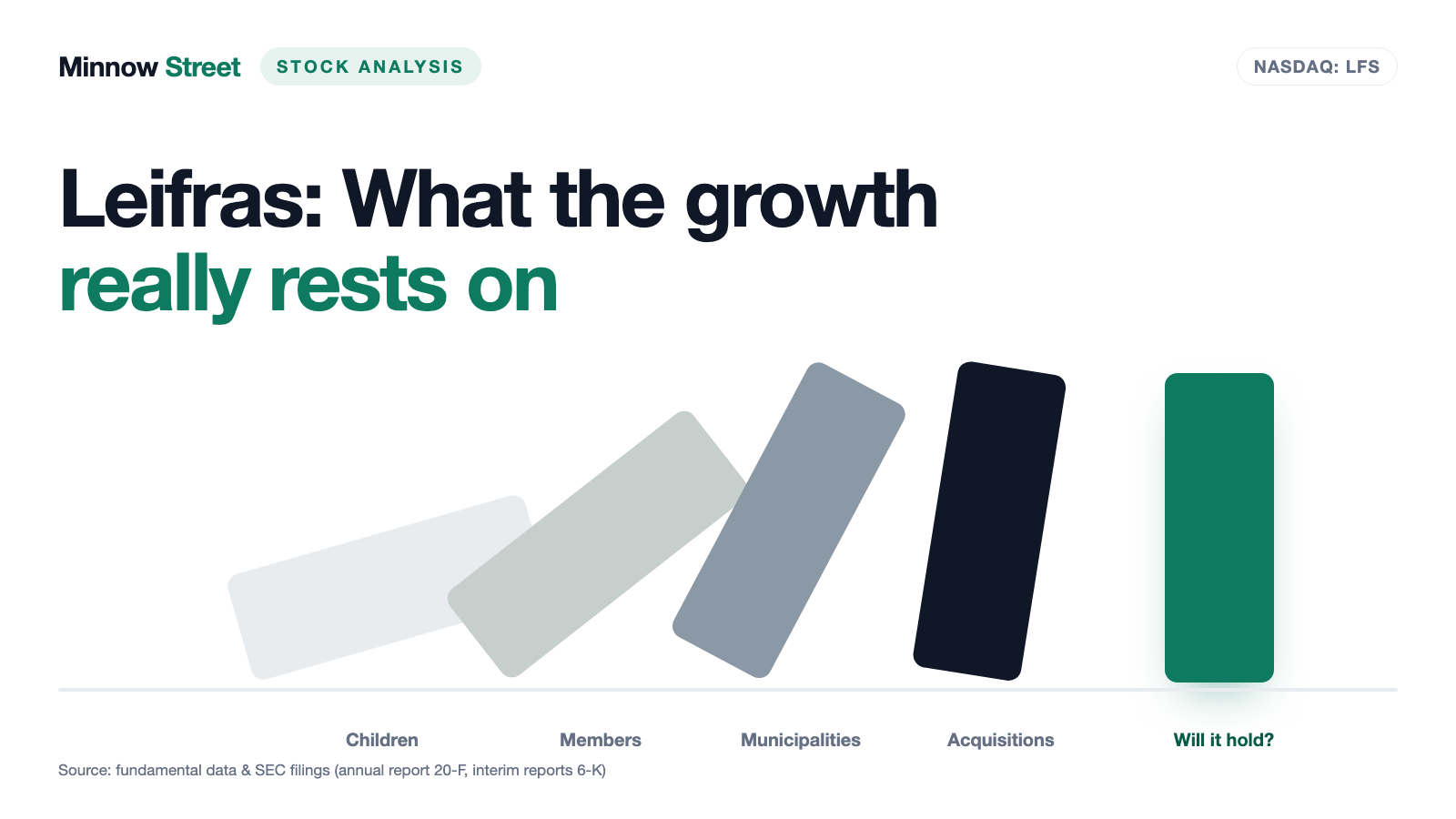
On paper Edenor looks like a bargain: Argentina's largest electricity distributor serves 3.4 million customers in greater Buenos Aires, holds a concession running to 2087 and trades at a price-to-earnings ratio of roughly 5.5. Its annual report to the U.S. securities regulator, the SEC, spells out what that profit is made of: Ps. 239,236 million of income for 2025 — next to a pure inflation entry of Ps. 307,317 million and a one-off debt gain of Ps. 218,114 million in the very same statement. Operating income from the grid business itself was Ps. 143,139 million. Add three things you can never forget in Argentina: the price of electricity is a political decision, the revenue arrives in pesos and the bonds are denominated in dollars. London fund Helikon Investments holds 6.02 percent of the depositary shares and has cut the position by 16.8 percent in a single quarter. Not investment advice — just the question of who actually wired this profit.
 Thomas Mücke
Founder & Publisher
Thomas Mücke
Founder & Publisher
Chart
Interactive price chart (TradingView).
Note: pure fact-based analysis, not investment advice and not a solicitation to buy or sell. All figures without guarantee.
Imagine a friend wants to sell you his pub and puts the numbers on the table: $100,000 of profit last year. Sounds good. On a second look you notice that $60,000 of it appeared because the landlord waived unpaid back rent, and another $70,000 because an old loan became lighter in real terms thanks to inflation. Selling food produced $30,000. Would you still value the pub at ten times $100,000? The reflex behind that mistake is so ordinary it barely registers: we assume that behind every dollar of profit stands a customer who wired it. Call it the invisible-payer trap. It sits between you and Empresa Distribuidora y Comercializadora Norte S.A., better known as Edenor (NYSE: EDN), Argentina's largest electricity distributor. The stock looks dirt cheap: a price-to-earnings ratio of roughly 5.5, a price below book value, 3.4 million customers and a concession that runs to 2087. So let's make a deal: before you think "cheap utility", we read together what the company itself reported to the U.S. securities regulator, the SEC — the annual report on Form 20-F for 2025 filed April 15, 2026, and the quarterly releases on Form 6-K. A filing to the SEC is honest under penalty of law. And this one describes a profit that mostly nobody wired, a selling price fixed by an agency, and pesos that are worth different amounts depending on the report date. What you make of it is your decision.
What Edenor actually does — it distributes electricity, it does not generate it
Edenor produces no power. It buys electricity in the Argentine wholesale market and carries it through substations and medium- and low-voltage networks into the apartment. In everyday terms: Edenor is not the dairy, it is the milkman — and the price of the milk is not set by him but by the state. The business rests on a concession dated August 5, 1992, created out of the privatization of the state utility SEGBA. It applies exclusively to the northwest of greater Buenos Aires and the north of the capital: 4,637 square kilometers, roughly nine million people and, as of March 31, 2026, exactly 3,396,632 customers. The term is 95 years and ends on August 31, 2087, extendable by ten years if Edenor applies at least 18 months in advance.
The money is made on the gap between purchase and sale — more precisely on the distribution margin, or VAD (Spanish valor agregado de distribución, "value added by distribution"). That is the part of the bill which does not go to the generator but stays with the network operator to cover operations, maintenance, depreciation and a return. This margin is set not by Edenor but by the regulator ENRE. Remember this one sentence, it carries the whole analysis: in a regulated distribution network the selling price is not a business decision, it is a political one.
That names the central tension of this piece: the stock is cheap on every standard metric — but both the earnings you divide by and the equity you compare against are figures out of a hyperinflation accounting system, and the price that creates those earnings is decided in Buenos Aires, not in the head office.
How the stock reached our desk
Not through a hit in our in-house stock scanner, but through two mandatory filings. On May 8, 2026, London-based Helikon Investments Ltd filed its Form 13F-HR for the quarter ended March 31, 2026 — the disclosure larger U.S. asset managers must make about their holdings. Of 17 positions worth $2,648,555,113 in total, Edenor is the second smallest: 1,331,614 American depositary shares worth $39,975,052. What matters is not the size but the direction. Across four quarters the position reads: 1,788,285 shares (June 30, 2025) → 1,788,285 (September 30) → 1,601,316 (December 31) → 1,331,614 (March 31, 2026). That is minus 16.8 percent in one quarter and minus 25.5 percent since the summer. In the same quarter the fund sold Pampa Energía outright ($50.0 million) — another Argentine energy name. Whoever held Argentine power in the first quarter of 2026 evidently took weight out.
The second filing is the real find. One day before the 13F, on May 7, 2026, Helikon reported the same position on a Schedule 13G/A — the beneficial ownership filing that becomes mandatory above five percent of a class. It contains the number the 13F omits: the 1,331,614 depositary shares equal 6.02 percent of all 22,110,519 outstanding ADSs. Converted into shares — one ADS represents 20 Class B shares — that is 26,632,280 shares, or roughly 2.9 percent of the entire capital stock of 906,455,100 shares. Small in the group, large in the class: the total free float is only 18.62 percent. As an aside, the same filing shows how such documents are made: in the description of the filer the issuer is named not as Edenor but as "Skeena Resources Ltd., a Vancouver corporation" — another name from the same portfolio, evidently left in from the template.
Before that turns into an investment case, the limits of the form belong in the picture: a 13F shows only U.S.-listed long positions, it appears 35 to 45 days late, and it contains no short sales, no derivatives beyond reported options and no European holdings. It is a rear-view mirror, not a route plan. Honesty also requires saying what our own metrics can and cannot do. The scanner carries eight quarters for Edenor and shows (data as of July 24, 2026) a Piotroski F-Score of 5 out of 9 — a nine-point test of the health of the books, where 8 or 9 means "robust" and 5 simply means "middling" — an equity ratio of 0.383 and a price-to-earnings ratio of 5.55. Altman Z, NCAV and cash are missing, and not out of sloppiness: the balance sheet is drawn up in Argentine pesos while the listing trades in U.S. dollars. Throw both into one formula and you get a number that helps nobody. Better an empty field than a wrong one — so we read the original documents instead.
The numbers over the years — and why you cannot line them up
First the part that genuinely impresses. Operationally 2025 was a turning point. Revenue rose 11.3 percent to Ps. 2,990,891 million (2024: 2,687,708; 2023: 2,008,401). Operating income swung from a loss of Ps. 343,145 million (2023) through Ps. 55,346 million (2024) to Ps. 143,139 million (2025). The distribution margin grew to Ps. 1,253,263 million. The first quarter of 2026 continued the trend: EBITDA of Ps. 190,579 million, up 127 percent year over year, with income for the period of Ps. 117,854 million (+147 percent). Network quality improved sharply too: average outage duration per customer (SAIDI) fell to 6.1 hours a year and the number of interruptions (SAIFI) to 2.9 — 78 and 67 percent better than 2017 and the best readings since. Rating agencies took note: on March 25, 2026 Fix SCR raised the long-term issuer rating from "A" to "A+", and on June 29, 2026 S&P raised the national scale issuer credit rating from "raA+" to "raAA−" and moved the outlook from positive to stable.
Now the catch that qualifies every one of those series. Argentina has qualified as a hyperinflationary economy since July 1, 2018; under the international standard IAS 29 every peso figure must be restated to the purchasing power of the reporting date. The annual report says so on its opening pages:
"Argentina has been considered a high-inflation economy for accounting purposes according to the IAS 29 'Financial reporting in hyperinflationary economies' since July 1, 2018. Therefore, the financial information included in this annual report for all the periods reported are presented on the basis of constant Argentine Pesos as of December 31, 2025, unless expressed otherwise."
— Empresa Distribuidora y Comercializadora Norte S.A., SEC annual report on Form 20-F for 2025, "Presentation of Financial Information"
What that means in practice shows up in a comparison people rarely make: the same balance sheet date in two different reports. For December 31, 2025 the annual report shows equity of Ps. 2,222,906 million and total assets of Ps. 5,759,383 million. The quarterly release of May 2026 gives, for exactly that day, Ps. 2,432,801 million of equity and Ps. 6,303,198 million of assets. Nothing happened — only the yardstick changed, because the figures are now measured in pesos of March 31, 2026. The ratio is identical in both: an equity ratio of 38.6 percent. Remember the practical rule: in Argentina ratios hold up, absolute peso amounts across years do not. The same quarter makes it even sharper: first-quarter 2026 revenue in constant pesos was Ps. 846,710 million — against Ps. 846,740 million a year earlier. Effectively no growth. In historical, unadjusted pesos the same company reports Ps. 819,959 million against Ps. 618,399 million for the same period — up 33 percent. Both numbers are correct. They are simply measured in different pesos.
When money units wobble, volumes help. Kilowatt-hours cannot be restated for inflation:
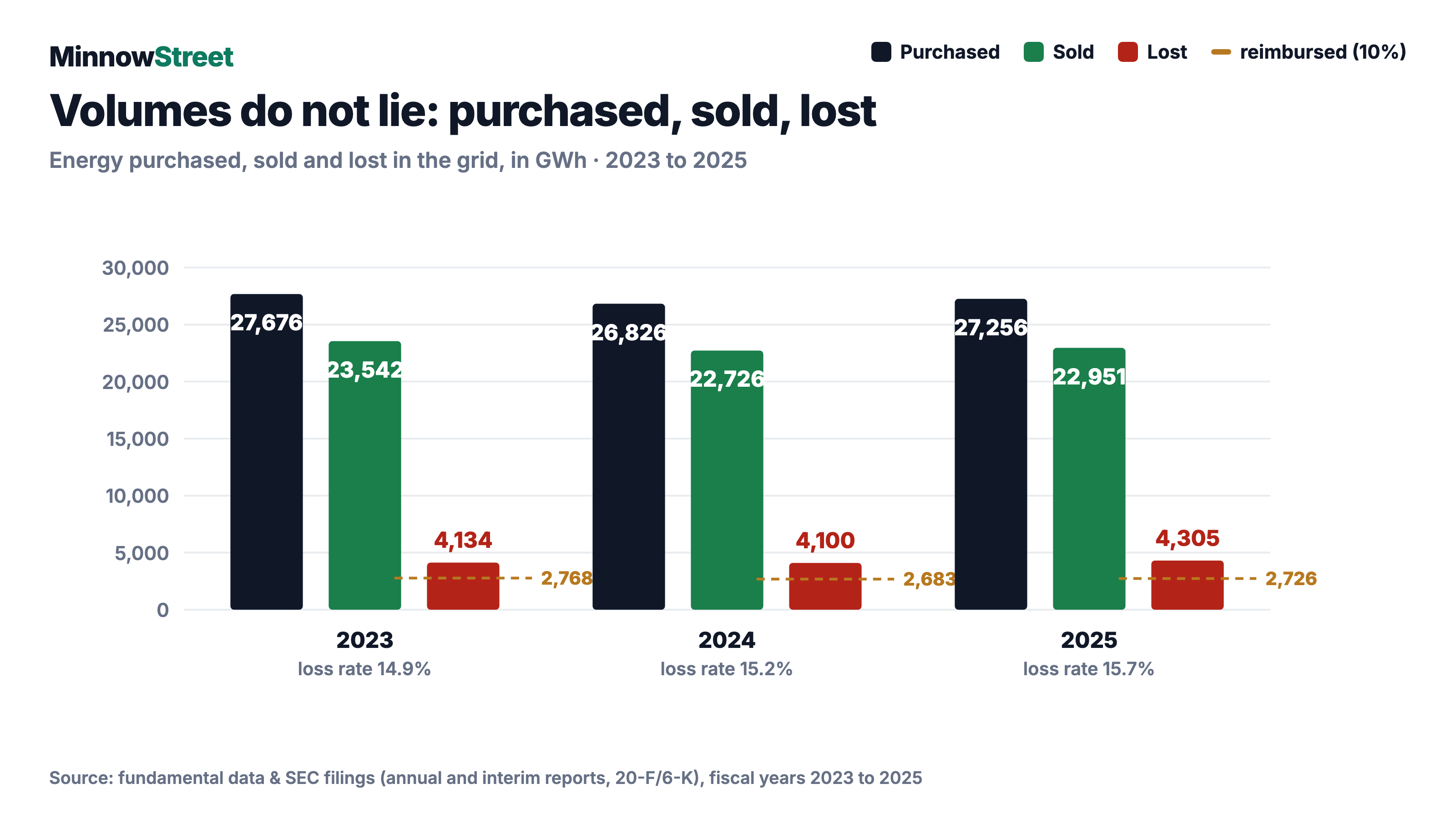
The picture is sobering and honest at once: 22,951 GWh were sold in 2025 — less than the 23,542 GWh of 2023. The customer count grew by a good one percent while consumption per customer fell. If you are looking for growth at Edenor, you will find it in the tariff, not in the meter.
What the filings say — the uncomfortable truths
Uncomfortable truth no. 1: most of the 2025 profit did not come from the grid
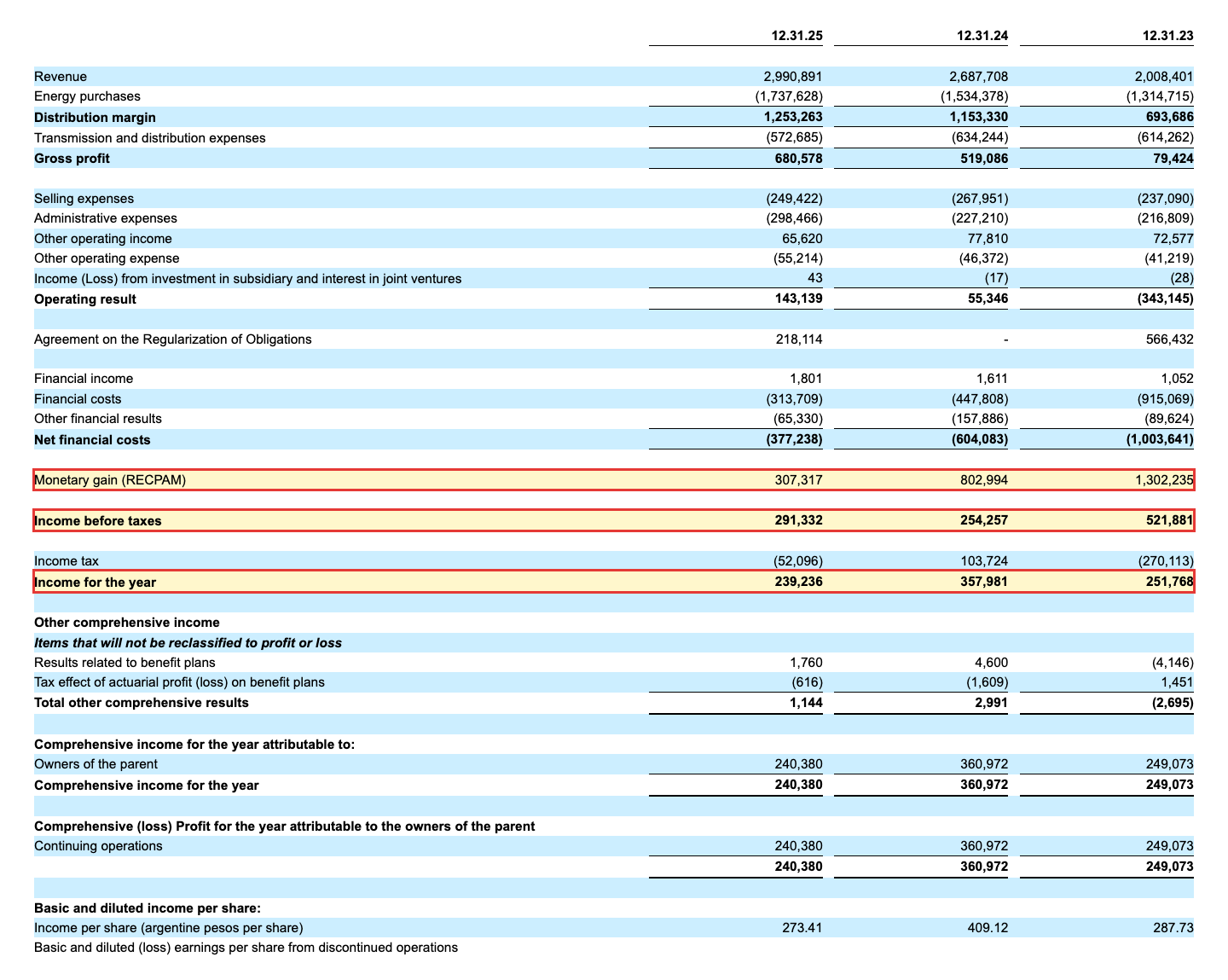
This is where a cheap price-to-earnings ratio turns into a question. Let us take the 2025 result apart — all figures in millions of pesos, constant purchasing power as of December 31, 2025:
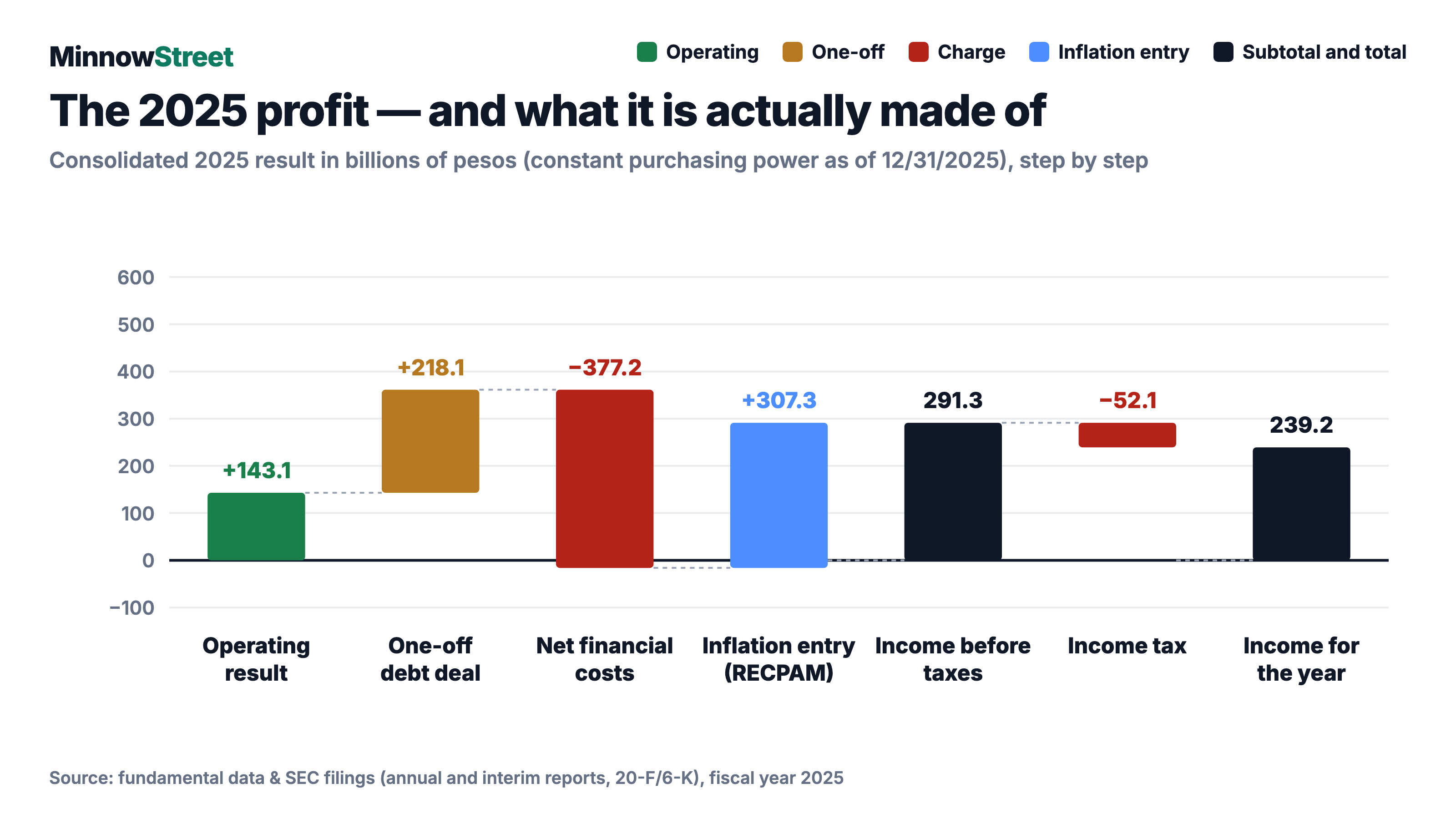
Two items deserve their own name. The first is RECPAM, defined in the report's glossary as "gain (loss) on exposure to the changes in the purchasing power of the currency". In everyday terms: if you owe $100,000 and overnight everything doubles in price, your debt has become half as heavy in real terms — under IAS 29 that advantage is booked as income. Edenor owes more money than it is owed, so the item is positive: Ps. 307,317 million in 2025, after 802,994 (2024) and 1,302,235 (2023). In all three years that single line was larger than all of income before taxes.
The second item appears in the statement as "Agreement on the Regularization of Obligations" and is a one-off gain of Ps. 218,114 million from restructuring the debt owed to CAMMESA — the company that administers the Argentine wholesale power market and is therefore Edenor's largest supplier. The annual report quantifies the effect and the remaining debt in one paragraph:
"The combined effect of the signed agreements amounts to Ps.218,114 million, which has been disclosed in the Agreement on the Regularization of Payment Obligations line item of the Statement of Comprehensive Income."
— Empresa Distribuidora y Comercializadora Norte S.A., SEC annual report on Form 20-F for 2025, Item 3 "Risk Factors" — commercial debt with CAMMESA

To be fair: the company hides nothing. It discloses the line separately, and its own quarterly release does the arithmetic for you — without the CAMMESA gain, 2025 EBITDA was about Ps. 354 billion instead of Ps. 572 billion, up 30 percent instead of 110 percent. But the debt has not disappeared, it has been stretched: the agreement of May 22, 2025 covering Ps. 129,970 million became 72 monthly installments with a twelve-month grace period, and as of April 14, 2026 the updated outstanding amount stood at Ps. 240,755 million. Remember the mechanism: a debt plan turns a liability into a book gain — it is still paid, only later.
Uncomfortable truth no. 2: the selling price is a political decision
A furniture store can raise prices when timber gets more expensive. Edenor cannot. How brutal that can get is written into the annual report as a history lesson: after the 2002 emergency law all adjustment clauses were revoked, and from January 2002 through January 2007 — five years — Edenor had to charge the same peso margin as in 2002, with no inflation or currency adjustment whatsoever. The report states the consequence plainly: a material adverse effect on financial condition, results of operations and cash flows, leading to net losses. If you want to know why a stock with a concession running to 2087 trades at a fraction of book value, a good part of the answer is here.
A new order has applied since April 2025, and it is real progress: the ENRE approved a five-year tariff review for 2025 to 2030 with automatic monthly adjustments based on a formula of the consumer price index (33 percent) and the wholesale price index (67 percent) — plus an extra 0.42 percent per month between June 2025 and November 2027. So far it works: tariffs rose 37 percent in 2025 against 32 percent consumer inflation, and 9 percent in the first quarter of 2026 against 9 percent inflation. But the order is not set in stone. The energy emergency, under which the regulator ENRE has been under government intervention since 2023, was extended by decree to July 9, 2026 — what applies after that date appears in none of the filings submitted through the end of June 2026. And Edenor itself considers the framework incomplete: it has filed a claim over the historical tariff freezes, the so-called "Regulatory Asset", whose amount was calculated by independent third parties and is still under review by the Energy Secretariat; according to the May 2026 quarterly release the executive has submitted a bill to Congress on the matter. The outcome is open — and it can move hundreds of billions of pesos in either direction.
Uncomfortable truth no. 3: revenue in pesos, bonds in dollars — and no hedge
This truth is the most dangerous because it sounds so technical. The annual report puts it in a single paragraph:
"Our revenues are collected in Pesos pursuant to tariffs that are not indexed to the U.S. Dollar, while a significant portion of our existing financial indebtedness is denominated in U.S. Dollars, which exposes us to the risk of loss from devaluation of the Peso. […] The Argentine Government does not allow companies, including us, to access the market to acquire U.S. Dollars to hedge our financial position."
— Empresa Distribuidora y Comercializadora Norte S.A., SEC annual report on Form 20-F for 2025, Item 3 "Risk Factors"

The magnitude: as of March 31, 2026 the books carried $832 million of financial debt, $763 million net. At the end of April 2026 Edenor placed a new Class 10 note of $550 million at a 9.5 percent coupon, amortizing in three installments in 2031, 2032 and 2033 — the order book for the first series reached $1,151 million, more than twice the size. With the proceeds the company bought back $175 million of the more expensive Class 7 notes; after that round, senior notes stood at $1,017 million pro forma as of April 30, 2026. The capital market trusts Edenor again. But the peso devalued 41 percent in nominal terms against the dollar in 2025 alone, against 31.5 percent inflation — the translation rate on December 31, 2025 was Ps. 1,455.00 per dollar. Every further devaluation makes the same dollar debt heavier in pesos, while revenue follows a formula that does not know the dollar.
Uncomfortable truth no. 4: one in six kilowatt-hours never arrives — one in ten is reimbursed
In 2025 Edenor purchased 27,256 GWh and sold 22,951 GWh. The gap of 4,305 GWh is network losses: 8.7 percentage points technical, 7.0 percentage points non-technical — theft and illegal connections. Together 15.7 percent, after 15.2 percent (2024) and 14.9 percent (2023). And here is the design flaw:
"Our concession does not allow us to pass through to our users the cost of additional energy purchased to cover any energy losses that exceed the loss factor contemplated by our concession, which is, on average, 10%. […] Our energy losses amounted to 4,305 GWh in 2025, showing a slight increase of 5% compared to 2024."
— Empresa Distribuidora y Comercializadora Norte S.A., SEC annual report on Form 20-F for 2025, Item 3 "Risk Factors"
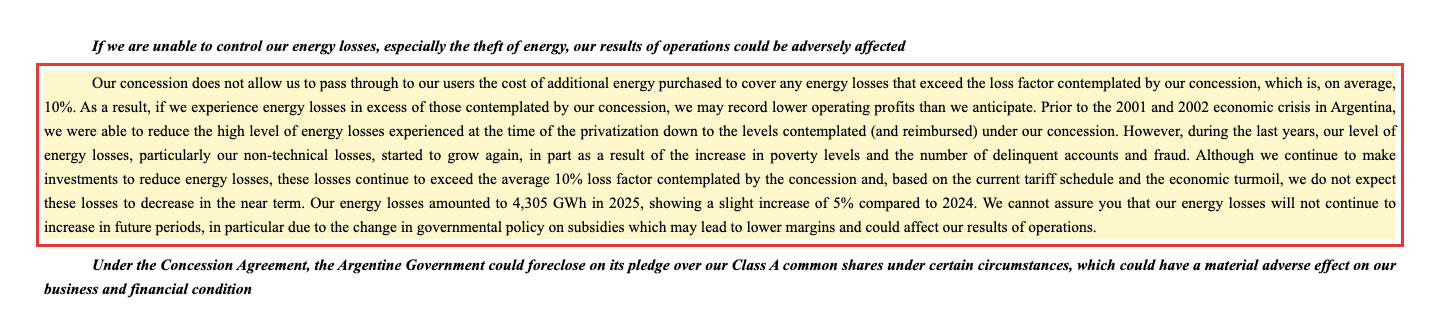
Do the math: about 2,726 GWh are reimbursed, 4,305 GWh are lost — leaving roughly 1,579 GWh that Edenor pays for and may never bill. At energy purchases of Ps. 1,737,628 million for 27,256 GWh, or about Ps. 63.8 million per GWh, that is around Ps. 100 billion a year — a good two thirds of the entire operating income. For scale: at privatization in 1992 losses ran at 26.59 percent, and by 2000 Edenor had pushed them down to 10 percent. They have been climbing since, and the company openly blames poverty, growing informal settlements and fraud. There is progress: after the first quarter of 2026 the trailing twelve-month rate eased to 15.3 percent, and 26,087 integrated energy meters (MIDE) were added in 2025, bringing the installed base to 260,233.
Uncomfortable truth no. 5: the state sits on both sides of the table — and nothing is paid out
Finally the ownership question, and it is remarkable. Control rests with 462,292,111 Class A shares, or 51.0 percent, held by Empresa de Energía del Cono Sur S.A. ("Edelcos"), which in turn belongs to UK-based South American Energy LLP and has controlled the company since June 30, 2021. The second-largest holder, with 242,999,553 shares or 26.81 percent, is FGS ANSES — the sustainability guarantee fund of Argentina's state social security administration. That makes the state simultaneously the grantor of the concession, the tariff regulator, the largest supplier through CAMMESA and the second-largest shareholder. The annual report states expressly that the government and ANSES could together determine substantially all matters requiring shareholder approval. The free float comes to 168,793,998 shares, or 18.62 percent; another 3.39 percent sits in treasury.
And none of it is paid out: Edenor has not declared or paid a dividend since August 14, 2001. The report at least states an intention — to evaluate a formal dividend policy "in a prudent manner", taking into account investment needs and debt service. The regulatory restriction was lifted back in February 2017, so the obstacle is not the law but the decision. For you as a minority holder that means you are betting purely on the share price — and a good part of that price is decided by a tariff ruling.
Valuation: why the P/E is single digit — and what that really means
We do not need a daily price for a dated valuation anchor: the company's own quarterly release puts market capitalization as of May 7, 2026 at Ps. 1,603,374,329,751, or $1,070,959,478, at a price of Ps. 1,831 per share and $24.46 per ADS. In orders of magnitude that implies a price-to-earnings ratio of roughly 6.7 on the 2025 result (earnings per share of Ps. 273.41) — our scanner shows 5.55 on a trailing basis — a price-to-book ratio of roughly 0.7 (equity of Ps. 2,222,906 million over 875.7 million shares outside treasury, or about Ps. 2,538 per share) and a market value equal to roughly 1.4 times net dollar debt. For a network operator with a monopoly area and a term running to 2087, that sounds like a misprint.
It is not — it is a price for three things you buy along with it. First, for earnings whose largest building block is the inflation entry: if inflation keeps falling (2023: 211.4 percent, 2024: 117.8 percent, 2025: 31.5 percent), the RECPAM line shrinks mechanically and the price-to-earnings ratio rises without a single customer using less electricity. Second, for equity whose peso amount is rescaled at every reporting date — book value per share is not a fixed quantity but a function of a price index. Third, for a country whose government once froze tariffs for five years. How completely a contract and regulatory structure can dominate a valuation is something we saw recently in another Argentine name from the same portfolio — our analysis of Corporación América Airports, where IAS 29 likewise renders the earnings series unreadable and a state may end the contract. More cases in which the accounting matters more than the story sit in our research section.
Opportunities and risks at a glance
What speaks for Edenor:
- A genuine monopoly with a very long term: an exclusive concession covering 4,637 square kilometers and roughly nine million people through August 31, 2087, extendable by ten years; 3,396,632 customers as of March 31, 2026 (+1.4 percent year over year).
- The tariff regime works for the first time in years: a five-year review since April 2025 with automatic monthly adjustments on a price-index formula plus 0.42 percent monthly through November 2027; tariffs up 37 percent in 2025 against 32 percent inflation, and up 9 percent against 9 percent in the first quarter of 2026.
- An operating turnaround: operating income from −Ps. 343,145 million (2023) to +Ps. 143,139 million (2025); EBITDA up 127 percent to Ps. 190,579 million in the first quarter of 2026; operating expenses down 9 percent; a collection rate of 95.68 percent.
- Network quality at its best level since 2017: SAIDI of 6.1 hours and SAIFI of 2.9 outages per customer per year, 78 and 67 percent better than 2017 and inside the regulator's requirements.
- The capital market is back: a $550 million note placed in April 2026 with an order book more than twice oversubscribed, plus a $175 million buyback of more expensive legacy debt; rating upgrades from Fix SCR (March 2026) and S&P National (June 2026, to "raAA−").
What speaks against it:
- Most of the profit is accounting: in 2025 an inflation entry of Ps. 307,317 million and a one-off gain of Ps. 218,114 million stood against operating income of Ps. 143,139 million and net financial costs of Ps. 377,238 million. Without the inflation line there would have been a pre-tax loss — in all three reported years.
- The annual series are not comparable: under IAS 29 the same December 31, 2025 balance sheet date shows equity of Ps. 2,222,906 million in the annual report and Ps. 2,432,801 million in the quarterly report. Lining up peso amounts across years means comparing units that merely share a name.
- The price is politics: from January 2002 through January 2007 the same peso margin applied with no inflation adjustment; the energy emergency with government intervention of the regulator has been extended by decree to July 9, 2026, and the claim over the old freezes ("Regulatory Asset") remains unquantified and unresolved.
- Peso revenue against dollar debt with no full hedge: $832 million of financial debt as of March 31, 2026, while the peso devalued 41 percent in nominal terms in 2025; per the annual report, access to the foreign exchange market for hedging purposes is not permitted.
- A structural loss gap and no payout: network losses of 15.7 percent against roughly 10 percent reimbursed cost an estimated Ps. 100 billion a year; the last dividend was paid on August 14, 2001, and the free float is only 18.62 percent.
A human conclusion
Back to the pub and the invisible-payer trap. Its core is not that Argentine numbers are faked — on the contrary, Edenor reports under an internationally recognized standard, discloses every special item on its own line and names its risks more clearly than many a European company does. Its core is that we never read the sender line on a profit. A ratio of 5.5 sounds like a bargain, but behind most of that denominator stands no customer — only a price index and a creditor who gave something up. What remains is nonetheless a real business: a grid that delivered 22,951 GWh and earned operationally for the first time in years, with better outage figures than ever and a tariff mechanism that has held so far. The honest question for you is therefore not "is the stock cheap?" but: do you trust yourself, five years from now, to still be able to tell how much of this profit comes from the grid — and how much from the accounting and from a tariff ruling? Whoever has an evidenced answer has a thesis. Whoever does not has a low number. What you make of it is your decision. And that is exactly as it should be.
Sources
Every original document used in this analysis, for you to read yourself:
- Empresa Distribuidora y Comercializadora Norte S.A. — SEC annual report on Form 20-F for 2025 (filed April 15, 2026)
- Empresa Distribuidora y Comercializadora Norte S.A. — First-quarter 2026 earnings release, Form 6-K filed May 8, 2026
- Empresa Distribuidora y Comercializadora Norte S.A. — Fourth-quarter and full-year 2025 earnings release, Form 6-K filed March 6, 2026
- Empresa Distribuidora y Comercializadora Norte S.A. — Rating upgrade by S&P National Ratings, Form 6-K filed June 29, 2026
- Full SEC filing history: EDGAR overview, Empresa Distribuidora y Comercializadora Norte S.A. (sec.gov)
- Helikon Investments Limited — Schedule 13G/A (Amendment No. 2) for the quarter ended March 31, 2026, filed May 7, 2026
- Helikon Investments Ltd — Form 13F-HR for the quarter ended March 31, 2026, filed May 8, 2026 (EDGAR overview, sec.gov)
- Fundamental data (scanner metrics, valuation; data as of July 24, 2026), reconciled with the SEC filings.
Transparency & disclaimer: This analysis is a journalistic contextualization of publicly available information and is not investment advice, not a regulated financial analysis and not a solicitation to buy or sell securities. Equity investments carry substantial risk up to total loss. All information without warranty; the data cut-off is noted in the text. The author holds no position in Edenor shares at the time of publication.
Our Bottom Line at a Glance
- Operating business positive
- After years in the red the grid earns again: operating income swung from −Ps. 343,145 million (2023) through Ps. 55,346 million (2024) to Ps. 143,139 million (2025), and first-quarter 2026 EBITDA rose 127 percent to Ps. 190,579 million. Network quality, at 6.1 hours of outage (SAIDI) and 2.9 interruptions (SAIFI) per customer per year, is the best since 2017.
- Quality of earnings negative
- The 2025 result of Ps. 239,236 million rests on two items no customer paid: the inflation entry RECPAM at Ps. 307,317 million and a one-off gain from the CAMMESA debt plan at Ps. 218,114 million. In all three reported years the RECPAM line was larger than all of income before taxes — and it shrinks with inflation, which has fallen from 211.4 percent to 31.5 percent.
- Reliability of the numbers negative
- IAS 29 hyperinflation accounting makes peso series unreadable across years. For the same December 31, 2025 date the annual report shows equity of Ps. 2,222,906 million and the quarterly report Ps. 2,432,801 million; first-quarter 2026 revenue in constant pesos is Ps. 846,710 million against Ps. 846,740 million — and 33 percent higher year over year in historical pesos.
- Regulation & country risk neutral
- The five-year tariff review in force since April 2025 has worked so far: automatic monthly adjustment on a price-index formula plus 0.42 percent through November 2027, with tariffs up 37 percent in 2025 against 32 percent inflation. Historically, however, tariffs were frozen from January 2002 through January 2007, the energy emergency has been extended by decree to July 9, 2026, and the "Regulatory Asset" claim is unquantified and unresolved.
- Balance sheet & currency neutral
- The equity ratio stands at 38.6 percent, cash rose to Ps. 207,180 million, and the capital market is back: a $550 million note in April 2026 with an order book more than twice oversubscribed, plus rating upgrades in March and June 2026. Against that sit $832 million of financial debt while revenue arrives in pesos and, per the annual report, cannot be fully hedged.
- Ownership & payout negative
- 51.0 percent sits with Edelcos and a further 26.81 percent with the state social security fund FGS ANSES — making the state grantor, tariff regulator, largest supplier and second-largest shareholder at once. The free float is 18.62 percent. The last dividend was paid on August 14, 2001, and the controlling block must be put out to international tender before the end of every management period.
Edenor is the invisible-payer trap in its purest form: on the ticker a monopolist with a concession to 2087, 3.4 million customers and a price-to-earnings ratio of roughly 5.5 — in the annual report a result whose largest building block is an inflation entry of Ps. 307,317 million, topped up by a one-off debt gain of Ps. 218,114 million. The grid itself earned Ps. 143,139 million. The operating turnaround is real, network quality is the best on record and the tariff regime is predictable for the first time in years; at the same time the price remains a political variable, the debt is in dollars and the losses in the grid exceed what is reimbursed. Not investment advice.
What Our Rating Means
Open questions
The business works in principle, but one material question is open. As long as it stays open, our findings do not carry a quality verdict.
Whoever buys today is betting less on kilowatt-hours than on rules: that the five-year tariff review survives untouched through 2030 and keeps the margin intact in real terms even as inflation falls, that the "Regulatory Asset" claim ends in money rather than paper, and that the peso does not make the $832 million of dollar debt heavier than the tariff formula can offset. Whoever waits checks three things in every report: how large is operating income without the inflation entry and without one-offs? Is the 15.7 percent loss rate moving toward the reimbursed 10 percent? And does a first dividend since 2001 arrive, or does the payout stay a statement of intent? Earnings that come mostly from the accounting are the reason for caution. The decision is yours.
A journalistic assessment by our editorial team at the time of the deep dive, based on public sources — not investment advice and not a solicitation to buy or sell. Your personal circumstances (investment goals, risk capacity, taxes) cannot be taken into account. What our levels mean, how verdicts are formed, and what conflicts of interest exist →
Worth Noting
- Edenor reached our research list through the Form 13F-HR of London-based Helikon Investments Ltd for the quarter ended March 31, 2026 (filed May 8, 2026): 1,331,614 depositary shares worth $39,975,052, the second smallest of 17 positions and down 25.5 percent over two quarters. The Schedule 13G/A of May 7, 2026 puts the holding at 6.02 percent of all 22,110,519 ADSs. A 13F shows only U.S.-listed long positions, appears 35 to 45 days late and contains no short sales or derivatives — a rear-view mirror, not a route plan.
- Edenor is a foreign private issuer: there is no 10-K and no 10-Q. The evidence chain for this analysis is the annual report on Form 20-F for 2025 (filed 15.04.2026) plus the announcements on Form 6-K (first-quarter 2026 figures filed 08.05.2026, fourth-quarter and full-year 2025 figures filed 06.03.2026, rating upgrade filed 29.06.2026). Our in-house stock scanner carries eight quarters with a Piotroski F-Score of 5 of 9, an equity ratio of 0.383 and a price-to-earnings ratio of 5.55; Altman Z, NCAV and cash are deliberately absent because the balance sheet is kept in pesos while the listing trades in U.S. dollars.
- Valuation figures are dated and evergreen: market capitalization and price come from the quarterly release as of May 7, 2026 (Ps. 1,603,374,329,751 or $1,070,959,478) and are not a daily price; analyses are evergreen, daily prices are not a buy argument. Because of IAS 29 hyperinflation accounting, peso series are only comparable across years to a limited extent — energy sold in GWh, customer count, the loss rate and ratios such as the equity ratio are the more reliable measures.
Stock Watch
This analysis is as of July 23, 2026. Stock Watch will tell you what's changed at EDN since then.
Later $1 a month per stock — signing up is free, and you'll be the first to know when it launches.
Frequently Asked Questions
Empresa Distribuidora y Comercializadora Norte S.A. (NYSE: EDN) distributes electricity — it does not generate it. Under a concession dated August 5, 1992 it serves the northwest of greater Buenos Aires and the north of the capital on an exclusive basis: 4,637 square kilometers, roughly nine million people and 3,396,632 customers as of March 31, 2026. By its own account it is Argentina's largest electricity distributor.
Because most of the profit consists of accounting entries. In 2025 Edenor reported income for the year of Ps. 239,236 million — including a pure inflation entry (RECPAM) of Ps. 307,317 million and a one-off gain of Ps. 218,114 million from the CAMMESA debt plan. Operating income was Ps. 143,139 million and net financial costs were Ps. 377,238 million. Without the inflation line the company would have shown a pre-tax loss.
Argentina has qualified as a hyperinflationary economy since July 1, 2018. Under IAS 29 every peso figure is restated to the purchasing power of the reporting date. That is why the same balance sheet date of December 31, 2025 shows equity of Ps. 2,222,906 million in the annual report and Ps. 2,432,801 million in the quarterly report three months later. Ratios such as the equity ratio (38.6 percent) stay the same; absolute amounts do not.
RECPAM is the gain or loss on exposure to changes in the purchasing power of the currency. Holding more monetary liabilities than monetary assets produces a gain under hyperinflation because the debt becomes lighter in real terms; IAS 29 books that advantage as income. At Edenor it came to Ps. 307,317 million (2025), Ps. 802,994 million (2024) and Ps. 1,302,235 million (2023) — each time more than all of income before taxes that year.
The regulator ENRE. It fixes the distribution margin (VAD), the part of the bill that stays with the network operator. Since April 2025 a five-year tariff review for 2025 to 2030 has applied, with automatic monthly adjustments based on a formula of the consumer price index (33 percent) and the wholesale price index (67 percent) plus 0.42 percent per month between June 2025 and November 2027. Tariffs were frozen from 2002 to 2007.
They reached 15.7 percent of energy purchased in 2025, or 4,305 GWh — 8.7 percentage points technical and 7.0 percentage points non-technical, meaning largely theft. The figures were 15.2 percent in 2024 and 14.9 percent in 2023. The concession, however, reimburses the cost only up to a loss factor of about 10 percent on average. On a trailing twelve-month basis the rate eased to 15.3 percent by March 2026.
No. According to the annual report, Edenor has not declared or paid a dividend since August 14, 2001. The regulatory restriction on payouts was lifted back in February 2017; the company says it intends to evaluate a formal dividend policy prudently, taking investment needs and debt service into account. No commitment and no timetable appear in the filing.
As of December 31, 2025 Empresa de Energía del Cono Sur S.A. ("Edelcos") held 462,292,111 Class A shares, or 51.0 percent; Edelcos belongs to UK-based South American Energy LLP. The second-largest holder is the state social security fund FGS ANSES with 242,999,553 shares, or 26.81 percent. The free float is 168,793,998 shares, or 18.62 percent, with a further 3.39 percent held in treasury.
Found an error?
Did you spot a factual error, an outdated number, or a typo in this deep dive? Let us know briefly — your report goes straight to the editorial team.