Carter's Stock: $2.87 in Earnings — $2.73 of It Came Back From Customs
In the second quarter of 2026 Carter's reported diluted earnings of $2.87 per share, against $0.01 a year earlier. The quarterly report explains the jump itself: $127.7 million of refunded import duties, which the company then removes again in its own reconciliation. Adjusted, $0.26 and a 2.9 percent operating margin remain instead of 22.7 percent — while first-half segment income falls and new tariffs took effect on July 24, 2026. Not investment advice — just the exercise of taking a headline apart until only the business is left.
 Thomas Mücke
Founder & Publisher
Thomas Mücke
Founder & Publisher
Chart
Interactive price chart (TradingView).
Note: pure fact-based analysis, not investment advice and not a solicitation to buy or sell. All figures without guarantee.
There is one investor trap that springs faster than any other, because it only needs a single number: the headline trap. It works like this. You see a report — "earnings per share up from $0.01 to $2.87" — and your head has finished the story before you have read the second sentence: turnaround, inflection, finally. What the head skips is the question of where the $2.87 came from. Carter's, Inc. (NYSE: CRI), the largest supplier of baby apparel in North America, reported that number on July 31, 2026. So let us make a deal: we leave the headline lying there for a moment and read together what the company itself told the U.S. Securities and Exchange Commission — the quarterly report (10-Q) for the period ended July 4, 2026, the earnings release filed the same day, and the annual report (10-K) for 2025. An SEC filing is honest under penalty of law. At the end, you decide for yourself.
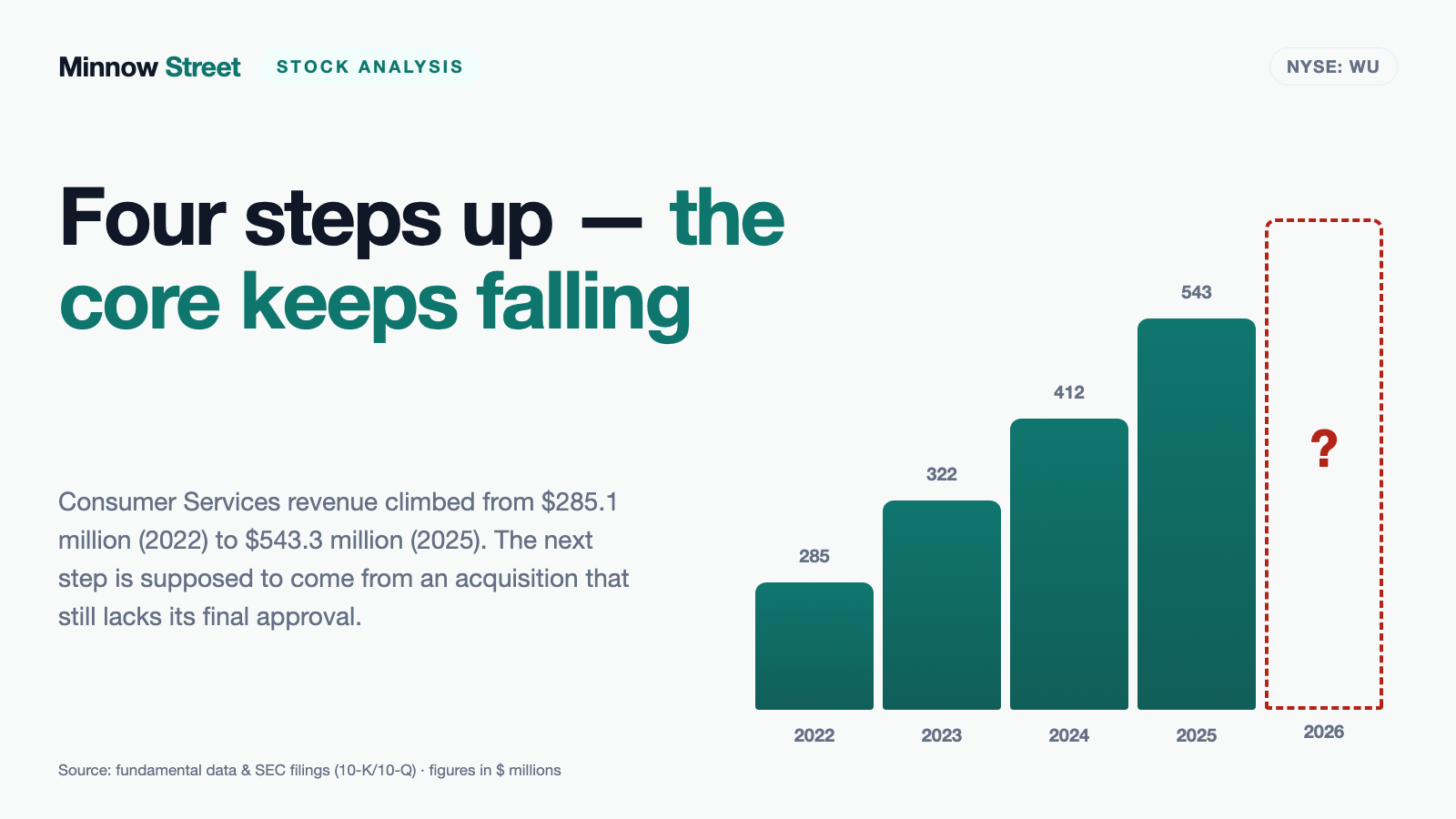
The central tension of this analysis sits inside a single quarterly report, and it runs through every chapter: Carter's reported the highest operating margin of its recent history in the second quarter of 2026 — 22.7 percent — and in the same document calculated that 2.9 percent of it came from the ongoing business. The rest came from the customs authority.
What Carter's actually does — onesies, shelf space and three cash registers it does not own
Carter's sells clothing for people who cannot walk yet. That is not a side business but the entire purpose of the firm: the annual report (10-K) for 2025 describes it as North America's largest and most enduring apparel company exclusively for babies and young children. The core brands are Carter's and OshKosh B'gosh, joined by Little Planet (organic cotton), Otter Avenue (toddlers) and Skip Hop (baby essentials from tubs to toys).
Selling happens through three routes, and the company reports along the same lines. U.S. Retail is the company's own stores and its own online shop: 804 stores in the United States as of January 3, 2026, plus 192 in Canada and 72 in Mexico — 1,068 company-operated stores in total, and half a year later still 1,042 (as of July 4, 2026). U.S. Wholesale is shelf space in other people's stores: roughly 19,500 locations across North America, from Costco to Kohl's to T.J. Maxx. And then there is a peculiarity you have to know in order to read the numbers: three exclusive brands that Carter's develops for one retailer each — Child of Mine for Walmart, Just One You for Target, Simple Joys for Amazon. The third segment, International, covers Canada, Mexico and partner stores outside North America.
That construction explains a number that matters later. The annual report for 2025 records that roughly 35 percent of consolidated net sales came from U.S. Wholesale, roughly 30 percent from the five largest wholesale customers — and the two largest alone accounted for 11.0 and 10.3 percent. Hold on to that picture: a fifth of revenue runs across two cash registers the company does not own.
The environment is not friendly. The U.S. market for apparel for ages zero to 10 was worth roughly $29 billion as of December 2025. Carter's is number one there — but with a narrowing lead. And the reason lies outside the company: the first market condition the annual report names as something it had to respond to is declining birth rates. Anyone selling baby clothes is selling into a market that is demographically shrinking. We described a comparable pattern — strong brand, shrinking base — in our analysis of Deckers, though with the sign reversed.
How the stock landed on our desk — through the calendar, not the price
Carter's came onto the research list through the SEC's filing calendar. On July 31, 2026 two documents arrived there on the same day: the quarterly report (10-Q) for the period ended July 4, 2026, and the earnings release as Exhibit 99.1 to a current report (8-K). Such double filings are the norm, and they are worth a look — because the company's outlook appears only in the exhibit, not in the quarterly report.
The headline was unambiguous: net sales up 5 percent, operating income from $4.0 million to $139.8 million, earnings per share from $0.01 to $2.87. Arithmetically that is a gain of more than 28,000 percent. Percentages like that almost never come from genuine improvement; they come from replacing a very small number with a very large one. A 28,000 percent earnings jump is not news, it is a question. And the report answers that question on page one of its own reconciliation.
The numbers across the years — given their honest due
First what speaks for Carter's, and it is more than the recent quarters suggest. This company makes money, every single year, and it has a balance sheet many retailers would envy. As of July 4, 2026 the books showed $653.6 million in cash, equity of $1,027.3 million against total assets of $2,732.4 million. Financial debt consists of a single bond of $575.0 million principal (carrying value net of issuance costs $567.8 million) — so cash exceeds financial debt. The $750 million revolving credit facility was undrawn, $568.6 million of it available, and the company was in compliance with its covenants. There is no going-concern warning, no goodwill impairment, no listing risk. What does not appear in that calculation and still has to be paid every month: $616.9 million of lease liabilities from the leases on the company's own stores.
The business is growing again, too — in nominal terms. Net sales rose 5.2 percent to $615.5 million in the second quarter of 2026 and 6.7 percent to $1,296.6 million in the first half. All three segments grew, and comparable sales in the company's own U.S. retail business were up 5.1 percent in the quarter and 7.8 percent in the half. After years of falling store sales, that is a genuine finding and not accounting cosmetics.
And now the frame it sits in. GAAP operating income fell for four consecutive fiscal years: from $379.2 million (2022) through $323.4 million (2023) and $254.7 million (2024) to $143.9 million (2025) — a 62 percent decline in three years. Earnings per share followed the same path: $6.34 · $6.24 · $5.12 · $2.53. Cash from operations, still $529.1 million in 2023, came to only $122.3 million in 2025 — after $53.7 million of capital expenditure and $56.4 million of dividends, roughly $12 million of that was left.
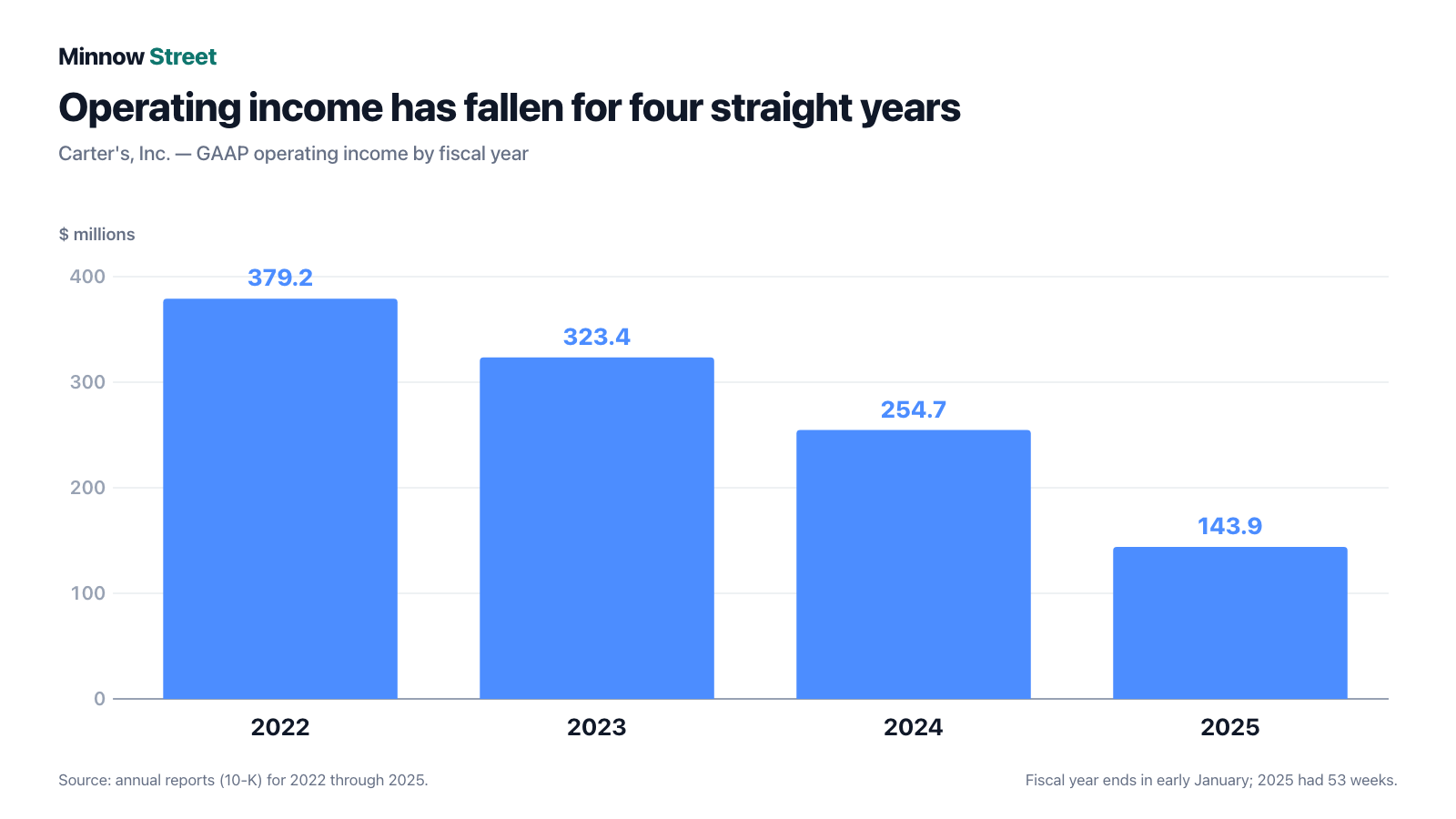
A word on the fiscal year, because it distorts comparisons: Carter's does not report in calendar years. Its fiscal year ends on the Saturday closest to December 31 — fiscal 2025 ended on January 3, 2026 and had 53 weeks instead of 52. That single extra week added roughly $37 million of net sales. Of the full-year 2025 sales increase of $54.3 million, that leaves roughly $17 million of real growth — a little under 0.6 percent.
What the filings say — the uncomfortable truths
Uncomfortable truth no. 1: the profit came from the customs authority, not the shop floor
This is the core of the analysis, and the good part is that Carter's does not hide it. In the first quarter of 2026 the U.S. Supreme Court ruled that tariffs imposed under the emergency powers act IEEPA were unlawful. U.S. Customs and Border Protection set up a refund process on April 20, 2026, Carter's filed claims of roughly $130 million — and in the second quarter the money arrived.
"During the second quarter of fiscal 2026, the Company received refund payments from U.S. Customs and Border Protection totaling approximately $132 million, including interest, in connection with various adjudicated claims, and the related recovery has been recognized."
— Carter's, Inc., SEC quarterly report 10-Q for the period ended July 4, 2026, Note 2
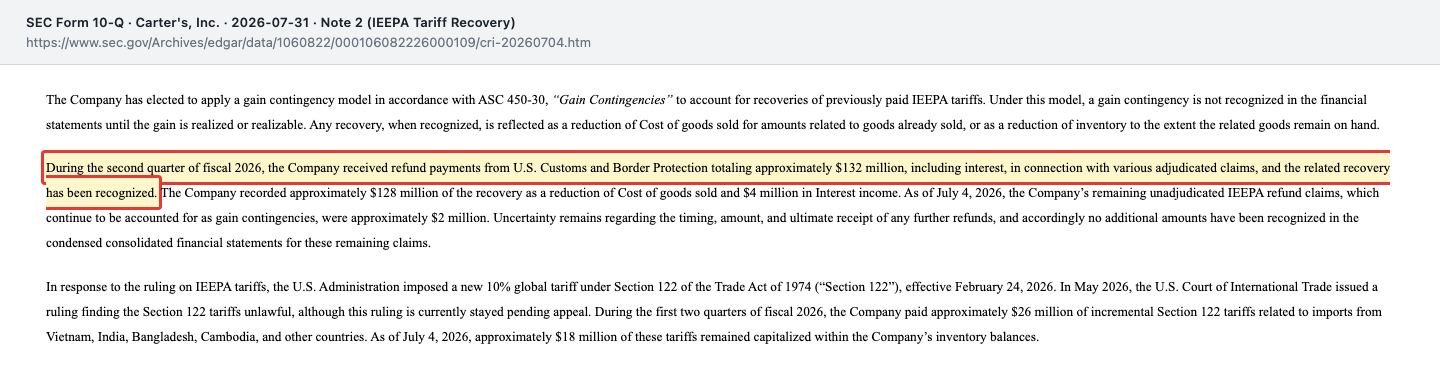
What that does to the numbers, the company works out in the earnings release itself — and it works it out against itself. From reported operating income of $139.8 million, Carter's deducts the tariff refund of $127.7 million, adds back $4.7 million of leadership transition costs and $1.2 million of litigation costs, and arrives at adjusted operating income of $18.1 million. A 22.7 percent margin becomes 2.9 percent. And $2.87 per share becomes $0.26.
Put plainly: a tariff refund is money you paid unlawfully and are now getting back. It is real cash — operating cash flow for the half year rose to $202.3 million after an $8.3 million outflow a year earlier, and that is almost entirely down to this payment. But it is not income from selling onesies, and it does not come again: as of July 4, 2026, roughly $2 million of the originally filed claims remained outstanding. The rest has been paid. A one-time effect is not earning power, it is a back payment.
And a second point that gets lost in the percentage arithmetic: the prior-year quarter was itself an outlier. The $0.01 per share in the second quarter of 2025 arose partly from $6.6 million of operating model improvement costs and $1.1 million of leadership transition costs; adjusted, it was $0.17. The honest comparison is therefore $0.26 against $0.17 — up 53 percent, respectable, but a long way from 28,000.
Uncomfortable truth no. 2: the tariff relief was over before it properly began
Anyone concluding from the refund that the tariff question is settled for Carter's has read only half the report. Two sentences later stands the opposite. As a replacement for the vacated IEEPA tariffs, the U.S. administration imposed a new worldwide 10 percent tariff under Section 122 of the Trade Act of 1974, effective February 24, 2026. Carter's paid roughly $26 million of that in the first half of 2026 — and a substantial part of it has not yet reached the income statement at all.
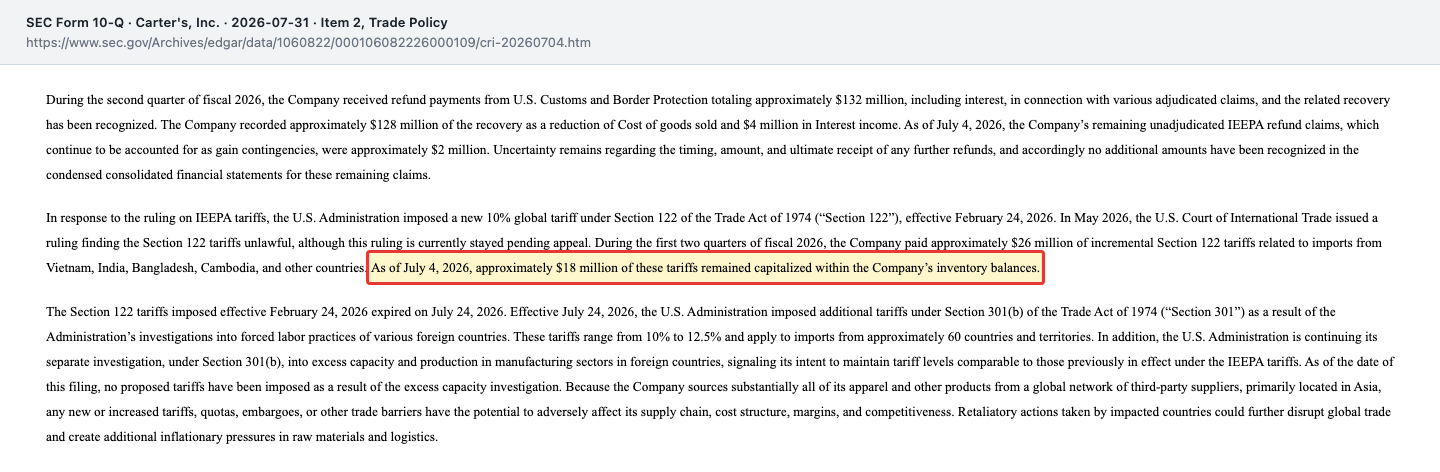
This is one of those places where accounting and reality drift apart, and it is easy to explain: a duty is paid when the goods enter the country — it becomes a cost only when those same goods are sold. Until then it sits inside the value of inventory. On July 4, 2026 that was roughly $18 million. For comparison: adjusted operating income for an entire quarter was $18.1 million. That burden is still outstanding.
And the next one is already queued. The Section 122 tariffs expired on July 24, 2026 — on the very same day, new tariffs under Section 301(b) took effect.
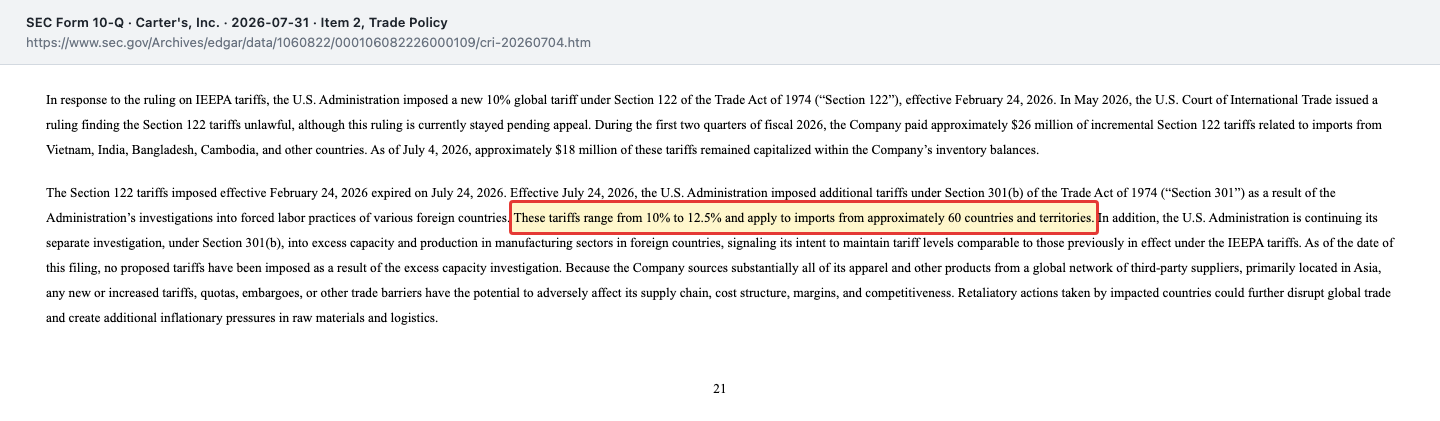
The report also names a second investigation running under the same provision, and states its evident intent unusually plainly: the administration is signalling that it means to maintain tariff levels comparable to those previously in effect under the IEEPA tariffs. In plain language: the refund was a repayment, not an exemption.
How large the ongoing burden is shows up in the gross margin discussion: in the second quarter of 2026, incremental tariff costs hit cost of goods sold by roughly $28 million, and by roughly $78 million across the half year. In fiscal 2025 Carter's had paid roughly $110 million of incremental duties, of which roughly $60 million landed in product costs. Those numbers keep running, entirely without a one-time effect.
Uncomfortable truth no. 3: the profit engine is failing — in wholesale
The group has three segments, but the profit so far comes from one: U.S. Wholesale. And that is exactly where it is receding. In the first half of 2026, U.S. Wholesale segment operating income fell 19.2 percent to $66.5 million, and the segment margin from 18.6 to 14.2 percent. The reason is in the report: higher average unit costs, driven by incremental tariff costs.
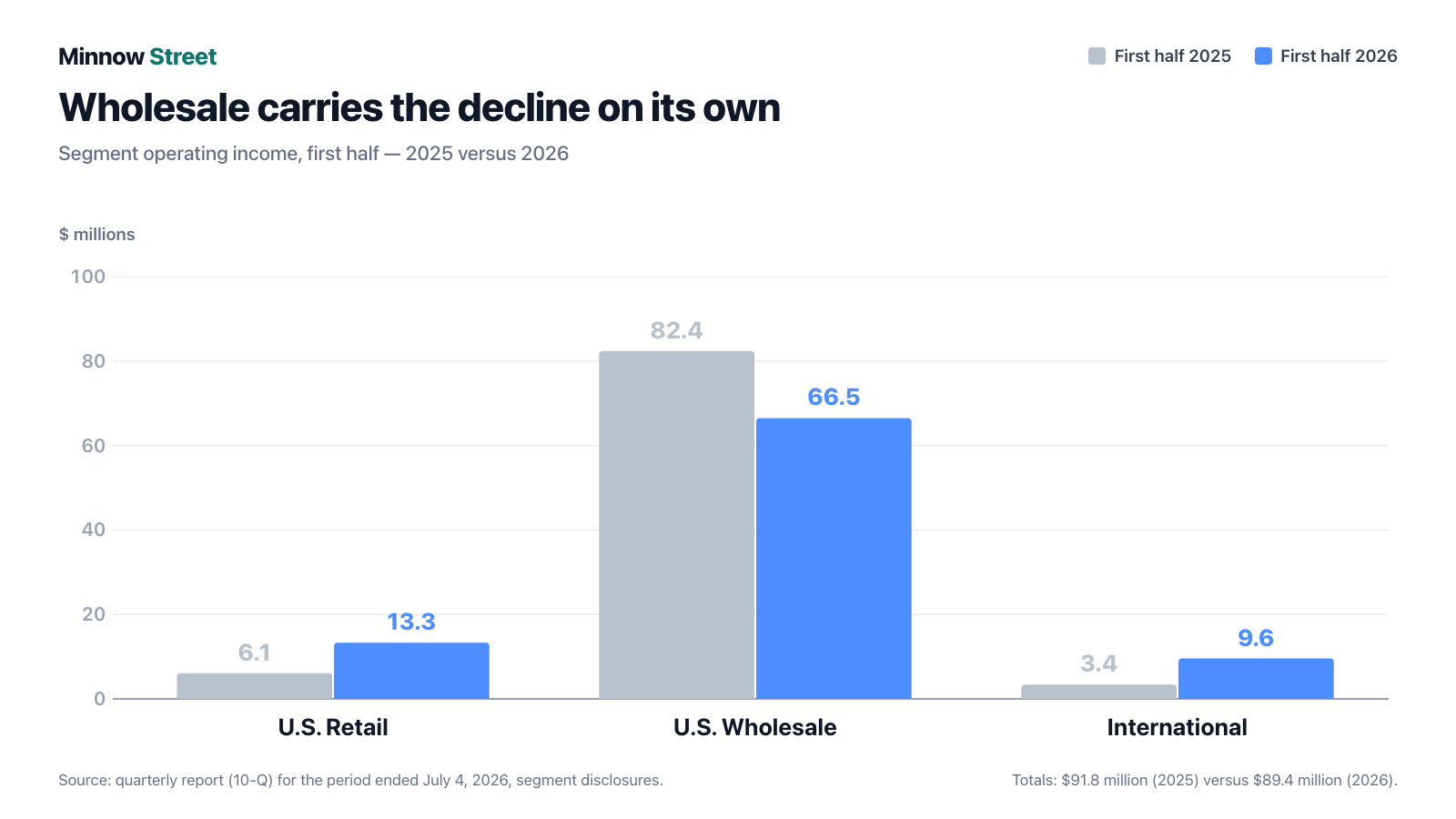
Do the arithmetic: the company's own U.S. retail business added $7.2 million, international added $6.2 million — $13.4 million together. Wholesale lost $15.8 million. On balance, total segment operating income fell 2.7 percent to $89.4 million even though net sales rose 6.7 percent. That is the real story of the half year, and it appears in no headline: more revenue, less profit.
The same movement shows in the adjusted figures. In the first half of 2026, adjusted operating income was $46.5 million against $47.1 million a year earlier, and adjusted earnings per share $0.65 against $0.83 — a decline of roughly 22 percent. The difference between those two figures is explained by interest: in November 2025, Carter's replaced a $500 million bond at 5.625 percent with a $575 million bond at 7.375 percent. Interest expense rose 47.2 percent to $23.1 million in the half year.
Uncomfortable truth no. 4: the company's own outlook calls for falling earnings — this year
If you want to know how a company really assesses its position, do not read the chief executive's quote; read the outlook table underneath it. At Carter's there are three lines for fiscal 2026, and the third contradicts the first two.
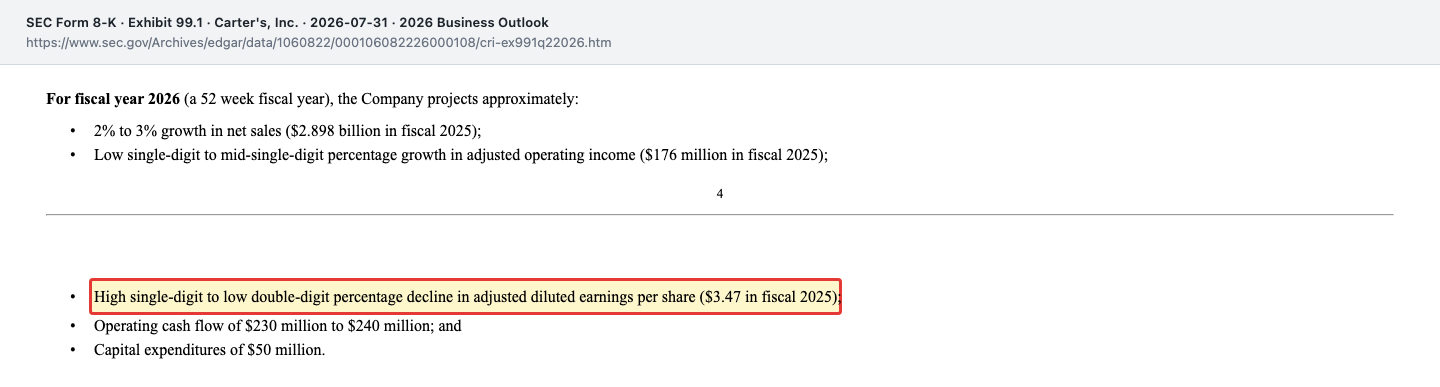
Net sales up 2 to 3 percent, adjusted operating income up low to mid single digits — and adjusted earnings per share down high single digits to low double digits. The difference between the second and third lines is interest: the company assumes roughly $35 million of net interest expense for 2026. On a base of $3.47 for 2025, the outlook lands at roughly $3.00 to $3.20. For the third quarter, Carter's names roughly $750 million of net sales, roughly $50 million of adjusted operating income and roughly $0.85 per share — so here things are meant to improve. The report attributes that to the year's earnings contribution falling into the second half because of the tariff timing.
The outlook only becomes revealing when you set it against the company's own from May. On the first-quarter earnings call on May 6, 2026, the company projected 2026 earnings per share "down low double digits to down mid-teens" — roughly 10 to 15 percent below the $3.47 of 2025. By July 31, that had become a decline in the high single-digit to low double-digit range. So the outlook improved slightly. The far larger move sits one line below: expected cash from operations jumped from $110 million to $120 million (May) to $230 million to $240 million (July). That doubling is not an operating improvement — it is almost exactly the $132 million tariff refund that arrived in between. Put the two forecasts side by side and you see the same one-time effect a second time, this time in the cash flow line.
Capital returns tell the same story in a different currency. The dividend was cut a year earlier, and the annual report names the timing and the reason without euphemism:
"In each of the second, third, and fourth quarters of fiscal 2025, the Board declared, and the Company paid, a cash dividend per common share of $0.25, which represented a 69% reduction when compared to the cash dividend per common share paid of $0.80 in the first quarter of fiscal 2025."
— Carter's, Inc., SEC annual report 10-K for 2025, "Dividend Update" section
As the reason, the same section states that the dividend was realigned with the current level of profitability, against the backdrop of a challenging market environment and significantly higher product costs from the incremental tariffs. No share repurchases took place in all of fiscal 2025 or in the first half of 2026, even though an authorisation of $599.0 million remains open and unused. A company that leaves a repurchase authorisation of that size — roughly 42 percent of its own market capitalisation — untouched while cutting its dividend by two thirds is saying something about its priorities.
Uncomfortable truth no. 5: the customers grow out of the brand
Carter's is the undisputed number one in baby clothing. How narrow that base is, the annual report for 2025 shows itself — you only have to read the market shares by age. As of December 2025: roughly 21 percent among babies aged zero to two, roughly 8 percent among toddlers aged three to four, roughly 2 percent among children aged five to ten. Across all age groups, the Carter's brands reach roughly 9 percent; for the company across all its brands, the same report names roughly 10 percent for fiscal 2025.
So from the baby years to the toddler years the share falls by about two thirds, and then by another three quarters. Translated: Carter's wins its customers where parents buy clothing for the first time — and loses them before the children start school. A company built that way has to pay for the most expensive part of customer acquisition again every year, in a market whose supply is demographically shrinking. The annual report names declining birth rates itself as one of the market conditions it had to respond to; it does not give a number for it.
And there is something else in that report which you rarely see stated so openly: whether the market share is rising or falling cannot be answered from the filings at all. In a footnote, Carter's records that market data cited in prior annual reports were based on a methodology the data provider no longer employs and are not comparable with the current presentation. Anyone building a trend out of old and new figures is measuring one method against another. So we stay with what is documented — the gradient across the age groups.
The company's answer to this situation is a restructuring: roughly 150 low-margin stores are to close between 2025 and 2028 — they represented roughly $110 million of net sales in 2025 — with 35 closed in 2025 and roughly 60 planned for 2026. On top of that comes a reduction of roughly 15 percent of office-based roles by the end of the second quarter of 2026, expected to save roughly $35 million annually from 2026. How far the store fleet has already shrunk shows in the quarterly report: as of July 4, 2026 there were 1,042 company-operated stores, down from 1,068 at year end — with 4 opened and 29 closed in the United States during the first half.
What management promised — and what became of it
A balance sheet tells you what was. An earnings call tells you what management believes. We read eleven of those calls between October 27, 2023 and May 6, 2026 — with particular weight on the question-and-answer section, because that is where nobody is reading from a script any more. That is where analysts do the arithmetic the prepared remarks leave out, and where you hear most clearly when someone is dodging. Five threads run through all eleven calls.
Thread 1: the pricing promise that turned four times
In October 2023 an analyst asked whether Carter's, faced with two years of falling store sales, ought to consider lower prices. The chief executive at the time, Michael Casey, declined: "We have tested, we have very smart people testing different pricing configurations, different prices, we've tested lower prices. It did not drive a change in unit velocity that would suggest that we should do that on a more sustained basis."
Nine months later, in July 2024, that is precisely what was done: "we plan to lower prices on about 20% of our product offerings in the second half" — with an earnings impact the company put at roughly $40 million. In February 2025 it named the actual figure: $65 million, of which $55 million was lower pricing and $10 million additional brand marketing. And in the same breath, chief financial officer Richard Westenberger declared the chapter closed: "At this point, we believe we've taken the action we need to on pricing."
Five months later, in July 2025, came the counter-move: "Given the magnitude of the challenge, we also intend to raise our prices." And in May 2026 the reverse was on the table again: "Some competitors may begin to take their prices down, and we may need to respond accordingly to ensure we're as competitive in our pricing as needed." Follow a pricing strategy over two and a half years and count four changes of direction, and you have not read a plan — you have read a chain of reactions.
Thread 2: the tariffs that were "not on the short list"
The most revealing statement of the whole period came as the very last answer on a call. In October 2024 an analyst asked about the China share and possible tariffs. Casey's answer: "The likelihood tariffs put on children's apparel, I don't think that will be on the short list, but time will tell."
Time told. The sequence of numbers over the following sixteen months reads like a staircase:
- February 2025: tariffs, freight rates and product investment together roughly $10 million of additional cost.
- April 2025: asked directly for the order of magnitude — "we're not going to quote a number today"; on the same call, full-year guidance is suspended.
- July 2025: "a gross additional tariff amount between $125 million and $150 million on an annualized basis".
- October 2025: "The tariff rates now in effect bring our effective duty rate into the high 30% range versus about 13% historically." — the duty rate on the company's own goods roughly triples.
- February 2026: "Recall that the gross impact of higher tariffs on our P&L in 2025 was approximately $60,000,000. In our 2026 assumptions, this gross impact grows to over $200,000,000."
From "not on the short list" to more than $200 million in sixteen months. That is not dishonesty — nobody could have known this in October 2024. But it shows how little lead time a company has when it manufactures practically everything in Asia and trade policy changes in a matter of months. And it explains why the second-quarter 2026 refund is not an all-clear: it repays part of that staircase, it does not dismantle it.
Thread 3: the offset promise and the assumption it rests on
In July 2025 an analyst asked the most precise question of the entire series: whether the company intended to offset the tariffs fully in 2026 or only in 2027. The answer was unusually binding: "Our intention, Paul, would be to offset them fully in 2026. So we'll have more to say over time, but that's the direction we've given to the organization and the teams are moving out against that priority."
Three months later another analyst wanted to know where the confidence came from — the savings programmes were, after all, smaller than the tariff load. Westenberger's answer in October 2025 lays bare the load-bearing assumption of the entire plan: "So we are assuming that we have success in raising prices and the consumer broadly accepts that without tremendous pushback." The offset therefore does not rest on a cost measure but on parents accepting higher prices.
Half a year on, that sounded more careful from inside the company itself. In May 2026, chief retail and digital officer Allison Peterson reported: "We are seeing some increased penetration of our opening price point product and clearance sales were up in the quarter. We think this reflects a consumer who is more focused on price."
The first half of 2026 is the first real test of the promise, and it has not been passed: adjusted operating income $46.5 million against $47.1 million, adjusted earnings per share $0.65 against $0.83 — and the company's own full-year outlook calls for a decline in adjusted EPS for 2026. In fairness: the company explicitly places the year's earnings contribution in the second half, and the third-quarter outlook of roughly $50 million adjusted operating income sits well above the $39 million of the prior year. So the promise is not disproved — but the first half argues against it.
Thread 4: the refund was announced — and was explicitly not to be counted
The most remarkable thing about the number that made the headline in July 2026 is that it was already on the table in May 2026. On the May 6 earnings call an analyst asked about expected tariff refunds. The answer from interim chief executive Richard Westenberger:
"First, as it relates to tariff refunds, there's about $130 million of incremental IEEPA tariffs that we paid between last year and early this year before the Supreme Court's decision. That is the amount that we have filed for refund with the government. […] We're not counting on that. We're not recognizing that until the cash hits the bank account."
— Richard Westenberger, first-quarter 2026 earnings call, May 6, 2026
And that is exactly how it went: the money arrived in the second quarter, was recognised — and produced an earnings figure that has nothing to do with the business. Anyone who had listened in May knew in July that the $2.87 is not earning power. The company said so itself, three months earlier.
Equally revealing is the question of what should happen to the money. Westenberger in May 2026: "Our first preference would be to put the money back to work in the business." That is checkable against three figures from the half year: no share repurchases, an unchanged dividend of $0.25 per quarter, and planned capital expenditure of $50 million for the whole year. So the money is still largely sitting in the till — $653.6 million as of July 4, 2026. What becomes of it is the new chief executive's first decision.
Thread 5: three chief executives in twenty-six months
In April 2025 Carter's suspended its full-year guidance. The company named two reasons — the leadership transition and the tariffs — and an analyst wanted to know which was the real one: would guidance have been pulled without the tariffs too? Westenberger's answer was notably candid: "I think both factors contributed to it, Bill." He added that it is not unusual for a new chief executive to take the time required, and "likely we would have made the same decision".
That new chief executive, Douglas Palladini, started on April 3, 2025 and was gone a year later: according to the current report of May 1, 2026, he departed effective April 28, 2026. Sharon Price John took over effective June 15, 2026 — the third occupant of the office in twenty-six months, with the chief financial officer stepping in as interim twice in between. The quarterly report puts the cost of this second transition at $4.7 million in the second quarter of 2026.
Palladini's arrival in April 2025 reads in hindsight like a programme without numbers: "My remit is clear, to return Carter's to growth" — and in July 2025, asked for concrete revenue and margin targets: "Yes, I have a lot of earnings goals and sales goals, but we're not going to share specific numbers today." Those numbers never came. His last statement before departing, on February 27, 2026, was after all a personal promise: "In 2026 and beyond, I believe both revenue and operating income will grow." Two months later he was out of office — and on that same call the chief financial officer had guided to a double-digit decline in adjusted earnings per share for 2026. No analyst raised the contradiction.
His successor put it differently in her first public appearance — the earnings release of July 31, 2026 quotes her saying "Demonstrating continued momentum, the Company posted positive results for the quarter as net sales increased 5% and adjusted operating profit increased 54%, exceeding the prior outlook". She is talking about adjusted operating profit and its 54 percent gain — not about the $2.87. That is the more honest number, and it is the comparison we worked out ourselves above.
Valuation — a multiple of exactly which earnings?
This is where it gets interesting, because at Carter's the valuation depends on which profit you plug in. Market capitalisation stood in the region of $1.4 billion in early August 2026 (data as of August 3, 2026), on roughly 36.7 million shares outstanding per the cover page of the quarterly report (as of July 24, 2026).
Insert reported trailing-twelve-month earnings of $5.36 per share and you get a price-earnings ratio of roughly 7. That looks like a bargain — and it is not, because those $5.36 contain the $2.73 from the tariff refund. Use adjusted earnings instead — roughly $3.30 for the trailing twelve months, or $3.00 to $3.20 per the company's own 2026 outlook — and you land at a price-earnings ratio of roughly 12. That is the more honest anchor. A price-earnings ratio is only ever as reliable as its denominator.
The remaining metrics: price-to-sales roughly 0.5 on trailing-twelve-month revenue of roughly $2,980 million, price-to-book roughly 1.4 on book equity of $27.98 per share, enterprise value roughly $2.0 billion. The $1.00 annual dividend equates to a yield of roughly 2.6 percent. The short interest is notable: roughly 12.3 percent of the float was sold short (data as of August 3, 2026) — every eighth freely tradable share sits with somebody betting on a falling price.
The professionals' view is correspondingly reserved. Of six recorded analyst ratings, three say hold, two say sell and one says strong sell — not a single buy. The average rating is 2.3 on a scale where 5 would be the best mark. The average price target of $42.67 does, however, sit above the price level of early August 2026 (data as of August 3, 2026). A picture like that — a low multiple, high short interest, no buy ratings, yet a target above the price — is a stock the market cannot agree on. We described a similar constellation in our analysis of Lovesac, where a large top line likewise meets a small profit.
Opportunities and risks at a glance
What speaks for Carter's:
- Market leadership with substance. Roughly 21 percent share of baby apparel for ages zero to two (December 2025), 1,042 company-operated stores and roughly 19,500 wholesale locations cannot be rebuilt in a few years.
- A balance sheet without distress. $653.6 million of cash against $575.0 million of financial debt, $1,027.3 million of equity, an undrawn $750 million credit facility and covenant compliance as of July 4, 2026.
- The company's own stores are turning. U.S. Retail comparable sales up 5.1 percent in the quarter and 7.8 percent in the first half of 2026, segment operating income more than doubled from $6.1 million to $13.3 million.
- The restructuring is quantified. Roughly $35 million of annual savings from the headcount reduction beginning in 2026, roughly 150 stores winding down through 2028.
- Cash from the business. $202.3 million in the first half of 2026 and an outlook of $230 million to $240 million for the full year against just $50 million of planned capital expenditure.
What speaks against it:
- The profit is borrowed. Without the $127.7 million tariff refund, the second quarter of 2026 leaves $18.1 million of operating income and a 2.9 percent margin; remaining open claims amount to roughly $2 million.
- The tariff burden keeps running. Roughly $78 million of incremental tariff costs in the first half of 2026 alone, roughly $18 million still in inventory, and new tariffs of 10 to 12.5 percent on roughly 60 countries since July 24, 2026.
- Profit falls despite revenue growth. First-half segment operating income down 2.7 percent, U.S. Wholesale down 19.2 percent, adjusted earnings per share down from $0.83 to $0.65.
- Customer concentration. Roughly 30 percent of net sales with the five largest wholesale customers, the two largest at 11.0 and 10.3 percent; 83 percent of gross receivables sat with the ten largest customers at the end of 2025.
- Leadership churn. Three chief executives in twenty-six months, $4.7 million of transition costs in the second quarter of 2026 alone, and a new chief executive since June 15, 2026 with no medium-term targets of her own.
- The customer grows out of it. Roughly 21 percent market share among babies aged zero to two, but only roughly 8 percent among toddlers aged three to four and roughly 2 percent among five- to ten-year-olds (December 2025); the company itself names declining birth rates as a market condition.
- More expensive debt. A bond at 7.375 percent instead of 5.625 percent, interest expense up 47.2 percent to $23.1 million in the half year — the main reason adjusted earnings per share are meant to fall in 2026 even as operating income is meant to rise.
A human conclusion
At the start there was the headline trap: a number your head instantly turns into a story. At Carter's the number was $2.87, and the story would have been called "turnaround". The remarkable thing about this case is that the company defuses the trap itself: it removes the tariff refund again in the very same release, names adjusted earnings of $0.26, and the new chief executive speaks in her first quote about adjusted operating profit rather than about a record. Anyone who reads the report is not being deceived. Anyone who reads only the headline deceives themselves.
What emerges behind it is neither a distressed situation nor a success story, but something more uncomfortable: a solid, market-leading company with a healthy balance sheet whose profit has been falling for four years and whose most important burden — trade policy — lies outside its control. The company's own stores are turning again; that is real. Wholesale, where the profit has come from so far, is losing margin; that is real too. And the company's own outlook calls for falling earnings per share in 2026, even as revenue is meant to rise.
The most honest summary sits in two numbers from the same report: a 22.7 percent operating margin if you count the customs authority — 2.9 percent if you do not. Which of the two you consider the more meaningful decides what you make of this stock. What you do with that is your decision. And that is exactly as it should be.
Sources
- Carter's, Inc. — Quarterly report (Form 10-Q) for the quarter ended July 4, 2026, filed July 31, 2026 (SEC EDGAR, CIK 0001060822)
- Carter's, Inc. — Second quarter 2026 earnings release (Exhibit 99.1 to the current report on Form 8-K), July 31, 2026
- Carter's, Inc. — Quarterly report (Form 10-Q) for the quarter ended April 4, 2026, filed May 6, 2026
- Carter's, Inc. — Annual report (Form 10-K) for fiscal 2025, ended January 3, 2026, filed February 27, 2026
- Carter's, Inc. — Annual report (Form 10-K) for fiscal 2024, ended December 28, 2024, filed February 25, 2025
- Carter's, Inc. — Current report (Form 8-K) on the leadership transition, May 1, 2026
- Transcripts of the quarterly earnings calls from October 27, 2023 through May 6, 2026 (eleven calls); all quotes verified verbatim against the transcripts
- Fundamental data: market capitalisation, trailing-twelve-month metrics, short interest and analyst consensus; data as of August 3, 2026
This analysis is journalistic commentary based on publicly available documents. It is not investment advice, not an offer or solicitation to buy or sell securities, and not a personal recommendation. Shares can lose substantial value, and a total loss of the capital invested is possible. Every figure carries the as-of date of its source; metrics drawn from market data carry the date August 3, 2026 and may have changed since. The author holds no position in Carter's, Inc. at the time of publication.
Our Bottom Line at a Glance
- Earnings quality negative
- Of the $139.8 million of reported operating income in the second quarter of 2026, $127.7 million came from a one-time tariff refund. Adjusted, $18.1 million and a 2.9 percent margin remain instead of 22.7 percent, and $0.26 per share instead of $2.87. Remaining open refund claims stood at only roughly $2 million as of July 4, 2026.
- Operating trend negative
- In the first half of 2026 net sales rose 6.7 percent to $1,296.6 million, yet segment operating income fell 2.7 percent to $89.4 million — and 19.2 percent to $66.5 million in U.S. Wholesale. Adjusted earnings per share fell from $0.83 to $0.65. GAAP operating income has fallen from $379.2 million (2022) to $143.9 million (2025).
- Balance sheet and liquidity positive
- As of July 4, 2026, $653.6 million of cash and $1,027.3 million of equity stood against a single bond of $575.0 million principal — cash exceeds financial debt. The $750 million credit facility was undrawn, $568.6 million available, covenants met. No going-concern warning, no goodwill impairment. Cash from operations for the half year was $202.3 million. On top of that sit $616.9 million of lease liabilities from store leases.
- Tariff and sourcing risk negative
- Incremental tariff costs hit cost of goods sold by roughly $78 million in the first half of 2026; roughly $18 million was still in inventory on July 4, 2026. Since July 24, 2026, new tariffs of 10 to 12.5 percent apply to imports from roughly 60 countries, and Carter's sources practically all of its goods from Asia — roughly 60 percent of the fabric still came from China in 2025.
- Market position neutral
- Carter's remains the clear market leader with roughly 21 percent of baby apparel for ages zero to two (December 2025) and operates 1,042 company-operated stores (04.07.2026). The share collapses as customers age, however: roughly 8 percent among toddlers aged three to four, roughly 2 percent among five- to ten-year-olds. Across all age groups the Carter's brands reach roughly 9 percent. The company itself names declining birth rates as a market condition.
- Leadership and capital returns negative
- Three chief executives in twenty-six months: Douglas Palladini started April 3, 2025 and departed effective April 28, 2026; Sharon Price John took over on June 15, 2026. Transition costs were $4.7 million in the second quarter of 2026. The dividend was cut 69 percent to $0.25 from the second quarter of 2025; there have been no repurchases since.
Carter's is the headline trap in its purest form: the second quarter of 2026 delivered $2.87 per share against $0.01 a year earlier — adjusted for the $127.7 million tariff refund, $0.26 and an operating margin of 2.9 percent instead of 22.7 percent remain, and the company works it out that way itself. Behind it stands a market-leading supplier of baby apparel with a healthy balance sheet ($653.6 million of cash, $1,027.3 million of equity) and a growing own-retail business — and at the same time an operating income that has fallen from $379.2 million to $143.9 million since 2022, a wholesale segment whose half-year profit is down 19.2 percent, and a company outlook that calls for falling adjusted earnings per share in 2026. Not investment advice.
What Our Rating Means
Open questions
The business works in principle, but one material question is open. As long as it stays open, our findings do not carry a quality verdict.
Yellow here stands for an open operating question, not for a risk to the substance. The substance is documented: $653.6 million of cash and $1,027.3 million of equity as of July 4, 2026, an undrawn $750 million credit facility, covenants met, no going-concern warning, no goodwill impairment, $202.3 million of cash from operations in the half year, and undisputed market leadership in baby apparel. What is open is earning power itself: operating income has fallen four years running, the only real profit engine — U.S. Wholesale — lost 19.2 percent of segment operating income in the half year, 92 percent of the quarterly profit came from a one-time effect, and the most important burden, trade policy, lies outside the company's control. On top of that comes the third chief executive in twenty-six months with no published medium-term targets. Whether the stock is cheap at a price-earnings ratio of roughly 7 reported and roughly 12 adjusted belongs to the price question and does not drive this assessment. Red would require cash, equity or interest cover to turn; green would require adjusted earnings to rise again with the tariff burden demonstrably offset.
A journalistic assessment by our editorial team at the time of the deep dive, based on public sources — not investment advice and not a solicitation to buy or sell. Your personal circumstances (investment goals, risk capacity, taxes) cannot be taken into account. What our levels mean, how verdicts are formed, and what conflicts of interest exist →
Worth Noting
- Carter's came onto the research list through the SEC filing calendar: on July 31, 2026 the quarterly report (10-Q) for the period ended July 4, 2026 and the earnings release as Exhibit 99.1 to a current report (8-K) arrived on the same day. The company's 2026 outlook appears exclusively in Exhibit 99.1, not in the quarterly report.
- Data basis: annual figures as of January 3, 2026 from the annual report (10-K) for 2025, interim figures as of July 4, 2026 from the quarterly report (10-Q), outlook and quarterly metrics as of July 31, 2026, market capitalisation, short interest and analyst consensus as of August 3, 2026. Market capitalisation is deliberately used only as an order of magnitude: the share count of 36,711,185 (as of July 24, 2026) comes from the cover page of the quarterly report, while the only price documented in a mandatory filing is the closing price of June 27, 2025 from the cover page of the annual report and is therefore more than a year old.
- Not to be confused: Carter's, Inc. (NYSE: CRI, children's apparel, CIK 0001060822) is a different company from Carter Bankshares, Inc. (Nasdaq: CARE), a regional bank in Virginia. Both trade under the Carter name but have nothing to do with each other.
- On the fiscal year: Carter's reports in 52- or 53-week years ending on the Saturday closest to December 31. Fiscal 2025 ended on January 3, 2026 and had 53 weeks — roughly $37 million of the $54.3 million sales increase came from that extra week. Comparisons between 2025 and 2026 are therefore not adjusted without further work.
Stock Watch
This analysis is as of August 3, 2026. Stock Watch will tell you what's changed at CRI since then.
Later $1 a month per stock — signing up is free, and you'll be the first to know when it launches.
Frequently Asked Questions
Because of a one-time tariff refund. After the U.S. Supreme Court ruled the IEEPA tariffs unlawful, Carter's received roughly $132 million back, of which about $128 million was recorded as a reduction of cost of goods sold. The company removes $127.7 million again in its own reconciliation: $2.87 per share becomes $0.26 adjusted.
In the second quarter of 2026, adjusted operating income was $18.1 million (a 2.9 percent margin) against $11.8 million in the prior-year quarter, and adjusted earnings per share $0.26 against $0.17. Across the first half of 2026, by contrast, adjusted earnings per share fell from $0.83 to $0.65.
The 10 percent Section 122 tariffs expired on July 24, 2026. On the same day, Section 301(b) tariffs of 10 to 12.5 percent on imports from roughly 60 countries took effect. Carter's sources practically all of its goods from Asia. On top of that, roughly $18 million of already-paid duties were still sitting in inventory as of July 4, 2026.
The earnings release of July 31, 2026 names 2 to 3 percent net sales growth, low to mid single-digit percentage growth in adjusted operating income, and a high single-digit to low double-digit percentage decline in adjusted diluted earnings per share against $3.47 in fiscal 2025. Operating cash flow is expected at $230 million to $240 million.
Because of interest. In November 2025 Carter's replaced a $500 million bond at 5.625 percent with a $575 million bond at 7.375 percent. Interest expense rose 47.2 percent to $23.1 million in the first half of 2026; for the full year the company assumes roughly $35 million of net interest expense.
Yes, back in the second quarter of fiscal 2025. The quarterly dividend fell from $0.80 to $0.25 per share, a 69 percent cut. For fiscal 2025 that came to $1.55 per share against $3.20 the year before. No share repurchases took place in 2025 or in the first half of 2026, even though an authorisation of $599.0 million remains open.
Heavily. U.S. Wholesale accounted for roughly 35 percent of consolidated net sales in 2025, the five largest customers for roughly 30 percent, and the two largest alone for 11.0 and 10.3 percent. Carter's develops dedicated exclusive brands for Walmart, Target and Amazon. At the end of fiscal 2025, 83 percent of gross receivables sat with the ten largest customers.
On the Saturday closest to December 31. Fiscal 2025 therefore ended on January 3, 2026 and comprised 53 weeks instead of 52 — that extra week added roughly $37 million of net sales. Fiscal 2026 has 52 weeks again; its second quarter ended on July 4, 2026.
Found an error?
Did you spot a factual error, an outdated number, or a typo in this deep dive? Let us know briefly — your report goes straight to the editorial team.