BrightSpring: $12.9 Billion in Revenue — and $2.30 of Profit per $100
BrightSpring Health Services booked $12,910.6 million of revenue in 2025. What was left after costs was $295.3 million of operating income — 2.29 percent. The annual report filed February 27, 2026, explains why: four of every five revenue dollars are the purchase price of medicines the company merely delivers. Add roughly $2.6 billion of buyout debt and a controlling owner who sold twice in three months. We do the arithmetic on what a giant top line actually leaves for shareholders.
 Thomas Mücke
Founder & Publisher
Thomas Mücke
Founder & Publisher
Chart
Interactive price chart (TradingView).
Note: pure fact-based analysis, not investment advice and not a solicitation to buy or sell. All figures without guarantee.
There is an investor trap that springs shut whenever a number is genuinely large: the checkout-belt trap. You see $12.9 billion of revenue, mentally attach a margin you consider normal, and arrive at a profit that never existed. Tens of thousands of dollars cross a supermarket checkout belt every day. Almost none of it stays in the till, because nearly all of it was the purchase price of the goods. That is exactly how BrightSpring Health Services, Inc. (Nasdaq: BTSG) works. So let us make a deal: before we talk about growth, we work out together what a revenue dollar actually leaves behind — using only what the company filed with the U.S. securities regulator, the SEC. A filing is honest under penalty of law. We use the annual report (10-K) for 2025, filed February 27, 2026, and the quarterly report (10-Q) as of March 31, 2026, filed May 1, 2026.
What BrightSpring actually does — a pharmacy with a care business attached
BrightSpring looks after people where they live: at home, in senior living, in skilled nursing facilities. It is headquartered in Louisville, Kentucky, and as of December 31, 2025, it employed more than 23,500 full-time equivalents, roughly 3,500 of them represented by labor unions. Jon Rousseau runs the company as chairman, president and chief executive.
There are two reportable segments. Pharmacy Solutions is a pharmacy at industrial scale: home infusion therapy, specialty medicines for cancer and rare diseases, daily medication management for seniors and nursing homes. More than 43 million prescriptions were filled in 2025, out of over 175 pharmacies, infusion centers and specialty oncology locations across all 50 states. Provider Services is the care arm: home health, hospice, rehab therapy, home-based primary care. Together, BrightSpring says it serves roughly 465,000 patients at any one time, about 330,000 of them in their own homes.
Now the ratio that explains everything that follows. In the first quarter of 2026 the pharmacy produced $3,171.3 million of revenue and the care business $442.4 million. That is 87.8 percent against 12.2 percent. Arithmetically, BrightSpring is drug logistics with a care business attached — and drug logistics is a trade in which the purchase price of the goods eats almost the entire top line.
That names the central tension of this analysis, and it runs through every chapter: BrightSpring is growing at double-digit rates and has cut its debt burden visibly — but the faster it grows, the thinner its margin gets, because the growth comes from passing expensive medicines through. How differently a U.S. health care provider can look when the government also pays most of the bills shows up in our Encompass Health analysis, where a similar reimbursement dependence sits on top of an entirely different cost structure.
One 2026 event belongs here right away, otherwise the prior-year figures confuse: on March 30, 2026, BrightSpring sold its Community Living business — residential and support services for people with intellectual and developmental disabilities — to National Mentor Holdings for $835.0 million, with $810.9 million actually received. Every revenue and earnings figure in this analysis is therefore from continuing operations, computed the same way for every year.
Where the stock showed up in our scanner
The hook is not a headline but a balance sheet screen. Our in-house stock scanner lists BrightSpring on the U.S. side of its fundamental ranking — the list that sorts companies by the quality of their numbers rather than by their chart (as of July 26, 2026; the lists are recalculated daily). On the same date the list carries 38 U.S. names. You can replicate it in three clicks: open the stock scanner, pick the “Fundamental Rank (A / A+)” list, set the market to the United States.
The confluence is what stands out. On July 26, 2026, BTSG appeared on 25 of our scanner lists at once, and the selection reads like a cross-section of every school of thought: quality growth and institutional accumulation on the fundamental side; William O’Neil (CAN SLIM), Ben Bennett: Power Screen, Stan Weinstein: Stage 2 and Gary Antonacci: Dual Momentum on the trend side, plus the all-time-high list. When a stock reads as solid, accelerating and trending at the same time, it is worth a second look. That is what we are doing.
Two metrics from the July 24, 2026, data cut-off belong here, and both get rated, not just listed. The stock stood 196.9 percent above its level twelve months earlier — which is why so many trend lists fire, and also a reason for caution: a share price that has nearly tripled forgives no disappointment. And the equity ratio of 31.9 percent sounds unremarkable at first. It is not, once you know what that equity is made of. More on that shortly.
The numbers over the years — honestly appraised
First what genuinely impresses. Revenue rose to $12,910.6 million in 2025 — up 28.2 percent on the $10,072.2 million of 2024 and the $7,691.0 million of 2023. That is 68 percent in two years. And 2025 was the first profitable year in a while: $190.7 million was attributable to shareholders, or $0.94 per share, after losses of $18.1 million in 2024 and $154.6 million in 2023.
The jump in actual cash is even sharper. Operating cash flow came in at $490.2 million in 2025 — after $23.8 million the year before. That is not window dressing but mostly lower interest and better operating income. Adjusted EBITDA, the earnings measure before interest, taxes and depreciation, rose 34.2 percent to $617.6 million.
And here is the finest number in this analysis, because it marks a turn:
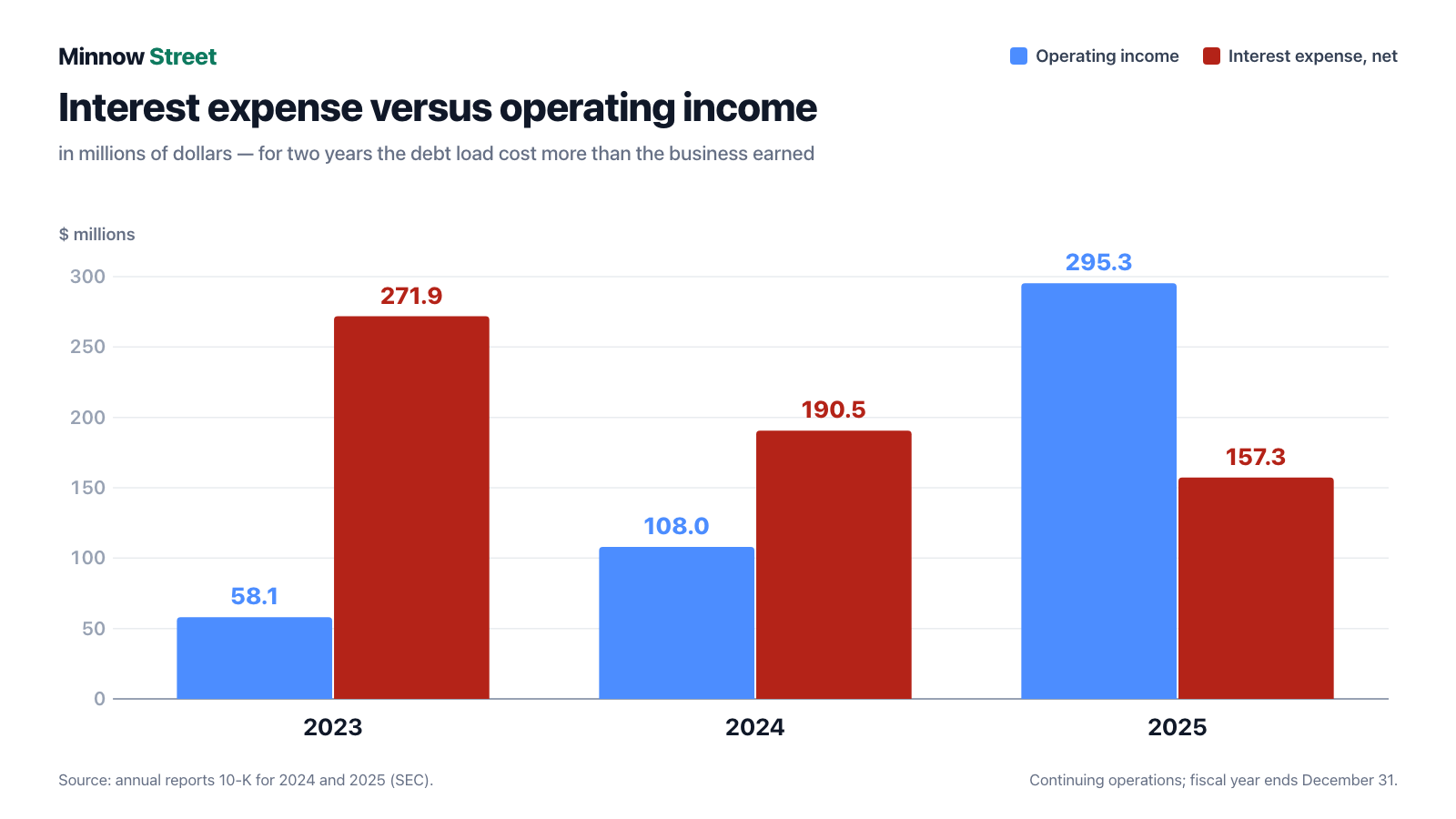
Remember this one: at BrightSpring the turn did not happen in revenue, it happened in the interest line. In 2023 the company paid $271.9 million of net interest on $58.1 million of operating income — it was working for its lenders. In 2025, $157.3 million of interest stood against $295.3 million of operating income. Interest is now covered nearly twice over.
The start of 2026 continued the run. First-quarter revenue climbed to $3,613.7 million from $2,878.1 million a year earlier (up 25.6 percent), and operating income to $121.4 million from $50.7 million. The bottom line was $148.8 million — but $74.3 million of that came from the divested Community Living business. Continuing operations contributed $74.4 million.
And leverage as measured by the credit agreement fell in a single quarter from 2.99x to 2.27x, helped by the sale proceeds that lifted cash from $88.4 million on December 31, 2025, to $888.8 million on March 31, 2026. That is the good half of the story, and it is real.
What the filings say — the uncomfortable truths
Uncomfortable truth no. 1: of every $100 in revenue, $2.30 is left
Let us run the checkout-belt trap all the way through. Of the $12,910.6 million of 2025 revenue, $10,507.4 million went to cost of goods — essentially the purchase price of the medicines BrightSpring delivers. Another $885.4 million was the cost of services rendered and $1,222.5 million selling, general and administrative expense. What was left was $295.3 million of operating income.
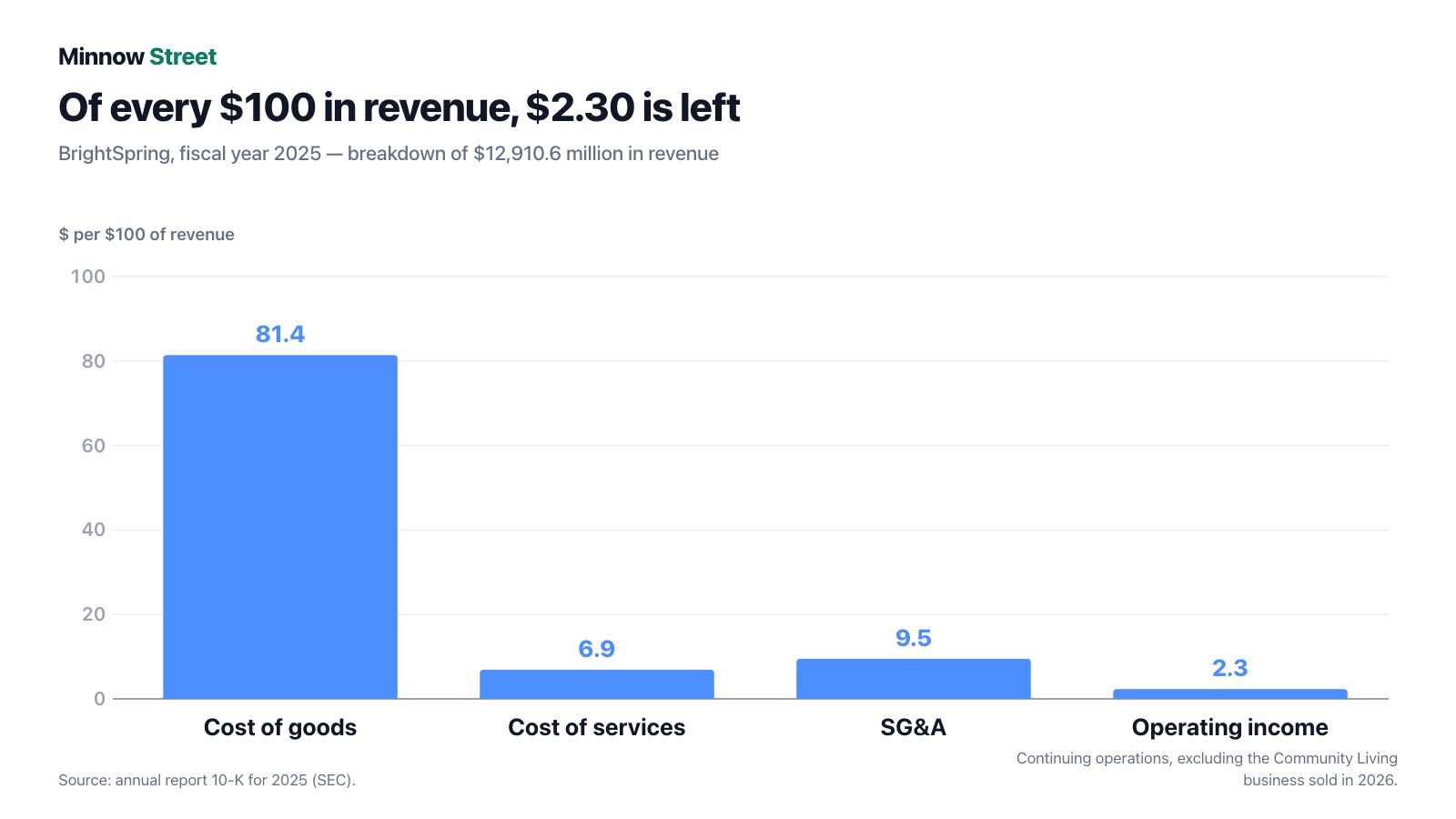
In everyday terms: this is not a restaurant, it is a delivery service. And the unpleasant part is in the time series. Gross margin — what is left after the pure cost of the goods — was 14.8 percent of revenue in 2023, 12.6 percent in 2024 and only 11.8 percent in 2025. The faster BrightSpring grows, the thinner the slice, because the growth comes mostly from expensive specialty medicines on which a pharmacy earns only a small markup.
Fairness requires the other side. In the first quarter of 2026 gross margin recovered to 13.3 percent from 11.8 percent a year earlier, and pharmacy segment EBITDA grew 46.1 percent against segment revenue growth of 25.2 percent. One quarter is not a trend — but it is the first one pointing the other way.
Uncomfortable truth no. 2: strip out goodwill and the equity is gone
The balance sheet as of March 31, 2026, reports total equity of $1,979.4 million, or 31.9 percent of total assets of $6,213.3 million. That sounds respectable. Now look at what it is made of. The asset side carries $2,533.6 million of goodwill — the amount BrightSpring paid in acquisitions above the value of the assets it took over — plus another $536.9 million of other intangibles such as customer relationships and licenses.
Deduct goodwill alone from equity and you are left with negative $554.2 million. Add the other intangibles and it is negative $1,091.1 million. In everyday terms: the house is paid off, but half the purchase price was the view. Goodwill is neither fraud nor an accounting error — it is the residue of the buyouts through which KKR and Walgreens Boots Alliance acquired PharMerica in 2017 and BrightSpring Health Holdings in 2019. But it generates no cash and disappears instantly in an impairment.
Then there is the other side of the balance sheet. The 2025 annual report names its own debt load in the risk factors:
"As of December 31, 2025, we had approximately $2,521.3 million outstanding under the First Lien Term Loan Facility. As of December 31, 2025, we had $475.0 million of borrowing capacity available under the Revolver as there were no borrowings under the Revolver or letters of credit outstanding, and $62.8 million of letters of credit outstanding under the LC Facility."
— BrightSpring Health Services, Inc., annual report 10-K for 2025, Item 1A Risk Factors

The loan — the Tranche B-5 term loan of originally $2,553.2 million, established December 11, 2024 — carries a floating rate of SOFR plus 2.50 percent and matures on February 21, 2031. Until then only 0.25 percent of the original principal amortizes each quarter; the rest sits in a balloon payment. Two things belong on the credit side: the $475.0 million revolver is undrawn, and leverage of 2.27x as of March 31, 2026, is not critical. But floating rate also means that a rising rate raises the bill.
Uncomfortable truth no. 3: government pays more than two-thirds of the revenue
The quarterly report as of March 31, 2026, breaks revenue down by payor, and the picture is unambiguous. 68.5 percent of group revenue in the first quarter of 2026 came from government programs: Medicare Part D (the drug benefit) alone 29.7 percent, Part C (Medicare Advantage) 18.5 percent, Medicaid 11.2 percent, Part A 8.5 percent and Part B 0.6 percent. Commercial insurers accounted for 28.0 percent, private and other payors for 3.5 percent.
BrightSpring puts it in a single sentence:
"The Company is substantially dependent on revenues received under contracts with federal, state, and local government agencies."
— BrightSpring Health Services, Inc., quarterly report 10-Q as of March 31, 2026, note 3 (Revenue)

Why this weighs more heavily here than elsewhere: at a 2.29 percent operating margin, a two-point cut in reimbursement rates is enough to erase the entire result. The annual report lists the risks at length — federal budget cuts, state budget shortfalls, changing pricing benchmarks for generics. Then there is the enforcement pressure: the 2025 annual report discloses an ongoing investigation by the Department of Justice and the Drug Enforcement Administration into the company’s own Embrace Hospice business over services that may not have been reasonable and medically necessary. No outcome has been reached and no amount is quantified — but it shows how tightly this business is bound to the rulebook.
Uncomfortable truth no. 4: the former owner is selling into strength
KKR built BrightSpring, took it public in January 2024 — and sold big twice within three months in 2026. On March 4, 2026, 20,000,000 shares were placed; the company bought 1,464,807 of them back at $40.96 for $60.0 million. On June 3, 2026, another 14,999,771 shares followed at a public offering price of $58.75.

The movement behind it: before the June placement KKR held 41,824,259 shares, or 21.2 percent of the voting power, and afterwards, per ownership filing SC 13D/A no. 5, 26,829,880 shares, or 13.6 percent. Directors, officers and affiliates together fell from 56.1 percent to 48.7 percent — the majority is gone. Selling alongside were chief executive Jon Rousseau (260,000 shares), chief financial officer Jennifer Phipps (35,000) and chief of staff Lisa Nalley (35,000).
This is expressly not a scandal. A financial sponsor exits eventually; that is the business model, and a shrinking overhang is better for remaining shareholders than a growing one. The timing is what is interesting. The June 2025 base prospectus reports a last sale price of $23.86 (as of June 9, 2025). The sales came nine and twelve months later at $40.96 and $58.75. The people who know the company best sold into strength. The agreed 45-day lock-up expired on July 18, 2026.
Uncomfortable truth no. 5: on February 1, 2027, roughly 11.7 million shares appear
A second security trades on Nasdaq alongside the stock: BTSGU, the 6.75 percent tangible equity units. Exactly 8,000,000 of them were issued at $50.00 each alongside the 2024 IPO. Each unit combines an amortizing note with a prepaid stock purchase contract. That contract settles into shares on a fixed date:

Let us do the arithmetic together. The 2025 annual report gives the minimum settlement rate of 3.2733 shares per unit and discloses that holders converted 31,211 units early in 2024 and another 4,384,020 in 2025; per the quarterly report, none at all were converted in the first quarter of 2026. That leaves 3,584,769 units — times 3.2733 equals roughly 11.7 million new shares, close to 6 percent of the 196,588,412 shares most recently reported. No new money arrives; the buyers paid in 2024.
The catch for anyone reading per-share metrics: those shares are already in the income statement. BrightSpring computed the first quarter of 2026 on a basic share count of 204.7 million and a diluted count of 221.3 million — while the balance sheet cover page for the same date shows only 193,209,722 shares. Take the smaller number and recompute earnings per share, and the answer comes out too flattering. In everyday terms: the cake is already cut into more slices than the plate shows.
What the stock costs
For valuation we deliberately use numbers that appear in documents rather than a daily quote. The prospectus supplement dated June 5, 2026, reports 196,588,412 shares after the offering and repurchase, and a closing price of $57.40 on June 4, 2026. That works out to a market value of roughly $11.3 billion.
That is 0.9 times 2025 revenue — an ordinary order of magnitude for a drug logistics business, precisely because most of the top line is pass-through goods. The earnings multiples say more: 59 times 2025 net income of $190.7 million and, after adding debt and deducting cash, roughly 21 times adjusted EBITDA of $617.6 million. For a business running a 2.29 percent operating margin, that is not a bargain price.
The fundamental data as of July 24, 2026, sit higher, because the share price kept climbing between early June and late July: price/earnings ratio 89.6, forward price/earnings ratio on current-year estimates 38.3, price/sales 1.01, price/book 6.8, enterprise value to EBITDA 29.4. On that date the stock stood 196.9 percent above its level twelve months earlier.
The professionals’ view is strikingly sober. As of July 24, 2026, the mean price target from 12 analysts was $67. The stock itself closed that day at $72.91 — so the target sat roughly 8 percent below it. Measured against the documented June 4, 2026, closing price of $57.40, from which we calculate the market value above, the very same $67 sits roughly 17 percent above. Put differently: analysts like the company and consider the price it ran to by late July full. At the same time, 7.46 percent of the free float was sold short. BrightSpring pays no dividend.
Opportunities and risks at a glance
What speaks for BrightSpring:
- A market with demographic tailwind: care at home is cheaper than care in hospital, and the number of very old patients keeps rising. BrightSpring serves roughly 465,000 patients at any one time.
- Revenue grew 68 percent in two years to $12,910.6 million in 2025, and another 25.6 percent in the first quarter of 2026 — organically and through acquisitions such as the Amedisys and LHC branches taken over in 2025.
- An interest turn inside the company: in 2025 operating income of $295.3 million clearly exceeded interest expense of $157.3 million, and operating cash flow jumped to $490.2 million from $23.8 million.
- Leverage under the credit agreement fell within one quarter from 2.99x to 2.27x, cash rose to $888.8 million, and the $475.0 million revolver is undrawn.
- The overhang is shrinking: KKR is down from 21.2 percent to 13.6 percent, and the free float stands at roughly 90 percent.
What speaks against it:
- A 2.29 percent operating margin leaves no room for error. Of every $100 in revenue, $81.40 is the purchase price of the goods.
- Gross margin fell from 14.8 percent in 2023 to 11.8 percent in 2025 — growth and margin are pulling in opposite directions.
- $2,497.8 million of financial debt as of March 31, 2026, floating rate, with a balloon payment in 2031; equity of $1,979.4 million is exceeded by goodwill of $2,533.6 million.
- 68.5 percent of revenue depends on Medicare and Medicaid, and the company calls itself substantially dependent on government contracts. An investigation into the Embrace Hospice business is open.
- Roughly 11.7 million shares arrive on February 1, 2027, out of the tangible equity units, on top of 13,087,872 options and 6,223,627 restricted stock units (as of June 2, 2026).
- The share price nearly tripled in twelve months (data as of July 24, 2026) — and the mean analyst price target sat below it.
A human conclusion
Back to the checkout-belt trap. It does not spring shut because anyone is lying — BrightSpring discloses every one of these numbers, in tables you can look up. It springs shut because our minds automatically attach a margin to large numbers that this business never had. $12.9 billion sounds like a company that prints money. In fact BrightSpring earns $2.30 on every $100 of revenue, before interest and taxes.
That does not make it a bad company. It makes it something other than what the top line suggests: a volume business in which the craft lies not in pricing but in purchasing, in logistics, and in getting along permanently with one very large payor — the government. If that appeals to you, here is a company with genuine tailwind, falling debt and a market that is not going away. If you prefer companies where a bad quarter has room inside the margin, there is little cushion here.
You have now done that check yourself, with the original documents on the table. What you make of it is your decision. And that is exactly as it should be.
Sources
Every original document used in this analysis, for you to read yourself:
- BrightSpring Health Services, Inc. — quarterly report 10-Q as of March 31, 2026 (filed May 1, 2026)
- BrightSpring Health Services, Inc. — annual report 10-K for 2025 (filed February 27, 2026)
- BrightSpring Health Services, Inc. — annual report 10-K for 2024 (filed March 6, 2025)
- BrightSpring Health Services, Inc. — current report 8-K dated June 3, 2026 (offering by KKR and management), plus the current report 8-K dated June 11, 2026 (appointment of Dr. Nigam H. Shah to the board)
- BrightSpring Health Services, Inc. — prospectus supplement 424B7 dated June 5, 2026 (share count, prices, ownership)
- KKR Phoenix Aggregator L.P. and others — ownership filing SC 13D/A no. 5 dated June 5, 2026, and all other filings: EDGAR overview for CIK 0001865782 (sec.gov)
- Fundamental data (metrics, valuation, analyst estimates; data as of July 24, 2026), reconciled with the SEC filings.
- Scanner lists: our in-house stock scanner, as of July 26, 2026; the lists are recalculated daily.
Transparency & disclaimer: this analysis is journalistic commentary on publicly available information. It is not investment advice, not a regulated financial analysis and not a solicitation to buy or sell securities. Equity investments carry substantial risk up to total loss. All figures are provided without warranty; the as-of date is noted in the text. The author holds no position in BrightSpring shares at the time of publication.
Our Bottom Line at a Glance
- Growth and market position positive
- Revenue rose from $7,691.0 million in 2023 through $10,072.2 million in 2024 to $12,910.6 million in 2025 — 68 percent in two years. The first quarter of 2026 added another 25.6 percent, to $3,613.7 million, and it came from both segments (pharmacy up 25.2 percent, provider services up 27.9 percent). BrightSpring filled more than 43 million prescriptions in 2025 from over 175 locations across all 50 states.
- Earning power neutral
- The direction is right, the level is not. Operating income quintupled from $58.1 million in 2023 to $295.3 million in 2025, and adjusted EBITDA rose 34.2 percent in 2025 to $617.6 million. Measured against revenue, that is still only 2.29 percent. Gross margin fell over the same period from 14.8 percent to 11.8 percent of revenue — growth comes mostly from expensive, low-margin drugs. In the first quarter of 2026 it recovered to 13.3 percent from 11.8 percent a year earlier; whether that is a real break in the trend will take a few more quarters to show.
- Balance sheet and debt negative
- As of March 31, 2026, $1,979.4 million of total equity stands against $2,533.6 million of goodwill and a further $536.9 million of intangible assets, so tangible equity is negative. The $2,497.8 million of financial debt dates back to the KKR buyout. On the positive side, leverage under the credit agreement fell from 2.99x to 2.27x, cash rose to $888.8 million on the sale of the Community Living business, and the $475.0 million revolver is undrawn.
- Dependence on government reimbursement negative
- In the first quarter of 2026, 68.5 percent of group revenue came from Medicare and Medicaid, with 29.7 percent from Medicare Part D alone. The quarterly report as of March 31, 2026, calls the company substantially dependent on contracts with government agencies. A cut in reimbursement rates hits the bottom line immediately at a 2.29 percent operating margin — and the Department of Justice and the Drug Enforcement Administration have an open investigation into the Embrace Hospice business.
- Ownership and capital structure neutral
- KKR placed shares twice in 2026 and, per ownership filing SC 13D/A no. 5 dated June 5, 2026, still holds 26,829,880 shares, or 13.6 percent, down from 21.2 percent. The overhang is shrinking and the free float has grown to 90 percent — but the selling was done into price strength, most recently at $58.75. On top of that sits a known but easily missed dilution: on February 1, 2027, the remaining tangible equity units turn into roughly 11.7 million shares.
- Valuation neutral
- From 196,588,412 shares and the $57.40 closing price of June 4, 2026, documented in the prospectus supplement, the market value works out to roughly $11.3 billion: 0.9 times 2025 revenue, 59 times 2025 earnings and about 21 times 2025 adjusted EBITDA on an enterprise value basis. As of July 24, 2026, the fundamental data show a P/E of 89.6 and a forward P/E of 38.3; the mean analyst price target of $67 sat about 8 percent below that day's closing price of $72.91 — and about 17 percent above the $57.40 closing price from which the market value above is calculated.
BrightSpring is not a bad business — it is a very large one with a very narrow edge. Revenue of $12,910.6 million in 2025, $617.6 million of adjusted EBITDA, $490.2 million of operating cash flow after $23.8 million the year before, and leverage down from 2.99x to 2.27x: that is a real improvement, and it is documented. Against it stand a 2.29 percent operating margin, a gross margin that thins with every growth year, $2.5 billion of buyout debt, goodwill larger than total equity, and a government that pays more than two-thirds of the bills. Buying here means buying volume and betting that reimbursement rates hold. Not investment advice.
What Our Rating Means
Open questions
The business works in principle, but one material question is open. As long as it stays open, our findings do not carry a quality verdict.
The business model works: BrightSpring serves more than 465,000 patients at any one time, grows at double-digit rates, has earned more than its interest costs since 2025 and cut leverage from 2.99x to 2.27x in a single quarter. What is missing for a green light is the substance underneath. Out of every $100 of revenue, $2.29 is operating income, and gross margin fell from 14.8 percent in 2023 to 11.8 percent in 2025 — the faster the company grows, the thinner the margin gets, because growth comes from passing expensive medicines through. Add $1,979.4 million of equity facing $2,533.6 million of goodwill, $2,497.8 million of financial debt and 68.5 percent of revenue from government programs. Red would be too harsh: interest is covered nearly twice over, cash stands at $888.8 million, the revolver is undrawn and operating cash flow is clearly positive. So yellow: a working business with one open operating question — does the margin hold when the government moves reimbursement rates? The decision is yours.
A journalistic assessment by our editorial team at the time of the deep dive, based on public sources — not investment advice and not a solicitation to buy or sell. Your personal circumstances (investment goals, risk capacity, taxes) cannot be taken into account. What our levels mean, how verdicts are formed, and what conflicts of interest exist →
Worth Noting
- BrightSpring reached our research list through our in-house stock scanner: the stock sits on the U.S. side of the “Fundamental Rank (A / A+)” list, which sorts companies by the quality of their numbers (as of July 26, 2026; the list currently carries 38 U.S. names). On the same date BTSG appeared on 25 lists at once, among them quality growth, institutional accumulation, William O’Neil (CAN SLIM), Ben Bennett: Power Screen and Stan Weinstein: Stage 2. The lists are recalculated daily.
- Currency of the data: this analysis works from the annual report 10-K for 2025 (filed February 27, 2026), the quarterly report 10-Q as of March 31, 2026 (filed May 1, 2026) and every filing submitted afterwards — in particular the current reports 8-K dated June 3, 2026 (KKR offering) and June 11, 2026 (appointment of Dr. Nigam H. Shah to the board), the prospectus supplement 424B7 dated June 5, 2026, and ownership filing SC 13D/A no. 5. The share count in the quarterly report (193,209,722 as of March 31, 2026) is therefore out of date; the 196,588,412 shares from the prospectus supplement govern.
- Valuation figures are dated and evergreen. The market value of roughly $11.3 billion is calculated from filing data (196,588,412 shares times the $57.40 closing price of June 4, 2026). The metrics drawn from fundamental data carry a July 24, 2026, cut-off and run higher because the share price rose in between; that day's closing price was $72.91. Both vintages are reported separately in the text, each named with the price it refers to. Analyses are evergreen; a daily quote is not a reason to buy.
Frequently Asked Questions
BrightSpring Health Services (Nasdaq: BTSG), based in Louisville, Kentucky, cares for chronically ill and elderly people at home. It runs two businesses: a specialty and infusion pharmacy that filled more than 43 million prescriptions in 2025, and a provider arm covering home health, hospice, rehab therapy and home-based primary care. Revenue in 2025 was $12,910.6 million.
Because most of the revenue is a pass-through item. Of the $12,910.6 million of 2025 revenue, $10,507.4 million was cost of goods — 81.4 percent, essentially the purchase price of the medicines. After cost of services and overhead, $295.3 million of operating income was left, or $2.29 for every $100 of revenue.
The 2025 annual report puts total indebtedness at approximately $2.6 billion as of December 31, 2025, including $2,521.3 million under the first lien term loan. As of March 31, 2026, $2,497.8 million of financial debt stood against $888.8 million of cash. Leverage under the credit agreement fell from 2.99x on December 31, 2025, to 2.27x on March 31, 2026.
Because the company was assembled through acquisitions. The March 31, 2026, balance sheet carries $2,533.6 million of goodwill and another $536.9 million of other intangible assets against $1,979.4 million of total equity. Subtract goodwill alone and $554.2 million of negative tangible equity remains. That is not an accounting error; it is the residue of the 2017 and 2019 buyouts.
Heavily. In the first quarter of 2026, 68.5 percent of group revenue came from government programs: Medicare Part D alone 29.7 percent, Part C 18.5 percent, Medicaid 11.2 percent, Part A 8.5 percent and Part B 0.6 percent. The quarterly report itself calls the company substantially dependent on contracts with federal, state and local government agencies.
KKR accelerated its exit. On March 4, 2026, 20,000,000 shares were placed; on June 3, 2026, another 14,999,771 shares went out at $58.75. Ownership filing SC 13D/A no. 5 dated June 5, 2026, still reports 26,829,880 shares, or 13.6 percent, down from 41,824,259 shares and 21.2 percent before. The company repurchased shares in both offerings.
They settle into shares by contract. BrightSpring issued 8 million units at $50.00 each alongside its IPO. By the end of 2025, 4,415,231 units had been converted early; the remaining 3,584,769 settle at the minimum rate of 3.2733 shares per unit. That works out to roughly 11.7 million new shares, with no new money entering the company.
No. As of the July 24, 2026, data cut-off, the fundamental data show no dividend and a payout ratio of zero. Free cash is used for acquisitions, interest and amortization, and for share repurchases tied to the KKR offerings — most recently $60.0 million in March 2026 for 1,464,807 shares.
Found an error?
Did you spot a factual error, an outdated number, or a typo in this deep dive? Let us know briefly — your report goes straight to the editorial team.