10x Genomics Stock: The Earnings Surprise That Came From the Courtroom
10x Genomics ranks no. 7 in our in-house Big Earnings Surprise scanner (U.S. selection, as of July 18, 2026): four straight quarters, the genomics specialist beat analyst estimates handily. We read the annual report (10-K) for 2025 and the quarterly report (10-Q) as of March 31, 2026 — and found a fault line: the net loss shrank from $255 million to $44 million, but the core business of instruments and consumables is shrinking with it. The reported 5 percent revenue gain comes almost entirely from one-off patent settlements with Vizgen and Bruker. Not investment advice — just the question of what a surprise is worth when, by definition, it does not repeat.
 Thomas Mücke
Founder & Publisher
Thomas Mücke
Founder & Publisher
Chart
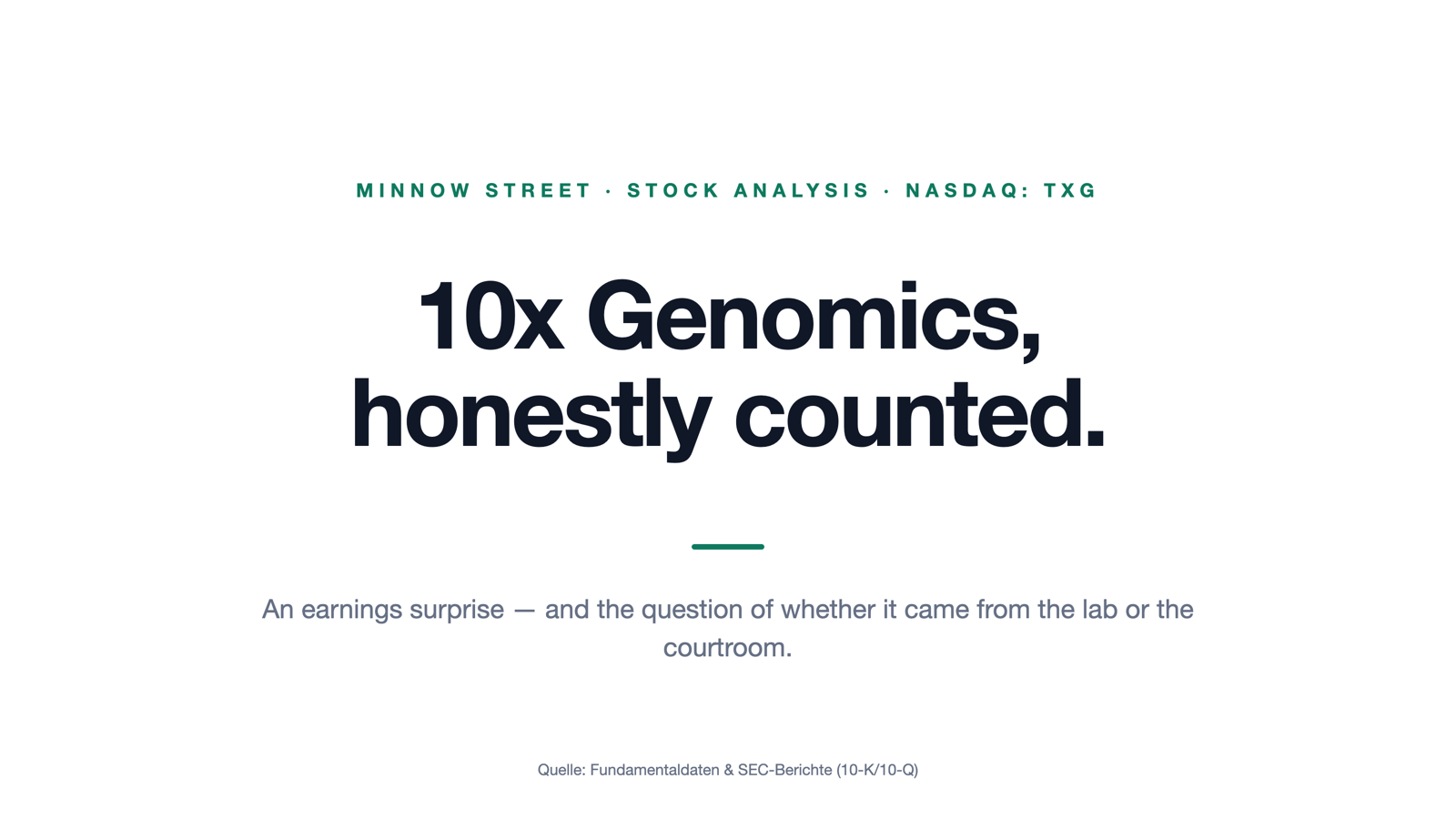
Interactive price chart (TradingView).
Note: pure fact-based analysis, not investment advice and not a solicitation to buy or sell. All figures without guarantee.
There is an investor trap that hides inside good news of all places: the surprise trap. It works like this: a company beats analysts' expectations — quarter after quarter — and your brain draws the comfortable conclusion: "They've turned the corner." That is exactly what our in-house Big Earnings Surprise scanner reports about 10x Genomics, Inc. (Nasdaq: TXG): rank 7 in the U.S. selection (as of July 18, 2026), four straight quarters well above the estimate. Before you trust your portfolio to the signal, let's make a deal: we read together what the company itself filed, under penalty of law, with the U.S. securities regulator, the SEC — the annual report (10-K) for 2025 and the quarterly report (10-Q) as of March 31, 2026. That is where you find where the surprise really comes from. And the answer leads not to the lab, but to the courtroom.
What 10x Genomics actually does — the toolmakers of cell biology
10x Genomics, incorporated in Delaware in 2012 and now based in Pleasanton, California, sells no drugs and makes no diagnoses. It builds the tools that make biology legible in the first place — think of the seller of picks and sieves in a gold rush, who earns no matter who finds the gold. Two product worlds carry the business: single-cell analysis (the Chromium platform) breaks a tissue sample into hundreds of thousands of individual cells and reads each one; spatial analysis (the Visium and Xenium platforms) additionally shows where in the tissue each cell sits — a map of gene activity. On top of that come the high-margin consumables (chips, reagents) and the analysis software (Cell Ranger, Loupe Browser, Xenium Explorer). Since its 2015 launch, 10x has sold 8,046 instruments into more than 50 countries; by its own estimate, more than 10,000 scientific papers rest on data generated by its devices.
The business model is elegant: sell the instrument (the printer), then supply consumables for years (the ink cartridge). In 2025, $507.2 million of revenue came from consumables and only $56.8 million from instruments — the refills carry the house. Which brings us to the central tension of this analysis, running through every chapter: the earnings surprise is real — but it comes largely from the courtroom, not the lab, while the actual product business shrinks and the market keeps pricing in growth.
Where the stock shows up in our scanner
Every day we run about 3,500 stocks through our scanners. As of July 18, 2026, 10x Genomics sits at rank 7 in the Big Earnings Surprise scanner (U.S. selection). To reproduce it: open the scanner, set the country filter to "US" — 10x is in the top group. The scanner's criterion: reported earnings per share came in at least 20 percent above the analyst estimate in each of the last four completed quarters. Now the catch the label "earnings surprise" conceals: 10x loses money. A "surprise to the upside" here does not mean "more profit than thought," but "a smaller loss than feared." In the first quarter of 2026 the loss was $0.10 per share — analysts had penciled in more. That is good news, but a different one from what the word "profit" implies. Remember the principle: a surprise signal measures direction against expectation — not the quality of the business. Which is exactly why we now read the filings. The same scanner's fundamental lens, for the record, shows a solid but not pristine balance sheet: a Piotroski F-score of 6 out of 9 (Q1 2026; a nine-point test for the direction of the balance sheet — 6 is okay, pristine starts at 8) and an Altman Z-score around 6 (a bankruptcy early-warning gauge — the danger zone starts below 1.8, and 10x is far above it).
The numbers over the years — honestly appreciated
First, what genuinely impresses. 10x's loss is shrinking dramatically: from $255.1 million (2023) to $182.6 million (2024) to just $43.5 million (2025) — per share from minus $2.18 to minus $1.52 to minus $0.35. More striking still is the cash flow: the operating business threw off plus $136.1 million in 2025 (2024: a meager plus $6.7 million). And the balance sheet is a fortress: $539.8 million in cash and securities as of March 31, 2026, virtually no financial debt, a 69 percent gross margin. For a company that was still burning a quarter of a billion just two years ago, that is a remarkable pivot.
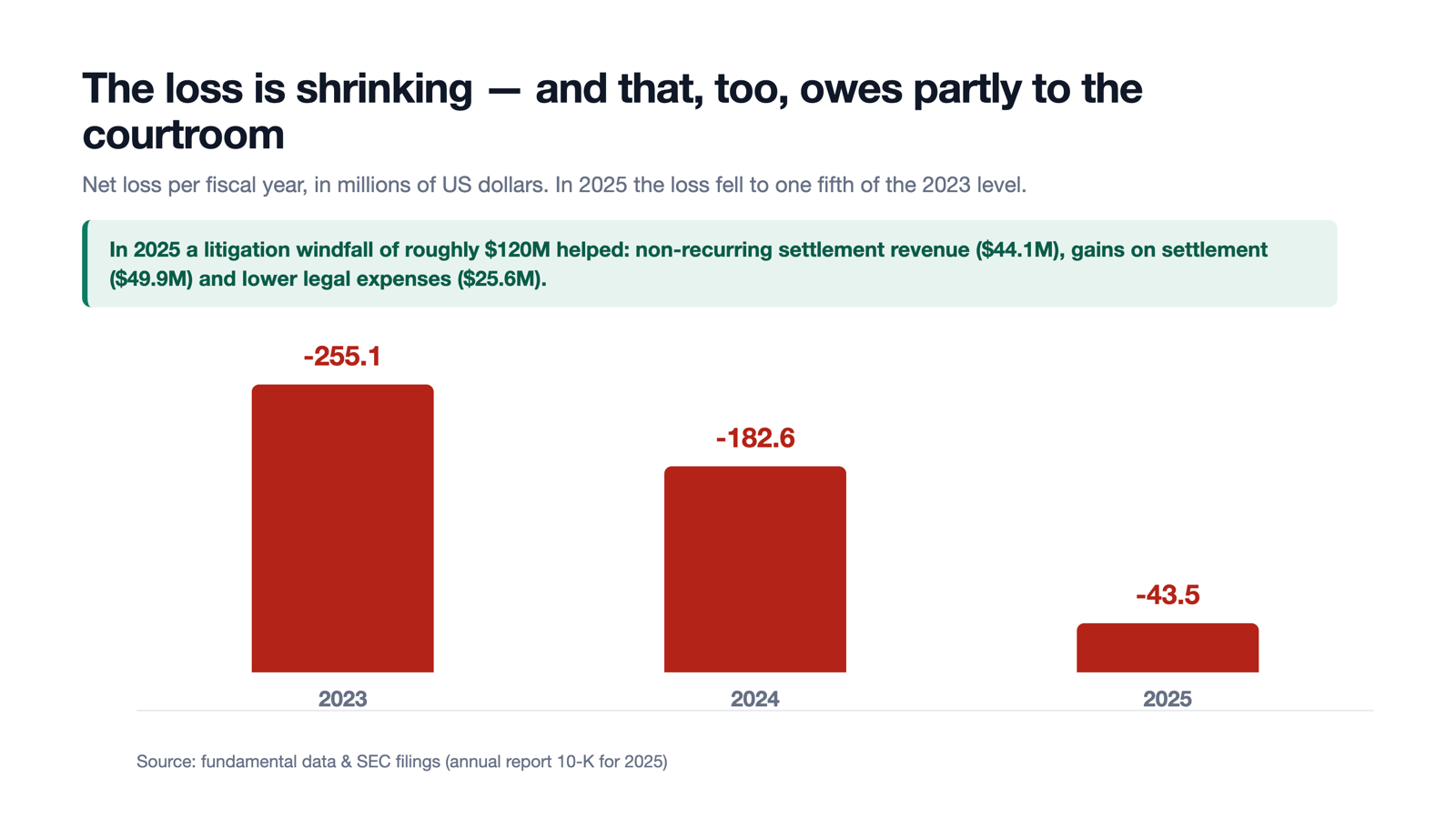
But pause a moment before the number rush takes over. A shrinking loss can have two causes: the business is getting better — or costs and one-off items are compressing the loss while the business stalls. At 10x it is largely the second. That is not between the lines, but in the lines themselves. Let's read them.
What the filings say — the uncomfortable truths
Uncomfortable truth no. 1: The core business is shrinking — instruments collapsed 39 percent in 2025
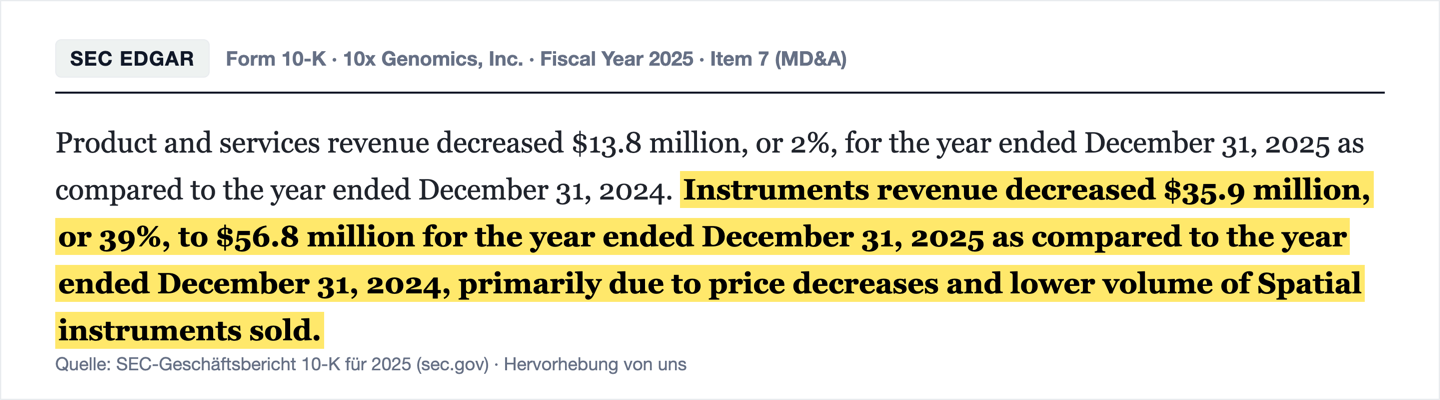
The reported 5 percent revenue gain (to $642.8 million) sounds like growth. But the products-and-services business — the thing 10x actually does — went backwards. The annual report is precise:
"Instruments revenue decreased $35.9 million, or 39%, to $56.8 million for the year ended December 31, 2025 as compared to the year ended December 31, 2024, primarily due to price decreases and lower volume of Spatial instruments sold."
— 10x Genomics, Inc., SEC annual report 10-K for 2025, Item 7 "Management's Discussion and Analysis"
Overall, products-and-services revenue fell from $618.7 million (2023) to $610.5 million (2024) to $596.7 million (2025) — three years running, downhill. So where did the gain come from? From a line that did not even exist in 2023: license and royalty revenue. And that has nothing to do with the lab.
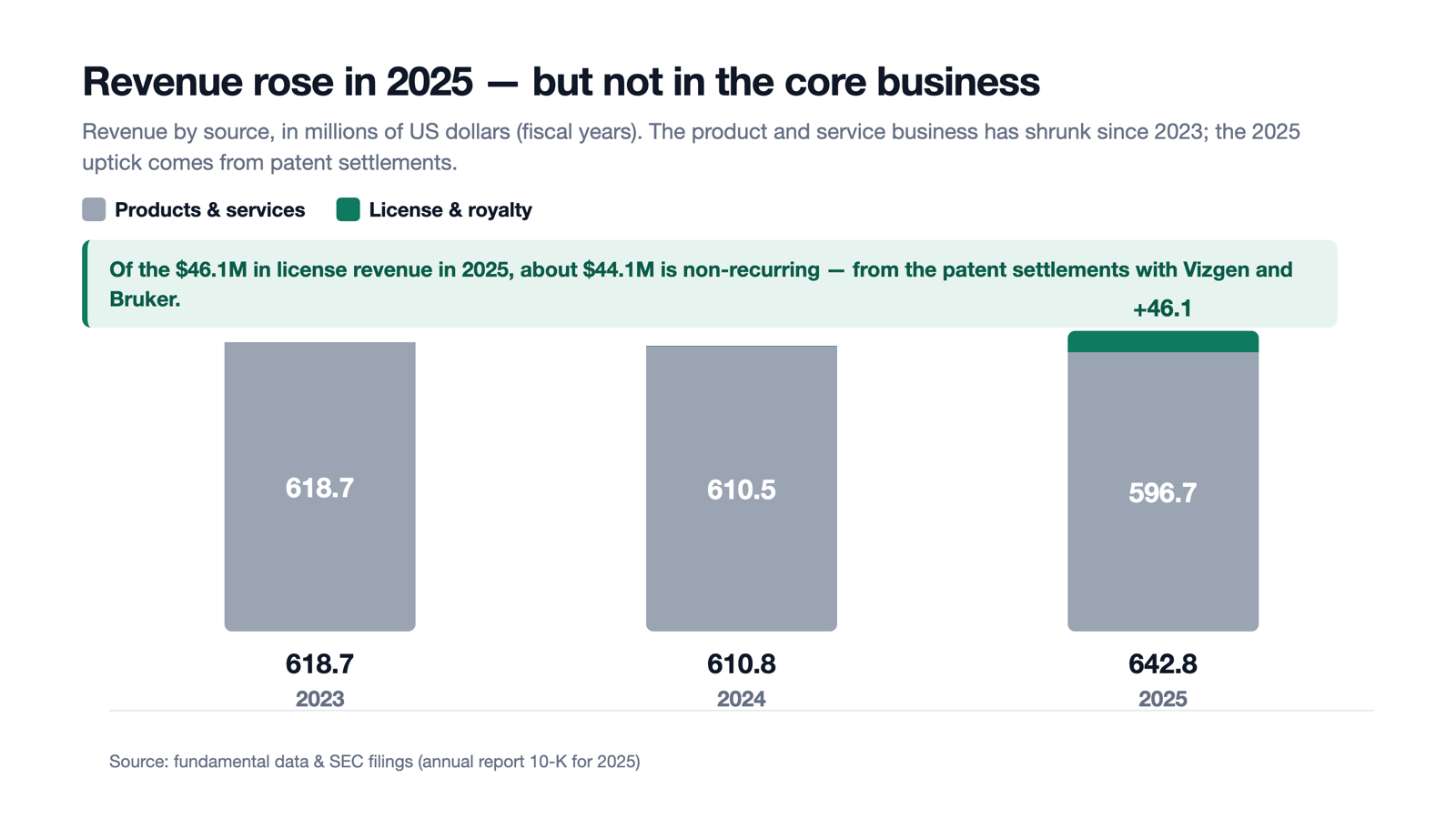
Uncomfortable truth no. 2: The turnaround came from the courtroom — and the company says so itself
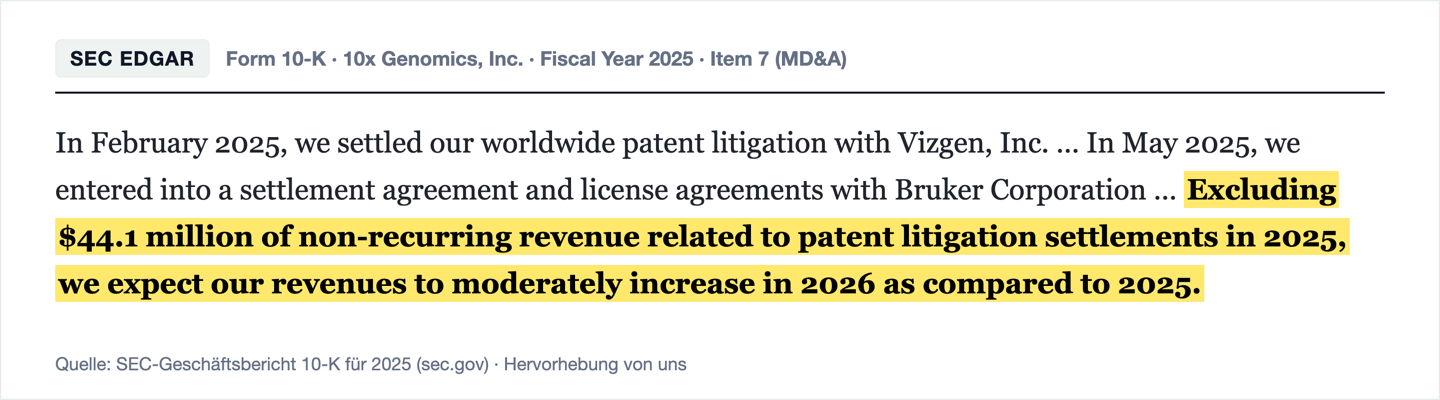
10x Genomics runs a hard patent policy: it does not license out its rights on principle, but defends them in court. In 2025, two of those wars were settled — and turned into revenue. In February 2025 the worldwide dispute with Vizgen ended ($26.0 million upfront: $9.2 million gain on settlement, $16.8 million license revenue); in May 2025 the settlement with Bruker followed, totaling $68.0 million ($40.7 million gain on settlement, $27.3 million license revenue). How much of that is one-off, the company states in a single, telling sentence:
"Excluding $44.1 million of non-recurring revenue related to patent litigation settlements in 2025, we expect our revenues to moderately increase in 2026 as compared to 2025."
— 10x Genomics, Inc., SEC annual report 10-K for 2025, Item 7 "Management's Discussion and Analysis" (License and Royalty Revenue)
And the settlements worked three ways. First: $44.1 million of one-off revenue. Second: $49.9 million of gains on settlement ($9.2 million from Vizgen, $40.7 million from Bruker), booked as income that lowered operating expenses. Third: because the cases ended, outside legal expenses fell by $25.6 million — that alone explains almost the entire drop in selling, general and administrative costs. Together that is roughly $120 million of earnings contribution from ending two lawsuits — against a net loss of $43.5 million. Strip out the litigation windfall and 2025 would have ended with a loss on the order of the prior year ($182.6 million). Remember the mechanism: a one-off item can trigger an earnings surprise without anything changing in the business — and non-recurring means non-recurring. What it looks like when a company sells the AI wave directly rather than merely working around it, we described in the Nvidia analysis — 10x sits on the other side of that ledger.
Uncomfortable truth no. 3: Still deep in the red — and the founders call the shots
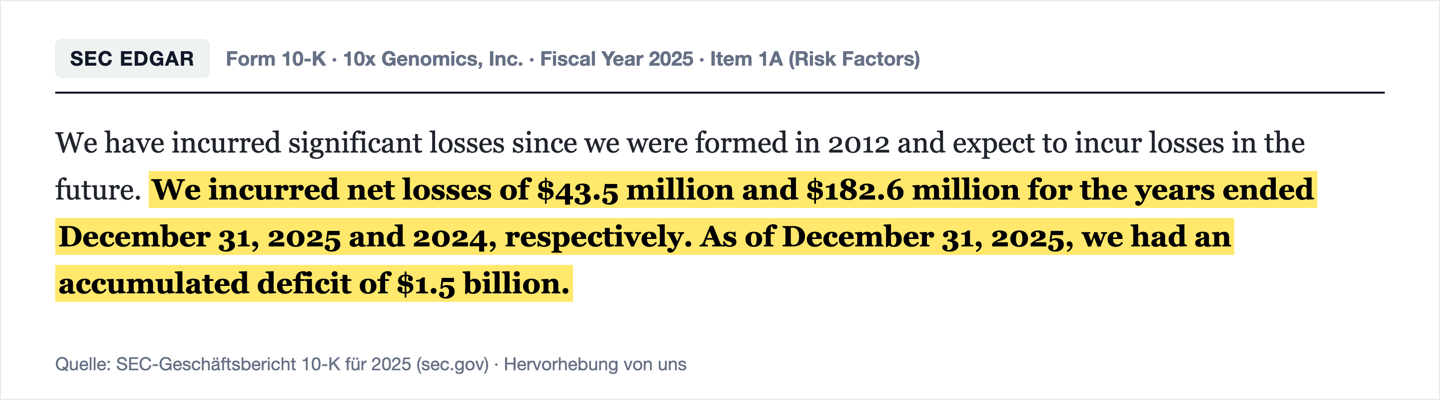
The shrinking loss must not obscure that 10x has burned money since its founding. The annual report puts it soberly:
"We incurred net losses of $43.5 million and $182.6 million for the years ended December 31, 2025 and 2024, respectively. As of December 31, 2025, we had an accumulated deficit of $1.5 billion."
— 10x Genomics, Inc., SEC annual report 10-K for 2025, Item 1A "Risk Factors"
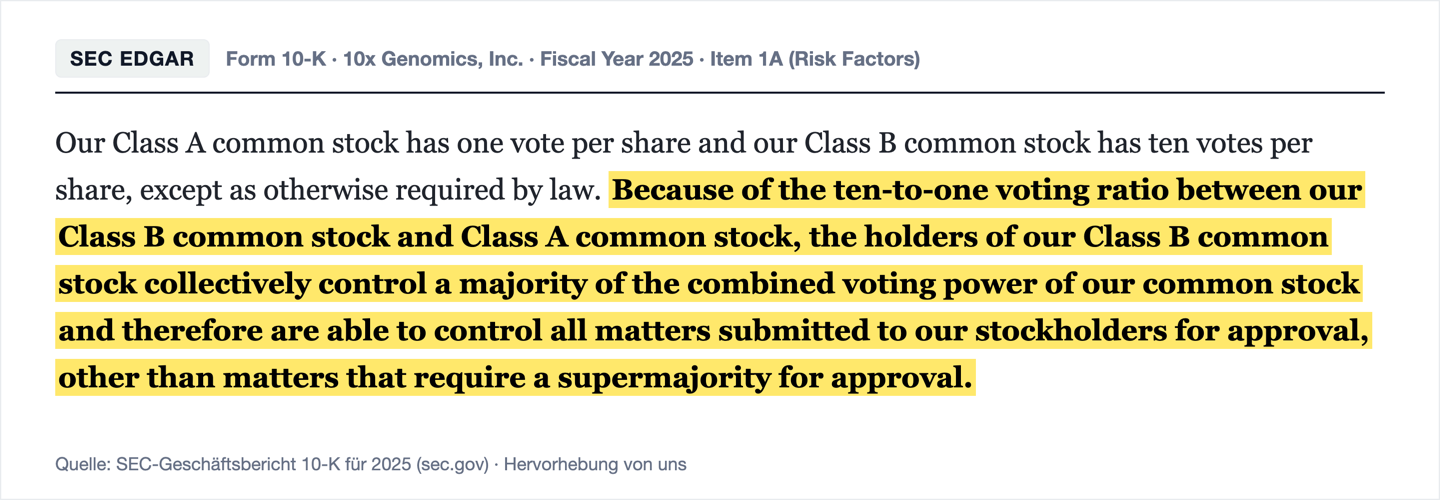
And whoever shares in the loss still does not share in the decisions. 10x has a dual-class structure: the publicly traded Class A has one vote per share, the founder-held Class B has ten. The report draws the clear consequence:
"Because of the ten-to-one voting ratio between our Class B common stock and Class A common stock, the holders of our Class B common stock collectively control a majority of the combined voting power of our common stock and therefore are able to control all matters submitted to our stockholders for approval, other than matters that require a supermajority for approval."
— 10x Genomics, Inc., SEC annual report 10-K for 2025, Item 1A "Risk Factors"
As of January 31, 2026, roughly 117.7 million Class A shares and only 10.1 million Class B shares were outstanding. The founders — CEO Serge Saxonov and chief scientist Ben Hindson — thus hold a majority of the votes on a small slice of the capital. That can be a blessing (the inventors stay at the wheel) or a concentration risk (no external check). Either way, it is worth knowing. Another concentration risk is in the report: China contributed about ten percent of revenue in 2025 — a market that could fall away at any time in a trade conflict.
Valuation: what the market charges for the surprise
Now the price tag — in orders of magnitude, not to the day. 10x Genomics is virtually debt-free and sits on $539.8 million of cash and securities (March 31, 2026); a meaningful part of the market value is therefore simply cash. At the same time, as of July 18, 2026, the stock trades at roughly 5 to 6 times book value (price-to-book around 5.7) — a valuation that bets on growth while the product business shrinks. The share price more than doubled in the twelve months to mid-2026 (relative strength at the very top of the scanner), carried by precisely the run of earnings surprises whose origin we have just dissected. The bet the price makes is clear: that the one-off litigation windfall becomes a durable recovery of the core business — that instruments sell again, that the spatial platform gathers pace, and that operating cash flow becomes real profit. No filing guarantees that continuation; the company itself guides only to a "moderate" revenue increase for 2026 — without the one-off tailwind.
Opportunities and risks at a glance
What speaks for 10x Genomics:
- Technology leader in a structurally growing field: single-cell and spatial analysis (Chromium, Visium, Xenium) are standard tools of modern biology; more than 10,000 scientific publications rest on 10x data, and 8,046 instruments sold form a base for high-margin consumables ($507.2 million in 2025).
- A fortress balance sheet: $539.8 million of cash and securities (March 31, 2026), virtually no financial debt, a 69 percent gross margin — enough cushion to fund years of shrinking losses.
- Real operating progress: the loss fell from $255.1 million (2023) to $43.5 million (2025), operating cash flow turned to plus $136.1 million, and R&D and selling costs were cut with discipline.
- Patent strength as a weapon: hard enforcement of its own rights forced two competitors (Vizgen, Bruker) into settlements and ongoing license payments in 2025 — a competitive edge that continues as a royalty stream beyond the one-off effects.
What speaks against it:
- The core business is shrinking: products-and-services revenue down three years running (to $596.7 million in 2025), instruments off 39 percent — the reported 5 percent revenue gain is a mirror effect of the one-off revenue.
- The earnings surprise is largely a one-off: roughly $120 million of 2025 earnings contribution from the patent settlements ($44.1 million revenue, $49.9 million gains on settlement, $25.6 million less in legal costs) — in 2026 this tailwind falls away.
- Still lossmaking: an accumulated deficit of $1.5 billion (December 31, 2025), no reported profitability; the valuation of 5 to 6 times book value prices in growth that the product business is currently missing.
- Control with the founders: dual-class voting (Class B, ten votes per share) secures the founders a majority — Class A holders effectively have no check. Add the China concentration (about ten percent of 2025 revenue) and a manufacturing risk from the AI-driven chip shortage.
A human bottom line
Back to the surprise trap from the start. Its core is not that the numbers lie — 10x really did beat expectations four times in 2025, the loss really did shrink, cash flow really did turn, the balance sheet really is strong. Its core is that a surprise signal measures direction against expectation, but does not say where the surprise comes from. At 10x it comes largely from two courtrooms: roughly $120 million of earnings contribution from the settlements with Vizgen and Bruker — a windfall the company itself labels "non-recurring," while the actual product business shrinks for the third year running. The honest reckoning looks like this: you get a technology leader with a fortress balance sheet and genuine cost discipline — but at a valuation that bets on the return of a recovery the core business has not yet delivered, and in a structure where the founders sit alone at the wheel. Whether the litigation windfall becomes lab growth before the one-off effect fades — that is the bet, and no filing takes it off your hands. Instead of the scanner rank, read the next quarterly reports (10-Q): instruments and consumables revenue (is the product business growing again?), license revenue excluding one-offs, and operating cash flow. What you make of it is your decision. And that is exactly as it should be.
Sources
All original documents used in this analysis — to read for yourself:
- 10x Genomics, Inc. — SEC annual report 10-K for 2025 (filed February 13, 2026)
- 10x Genomics, Inc. — SEC annual report 10-K for 2024 (filed February 13, 2025)
- 10x Genomics, Inc. — SEC quarterly report 10-Q as of March 31, 2026 (filed May 8, 2026)
- Full SEC filing history of 10x Genomics: EDGAR overview (sec.gov)
- Fundamental data (metrics, quarterly series, valuation; data as of July 18, 2026), reconciled with the SEC filings.
- Screener and rating data: in-house stock scanner (data as of July 18, 2026), including the Big Earnings Surprise scanner (U.S. selection, rank 7).
Transparency & disclaimer: This analysis is a journalistic assessment of publicly available information and is not investment advice, not a financial analysis in the regulatory sense, and not a solicitation to buy or sell securities. Equity investments carry substantial risks up to total loss. All information without guarantee; the data cut-off is noted in the text in each case. At the time of publication, the author holds no position in 10x Genomics shares.
Our Bottom Line at a Glance
- Technology & market position positive
- Technology leader in single-cell and spatial analysis (Chromium, Visium, Xenium); 8,046 instruments sold and more than 10,000 scientific publications form a broad installed base for high-margin consumables ($507.2 million in 2025).
- Balance sheet & cash flow positive
- $539.8 million of cash and securities (March 31, 2026), virtually no financial debt, a 69 percent gross margin; operating cash flow turned to plus $136.1 million in 2025 (2024: plus $6.7 million). The balance sheet funds years of shrinking losses.
- Quality of the earnings surprise negative
- The four straight beats are largely a one-off: roughly $120 million of 2025 earnings contribution from the patent settlements ($44.1 million non-recurring revenue, $49.9 million gains on settlement, $25.6 million less in legal costs). The company guides to only a "moderate" revenue increase for 2026 without this tailwind (10-K 2025).
- Core business negative
- The products-and-services business is shrinking for the third year running (to $596.7 million in 2025), and instruments collapsed 39 percent to $56.8 million (price decreases, lower spatial volumes). The reported 5 percent revenue gain is a mirror effect of the one-off revenue.
- Profitability & valuation neutral
- Still lossmaking (net loss $43.5 million in 2025, accumulated deficit $1.5 billion); the valuation of 5 to 6 times book value (data as of July 18, 2026) prices in growth the product business is currently missing — cushioned by the large cash pile.
- Governance & concentration risks neutral
- Dual-class voting (Class B, ten votes per share) secures the founders a majority — inventors at the wheel, but no external check. Add the China concentration (about ten percent of 2025 revenue) and a manufacturing risk from the AI-driven chip shortage (10-K 2025).
The Big Earnings Surprise scanner reports four quarters of beats for 10x Genomics — but the surprise comes largely from two courtrooms: roughly $120 million of 2025 earnings contribution from the patent settlements with Vizgen and Bruker, which the company itself labels "non-recurring." Behind it, the actual product business is shrinking for the third year running (instruments down 39 percent), while the accumulated deficit stands at $1.5 billion and the founders keep control through dual-class voting. Against that stand a fortress balance sheet ($539.8 million in cash, barely any debt), genuine cost discipline and a turned operating cash flow. Whoever invests here is betting that the one-off litigation windfall becomes a recovery of the core business. Not investment advice.
What Our Rating Means
- If you don't own the stock
- As long as the question raised in the bottom line stays open, we see no basis for an entry.
- If you hold it in your portfolio
- Our findings offer no acute reason to sell — the checkpoints named remain decisive.
A journalistic assessment by our editorial team at the time of the deep dive, based on public sources — not investment advice and not a solicitation to buy or sell. Your personal circumstances (investment goals, risk capacity, taxes) cannot be taken into account. What our categories mean, how verdicts are formed, and what conflicts of interest exist →
Worth Noting
- TXG made the research list as rank 7 in our in-house Big Earnings Surprise scanner (U.S. selection, as of July 18, 2026) — part of our series on the top 20 of that selection.
- The scanner evaluates the reported earnings surprises of the last four quarters; for a lossmaking company, a positive surprise means a smaller loss than expected, not a profit.
- Price and valuation figures (price-to-book around 5.7, a share price that more than doubled within twelve months) are from the feed of July 18, 2026; analyses are evergreen, and daily prices are no reason to buy. The one-off patent-settlement revenue ($44.1 million) is expressly disclosed as "non-recurring" in the 10-K 2025.
Frequently Asked Questions
10x Genomics, Inc. (Nasdaq: TXG, Pleasanton, California) builds tools for cell biology: the single-cell Chromium platform and the spatial Visium and Xenium platforms — plus consumables and software. In 2025 the company posted revenue of $642.8 million; $507.2 million of that came from high-margin consumables and only $56.8 million from instrument sales. Since 2015 it has sold 8,046 instruments into more than 50 countries.
Because reported earnings per share came in at least 20 percent above the analyst estimate in each of the last four quarters — rank 7 in the U.S. selection (as of July 18, 2026). Important: 10x loses money. A "surprise to the upside" here means "a smaller loss than expected," not "profit." In the first quarter of 2026 the loss per share was $0.10, after $0.28 in the year-earlier quarter.
Almost entirely from one-off patent settlements. The products-and-services business fell to $596.7 million in 2025 (down 2 percent), and instruments collapsed 39 percent. The reported 5 percent gain comes from $46.1 million of license and royalty revenue — of which $44.1 million is non-recurring, from the settlements with Vizgen (February 2025) and Bruker (May 2025). It says so verbatim in the annual report (10-K).
No. In 2025, 10x posted a net loss of $43.5 million (2024: $182.6 million), and the accumulated deficit stood at $1.5 billion as of December 31, 2025. The loss is shrinking sharply and operating cash flow turned to plus $136.1 million in 2025 — but the company does not yet report a bottom-line profit.
Very strong: as of March 31, 2026, 10x held $539.8 million in cash and securities and had virtually no financial debt. The gross margin was 69 percent in 2025. A meaningful part of the market value is therefore simply cash — which gives the company plenty of time to fund the path to profitability.
The founders. 10x has a dual-class structure: the publicly traded Class A has one vote per share, the founder-held Class B has ten. Per the annual report (10-K), the Class B holders collectively control a majority of the voting power — even though, as of January 31, 2026, only 10.1 million Class B shares were outstanding next to 117.7 million Class A shares. Behind the Class B stand, in essence, CEO Serge Saxonov and chief scientist Ben Hindson.
That the earnings surprise is not durable. Roughly $120 million of the 2025 earnings contribution came from one-off patent settlements; in 2026 this tailwind falls away, and the company itself guides only to a "moderate" revenue increase. If the shrinking core business does not grow again, a valuation of 5 to 6 times book value has no operating growth behind it.
Found an error?
Did you spot a factual error, an outdated number, or a typo in this deep dive? Let us know briefly — your report goes straight to the editorial team.